
 100% FREE ACCESS
11th Standard Syllabus & Materials
11th Standard
TN 11th Tamil இயற்கை வேளாண்மை,சுற்றுச்சூழல் -செய்யுள் - மனோன்மணீயம் Important Questions And Answers Study Material - QB365 Set A
NEW11th Standard
TN 11th Tamil என்னுயிர் என்பேன் -துணைப்பாடம் - இசைத்தமிழர் இருவர் Important Questions And Answers Study Material - QB365 Set A
NEW11th Standard
TN 11th Tamil மொழி கலை -செய்யுள் - ஒவ்வொரு புல்லையும் Important Questions And Answers Study Material - QB365 Set A
NEW11th Standard
TN 11th Tamil பீடு பெற நில் - இலக்கணம் - பகுபத உறுப்புகள் Important Questions And Answers Study Material - QB365 Set A
NEW11th Standard
TN 11th Tamil பீடு பெற நில் - துணைப்பாடம் - வாடிவாசல் Important Questions And Answers Study Material - QB365 Set A
NEW11th Standard
TN 11th Tamil பீடு பெற நில் - செய்யுள் - குறுந்தொகை Important Questions And Answers Study Material - QB365 Set A

Published on: 24/07/2019
Kinematics
Download Tamil Nadu 11th Standard Physics question papers, model tests, one-mark questions, important questions, and public exam papers in PDF format. Free study materials and answer keys for TN State Board students.
Questions + Answers key
Take MCQ Physics Test1.
Distance is a scalar quantity and ______________ is a vector.
Speed
Length
Time
Displacement
2.
The length of a vector is _______________
always a negative quantity
always a positive quantity
either positive or negative
denoted by '\(\lambda \)'
3.
Consider the quantities pressure, power, energy, impulse, charge. Out of these, the only vector quantity is _______________.
pressure
power
impulse
charge
4.
The component of position vector \(\overrightarrow { r } \) along x-axis will maximum value if ____________
\(\overrightarrow { r } \) is along the x - axis
\(\overrightarrow { r } \) makes an angle of 45° with x - axis
\(\overrightarrow { r } \) is along the y - axis
\(\overrightarrow { r } \) is along - ve y - axis
5.
The angle between A i +j and B = i - j is ______________.
45°
90°
-45°
180°
6.
Which one of the following statement is true?
A scalar quantity is conserved in a process
A scalar quantity does not vary from one point to another in apace
A scalar quantity can never take -ve values
A scalar quantity has only magnitude and no direction.
7.
If an object is dropped from the top of a building and it reaches the ground at t = 4 s, then the height of the building is (ignoring air resistance) (g = 9.8 ms-2)
77.3 m
78.4 m
80.5 m
79.2 m
8.
If the velocity is \(\overrightarrow { v } =2\hat { i } +{ t }^{ 2 }\hat { j } -9\overrightarrow { k } \), then the magnitude of acceleration at t = 0.5s is
1 ms-2
2 ms-2
zero
-1 ms-2
9.
If a particle has negative velocity and negative acceleration, its speed
increases
decreases
remains same
zero
10.
Identify the unit vector in the following?
\(\hat { i } +\hat { j } \)
\(\frac { \hat { i } }{ \sqrt { 2 } } \)
\(\hat { k } -\frac { \hat { j } }{ \sqrt { 2 } } \)
\(\frac { \hat { i } +\hat { j } }{ \sqrt { 2 } } \)
11.
What is right handed coordinate system?
12.
What is meant by frame of reference?
13.
What is Kinematics?
14.
Define a scalar. Give examples
15.
Define a vector. Give examples.
16.
Explain what is meant by Cartesian coordinate system?
17.
Two vectors \(\vec A\) and \(\vec B\) of magnitude 5 units and 7 units respectively make an angle 60° with each other as shown below. Find the magnitude of the resultant vector and its direction with respect to 7 unit the vector \(\vec A\).
.png)
18.
What are the different types of vectors?
19.
What do you mean by motion in one, two and three dimensions?
20.
What is meant by point mass and give suitable example?
21.
Define velocity and speed
22.
Define displacement and distance.
23.
How do you deduce that two vectors are perpendicular?
24.
Derive the relation between Tangential acceleration and angular acceleration.
1.
(d)
Displacement
2.
(b)
always a positive quantity
3.
(c)
impulse
4.
(a)
\(\overrightarrow { r } \) is along the x - axis
5.
(b)
90°
6.
(d)
A scalar quantity has only magnitude and no direction.
7.
(b)
78.4 m
8.
\(\vec{v}=2 \hat{l}+t^{2} \hat{j}-9 \vec{k}\)
\(\vec{a}=\frac{d \vec{v}}{d t}=2 t \hat{j}\)
\(\text { When } t=0.5 \mathrm{~s}\)
\(a=1 \mathrm{~ms}^{-2}\)
9.
Velocity and acceleration are in the same direction: So speed increases.
10.
Unit vector specifies only direction
\(\hat{A}=\frac{\vec{A}}{|\vec{A}|} \)
\(\therefore \hat{i}+\hat{j}=\frac{\hat{l}+\hat{j}}{|\hat{l}+\hat{j}|}
\)
\(\hat{i} \text { and } \hat{j} \text { are orthogonal components of vectors. }\)
\(\therefore|\hat{i}+\hat{j}|=\sqrt{1^{2}+1^{2}}=\sqrt{1+1}=\sqrt{2}\)
11.
If the x, y and z axes are drawn in anticlockwise direction then the coordinate system is called as "right-handed Cartesian coordinate system".
12.
A coordinate system and the position of an object is described relative to it, then such a coordinate system is called frame of reference.
13.
Kinematics is the branch of mechanics which deals with the motion of objects without taking force into account. The Greek word "kinema" means "motion".
14.
Scalar is a property which can be described only by magnitude.
Examples:
Distance, mass, temperature, speed and energy.
15.
(i) A quantity which is described by both its magnitude and direction is called a vector quantity.
(ii) Geometrically, a vector is a directed line segment
Examples: Force, velocity displacement, acceleration, position vector, linear momentum and angular momentum.
16.
(i) Cartesian Coordinate system is a frame of reference in which the position of an object at any given instant is described in terms of its distances along x, y and z axes.
(ii) Conventionally right - handed Cartesian Coordinate system where the x, y and z axes are drawn in anti clockwise direction is followed in physics.
17.
By following the law of triangular addition, the resultant vector is given by \(\vec R\) = \(\vec A\) + \(\vec B\) as illustrated below.
The magnitude of the resultant vector \(\vec R\) is given by
\(R=|\vec R|=\sqrt{5^2+7^2+2\times 5\times 7\cos 60^o}\)
\(R=\sqrt{25+49+\frac{70\times 1}{2}}=\sqrt{109}\) units
i.png)
The angle \(\alpha\) between \(\vec R\) and \(\vec A\) is given by
\(\tan\alpha=\frac{B\sin\theta}{A+B\cos\theta}\)
\(\tan\alpha=\frac{7\times\sin60^o}{5+7\cos60^o}=\frac{7\sqrt{3}}{10+7}=\frac{7\sqrt{3}}{17}\) = 0.713
\(\therefore\alpha=35^o\)
ii.png)
18.
1. Equal vectors: Two vectors \(\vec { A } \) and \(\vec { B } \) are said to be equal when they have equal magnitude and same direction and represent the same physical quantity.
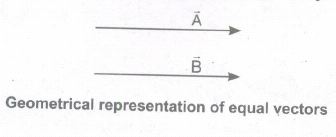
(a) Collinear vectors: Collinear vectors are those which act along the same line.The angle between them can be 0o or 180o
(i) Parallel vectors: If two vectors \(\vec { A } \) and \(\vec { B } \) act in the same direction along the same line or on parallel lines, then the angle between them is 0o
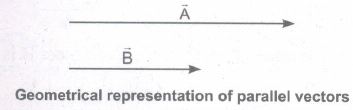
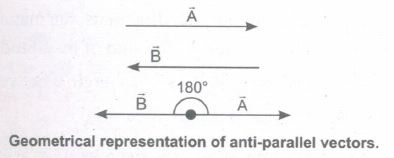
(ii) Anti-parallel vectors: Two vectors \(\vec { A } \) and \(\vec { B } \) are said to be anti-parallel when they are in opposite directions along the same line or on parallel lines. Then the angle between them is 180o.
2. Unit vector: A vector divided by its magnitude is a unit vector. The unit vector for \(\vec { A } \) is denoted by\(\hat { A } \). It has a magnitude equal to unity or one.
Since, \(\hat { A } =\frac { \vec { A } }{ A } \) we can write \(\vec { A } -A\hat { A } \)
Thus, we can say that the unit vector specifies only the direction of the vector quantity.
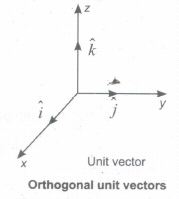
3. Orthogonal unit vectors: Let \(\hat { i } ,\hat { j } \) and \(\hat { k } \) be three unit vectors which specify the directions along positive x-axis, positive y-axis and positive z-axis respectively. These three unit vectors are directed perpendicular to each other, the angle between any two of them is 90o.\(\hat { i } ,\hat { j } \)and \(\hat { k } \) and are examples of orthogonal vectors. Two vectors which are perpendicular to each other are called orthogonal vectors as shown in the figure.
19.
Motion in one dimension
(i) One dimensional motion is the motion of a particle moving along a straight line.
(ii) In this motion, only one of the three rectangular coordinates specifying the position of the object changes with time.
Motion in two dimensions
(i) If a particle is moving along a curved path in a plane, then it is said to be in two dimensional motion.
(ii) In this motion, two of the three rectangular coordinates specifying the position of object change with time.
(iii) Motion of a coin on a carrom board.
Motion in three dimensions
(i) A particle moving in usual three dimensional space has three dimensional motion.
(ii) In this motion, all the three coordinates specifying the position of an object change with respect to time. When a particle moves in three dimensions all the three coordinates x, y and z..will vary.
20.
(i) The mass of any object be assumed to be concentrated at a point.
(ii) Then this idealized mass is called "point mass".
(iii) Term "point mass" is a relative term. It has meaning only with respect to a reference frame and with respect to the kind of motion that we analyse.
(iv) To analyse the motion of Earth with respect to Sun, Earth can be treated as a point mass.
(v) If we throw an irregular object like a small stone in the air, to analyse its motion, it is simpler to consider the stone as a point mass as it moves in space.
21.
Velocity:
Velocity is equal to the rate of change of position vector with respect to time.
It is a vector quantity \(\overrightarrow{v}=\frac{d\overrightarrow{r}}{dt}\)
Speed:
The magnitude of velocity is called speed and is given by \(v= \sqrt{v^2_x+v^2_y+v^2_z}\). It is a positive scalar.
22.
(i) Displacement is the difference between the final and initial positions of the object in a given interval of time. It can also be defined as the shortest distance between these two positions of the object and its direction is from the initial to final position of the object, during the given interval of time. It is a vector quantity.
(ii) Distance is the actual path length travelled by an object in the given interval of time during the motion. It is a positive scalar quantity.
23.
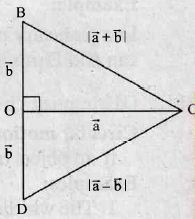
The condition for the two vectors \(\vec{a}\ and \ \vec{b}\) to be perpendicular to each other is \(\vec{a} \cdot \vec{b}=|\vec{a}||\vec{b}| \cos \theta=0\).
Diagrammatically, when \(\vec{a}\ and \ \vec{b}\) are perpendicular to each other
\(|\vec{a}+\vec{b}| =|\vec{a}-\vec{b}|
\)
\(\text {Squaring }|\vec{a}+\vec{b}|^{2} =|\vec{a}-\vec{b}|^{2}
\)
\(a^{2}+b^{2}+2 a b \cos \theta =a^{2}+b^{2}-2 a b \cos \theta .
\)
\(4 a b \cos \theta =0
\)
\(\text { or } \cos \theta =0
\)
\(\theta =\frac{\pi}{2}\)
If \(|\vec{a}+\vec{b}|=|\vec{a}-\vec{b}|\) then \(\vec{a}\ and \ \vec{b}\) are perpendicular to each other.
24.
Consider an object moving along a circle of radius r. In a time ∆t, the object travels in an arc distance ∆s as shown in figure. The corresponding angle subtended is ∆\(\theta\)
The ∆s can be written in terms of ∆\(\theta\)
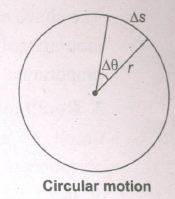
∆s = r∆\(\theta\) ...............(i)
In a time ∆t, we have
\(\frac { \Delta s }{ \Delta t } =t\frac { \Delta \theta }{ \Delta t } \) .......(ii)
In the limit Δt⟶0 the above equation becomes
\(\frac { ds }{ dt } =r\omega \) ........(iii)
Here\(\frac { ds }{ dt } \) is linear speed (v) which is tangential to the circle and \(\omega \) is angular speed. So equation (iii) becomes
vr = rω ........(iv)
which gives the relation between linear speed and angular speed
Eq (iv) is true only for circular motion. In general the relation between linear and angular velocity is given by
\(\vec { v } =\vec { \omega } \times \vec { r } \)...........(v)
For circular motion eq. (v) reduces to eq. (iv) since \(\vec { \omega } \) and \(\vec { r } \) are perpendicular to each other Differentiating the eq. (iv) with respect to time, we get (since r is constant)
\(\frac { dv }{ dt } =\frac { rd\omega }{ dt } =r\alpha \)
Here\(\frac { dv }{ dt } \) is the tangential acceleration and is denoted as at = \(\frac { d\omega }{ dt } \) is the angular acceleration Then eq.(v) becomes
at = r∝ ......(vii)

11th Standard Syllabus & Materials
11th Standard
TN 11th Tamil பீடு பெற நில் - செய்யுள் - காவடிச்சிந்து Important Questions And Answers Study Material - QB365 Set A
NEW11th Standard
TN 11th Tamil பீடு பெற நில் - உரைநடை - மலை இடப்பெயர்கள் : ஓர் ஆய்வு Important Questions And Answers Study Material - QB365 Set A
NEW11th Standard
TN 11th Tamil மாமழை போற்றுதும் - துணைப்பாடம் - யானை டாக்டர் Important Questions And Answers Study Material - QB365 Set A
NEW11th Standard
TN 11th Tamil மாமழை போற்றுதும் - செய்யுள் - ஐங்குறுநூறு Important Questions And Answers Study Material - QB365 Set A



Tamilnadu Stateboard 11th Standard Subjects

Maths

Commerce

Economics

Biology

Business Maths and Statistics

Accountancy

Computer Science
Physics

Chemistry
Maths
Biology
Economics
Physics
Chemistry

History
Business Maths and Statistics

Computer Science
Accountancy

Computer Applications
History
Computer Technology
Commerce
Computer Applications
Computer Technology

Tamil

English

French
Tamilnadu Stateboard Standards

