
 100% FREE ACCESS
11th Standard Syllabus & Materials
11th Standard
TN 11th Tamil இயற்கை வேளாண்மை,சுற்றுச்சூழல் -செய்யுள் - மனோன்மணீயம் Important Questions And Answers Study Material - QB365 Set A
NEW11th Standard
TN 11th Tamil என்னுயிர் என்பேன் -துணைப்பாடம் - இசைத்தமிழர் இருவர் Important Questions And Answers Study Material - QB365 Set A
NEW11th Standard
TN 11th Tamil மொழி கலை -செய்யுள் - ஒவ்வொரு புல்லையும் Important Questions And Answers Study Material - QB365 Set A
NEW11th Standard
TN 11th Tamil பீடு பெற நில் - இலக்கணம் - பகுபத உறுப்புகள் Important Questions And Answers Study Material - QB365 Set A
NEW11th Standard
TN 11th Tamil பீடு பெற நில் - துணைப்பாடம் - வாடிவாசல் Important Questions And Answers Study Material - QB365 Set A
NEW11th Standard
TN 11th Tamil பீடு பெற நில் - செய்யுள் - குறுந்தொகை Important Questions And Answers Study Material - QB365 Set A

Published on: 09/10/2019
Waves
Download Tamil Nadu 11th Standard Physics question papers, model tests, one-mark questions, important questions, and public exam papers in PDF format. Free study materials and answer keys for TN State Board students.
Questions + Answers key
Take MCQ Physics Test1.
What is Reverberation?
2.
What is Echo?
3.
How do animals sense impending danger of hurricane?
4.
Why is it that transverse waves cannot be produced in a gas? Can the transverse waves can be produced insolids and liquids?
5.
What is meant by an echo? Explain.
6.
Explain Doppler Effect.
7.
Define wavelength.
8.
What is meant by waves?.
9.
Sketch y = x −a for different values of a.
10.
Calculate the speed of sound in a steel rod whose Young’s modulus Y = 2\(\times\)1011 N m-2 and \(\rho\) = 7800 kg m-3.
11.
Consider a string whose one end is attached to a wall. Then compute the following in both situations given in figure (assume waves crosses the distance in one second)
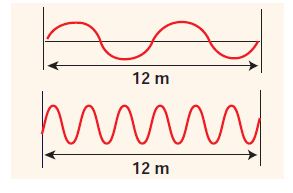
(a) Wavelength
(b) Frequency and
(c) Velocity
12.
The average range of frequencies at which human beings can hear sound waves varies from 20 Hz to 20 kHz. Calculate the wavelength of the sound wave in these limits. (Assume the speed of sound to be 340 m s-1.
13.
Derive the relation between Intensity and loudness
14.
Write a not about Stethoscope.
15.
Distinguish between transverse and longitudinal waves.
16.
Write the characteristics of wave motion.
17.
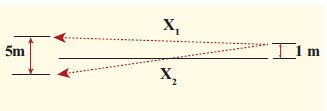
Two speakers C and E are placed 5 m apart and are driven by the same source. Let a man stand at A which is 10 m away from the mid point O of C and E. The man walks towards the point O which is at 1 m (parallel to OC) as shown in the figure. He receives the first minimum in sound intensity at B. Then calculate the frequency of the source. (Assume speed of sound = 343 m s-1)
18.
Length of a string tied to two rigid supports is 40 cm maximum length of a stationary wave produced on it is ___________.
20
80
40
120
19.
With propagation of longitudinal waves through a medium, the quantity transmitted is ______________.
matter
energy
energy and matter
energy, matter and momentum
20.
21.
The displacement y of a wave travelling in the x direction is given by y = (2\(\times\)10 -3) sin (300t - 2x + \(\frac{\pi}{4}\)), where x and y are measured in metres and t in second. The speed of the wave is
150 ms-1
300 ms-1
450 ms-1
600 ms-1
22.
A sound wave whose frequency is 5000 Hz travels in air and then hits the water surface. The ratio of its wavelengths in water and air is
4.30
0.23
5.30
1.23
23.
For a particular tube, among six harmonic frequencies below 1000 Hz, only four harmonic frequencies are given: 300 Hz, 600 Hz, 750 Hz and 900 Hz. What are the two other frequencies missing from this list?
100 Hz, 150 Hz
150 Hz, 450 Hz
450 Hz, 700 Hz
700 Hz, 800 Hz
24.
A student tunes his guitar by striking a 120 Hertz with a tuning fork, and simultaneously plays the 4th string on his guitar. By keen observation, he hears the amplitude of the combined sound oscillating thrice per second. Which of the following frequencies is the most likely the frequency of the 4th string on his guitar?
130
117
110
120
25.
What is a sonometer? Give its construction and working. Explain how to determine the frequency of tuning fork using sonometer.
26.
Briefly explain the concept of superposition principle.
1.
In a closed room the sound is repeatedly reflected from the walls and it is even heard long after the sound source ceases to function. The residual sound remaining in an enclosure and the phenomenon of multiple reflections of sound is called reverberation.
2.
An echo is a repetition of sound produced by the reflection of sound waves from a wall, mountain or other obstructing surfaces.
3.
Hurricane produces a shock wave which has a speed greater than the speed of sound. If travels with a supersonic sound that can be easily sensed by animals, using Doppler effect, The multiple reflections of sound can be easily sensed by animals.
4.
Transverse waves travel in the form of crests and troughs and so involve change in shape. Transverse waves can be produced in a medium which has elasticity in shape. As gas has no elasticity of shape, hence transverse wave cannot be produced in a gas. Transverse waves can be produced in solids and on the surface of liquids.
5.
An echo is a repetition of sound produced by the reflection of sound waves fiom a wall, mountain or other obstructing surfaces. The speed of sound in air at 20De is 344 ms-1. If we shout at a wall which is at 344 m away, then the sound will take 1 second to reach the wall. After reflection, the sound will take one more second to reach us. Therefore, we hear the echo after two seconds. Scientists have estimated that we can hear two sounds properly if the time gap or time interval between each sound is \((\frac{1}{10})^{th}\) of a second (persistence of hearing) i.e., 0.1 s. Then,
Velocity = \(\frac{Distance\ travelled}{time\ taken}=\frac{2d}{r}\)
2d = 344\(\times\)0.1 = 34.4 m
d = 17.2 m
The minimum distance from a sound reflecting wall to hear an echo at 2oCe is 17.2 meter.
6.
When the source and the ob.server are in relative motion with respect to each other and to the medium in which sound propagates, the frequency of the sound wave observed is different from the frequency of the source. This phenomenon is called Doppler effect.
7.
For transverse waves, the distance between two neighbouring crests or troughs is known as the wavelength. For longitudinal waves, the distance between two neighbouring compressions or rarefactions is known as the wavelength. The SI unit of wavelength is meter.
8.
The disturbance which carries energy and momentum from one point in space to another point in space without the transfer of the medium is known as a wave.
9.
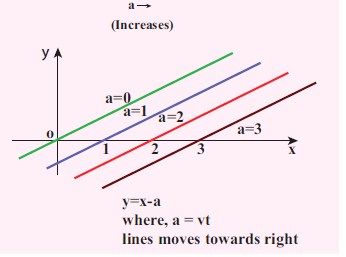
This implies, when increasing the value of a, the line shifts towards right side. For a = vt, y = x − vt satisfies the differential equation. Though this function satisfies the differential equation, it is not finite for all values of x and t. Hence, it does not represent a wave.
10.
\(v=\sqrt { \frac { y }{ \rho } } =\sqrt { \frac { 2\times { 10 }^{ 11 } }{ 7800 } } =\sqrt { 0.2564\times { 10 }^{ 8 } } \)
= 0.506\(\times\)104ms-1= 5\(\times\)103ms-1
Therefore, longitudinal waves travel faster in a solid than in a liquid or a gas. Now you may understand why a shepherd checks before crossing railway track by keeping his ears on the rails to safeguard his cattle.
11.
| First case | Second case | |
| (a) Wavelength | λ = 6 m | λ = 2 m |
| (b) Frequency | f = 2 Hz | f = 6 Hz |
| (c) Velocity | v = 6 × 2 = 12 m s-1 | v = 2 × 6 = 12 m s-1 |
This means that the speed of the wave along a string is a constant. Higher the frequency, shorter the wavelength and vice versa, and their product is velocity which remains the same.
12.
\({ \lambda }_{ 1 }=\frac { v }{ { f }_{ 1 } } =\frac { 340 }{ 20 } =17m\)
\({ \lambda }_{ 2 }=\frac { v }{ { f }_{ 2 } } =\frac { 340 }{ 20\times { 10 }^{ 3 } } =0.017m\)
Therefore, the audible wavelength region is from 0.017 m to 17 m when the velocity of sound in that region is 340 m s -1.
13.
According to Weber-Fechner's law, "loudness (L) is proportional to the logarithm of the actual intensity (1) measured with an accurate nonhuman instrument". This means that
L ∝ 1n I|
L = k 1n I
where k is a constant, which depends on the unit of measurement. The difference between two loudnesses, L1 and Lo measures the relative loudness between two precisely measured intensities and is called as sound intensity level. Mathematically, sound intensity level is
ΔL = L1-Lo = k In I1- k In I0 = k In \(\left[I_1\over I_0\right]\)
If k = 1, then sound intensity level is measured in bel, Therefore,
\(ΔL=In\)\(\left[I_1\over I_0\right]\)bel
However, this to express smaller unit, decibel. Thus, [decibel = \(1\over10\)bel] by multiplying and dividing by 10
\(ΔL=10\left(In\left[I_1\over I_0\right]\right){1\over 10}bel\)
\(ΔL=10In\left[I_1\over I_0\right]\)decibel with k = 10
For practical purposes,
\(ΔL=10log_{10}\left[I_1\over I_0\right]\)decibel.
14.
It works on the principle of multiple reflections.
It consists of three main parts:
(i) Chest piece
(ii) Ear piece
(iii) Rubber tube
(i) Chest piece: It consists of a small disc-shaped resonator (diaphragm) which is very sensitive to sound and amplifies the sound it detects.
(ii) Ear piece: It is made up of metal tubes which are used to hear sounds detected by the chest piece.
(iii) Rubber tube: This tube connects both chest piece and ear piece. It is used to transmit the sound signal detected by the diaphragm, to the ear piece. The sound of heart beats (or lungs) or any sound produced by internal organs can be detected, and it reaches the ear piece through this tube by multiple reflections.
15.
| S.No | Transverse waves | Longitudinal waves |
|---|---|---|
| 1 | The direction of vibration of particles of the medium is perpendicular to the direction of propagation of waves. | The direction of vibration of particles of the medium is parallel to the direction of propagation of waves. |
| 2 | The disturbances are in the form of crests and troughs. | The disturbances are in the form of compressions and rarefactions. |
| 3 | Transverse waves are possible m elastic medium. | Longitudinal waves are possible in all types of media (solid liquid and gas). |
16.
(i) For the propagation of the waves, the medium must possess both inertia and elasticity, which decide the velocity of the wave in that medium.
(ii) In a given medium, the velocity of a wave is a constant whereas the constituent particles in that medium move with different velocities at different positions. Velocity is maximum at their mean position and zero at extreme positions.
(iii) Waves undergo reflections, refraction, interference, diffraction and polarization.
17.
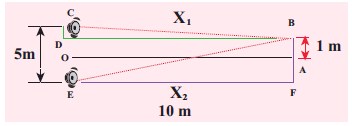
The first minimum occurs when the two waves reaching the point B are 180° (out of phase). The path difference \(\Delta x=\frac { \lambda }{ 2 } \) . In order to calculate the path difference, we have to find the path lengths x1 and x2. In a right triangle BDC,
18.
(b)
80
19.
(b)
energy
20.
(d)
21.
The given equation is similar to
\(\mathrm{y} =\mathrm{A} \sin \left(\omega t-\frac{x}{\lambda}\right) \)
\(\omega=300, \ \mathrm{f} =\frac{300}{2 \pi}=\frac{150}{\pi} \)
\(\text { Speed } \mathrm{v} =\mathrm{f} \lambda \)
\(=\frac{150}{\pi} \times \pi \)
\(=150 \mathrm{~ms}^{-1} \)
22.
Frequency = 5000 Hz
Speed of sound in air = 332 m/s
Speed of sound in water = 1450 m/s
Wavelength of sound in air \(=\frac{332}{5000}\)
\(=66.4 \times 10^{-3}\)
\(\text { Wavelength of sound water } \lambda_{\text {water }}\)
\(=\frac{1450}{5000} =290 \times 10^{-3} \mathrm{~m} \)
\(\therefore \frac{\lambda_{\text {water }}}{\lambda_{\text {air }}} =\frac{290 \times 10^{3}}{66.4 \times 10^{-3}} =4.367 \)
23.
\(\mathrm{f}_{\mathrm{o}}=150 \mathrm{~Hz}\)
\(\text { From the series of frequencies is }\)
\(f_{1} =2 f_{0} \)
\(f_{2} =3 f_{0} \)
\(=3 \times 150=450 \mathrm{~Hz}
\)
24.
f = 120Hz
Frequency of the 4th string is obtained from harmonic series
120,119, 118 and 117 Hz
(1) (2) (3) (4)
\(\therefore\) f4 = 117 Hz
25.
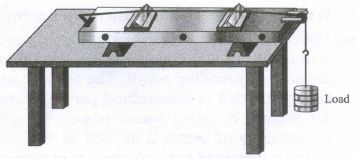
Sono means sound related, and sonometer implies sound-related measurements. It is a device for demonstrating the relationship between the frequency of the sound produced in the transverse standing wave in a string, and the tension, length and mass per unit length of the string. Therefore, using this device, we can determine the following quantities:
(a) the frequency of the tuning fork or frequency of alternating current
(b) the tension in the string
(c) the unknown hanging mass
Construction:
The sonometer is made up of a hollow box which is one meter long with a uniform metallic thin string attached to it. One end of the string is connected to a hook and the other end is connected to a weight hanger through a pulley as shown in Figure. Since only one string is used, it is also known as monochord. The weights are added to the free end of the wire to increase the tension of the wire. Two adjustable wooden knives are put over the board, and their positions are adjusted to change the vibrating length of the stretched wire.
Working:
A transverse stationary or standing wave is produced and hence, at the knife edges P and Q, nodes are formed. In between the knife edges, anti-nodes are formed.
If the length of the vibrating element is I then
\(l={\lambda\over2}\Rightarrow\lambda=2l\)
Let f be the frequency of the vibrating element, T the tension of in the string and μ the mass per unit length of the string. Then using equation
\(v={\sqrt{T\over \mu}}\), we get
\(f={v\over \lambda}={1\over 2l}\sqrt{T\over \mu}\) in Hertz ....(1)
Let ρ be the density of the material of the string and d be the diameter of the string. Then the mass per unit length μ,
μ = Area\(\times\)density = πr2ρ = \(π\rho d^2\over4\)
frequency \(f={v\over \lambda}={1\over 2l}\sqrt{T\over {\pi d^2\rho\over4}}\)
\(∴ f={1\over ld}\sqrt{T\over \pi \rho}\) .....(2)
26.
When a jerk is given to a stretched string which is tied at one end, a wave pulse is produced and the pulse travels along the string. Suppose two persons holding the stretched string on either side give a jerk simultaneously, then these two wave pulses move towards each other, meet at some point and move away from each other with their original identity. Their behaviour is very different only at the crossing/meeting points; this behaviour depends on whether the two pulses have the same or different shape as shown in Figure.
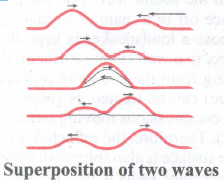
When the pulses have the same shape, at the crossing, the total displacement is the algebraic sum of their individual displacements and hence its net amplitude is higher than the amplitudes of the individual pulses. Whereas, if the two pulses have same amplitude but shapes are 1800 out of phase at the crossing point, the net amplitude vanishes at that point and the pulses will recover their identities after crossing. Only waves can possess such a peculiar property and It is called superposition of waves. This means that the principle of superposition explains the net behaviour of the waves when they overlap. Generalizing to any number of waves i.e, if two or more waves in a medium move simultaneously, when they overlap, their total displacement is the vector sum of the individual displacements.
To express mathematically, consider two functions which characterize the displacement of the waves, for example,
Y1 = A1 sin(kx - \(\omega t\))
and
Y2 = A2 cos(kx - \(\omega t\))
Since, both Y1 and Y2 satisfy the wave equation (solutions of wave equation) then their algebraic sum
Y = Y1 + Y2
also satisfies the wave equation. This means, the displacements are additive. Suppose we multiply Y1 and y2 with some constant then their amplitude is scaled by that constant Further, if C1 and C2 are used to multiply the displacernents y1 andY2 respectively, then, their net displacement Y is
Y = C1Y1 + C2Y2
This can be generalized to any number of waves. In the case of n such waves in more than one dimension the displacements are written using vector notation.
Here, the net displacement \(\vec y\) is
\(\vec { y } =\overset { n }{ \underset { i=1 }{ \Sigma } } { C }_{ i }\vec { { y }_{ i } } \)
The principle of superposition can explain the following:
(a) Space (or spatial) Interference (also known as Interference)
(b) Time (or Temporal) Interference (also known as Beats)
(c) Concept of stationary waves
Waves that obey principle of superposition are called linear waves (amplitude is much smaller than their wavelengths). In general, if the amplitude of the wave is not small then they are called non-linear waves.

11th Standard Syllabus & Materials
11th Standard
TN 11th Tamil பீடு பெற நில் - செய்யுள் - காவடிச்சிந்து Important Questions And Answers Study Material - QB365 Set A
NEW11th Standard
TN 11th Tamil பீடு பெற நில் - உரைநடை - மலை இடப்பெயர்கள் : ஓர் ஆய்வு Important Questions And Answers Study Material - QB365 Set A
NEW11th Standard
TN 11th Tamil மாமழை போற்றுதும் - துணைப்பாடம் - யானை டாக்டர் Important Questions And Answers Study Material - QB365 Set A
NEW11th Standard
TN 11th Tamil மாமழை போற்றுதும் - செய்யுள் - ஐங்குறுநூறு Important Questions And Answers Study Material - QB365 Set A



Tamilnadu Stateboard 11th Standard Subjects

Maths

Commerce

Economics

Biology

Business Maths and Statistics

Accountancy

Computer Science
Physics

Chemistry
Maths
Biology
Economics
Physics
Chemistry

History
Business Maths and Statistics

Computer Science
Accountancy

Computer Applications
History
Computer Technology
Commerce
Computer Applications
Computer Technology

Tamil

English

French
Tamilnadu Stateboard Standards

