
 100% FREE ACCESS
11th Standard Syllabus & Materials
11th Standard
TN 11th Tamil இயற்கை வேளாண்மை,சுற்றுச்சூழல் -செய்யுள் - மனோன்மணீயம் Important Questions And Answers Study Material - QB365 Set A
NEW11th Standard
TN 11th Tamil என்னுயிர் என்பேன் -துணைப்பாடம் - இசைத்தமிழர் இருவர் Important Questions And Answers Study Material - QB365 Set A
NEW11th Standard
TN 11th Tamil மொழி கலை -செய்யுள் - ஒவ்வொரு புல்லையும் Important Questions And Answers Study Material - QB365 Set A
NEW11th Standard
TN 11th Tamil பீடு பெற நில் - இலக்கணம் - பகுபத உறுப்புகள் Important Questions And Answers Study Material - QB365 Set A
NEW11th Standard
TN 11th Tamil பீடு பெற நில் - துணைப்பாடம் - வாடிவாசல் Important Questions And Answers Study Material - QB365 Set A
NEW11th Standard
TN 11th Tamil பீடு பெற நில் - செய்யுள் - குறுந்தொகை Important Questions And Answers Study Material - QB365 Set A

Published on: 04/03/2019
11th Public Exam March 2019 Model Test
Download Tamil Nadu 11th Standard Physics question papers, model tests, one-mark questions, important questions, and public exam papers in PDF format. Free study materials and answer keys for TN State Board students.
Questions + Answers key
Take MCQ Physics Test1.
A spring balance has a scale that reads from o to 50 kg the length of the scale is 20 cm. A body suspended from this balance, when displaced and released, oscillates with a period of 0.6 s. Then the weight of the body will be ______________.
200 N
208 N
219.3 N
272.1 N
2.
A parrot sitting on the floor of a wire cage which is carried by a boy, starts flying the boy will feel that the box is now _____________.
heavier
lighter
shows no change in weight
lighter in beginning & heavier later
3.
An organ pipe A closed at one end is allowed to vibrate in its first harmonic and another pipe B open at both ends is allowed to vibrate in its third harmonic. Both A and B are in resonance with a given tuning fork. The ratio of the length of A and B is
\(\frac{8}{3}\)
\(\frac{3}{8}\)
\(\frac{1}{6}\)
\(\frac{1}{3}\)
4.
A hollow sphere is filled with water. It is hung by a long thread. As the water flows out of a hole at the bottom, the period of oscillation will
first increase and then decrease
first decrease and then increase
increase continuously
decrease continuously
5.
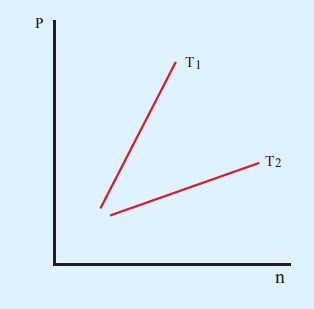
The following graph represents the pressure versus number density for ideal gas at two different temperatures T1 and T2. The graph implies
T1 = T2
T1 > T2
T1 < T2
Cannot be determined
6.
A distant star emits radiation with maximum intensity at 350 nm. The temperature of the star is
8280 K
5000 K
7260 K
9044 K
7.
For a given material, the rigidity modulus is \(\left( \frac { 1 }{ 3 } \right) \)rd of Young’s modulus. Its Poisson’s ratio is
0
0.25
0.3
0.5
8.
If the distance between the Earth and Sun were to be doubled from its present value, the number of days in a year would be
64.5
1032
182.5
730
9.
Moment of inertia of a this uniform hollow cylinder about an axis passing perpendicular to the length and passing through the center is _____________.
MR2
M\(\left( \frac { { R }^{ 2 } }{ 2 } +\frac { { l }^{ 2 } }{ 12 } \right) \)
\(\frac { 1 }{ 2 } \)MR2
M\(\left( \frac { { R }^{ 2 } }{ 4 } +\frac { { l }^{ 2 } }{ 12 } \right) \)
10.
\(\vec A\times \vec B\) is ____________.
\(AB\cos\theta\)
\(AB\sin\theta\)
\(AB\tan\theta\)
\(AB\sec\theta\)
11.
From a disc of radius R a mass M, a circular hole of diameter R, whose rim passes through the center is cut. What is the moment of inertia of the remaining part of the disc about a perpendicular axis passing through it
15MR2/32
13MR2/32
11MR2/32
9MR2/32
12.
A spring of force constant k is cut into two pieces such that one piece is double the length of the other. Then, the long piece will have a force constant of
\(\frac{2}{3}\)k
\(\frac{3}{2}\)k
3k
6k
13.
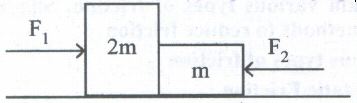
Two blocks of masses m and 2m are placed on a smooth horizontal surface as shown. In the first case only a force F1 is applied from the left. Later only a force F2 is applied from the right. If the force acting at the interface of the two blocks in the two cases is same, then F1 :F2 is
1:1
1:2
2:1
1:3
14.
If the velocity is \(\overrightarrow { v } =2\hat { i } +{ t }^{ 2 }\hat { j } -9\overrightarrow { k } \), then the magnitude of acceleration at t = 0.5s is
1 ms-2
2 ms-2
zero
-1 ms-2
15.
The velocity of a particle v at an instant t is given by v = at + br2. The dimensions of b is
[L]
[LT-1]
[LT-2]
[LT-3]
16.
A particle is projected upward from the surface of the earth (radius) with a K.E equal to half the minimum value needed for it to escape. To which height, does it rise above the surface of earth?
17.
In the upper part of the atmosphere the kinectic temperature of air is of the order of 1000 K, even then one feels severe cold there. Why?
18.
What is meant by triple point? Give the values of triple point pressure & triple point temperature of water.
19.
Consider a tuning fork which is used to produce resonance in an air column. A resonance air column is a glass tube whose length can be adjusted by a variable piston. At room temperature, the two successive resonances observed are at 20 cm and 85 cm of the column length. If the frequency of the length is 256 Hz, compute the velocity of the sound in air at room temperature.
20.
Write short notes on two springs connected in series.
21.
Distinguish between cohesive and adhesive forces.
22.
20 J work is required to stretch a spring through 0.1 m. Find the force constant of the spring. If the spring is further stretched through 0.1 m, calculate work done.
23.
Is it possible to measure the depth of a well using kinematic equations?
24.
The Moon orbits the Earth once in 27.3 days in an almost circular orbit. Calculate the centripetal acceleration experienced by the Earth? (Radius of the Earth is 6.4\(\times\)106 m).
25.
Write an expression for Cartesian co-ordinates of the CM for uniform distribution of mass.
26.
What are fundamental units and derived units?
27.
What is the difference between velocity and average velocity
28.
Two astronauts on the surface of the moon cannot talk to each other why
29.
What is Wien’s law?
30.
A force of \((4\hat{i}-3\hat{j}+5\hat{k})\) N is applied at a point whose position vector is \((7\hat{i}+4\hat{j}-2\hat{k})\) m. Find the torque of force about the origin.
31.
State the number of significant figures in 0.2300m
32.
Consider a horse attached to the cart which is initially at rest. If the horse starts walking forward, the cart also accelerates in the forward direction. If the horse pulls the cart with force Fh in forward direction, then according to Newton's third law, the cart also pulls the horse by equivalent opposite force Fc = Fh in backward direction. Then total force on 'cart+horse' is zero. Why is it then the 'cart+horse' accelerates and moves forward?
33.
Why a metal ball rebounds better than a rubber ball?
34.
The momentum of a system of particles is always conserved. True or false?
35.
Derive Meyer's relation.
36.
Discuss in detail the energy in simple harmonic motion.
37.
Explain in detail the isochoric process.
38.
Derive an equation for the total pressure at a depth ‘h’ below the liquid surface.
39.
Derive an expression for escape speed.
40.
The force F acting on a body moving in a circular path depends on mass of the body (m), velocity (v) and radius (r) of the circular path. Obtain the expression for the force by dimensional analysis method. (Take the value of k = 1)
41.
Calculate the work done by the torque.
42.
Mention important properties of the scalar product of two vectors.
43.
What is meant by elastic potential energy? Derive an expression for the elastic potential energy of the spring.
1.
(c)
219.3 N
2.
(b)
lighter
3.
First harmonic of a closed organ pipe
\(\mathrm{L}_{\mathrm{c}}=\frac{\lambda}{4}\)
Third harmonic of an open organ pipe
\(\mathrm{L}_{\mathrm{o}} =\frac{3 \lambda}{2} \)
\(\frac{L_{c}}{L_{o}} =\frac{\lambda}{4} \times \frac{2}{3 \lambda} \)
\(\frac{L_{c}}{L_{o}} =, \frac{1}{6} \)
4.
Initially when the sphere in completely filled with water, its centre of gravity (C.G) lies at its centre. As water flows out, the centre of gravity begins to shift below the centre of the sphere. The effective length of the pendulum increases and hence the time period increases. When the sphere is half empty C.G begins to rise up. As the length of pendulum decreases T decreases.
5.
From the graph we get T1 > T2
6.
\(\lambda_{m} T =\mathrm{b} \)
\(\therefore T =\frac{2.898 \times 10^{-3}}{350 \times 10^{-9}}\)
\(\mathrm{~T} =0.00828 \times 10^{6} \)
\(=8280 \mathrm{~K} \)
7.
\(\text { Rigidity modulus }=\frac{1}{3} \times \text { Young's modulus }\)
\(\text { Poisson ratio }=\frac{\text { lateral strain }}{\text { longitudinal strain }}\)
8.
T2 = C (R + h)3
\(\therefore T \alpha (R_E)^\frac{3}{2}\)
RE = 2RE
\(\therefore T \alpha (2R_E)^\frac{3}{2}\)
Time period increases by \(2^\frac{2}{3}\)= 2\(\sqrt 2\)
No. of days in a year = (365.4) \(\times\)2\(\sqrt 2\)
= 1032
9.
(b)
M\(\left( \frac { { R }^{ 2 } }{ 2 } +\frac { { l }^{ 2 } }{ 12 } \right) \)
10.
(b)
\(AB\sin\theta\)
11.
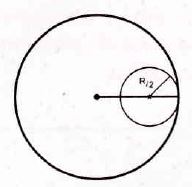
Moment of inertia of a disc
\(\mathrm{I}_{1}=\frac{M R^{2}}{2}\)
\(\text { Mass of small disc }=\frac{M}{\pi R^{2}} \times \pi \times\left(\frac{R}{2}\right)^{2}\)
\(=\frac{M}{\pi R^{2}} \times \frac{\pi R^{2}}{4}=\frac{M}{4}\)
By the theorem of parallel axis, the moment of inertia of the small disc. About an axis passing through 0 is
\(I_{2} =\frac{1}{2} \times \frac{M}{4}\left(\frac{R}{2}\right)^{2}+\frac{M}{4}\left(\frac{R}{2}\right)^{2} \)
\(=\frac{M}{8} \times \frac{R^{2}}{4}+\frac{M}{4} \times \frac{R^{2}}{4} \)
\(=\frac{M R^{2}}{32}+\frac{M R^{2}}{16}=\frac{M R^{2}+2 M R^{2}}{32} \)
\(I_{2} =\frac{3 M R^{2}}{32} \)
Moment of inertia of the remaining part is I= I1 - I2
\(=\frac{M R^{2}}{2}-\frac{3 M R^{2}}{32} \)
\(=\frac{16 M R^{2}-3 M R^{2}}{32}=\frac{13 M R^{2}}{32}\)
\(I =\frac{13 M R^{2}}{32} \)
12.
For any spring kl = constant
Length of the longer piece
\(=\frac{2 l}{3} \)
\(\therefore k^{1} \times \frac{2 l}{3} =k l \)
\(\therefore k^{1}=\frac{k l \times 3}{2 l}=\frac{3}{2} k \)
\(\therefore k^{1}=\frac{3}{2} k \)
13.
(c)
2:1
14.
\(\vec{v}=2 \hat{l}+t^{2} \hat{j}-9 \vec{k}\)
\(\vec{a}=\frac{d \vec{v}}{d t}=2 t \hat{j}\)
\(\text { When } t=0.5 \mathrm{~s}\)
\(a=1 \mathrm{~ms}^{-2}\)
15.
\(v=a t+b t^{2}\)
\(\text { Dimensional equation is } \mathrm{LT}^{-1}\)
\(=a T=b T^{2}\)
\(\therefore \text { The dimension of } b=\frac{\mathrm{LT}^{-1}}{\mathrm{~T}^{2}}=\mathrm{LT}^{-3}\)
16.
For the particle to escape, K.E = P.E
\(\frac { 1 }{ 2 } { mV }_{ e }^{ 2 }=\frac { GMm }{ R+h } \)
But supphed K.E =\(=\frac { 1 }{ 2 } \times \frac { 1 }{ 2 } { mV }_{ e }^{ 2 }=\frac { GMm }{ 2R } \)
Suppose the particle rises to a height h, then
\(=\frac { 1 }{ 2 } \times \frac { 1 }{ 2 } { mV }_{ e }^{ 2 }=\frac { GMm }{ R+h } \)
\(\frac { GMm }{ R+h } =\frac { GMm }{ R+h } \)
h=R
17.
(i) As we go up in the atmosphere, the number of air molecule per unit volume decreases.
(ii) The quantity of heat per unit volume or the heat density is low.
(iii) But the translational K.E per molecule is quite large. As the temperature is the measure of K.E, so temperature is high in the upper atmosphere but one feels cold due to low heat density.
(iv) Accumulate to the law of equipartition of energy average energy of each molecule =\(\frac{f}{2}\)KBT.
(v) \(\therefore\) Internal energy of one molecule of the gas.
U = \(\frac{f}{2}\)KBT.T\(\times\)NA =\(\frac{f}{2}\)RT
Cr = \(\frac{du}{dt}\)=\(\frac{f}{2}\)R
Cp = Cr+R
= \(\frac{f}{2}\)R + R = R\(\left( \frac { f }{ 2 } +1 \right) \)
\(\gamma =\frac { { C }_{ p } }{ { C }_{ v } } =\frac { \left( \frac { f }{ 2 } +1 \right) R }{ \frac { f }{ 2 } R } =1+\frac { 2 }{ f } \)
\(\therefore \gamma =1+\frac { 2 }{ f } \)
18.
(i) It is a point in phase diagram, representing a particular pressure & temperature at which the solid, liquid & vapour phases of the substance can co-exist
(Ii) Triple point pressure of water is 0.46cm of mercury column or 0.066 atm & triple point temperature of water is 273.16K or 0.010C.
19.
Given two successive length (resonance) to be L1 = 20 cm and L2 = 85 cm
The frequency is f = 256 Hz
v = f \(\lambda\) = 2f \(\Delta\)L = 2f (L2 − L1)
= 2 × 256 × (85 − 20) × 10 −2 m s−1
v = 332.8 cm−1
20.
When two or more springs are connected in series, we can replace all the springs in series with an equivalent spring where net effect is the same as if all the springs are in series connection.
\(\frac{1}{k_{s}} =\frac{1}{k_{1}}+\frac{1}{k_{2}}
\)
\(\mathrm{k}_{\mathrm{s}} =\frac{k_{1} k_{2}}{k_{1}+k_{2}}\)
If n springs are connected in series then
\(\mathbf{k}_{\mathrm{s}}=\frac{k}{n}\)
21.
| S.No | Cohesive force | Adhesive force |
| 1. | It is the force between the like molecules that holds the liquid together. |
When the liquid is in, contact with a solid, the molecules of these solid and liquid will experience an attractive force is called adhesive force. |
| 2. | It is very strong in solids weak in liquids and extremely weak in gases. |
It is very strong when solid and fluid are in contact. |
22.
U=W.D.= \(\frac{1}{2}\)K.x2 = 20J
or K = 4000 N/m
When spring is further stretched through 0.1m, then P.E. will be:
U' = \(\frac{1}{2}\)K(0.2)2 = 80J
W.D.= U'-U = 80-20 = 60J
23.
Consider a well without water, of some depth d. Take a small object (for example lemon) and a stopwatch. When you drop the lemon, start the stop watch. As soon as the lemon touches the bottom of the well, stop the watch. Note the time taken by the lemon to reach the bottom and denote the time as t.
Since the initial velocity of lemon u = 0 and the acceleration due to gravity g is constant over the well, we can use the equations of motion for constant acceleration.
s= \(ut+\frac { 1 }{ 2 } { at }^{ 2 }\)
Since u = 0 s=d, a = g (Since we choose the y-axis downwards),Then
d = \(\frac { 1 }{ 2 } { gt }^{ 2 }\)
Substituting g = 9.8 m s-2 we get the depth of the well.
To estimate the error in our calculation we can use another method to measure the depth of the well. Take a long rope and hang the rope inside the well till it touches the bottom. Measure the length of the rope which is the correct depth of the well (dcorrect).Then error = dconnect -d
relative error = \(\frac { { d }_{ corrct }-d }{ { d }_{ corrct } } \)
percentage of relative error = \(\frac { { d }_{ corrct }-d }{ { d }_{ corrct } } \times 100\)
What would be the reason for an error, if any? Repeat the experiment for different masses and compare the result with dcorrect every time.
24.
The centripetal acceleration is given by a = \(\frac { { v }^{ 2 } }{ r } \). This expression explicitly depends on Moon's speed which is non trivial. We can work with the formula
ω2Rm= am
am is centripetal acceleration of the Moon due to Earth's gravity
ω is angular velocity
Rm is the distance between Earth and the Moon, which is 60 times the radius of the Earth.
Rm= 60R = 60\(\times\)6.4\(\times\)106 = 384\(\times\)106 m
As we know the angular velocity ω = \(\frac { 2\pi }{ T } \) and T= 27.3 days = 27.3\(\times\)24\(\times\) 60\(\times\)60 second = 2.358\(\times\)106 sec
By substituting these values in the formula for acceleration
am = \(\frac { (4{ \pi }^{ 2 })(384\times 10^{ 6 }) }{ (2.358\times 10^{ 8 })^{ 2 } } \) = 0.00272 ms-2
The centripetal acceleration of Moon towards the Earth is 0.00272 ms-2.
25.
\({ X }_{ CM }=\frac { \sum { \left( { \Delta m }_{ i } \right) { x }_{ i } } }{ \sum { { \Delta m }_{ i } } } \)
\({ Y }_{ CM }=\frac { \sum { \left( { \Delta m }_{ i } \right) { y }_{ i } } }{ \sum { { \Delta m }_{ i } } } \)
\({ Z }_{ CM }=\frac { \sum { \left( { \Delta m }_{ i } \right) { z }_{ i } } }{ \sum { { \Delta m }_{ i } } } \)
26.
Fundamental units:
The units in which the fundamental quantities are measured are called fundamental units. It is also known as base units.
Derived units:
The units of measurements of all other physical quantities, which can be obtained by a suitable multiplication or division of powers of fundamental units are called derived units.
Example:
Unit of speed = \({{Unit\ of\ distance}\over{Unit\ of\ \ time}}\)
\(={{m}\over{s}}={ms}^{-1}\)
ms-1 is a derived unit.
27.
| Velocity | Average Velocity |
|---|---|
| It refers to the rate of change of position vector with respect to time. | It refers to the rate of change of displacement vector with respect to time |
| \(\overrightarrow { v } = \underset { \Delta t\rightarrow 0 }\lim { \frac { \Delta \overrightarrow { r } }{ \Delta t } } \) | \(\overrightarrow { v }_ {avg}=\frac { \Delta \overrightarrow { r } }{ \Delta t } \) |
28.
Sound waves require material medium for their propagation. As there is no atmosphere on the moon, hence the sound wave cannot propagate on the moon
29.
Wien's law states that, the wavelength of maximum intensity of emission of a black body radiation is inversely proportional to the absolute temperature of the black body.
\({ \lambda }_{ m } \)∝\(\frac { 1 }{ T } \)
\({ \lambda }_{ m }=\frac { b }{ T } \)
30.
\(\overrightarrow{r}=7\hat{i}+4\hat{j}-2\hat{k}\)
\(\overrightarrow{F}=4\hat{i}-3\hat{j}+5\hat{k}\)
Torque,\(\overrightarrow{\tau}=\overrightarrow{r}\times \overrightarrow{F}\)
\(\overrightarrow{\tau}=\left| \begin{matrix} \hat { i } & \hat {j } & \hat {k } \\ 7 &4 & -2 \\ 4 & -3 & 5 \end{matrix} \right| \)
\(\overrightarrow{\tau}=\hat{i}(20-6)-\hat{j}(35+8)+\hat{k}(-21-16)\)
\(\overrightarrow {\tau}=(14\hat{i}-43\hat{j}-37\hat{k})Nm\)
31.
4
32.
This paradox arises due to wrong application of Newton's second and third laws. Before applying Newton's laws, we should decide 'what is the system?'. Once we identify the 'system', then it is possible to identify all the forces acting on the system. We should not consider the force exerted by the system. If there is an unbalanced force acting on the system, then it should have acceleration in the direction of the resultant force. By following these steps we will analyse the horse and cart motion.
If we decide on the cart+horse as a 'system', then we should not consider the force exerted by the horse on the cart or the force exerted by cart on the horse. Both are internal forces acting on each other. According to Newton's third law, total internal force acting on the system is zero and it cannot accelerate the system. The acceleration of the system is caused by some external force. In this case, the force exerted by the road on the system is the external force acting on the system. It is wrong to conclude that the total force acting on the system (cart+horse) is zero without including all the forces acting on the system. The road is pushing the horse and cart forward with acceleration. As there is an external- force acting on the system, Newton's second law has to be applied and not Newton's third law. The following figures illustrates this.
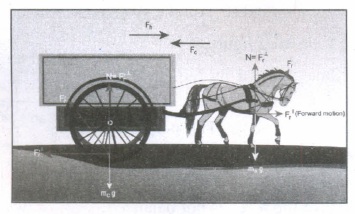
If we consider the horse as the 'system', then there are three forces acting on the horse.
(i) Downward gravitational force (mhg)
(ii) Force exerted by the road (Fr)
(iii) Backward force exerted by the cart (Fc)
It is shown in the following figure.
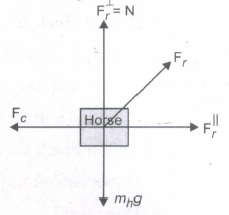
Fr - Force exerted by the road on the horse
Fc - Force exerted by the cart on the horse
F丄r-Perpendicular component of Fr=N
F||r-Parallel component of Fr which is reason for forward movement.
The force exerted by the road can be resolved into parallel and perpendicular components. The perpendicular component balances the downward gravitational force. There is parallel component along the forward direction. It is greater than the backward force (Fc). So there is net force along the forward direction which causes the forward movement of the horse.
If we take the cart as the system, then there are three forces acting on the cart.
(i) Downward gravitational force (mcg)
(ii) Force exerted by the road (Fr)
(iii) Force exerted by the horse (Fh)
It is shown in the figure.
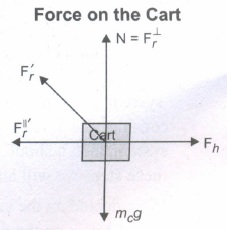
The force exerted by the road (\(\vec { { F }_{ r } } \) ) can be resolved into parallel and perpendicular components. The perpendicular component cancels the downward gravity (mcg). Parallel component acts backwards and the force exerted by the horse (\(\vec { { F }_{ h } } \) ) acts forward. Force (\(\vec { { F }_{ h } } \) ) is greater than the parallel component acting in the opposite direction. So there is an overall unbalanced force in the forward direction which causes the cart to accelerate forward.
If we take the cart+horse as a system, then there are two forces acting on the system.
(i) Downward gravitational force (mh + mc)g
(ii) The force exerted by the road (Fr) on the system.
It is shown in the following figure.
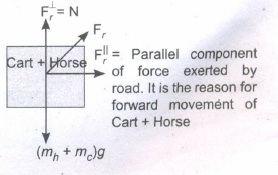
(iii) In this case the force exerted by the road (Fr) on the system (cart+horse) is resolved in to parallel and perpendicular components. The perpendicular component is the normal force which cancels the downward gravitational force (mh + mc)g. The parallel component of the force is not balanced, hence the system (cart+horse) accelerates and moves forward due to this force.
33.
When a rubber ball hits a massive object, say, earth, the ball is distorted. A large amount of heat is generated in the ball by the rubbing of the rubber molecules against each other. This effect is essentially absent in a hard material. So, a metal ball would often lose less energy upon collision than would a rubber ball.
34.
True
35.
Consider are mole of an ideal gas enclosed in a cylinder provided with a frictionless piston of area A.
P - pressure of gas
V - volume of gas
T - absolute temperature gas
dQ - quantity of heat supplied
To keep the volume of the gas constant a small Wt is placed over the piston.
The pressure and temperature increase to p + dp and T+ dt.
dQ is used to increase the internal energy dU of the gas. But the gas does not do any work [dw = 0]
\(\therefore\) dQ = dU = 1\(\times\)Cv\(\times\)dT.
Now the Wt is removed. The piston now moves upwards thus a dist. dx, the pres. of the enclosed gas equal to atmosphere pressure P. Due to expansion, temperature decreases.
Now a quantity of heat dQ is supplied till its temperature become T + \(\Delta\)T. This heat energy is not only used to increase the internal energy dU of the gas but also to do exists wor k dW in moving the piston upwards.
\(\therefore\) dQ1 = dU+dW
At constant pressure
dQ1 = cp dT
\(\therefore\) cp dT = Cv dT + dW
work done dW = Force\(\times\)dist.
=p\(\times\)A\(\times\)dx
dW = p. dv [A. dx = dv change in volume]
\(\therefore\) cp dT = cv dT + pdv ........... (1)
The eqn of state of an ideal gas is
pv = RT
Difference both the sides
pdv = RdT ............. (2)
Subtract (2) in (1)
cpdT = cvdT+RdT
cp= cv+R
\(\therefore\) Cp-Cv + R.
This equation is known as Meyer's electron.
36.
a. Expression for Potential Energy For the simple harmonic motion, the force and the displacement are related by Hooke's law
\(\vec { F } =-k\vec { r } \)
(i) Since force is a vector quantity, in three dimensions it has three components. Further, the force in the above equation is a conservative force field; such a force can be derived from a scalar function which has only one component. In one dimensional case
F = -kx .....(i)
(ii) As we have discussed in unit 4 of volume I, the work done by the conservative force field is independent of path. The potential energy U can be calculated from the following expression.
F = \(\frac { dU }{ dx } \) .......(2)
Comparing (1) and (2). we get
-\(\frac { dU }{ dx } \) = -kx
dU = kxdx
(iii) This work done by the force F during a small displacement dx stores as potential energy
U(x)=\(\int _{ 0 }^{ x }{ kx'dx=\frac { 1 }{ 2 } (x')^{ 2 }{ |_{ 0 }^{ x } } } =\frac { 1 }{ 2 } kx^{ 2 }\) ....(3)
From equation \(\sqrt { \frac { k }{ m } } \) , we can substitute the value of force constant k=ω2 in equation (3)
where ω is the natural frequency of the oscillating system. For the particle executing simple harmonic motion from equation y =A sin ωt,
we get x =A sin ωt
U(t)=\(\frac { 1 }{ 2 } mv_{ x }^{ 2 }=\frac { 1 }{ 2 } m\left( \frac { dx }{ dty } \right) ^{ 2 }\) ......(4)
This variation of U is shown below.
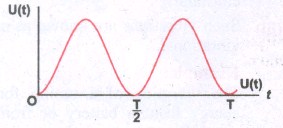
Variation of potential energy with time t
b. Expression for Kinetic Energy
KE = \(\frac { 1 }{ 2 } mv_{ x }^{ 2 }=\frac { 1 }{ 2 } m\left( \frac { dx }{ dy } \right) ^{ 2 }\)
(i) Since the particle is executing simple harmonic motion, from equation
y =A sin ωt
x =A sin ωt
Therefore, velocity is
vx =\(\frac { dx }{ dt } \)Aω cosωt
\(A\omega \sqrt { 1-\left( \frac { x }{ A } \right) ^{ 2 } } \)
vx = \(\omega \sqrt { { A }^{ 2 }-{ x }^{ 2 } } \) ....(5)
Hence
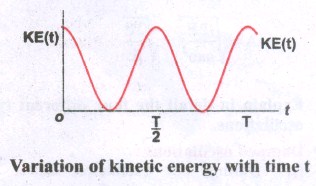
KE = \(\frac { 1 }{ 2 } mv_{ x }^{ 2 }=\frac { 1 }{ 2 } m{ \omega }^{ 2 }({ A }^{ 2 }-{ x }^{ 2 })\) ...(6)
KE = \(\frac { 1 }{ 2 } m{ \omega }^{ 2 }A^{ 2 }cos^{ 2 }\omega t\) ....(7)
This variation with time is shown below.
c. Expression for Total Energy
(i) Total energy is the sum of kinetic energy and potential energy
E = KE+U ..............(8)
E = \(\frac { 1 }{ 2 } m{ \omega }^{ 2 }=\frac { 1 }{ 2 } m{ \omega }^{ 2 }({ A }^{ 2 }-{ x }^{ 2 })\)
Hence excelling x2 term,
E = \(\frac { 1 }{ 2 } m{ \omega }^{ 2 }A^{ 2 }\) = constant .....(9)
(ii) Alternatively, from equation (4), and equation (7), we get the total energy as
E =\(\frac { 1 }{ 2 } m{ \omega }^{ 2 }A^{ 2 }sin^{ 2 }\omega t+\frac { 1 }{ 2 } m{ \omega }^{ 2 }A^{ 2 }cos^{ 2 }\omega t\)
= \(\frac { 1 }{ 2 } m{ \omega }^{ 2 }A^{ 2 }(sin^{ 2 }\omega t+cos^{ 2 }\omega t)\)
(iii) From trigonometry identity,
sin2ωt+cos2ωt_=1
E = \(\frac { 1 }{ 2 } m{ \omega }^{ 2 }A^{ 2 }\) = constant
which gives the law of conservation of total energy. This is depicted.
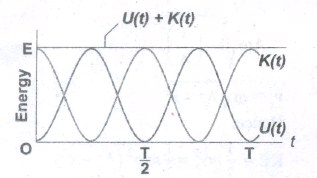
(iv) Thus the amplitude of simple harmonic oscillator, can be expressed in terms of total energy.
A =\(\sqrt { \frac { 2E }{ m{ \omega }^{ 2 } } } =\sqrt { \frac { 2E }{ k } } \) .
37.
This is a thermodynamic process in which the volume of the system is kept constant. But pressure, temperature and internal energy continue to be variables.
The pressure-volume graph for an isochoric process is a vertical line parallel to pressure axis as shown in Figure.
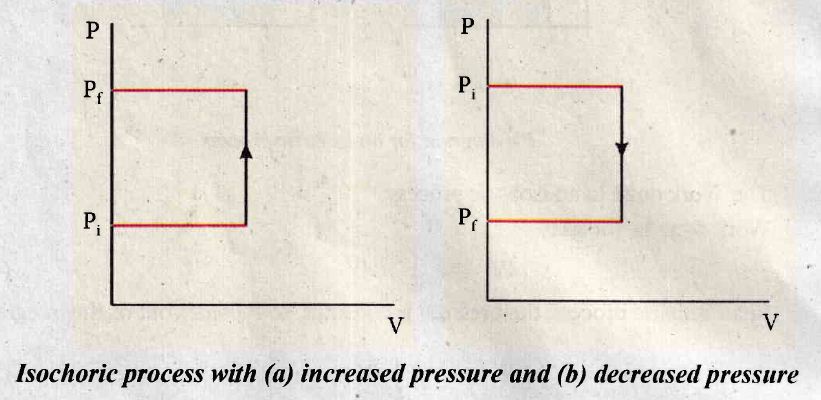
The equation of state for an isochoric process is given by
\(P=\left( \cfrac { \mu R }{ V } \right) T\) ...(1)
Where \(\left( \cfrac { \mu R }{ V } \right) \)= constant
It is that the pressure is directly proportional to temperature. This implies that the P-T graph for an isochoric process is a straight line passing through origin.
If a gas goes from state (Pi,Ti) to (Pf, Tf) at constant volume, then the system satisfies the following equation
\(\cfrac { { P }_{ i } }{ { T }_{ i } } =\cfrac { { P }_{ f } }{ { T }_{ f } } \) ...(2)
For an isochoric processes, \(\triangle \)V = 0 and W = 0. Then the first law becomes
\(\triangle \)U = Q ....(3)
Implying that the heat supplied is used to increase only the internal energy. As a result the temperature increases and pressure also increases.
Suppose a system loses heat to the surroundings through conducting walls by keeping the volume constant, then its internal energy decreases. As a result the temperature decreases; the pressure also decreases.
1. When food is cooked by closing with a lid as shown in figure.
When food is being cooked in this closed position, after a certain time you can observe the lid is being pushed upwards by the water steam. This is because when the lid is closed, the volume is kept constant. As the heat continuously supplied, the pressure increases and water steam tries to push the lid upward's.
.JPG)
2. In automobiles the petrol engine undergoes four processes. First the piston is adiabatically compressed to some volume as shown in the Figure (a). In the second process (Figure (b)), the volume of the air-fuel mixture is kept constant and heat is being added. As a result the temperature and pressure are increased. This is an isochoric process. For a third stroke (Figure (c)) there will be an adiabatic expansion and fourth stroke again isochoric process by keeping the piston immoveable (Figure (d)).
.JPG)
38.
In order to understand the increase in pressure with depth below the water surface, consider a water sample of cross sectional area in the form of a cylinder. Let h1 and h2 be the depths from the air-water interface to level 1 and level 2 of the cylinder, respectively as shown in Figure. Let F1 be the force acting downwards on level 1 and F2 be the force acting upwards on level 2, such that, F1= P1 A and F2 = P2 A. Let us assume the mass of the sample to be m and under equilibrium condition, the total upward force (F2) is balanced by the total downward force (F1 + mg), in other words, the gravitational force will act downward which is being exactly balanced by the difference between the force F2 - F1.
F2 - F1
F2 - F1 = mg = FG .....(1)
where m is the mass of the water available in the sample element. Let p be the density of the water then, the mass of water available in the sample element is
\(m=\rho V=\rho A(h_{2}-h_{1})\)
V = A(h2 - h1)
Hence, gravitational force,
\(F_G=\rho A(h_{2}-h_{1})g\)
On substituting the value of W in equation (1)
\(F_{2}=F_{1}+mg\Rightarrow P_{2}A=P_{1}A+\rho A(h_{2}-h_{1})g\)
Cancelling out A on both sides,
\(P_{2}=P_{1}+\rho (h_{2}-h_{1})g\) ....(2)
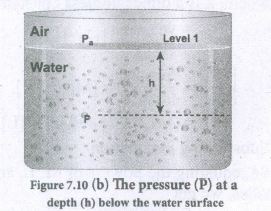
If we choose the level 1 at the surface of the liquid (i.e., air-water interface) and the level 2 at a depth 'h' below the surface, then the value of h1 becomes zero (h1 = 0) and in turn P1 assumes the value of atmospheric pressure (say Pa). In addition, the pressure (P2) at a depth becomes P. Substituting these values in equation (2), we get
\(\mathrm{P} = \mathrm{P}_{\mathrm{a}}+\rho g h ....(1)\)
which means, the pressure at a depth h is greater than the pressure on the surface of the liquid, where Pa is the atmospheric pressure which is equal to 1.013 x 10⁵ Pa. If the atmospheric pressure is neglected or ignored then
\(\mathrm{P}=\rho g h\)
For a given liquid, \(\rho\) is fixed and g is also constant, then the pressure due to the fluid column is directly proportional to vertical distance or height of the fluid column. This implies, the height of the fluid column is more important to decide the pressure and not the cross sectional or base area or even the shape of the container.
39.
Consider an object of mass M on the surface of the Earth. When it is thrown up with an initial speed Vi' the initial total energy of the object is
Ei = \(\frac { 1 }{ 2 } { Mv }_{ i }^{ 2 }-\frac { GMM_{ E } }{ R_{ E } } \) ............(1)
where, ME is the mass of the Earth and RE- the radius of the Earth. The term \(\frac { GMM_{ E } }{ R_{ E } } \) is the potential energy of the mass M.
When the object reaches a height far away from Earth and hence treated as approaching infinity, the gravitational potential energy becomes zero [U(∝) = 0] and the kinetic energy becomes zero as well. Therefore the final total energy of the object becomes zero. This is for minimum energy and for minimum speed to escape. Otherwise Kinetic energy can be non-zero.
Ef = 0
According to the law of energy conservation,
Ei = Ef .............(2)
Substituting (1) in (2) we get,
\(\frac { 1 }{ 2 } { Mv }_{ i }^{ 2 }-\frac { GMM_{ E } }{ R_{ E } } \) =0
\(\frac { 1 }{ 2 } { Mv }_{ e }^{ 2 }-\frac { GMM_{ E } }{ R_{ E } } \) = 0 .............(3)
Consider the escape speed, the minimum speed required by an object to escape Earth's gravitational field, hence replace vi with ve. i.e.,
\(\frac { 1 }{ 2 } { Mv }_{ e }^{ 2 }-\frac { GMM_{ E } }{ R_{ E } } \)
\(v_{ e }^{ 2 }-\frac { GMM_{ E } }{ R_{ E } } .\frac { 2 }{ M } \)
\(v_{ e }^{ 2 }=\frac { 2G{ M }_{ E } }{ { R }_{ E } } \) ..............(4)
Using g = \(\frac { G{ M }_{ E } }{ { R }_{ e } } \) ..............(5)
\(v_{ e }^{ 2 }=2g{ R }_{ E }\)
\({ v }_{ e }=\sqrt { 2g{ R }_{ E } } \) .................(6)
40.
F ∝ ma vb rc ;
F = k ma vb rc
where k is a dimensionless constant of proportionality. Rewriting above equation in terms of dimensions and taking k= 1, we have
[MLT-2] = [M]a [LT-1]b [L]c
= [MaLbT-bLc]
[MLT-2] = [MaLb+cT-b]
Comparing the powers of M, L and T on both sides
a = 1 ; b + c = 1; -b =-2
2 + c = 1 ; b = 2;
a = 1 b = 2 and c = -1
From the above equation we get
F = mavbrc
F =m1v2r-1
or F = \(\frac { m{ v }^{ 2 } }{ r } \)
41.
Consider a rigid body rotating about a fixed axis. The figure shows a point P on the body rotating about an axis perpendicular to the plane of the page. A tangential force F is applied on the body.
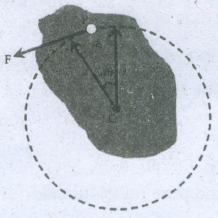
It produces a small displacement ds on the body. The work done (dw) by the force is,
dw=Fds
As the distance ds, the angle of rotation dθ and radius r are related by the expression,
ds =rdθ
The expression for work done now becomes,
dw = Fds; dw = Frdθ
The term (Fr) is the torque r produced by the force on the body.
dw=ፒdθ
This expression gives the work done by the external torque ፒ, which acts on the body rotating about a fixed axis through an angle dθ
42.
(i) The product quantity \(\overrightarrow{A}.\overrightarrow{B}\) is always a scalar. It is positive if the angle between the vectors is acute (i.e., < 90°) and negative if the angle between them is obtuse (i.e. 90°<0< 180°).
(ii) The scalar product is commutative i.e., \(\overrightarrow{A}.\overrightarrow{B}=\overrightarrow{B}.\overrightarrow{A}\)
(iii) The vectors obey distributive law i.e.
\(\overrightarrow{A}.\left( \overrightarrow{B}+\overrightarrow{C} \right)=\overrightarrow{A}+\overrightarrow{B}+\overrightarrow{A}.\overrightarrow{C}\)
(iv) The angle between the vectors
\(\theta={cos}^{-1}\left[ {{\overrightarrow{A}.\overrightarrow{B}}\over{AB}} \right]\)
(v) The scalar product of two vectors will be maximum when cos \(\theta\) = 1, i.e., \(\theta=0°\) , i.e., when the vectors are parallel;
\((\overrightarrow{A}.\overrightarrow{B})_{max}=AB\)
(vi) The scalar product of two vectors will be minimum, when cos \(\theta\) = -1, i.e. 0 = 180° \((\overrightarrow{A}.\overrightarrow{B})=-AB,\) when the vectors are mm anti-parallel.
(vii) If two vectors \(\overrightarrow{A}\) and \(\overrightarrow{B}\) are perpendicular to each other then their scalar product \(\overrightarrow{A}.\overrightarrow{B}=0,\) 0, because cos 90°= O. Then the vectors \(\overrightarrow{A}\) and \(\overrightarrow{B}\) are said to be mutually orthogonal.
(viii) The scalar product of a vector with itself is termed as self-dot product and is given by \({(\overrightarrow{A})}^{2}=\overrightarrow{A}.\overrightarrow{A}=AA\ \cos\ \theta={A}^{2}.\)
Here angle 0 = 0°
The magnitude or norm of the vector \(\overrightarrow{A}\) is \(|\overrightarrow{A}|=A=\sqrt{\overrightarrow{A}.\overrightarrow{A}}\)
(ix) In case of a unit vector \(\overrightarrow{n}\)
\(\hat{n},\hat{n}=1\times1\times\cos\theta=1.\) For example,
\(\hat{i},\hat{j}=\hat{j}.\hat{j}=\hat{k},\hat{k}=1.\)
(x) In the case of orthogonal unit vectors \(\hat{i},\hat{j}\) and \(\hat{k}.\)
\(\hat{i},\hat{j}=\hat{j},\hat{k}=\hat{k},\hat{i}=1.1\cos 90°=0\)
(xi) In terms of components, the scalar product of \(\overrightarrow{A}\) and \(\overrightarrow{B}\) can be written as \(\overrightarrow{A}.\overrightarrow{B}=(A_z\hat{i}+A_y\hat{j}+A_z\hat{k}).(B_x\hat{i}+B_y\hat{j}+B_z\hat{k})\)
\(=A_xB_x+A_yB_y+A_zB_z,\) with all other terms zero. The magnitude of vector \(|\overrightarrow{A}|\) is given by \(|\overrightarrow{A}|=A=\sqrt{{A}_{x}^{2}+{A}_{y}^{2}+{A}_{z}^{2}}\)
43.
(i) The potential energy possessed by a spring due to a deforming force which stretches or compresses the spring is termed as elastic potential energy. The work done by the applied force against the restoring force of the spring is stored as the elastic potential energy in the spring.
(ii) Consider a spring-mass system. Let us assume a mass, m lying on a smooth horizontal table as shown in Figure. Here, x = 0 is the equilibrium position. One end of the spring is attached to a rigid wall and the other end to the mass.
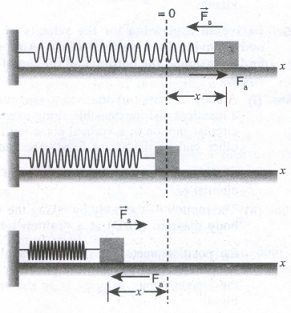
(iii) As long as the spring remains in equilibrium position, its potential energy is zero. Now an external force \(\overrightarrow { { F }_{ a } } \) is applied so that it is stretched by a distance (x) in the direction of the force.
(iv) There is a restoring force called spring force \(\overrightarrow { { F }_{ s } } \) developed in the spring which tries. to bring the mass back to its original position. This applied force and the spring force are equal in magnitude but opposite in direction i.e \(\overrightarrow { { F }_{ a } } \) = - \(\overrightarrow { { F }_{ s } } \) According Hooke's law, the restoring force developed in the spring is
\(\overrightarrow { { F }_{ s } } \) = -k\(\overrightarrow { x } \)
(v) The negative sign in the above expression implies that the spring force is always opposite to that of displacement \(\overrightarrow { x } \) and k is the force constant. There, fore applied force is \(\overrightarrow { { F }_{ a } } \) = +k\(\overrightarrow { x } \) The positive sign implies. that the applied force is in the direction of displacement \(\overrightarrow { x } \). The spring force is an example of variable force as it depends on the displacement \(\overrightarrow { x } \). Let the spring be stretched to a small distance d\(\overrightarrow { x } \). The work done by the applied force on the spring to stretch it by a displacement \(\overrightarrow { x } \) is stored as elastic potential energy.
\(U=\int \overrightarrow { { F }_{ a } } .d\overrightarrow { r } =\overset { x }{ \underset { 0 }{ \int } } \left| \overrightarrow { { F }_{ a } } \right| \left| d\overrightarrow { r } \right| \cos { \theta } \)
\(=\overset { x }{ \underset { 0 }{ \int } } { F }_{ a }dx\cos { \theta } \)
(vi) The applied force \(\overrightarrow { { F }_{ a } } \) and the displacement d\(\overrightarrow { { r } } \) (i.e., here dx ) are in the same direction. As, the initial position is taken as the equilibrium position or mean position, x = 0 is the lower limit of integration.
\(U=\overset { x }{ \underset { 0 }{ \int } } Kxdx\)
\(U={ \left[ \frac { { x }^{ 2 } }{ 2 } \right] }_{ 0 }^{ x }\)
\(U=\frac { 1 }{ 2 } { kx }^{ 2 }\)
(vii) If the initial position is not zero, and if the mass is changed from position xi to xf then the elastic potential energy is
\(U=\frac { 1 }{ 2 } k\left( { x }_{ f }^{ 2 }-{ x }_{ i }^{ 2 } \right) \)
From equations (1) and (2), we observe that the' potential energy of the stretched spring depends on the force constant k and elongation or compression x.

11th Standard Syllabus & Materials
11th Standard
TN 11th Tamil பீடு பெற நில் - செய்யுள் - காவடிச்சிந்து Important Questions And Answers Study Material - QB365 Set A
NEW11th Standard
TN 11th Tamil பீடு பெற நில் - உரைநடை - மலை இடப்பெயர்கள் : ஓர் ஆய்வு Important Questions And Answers Study Material - QB365 Set A
NEW11th Standard
TN 11th Tamil மாமழை போற்றுதும் - துணைப்பாடம் - யானை டாக்டர் Important Questions And Answers Study Material - QB365 Set A
NEW11th Standard
TN 11th Tamil மாமழை போற்றுதும் - செய்யுள் - ஐங்குறுநூறு Important Questions And Answers Study Material - QB365 Set A



Tamilnadu Stateboard 11th Standard Subjects

Maths

Commerce

Economics

Biology

Business Maths and Statistics

Accountancy

Computer Science
Physics

Chemistry
Maths
Biology
Economics
Physics
Chemistry

History
Business Maths and Statistics

Computer Science
Accountancy

Computer Applications
History
Computer Technology
Commerce
Computer Applications
Computer Technology

Tamil

English

French
Tamilnadu Stateboard Standards

