
 100% FREE ACCESS
11th Standard Syllabus & Materials
11th Standard
TN 11th Tamil இயற்கை வேளாண்மை,சுற்றுச்சூழல் -செய்யுள் - மனோன்மணீயம் Important Questions And Answers Study Material - QB365 Set A
NEW11th Standard
TN 11th Tamil என்னுயிர் என்பேன் -துணைப்பாடம் - இசைத்தமிழர் இருவர் Important Questions And Answers Study Material - QB365 Set A
NEW11th Standard
TN 11th Tamil மொழி கலை -செய்யுள் - ஒவ்வொரு புல்லையும் Important Questions And Answers Study Material - QB365 Set A
NEW11th Standard
TN 11th Tamil பீடு பெற நில் - இலக்கணம் - பகுபத உறுப்புகள் Important Questions And Answers Study Material - QB365 Set A
NEW11th Standard
TN 11th Tamil பீடு பெற நில் - துணைப்பாடம் - வாடிவாசல் Important Questions And Answers Study Material - QB365 Set A
NEW11th Standard
TN 11th Tamil பீடு பெற நில் - செய்யுள் - குறுந்தொகை Important Questions And Answers Study Material - QB365 Set A

Published on: 30/09/2018
Important questions -chapter 7,8
Download Tamil Nadu 11th Standard Chemistry question papers, model tests, one-mark questions, important questions, and public exam papers in PDF format. Free study materials and answer keys for TN State Board students.
Questions + Answers key
Take MCQ Chemistry Test
1.
Consider the following reactions,
H2(g) + I2(g) ⇌ 2 HI(g)
In each of the above reaction find out whether you have to increase (or) decrease the volume to increase the yield of the product.
2.
Define System?
3.
How do you measure the enthalpy of formation of carbon monoxide?
4.
Define the calorific value of food. What is the unit of calorific value?
5.
1 mol of CH4, 1 mole of CS2 and 2 mol of H2S are 2 mol of H2 are mixed in a 500 ml flask. The equilibrium constant for the reaction KC = 4 x 10⁻² mol2 lit–2. In which direction will the reaction proceed to reach equilibrium ?
6.
For the reaction
SrCO3 (s) ⇌ SrO (s) + CO2(g),
the value of equilibrium constant KP = 2.2 x 10⁻⁴ at 1002 K. Calculate KC for the reaction.
7.
What is the relation between KP and KC. Give one example for which KP is equal to KC.
8.
The value of Kc for the following reaction at 717 K is 48.
9.
Define the Molar Heat of Sublimation
10.
Applications of the heat of combustion?
11.
The equilibrium constant of a reaction is 10, what will be the sign of ΔG? Will this reaction be spontaneous?
12.
In a chemical equilibrium, the rate constant for the forward reaction is 2.5 \(\times\)102 and the equilibrium constant is 50. The rate constant for the reverse reaction is ____________
11.5
5
2 x 10²
2 x 10⁻³
13.
In the equilibrium,
2A(g) ⇌ 2B(g) + C2(g)
the equilibrium concentrations of A, B and C2 at 400 K are 1\(\times\)10–4 M, 2.0 \(\times\)10–3 M, 1.5 \(\times\)10–4 M respectively. The value of KC for the equilibrium at 400 K is ________
0.06
0.09
0.62
3 x 10⁻²
14.
In general, for an exothermic reaction to be spontaneous:
temp should be high
temp should be zero
temp should be low
temp has no effect
15.
Match the list I with list II and select the correct answer using the code given below the list.
| List-I | List-II | ||
| A | ΔS<0 | 1 | I2(s)⟶I2(g) |
| B | ΔG<0 | 2 | \(Ice\overset { 273\quad K }{ \rightleftharpoons } Water\) |
| C | ΔG=0 | 3 | 2O3(g)⟶3O2(g) |
| D | ΔS>0 | 4 | \(H_{ 2 }O_{ (I) }\overset { 270K }{ \longrightarrow } { H }_{ 2 }O_{ (s) }\) |
| A | B | C | D |
| 1 | 2 | 3 | 4 |
| A | B | C | D |
| 3 | 4 | 1 | 2 |
| A | B | C | D |
| 1 | 2 | 4 | 3 |
| A | B | C | D |
| 4 | 3 | 2 | 1 |
16.
Which among the following is an intensive property?
free energy
heat capacity
volume
molar volume
17.
28 g of Nitrogen and 6 g of hydrogen were mixed in a 1 litre closed container. At equilibrium 17 g NH3 was produced. Calculate the weight of nitrogen, hydrogen at equilibrium.
18.
Explain how heat absorbed at constant pressure is measured using coffee cup calorimeter with neat diagram.
19.
Calculate the standard heat of formation of carbon di sulphide (l). Given that the standard heats of combustion of carbon (s), sulphur (s) and carbon di sulphide (l) are - 393.3, -293.72, and -1108. 76 kJ mol-1 respectively.
20.
Calculate the entropy change of a process possessing ΔHt = 2090 J mole-1.
1.
\( \mathrm{H}_{2(\mathrm{~g})}+\mathrm{I}_{2(\mathrm{~g})} \rightleftharpoons 2 \mathrm{HI}_{(\mathrm{g})} \)
\(\mathrm{K}_{\mathrm{c}}=\frac{4 x^{2}}{(a-x)(b-x)}\)
This expression doesn't involve, V. So, increase or decrease of volume will not affect the equilibrium and hence the yield of the product.
2.
System: A system is defined as any portion of matter under thermodynamic consideration, which is separated from the rest of the universe by real or imaginary boundaries.
e.g., Water taken in a beaker, balloon filled with air, seed, plant, flower and bird.
3.
(i) Hess's law can be applied to calculate the enthalpy of formation of carbon monoxide. It is very difficult to control the oxidation of graphite to give pure CO. However, enthalpy for the oxidation of graphite to CO2 can be easily measured and enthalpy of oxidation of CO to CO2 is also measurable.
(ii) The application of Hess's law enables us to estimate the enthalpy of formation of CO.
C + O2 \(\rightarrow\) CO2 \(\Delta\)Ho = -393.5 kJ.....(1)
CO + 1/2O2 \(\rightarrow\) CO2 \(\Delta\)Ho = -283 kJ..(2)
on inverting equation (2), we get
CO2 \(\rightarrow\) CO + 1/2 O2 \(\Delta\)Ho = +283 kJ ....(3)
on adding equations (2) and (3), we get
C + 1/2 O2 \(\rightarrow\) CO \(\Delta\)Ho = -393.5 + 283 = -110.5 kJ.
4.
The calorific value is defined as "The amount of heat produced in calories (or joules) when one gram of the substance is completely burnt." The SI unit of calorific value is J kg-1. It is usually expressed in cal g -1.
5.
CH4(g) + 2H2S(g) ⇌ CS2(g) + 4H2(g)
KC = 4 x 10⁻² mol lit–2
Volume = 500 ml = 1/2 L
\(\left[\mathrm{CH}_{4}\right]_{\text {in }}=\frac{2 \mathrm{~mol}}{1 / 2 \mathrm{~L}} \)
= 2 mol L-1
\(\left[\mathrm{CS}_{2}\right]_{\text {in }}=\frac{1 \mathrm{~mol}}{1 / 2 \mathrm{~L}}\)
= 2 mol L-1
\( {\left[\mathrm{H}_{2} \mathrm{~S}\right]_{\text {in }}=\frac{2 \mathrm{~mol}}{1 / 2 \mathrm{~L}}=4 \mathrm{~mol} \mathrm{~L}^{-1} \quad\left[\mathrm{H}_{2}\right]=\frac{2 \mathrm{~mol}}{1 / 2 \mathrm{~L}}=4 \mathrm{~mol} \mathrm{~L}^{-1}} \)
\(\mathrm{Q}=\frac{\left[\mathrm{CS}_{2}\right]\left[\mathrm{H}_{2}\right]^{4}}{\left[\mathrm{CH}_{4}\right]\left[\mathrm{H}_{2} \mathrm{~S}\right]^{2}}=\frac{2 \times(4)^{4}}{(2) \times(4)^{2}}=16 \)
Q > Kc
\(\therefore \) The reaction will proceed in the reverse direction to reach the equilibrium.
6.
for the reaction,
SrCO3 (S) ⇌ SrO(S) + CO2(S)
Δng = 1 – 0 = 1
\(\therefore\) KP = KC (RT)
2.2 x 10–24 = KC (0.0821) (1002)
\(K_c={2.2\times 10^{-4}\over 0.0821\times 1002}\)
KC = 2.674 x 10⁻⁶
7.
i) \(K_{p}=K_{c}(R T)^{\Delta n_{g}}\)
Kp = Equilibrium constant in term of partial Pressures.
Kc = Equilibrium constant in term of concentration.
R = Gas constant; T = Temperature
\(\Delta \mathrm{n}_{\mathrm{g}}\) = Difference between the sum of number of moles of products and the sum of number of moles of reactants in gas phases.
ii) Synthesis of HI:
\( \mathrm{H}_{2(\mathrm{~g})}+\mathrm{I}_{2(\mathrm{~g})} \rightleftharpoons 2 \mathrm{HI}_{(\mathrm{g})} \)
\(\Delta n_{g}=0 \therefore K_{p}=K_{c}(R T) \Delta n_{g}\)
\(K_{p}=K_{c}(R T)^{\circ} \)
\(K_{p}=K_{c} \text {. }\)
8.
H2(g) + I2(g) \(\rightleftharpoons \) 2HI(g)
At a particular instant, the concentration of H2, I2and HI are found to be 0.2 mol L-1, 0.2 mol L-1 and 0.6 mol L-1 respectively. From the above information we can predict the direction of reaction as follows.
\(Q={[HI]^2\over[H_2][I_2]}={0.6\times 0.6\over 0.2\times 0.2}=9\)
Since Q < Kc, the reaction will proceed in the forward direction.
9.
Molar Heat of Sublimation: Molar Heat of sublimation is defined as "The change in enthalpy when one mole of a solid is directly converted into the gaseous state at its sublimation temperature". For example, the heat of sublimation of iodine is represented as
I2(s)⟶I2(g) ΔHsub = + 62.42 KJ
10.
Heat of combustion is used
(i) to calculate heat of formation
(ii) to find the calorific value of food and fuel
11.
Given Keq= 10
Gas constant R = 8.314 JK-1 mol-1
T=300K
The relationship between Free energy change ΔG and equilibrium constant K is ΔGo=-RTlnK
Since K, T and R are positive values, ΔGo will be negative.
When ΔG is -ve, the process is spontaneous and feasible
12.
(b)
5
13.
(a)
0.06
14.
(c)
temp should be low
15.
(d)
| A | B | C | D |
| 4 | 3 | 2 | 1 |
16.
(d)
molar volume
17.
Given \(m_{N_2}\) = 28 g \(m_{H_2}\) = 6g
V = 1 L
\((n_{N_2})_{initial}={28\over 28}=1\ mol\)
\((n_{H_2})_{initial}={6\over 2}=3\ mol\)
N2(g) + 3H2(g) ⇌ 2 NH3(g)
| N2(g) | H2(g) | NH3(g) | |
| Initial concentration | 1 | 3 | - |
| Reacted | 0.5 | 1.5 | - |
| Equilibrium concentration | 0.5 | 1.5 | 1 |
\([NH_3]=({17\over 17})=1\ mol=1\ mol\)
Weight of N2 = (no. of moles of N2) × molar mass of N2
= 0.5 x 28 = 14 g
Weight of H2 = (no. of moles of H2) × molar mass of H2
= 1.5 x 2 = 3 g
18.
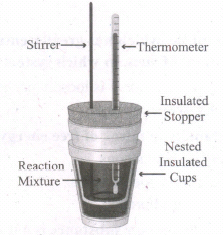
(i) Measurement of heat change at constant pressure can be done in a coffee cup calorimeter.
(ii) We know that \(\Delta H\) = qp (at constant P) and therefore, heat absorbed or evolved, qp at constant pressure is also called the heat of reaction or enthalpy of reaction, \(\Delta H_r.\)
(iii) In an exothermic reaction, heat is evolved, and system loses heat to the surroundings. Therefore, qp will be negative and \(\Delta H_r\)will also be negative.
(iv) Similarly, in an endothermic reaction, heat is absorbed, qp is positive and \(\Delta H_r\) will also be positive.
19.
The required equation is
C(s) + 2S(s) \(\rightarrow\) CS2(l); \(\Delta\)H= ?
Given: C(s) + O2(g) \(\rightarrow\) CO2(g); \(\Delta\)H = -393.3 kJ .....(1)
S(s) + O2(g) \(\rightarrow\) SO2(g); \(\Delta\)H = -293.7 kJ .....(2)
CS2(l) + O2(g) \(\rightarrow\) CO2(g) + SO2(g); \(\Delta\) H = -1108.76 kJ .....(3)
First method: Multiply equation (2) by 2
2S(s) + 2O2(g) \(\rightarrow\) 2SO2(g)\(\rightarrow\) 2SO2 (g); \(\Delta\)H = -587.44
Adding equations (10 and (4) and subtracting (3),
C(s) + 2S(s) + 3O2(g) - CS2(l) - 3O2(g) \(\rightarrow\) CO2(g) + 2SO2(g)- CO2(g) - 2SO2(g)
C(s) + 2S(s) \(\rightarrow\) CS2(l)
Thus,\(\Delta\)Hf = -393.3 - 587.44 + 1108.76 = 128.02 kJ
i.e., standard heat offormation of CS2 is 128.02 kJ
Second method: Standard enthalpy of formation of
CO2 = -393.3 kJ
SO2 = -293.72 kJ
CS2 =?
From the first law of thermodynamics, the standard enthalpy of a compound is equal to the standard enthalpy of formation of the compound and the standard enthalpies of elements is equal to zero.
The equation is CS2(l) + 3SO2(g) \(\rightarrow\) CO2(g) + 2SO2(g); \(\Delta\)H° = -1108.76 kJ
\(\Delta\)H°=\(\sum { H°(products)-\sum { H°(reactants) } } \)
={\(\Delta\)H°f(CO2) + 2H°f(SO2)} - {\(\Delta\)H°f(CS2) + 3H°f(O2)}-1108.76 = {-393.3 + 2 \(\times\) (-296.72)}-\(\Delta\)H°f(CS2)
\(\Delta\)H°f(CS2) =+ 1108.76 - 393.3 - 2 \(\times\)(297.72)
= 1108.76 - 980.74 = 128.02 kJ
\(\therefore\) \(\Delta\)H°f(CS2) = 128.02 kJ mol-1
Bond energies or Bond enthalpies:
The bond dissociation energy of a diatomic molecule is also called bond energy.
When a molecule or a compound contains more than one bond of the same kind, the average value of the dissociation energies of a given bond is taken. This average bond dissociation energy required to break each bond in a compound is called bond energy.
Using bond energy data, heat of reaction is (\(\Delta\) H) can be calculated by using the equation.
\(\Delta H=\sum { B.E\ of\ (reactants)-\sum { B.E\ of\ (products) } } \)
Alternating, of enthalpy change for the reaction and bond energies of all the bonds except one, the bond energy of that bond can be calculated.
20.
ΔHt = 2090 Jmol-1
Tt = 13+273 = 286K
ΔSt = \(\frac { { \triangle H }_{ t } }{ { T }_{ t } } \)
ΔSt = \(\frac { 2090 }{ 286 } \)
ΔSt = 7.307 JK-1mol-1

11th Standard Syllabus & Materials
11th Standard
TN 11th Tamil பீடு பெற நில் - செய்யுள் - காவடிச்சிந்து Important Questions And Answers Study Material - QB365 Set A
NEW11th Standard
TN 11th Tamil பீடு பெற நில் - உரைநடை - மலை இடப்பெயர்கள் : ஓர் ஆய்வு Important Questions And Answers Study Material - QB365 Set A
NEW11th Standard
TN 11th Tamil மாமழை போற்றுதும் - துணைப்பாடம் - யானை டாக்டர் Important Questions And Answers Study Material - QB365 Set A
NEW11th Standard
TN 11th Tamil மாமழை போற்றுதும் - செய்யுள் - ஐங்குறுநூறு Important Questions And Answers Study Material - QB365 Set A



Tamilnadu Stateboard 11th Standard Subjects

Maths

Commerce

Economics

Biology

Business Maths and Statistics

Accountancy

Computer Science

Physics
Chemistry
Maths
Biology
Economics
Physics
Chemistry

History
Business Maths and Statistics

Computer Science
Accountancy

Computer Applications
History
Computer Technology
Commerce
Computer Applications
Computer Technology

Tamil

English

French
Tamilnadu Stateboard Standards
