
 100% FREE ACCESS
11th Standard Syllabus & Materials
11th Standard
TN 11th Tamil இயற்கை வேளாண்மை,சுற்றுச்சூழல் -செய்யுள் - மனோன்மணீயம் Important Questions And Answers Study Material - QB365 Set A
NEW11th Standard
TN 11th Tamil என்னுயிர் என்பேன் -துணைப்பாடம் - இசைத்தமிழர் இருவர் Important Questions And Answers Study Material - QB365 Set A
NEW11th Standard
TN 11th Tamil மொழி கலை -செய்யுள் - ஒவ்வொரு புல்லையும் Important Questions And Answers Study Material - QB365 Set A
NEW11th Standard
TN 11th Tamil பீடு பெற நில் - இலக்கணம் - பகுபத உறுப்புகள் Important Questions And Answers Study Material - QB365 Set A
NEW11th Standard
TN 11th Tamil பீடு பெற நில் - துணைப்பாடம் - வாடிவாசல் Important Questions And Answers Study Material - QB365 Set A
NEW11th Standard
TN 11th Tamil பீடு பெற நில் - செய்யுள் - குறுந்தொகை Important Questions And Answers Study Material - QB365 Set A

Published on: 15/09/2018
Model paper
Download Tamil Nadu 11th Standard Maths question papers, model tests, one-mark questions, important questions, and public exam papers in PDF format. Free study materials and answer keys for TN State Board students.
Questions + Answers key
Take MCQ Maths Test1.
Discuss the following relations for reflexivity, symmetricity and transitivity :
On the set of natural numbers, the relation R is defined by "xRy if x + 2y = 1".
2.
Discuss the following relations for reflexivity, symmetricity and transitivity :
Let A be the set consisting of all the female members of a family. The relation R defined by "aRb if a is not a sister of b".
3.
Discuss the following relations for reflexivity, symmetricity and transitivity:
Let A be the set consisting of all the members of a family. The relation R defined by "aRb if a is not a sister of b".
4.
State whether the following sets are finite or infinite.
{x \(\in \) N:x is a rational number}
5.
State whether the following sets are finite or infinite.
{x \(\in \) R : x is a rational number}
6.
State whether the following sets are finite or infinite.
{x \(\in \) Z : x is even and less than 10}
7.
State whether the following sets are finite or infinite.
{x \(\in \) N : x is an odd prime number}
8.
State whether the following sets are finite or infinite.
{x \(\in \) N : x is an even prime number}
9.
Write the following in roster form {x\(\in \)N : 4x + 9 < 52}
10.
The natural domain of the function \(y=\sqrt{9-x^2}\) is ___________
\(-3\le x \le 3\)
-3
0
\((-\infty, -3)\cup(3,\infty)\)
11.
The number of relations from a set containing 4 elements to a set containing 3 elements is:
216
25
27
212
12.
13.
For non-empty sets A and B, if A ⊂ B then (A \(\times\)B) ⋂ (B \(\times\)A) is equal to
A ⋂ B
A \(\times\)A
B \(\times\)B
none of these.
14.
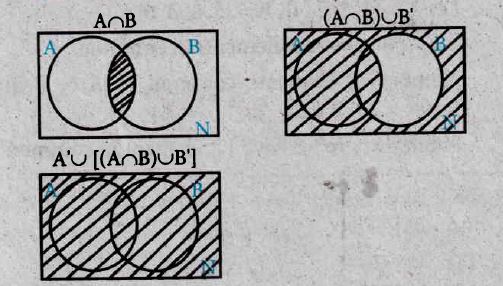
Let A and B be subsets of the universal set N, the set of natural numbers. Then A'∪[(A⋂B)∪B'] is
A
A'
B
N
15.
Let R be the set of all real numbers. Consider the following subsets of the plane R x R: S = {(x, y) : y =x + 1 and 0 < x < 2} and T = {(x,y) : x - y is an integer} Then which of the following is true?
T is an equivalence relation but S is not an equivalence relation
Neither S nor T is an equivalence relation
Both S and T are equivalence relation
S is an equivalence relation but T is not an equivalence relation.
16.
If f(x) = |x - 2| + |x + 2|, x ∈ R, then
\(f(x)=\left\{\begin{array}{lll} -2 x & \text { if } & x \in(-\infty,-2] \\ 4 & \text { if } & x \in(-2,2] \\ 2 x & \text { if } & x \in(2, \infty) \end{array}\right.\)
\(f(x)=\begin{cases}2x\ if\ x∈(-∞,-2] \\4x\ if \ x∈(-2,2]\\ - 2x\ if\ x∈(2,∞)\end{cases}\)
\(f(x)=\begin{cases}-2x\ if\ x∈(-∞,-2] \\-4x\ if \ x∈(-2,2]\\ 2x\ if\ x∈(2,∞)\end{cases}\)
\(f(x)=\begin{cases}-2x\ if\ x∈(-∞,-2] \\2x\ if \ x∈(-2,2]\\ 2x\ if\ x∈(2,∞)\end{cases}\)
17.
If the function f:[-3,3]➝S defined by f(x) = x2 is onto, then S is
[-9,9]
R
[-3,3]
[0,9]
18.
The function f:[0,2π]➝[-1,1] defined by f(x) = sin x is
one-to-one
onto
bijection
cannot be defined
19.
The number of constant functions from a set containing m elements to a set containing n elements is
mn
m
n
m+n
20.
Let X = {a, b, c, d}, and R = {(a, a) (b, b) (a, c)}. Write down the minimum number of ordered pairs to be included to R to make it
(i) reflexive
(ii) symmetric
(iii) transitive
(iv) equivalence
21.
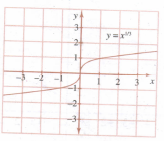
For the given curve, \(y=x^{1\over 3}\)given in figure draw
(i) \(y=-x^{ \left( \frac { 1 }{ 3 } \right) }\)
(ii) \(y=x^{ \left( \frac { 1 }{ 3 } \right) }+1\)
(iii) \(y=x^{ \left( \frac { 1 }{ 3 } \right) }-1\)
(iv) \(y=(x+1)^{1\over 3}\)
22.
Write the steps to obtain the graph of the function y = 3(x-1)2+5 from the graph y = x2
1.
The relation R is defined by xRy if x + 2y = 1 for x, y \(\in \) N.
Reflexivity : Let x, y \(\in \) N
xRx \(\Rightarrow\) x + 2x = 1 \(\Rightarrow\) 3x = 1 \(\Rightarrow\) x = \(\frac { 1 }{ 3 } \notin N\)
\(\therefore\) R is reflexive.
Symmetricity: xRy \(\Rightarrow\) yRx for x, y \(\in \) N
xRy \(\Rightarrow\) x + 2y = 1 which is not possible for any values of x, Y \(\in \) N
\(\therefore\) R is not symmetric
Transitivity: xRy and yRz \(\Rightarrow\) xRz.
xRy and yRz are not possible for any values of x, y, z \(\in \) N
\(\therefore\) R is not transitive.
\(\therefore\) R is neither reflexive, nor symmetric and not transitive.
2.
Given relation is aRb if a is not a sister of b.
Let a, b, C \(\in \) A.
Reflexivity : aRa \(\Rightarrow\) a is not a sister of a
\(\therefore\) R is reflexive.
Symmetricity: aRb \(\Rightarrow\) bRa
a is not a sister of b \(\Rightarrow\) b is not a sister of a.
\(\therefore\) R is symmetric.
Transitivity : aRb and bRc \(\Rightarrow\) aRC
a is not a sister of b, b is not a sister of C [Eg : Mother is not a sister of daughter, daughter is not a sister of chithi, but mother is a sister of chithi.]
\(\Rightarrow\) a is a sister of C.
\(\therefore\) R is not transitive.
\(\therefore\) R is reflexive, symmetric but not transitive.
3.
Given relation is "aRb if a is not a sister of b". and a, b, c \(\in \) A.
Reflexivity: aRa \(\Rightarrow\) a is not a sister of a
\(\therefore\) R is reflexive.
Symmetric : aRb \(\Rightarrow\) bRa
a is not a sister of b \(\Rightarrow\) b is not a sister of a
\(\therefore\) R is not symmetric.
Transitivity: aRb and bRC \(\Rightarrow\) aRC
a is not a sister of b and b is not a sister of C. [Eg : Mother is not a sister of daughter, daughter is not a sister of chithi, but mother is a sister of chithi.]
\(\Rightarrow\) a is not a sister of C.
\(\therefore\) R is not transitive.
4.
Let N = {x \(\in \) N: x is a rational number}
\(\Rightarrow N=\left\{ \frac { 1 }{ 1 } ,\frac { 2 }{ 1 } ,\frac { 3 }{ 1 } ,\frac { 4 }{ 1 } ,....\infty \right\} \)
\(\Rightarrow\) N is an infinite set.
5.
Let D = {x \(\in \) R : x is a rational number}
\(\Rightarrow\) D = {set of all rational numbers}
\(\Rightarrow\) D is an infinite set.
6.
Let C = {x \(\in \) Z : x is even and < 10}
\(\Rightarrow\) C = {2, 4, 6, 8}
\(\Rightarrow\) C is a finite set.
7.
Let B = {x\(\in \)N : x is an odd prime number}
\(\Rightarrow\) B = {3, 5, 7, 11, .......}
\(\Rightarrow\) B is an infinite set.
8.
Let A = { x \(\in \) N: x is an even prime number}
\(\Rightarrow\) A = {2}
\(\Rightarrow\) A is a finite set.
9.
{x \(\in \) N : 4x + 9 < 52}
Let C = {x\(\in \)N:4x + 9 < 52}
\(\Rightarrow\) C = {x\(\in \)N:4x < 52 - 9}
\(\Rightarrow\) C = {x\(\in \)N: 4x < 43}
\(\Rightarrow\) C = \(\left\{ x\in N:x<\frac { 43 }{ 4 } \right\} \) \(\Rightarrow\) C = {x \(\in \) N : x < 10.75}
\(\Rightarrow\) C = {1,2,3,4,5,6,7,8,9,10}.
10.
(a)
\(-3\le x \le 3\)
11.
(d)
212
12.
(c)
13.
Let A = (a, b),B = (a,b,c)
A \(\times\)B = {(a, a), (a, b), (a, c), (b, a), (b, b), (b, c)}
B \(\times\)A = {(a, a),(a, b), (b, a), (b, b), (c, a),(c, b)}
(A \(\times\)B) ⋂ (B \(\times\)A) = {(a, a), (a,b), (b, a): (b, b)}
= A \(\times\)A
14.
15.
\(\mathrm{T}: x-y \text { is an integer } \Rightarrow x \mathrm{R} y\)
\(\text { i) } x-x=0 \text { is an integer }\)
\(\therefore \text { T is reflexive. }\)
\(\text { ii) }(x-y) \text { is an integer } \Rightarrow y-x \text { is also an integer }\)
\(\therefore \mathrm{T} \text { is symmetry }\)
iii) If (x - y) is an integer and y- z is also an integer, by adding
x - z is also an integer.
\(\therefore \mathrm{T} \text { is transitive }\)
Thus, T is an equivalence relation.
\(\mathrm{S}: \mathrm{y}=x+1 \Rightarrow x \mathrm{~S} y\)
\(\text { i) } x=x+1 \Rightarrow x S x \text { is not true. }\)
\(\therefore S \text { is not reflexive. }\)
Hence T is an equivalence relation but S is not an equivalence relation
16.
\(\text { If } x \in(-\infty,-2), \text { Let } x=-3\)
\(\text { then } f(x)=|-5|+|1|=6=-2 x\)
\(\text { If } x \in(-2,-2), \text { Let } x=0 \text { then }\)
\(f(x)=|0-2|+|0+2|=4\)
\(\text { If } x \in(2, \infty), \text { Let } x=4\)
\(\text { then } f^{}(x)=|2|+|6|=8=2 x\)
\(\therefore \mathrm{f}(x)=\left\{\begin{array}{rl} -2 x & x \in(-\infty,-2] \\ 4 & x \in(-2,2] \\ 2 x & x \in(2, \infty) \end{array}\right.\)
17.
f(0) = 0, f(-3) = 9 and f(3) = 9
.'. S is [0,9]
18.
It is onto not one-one
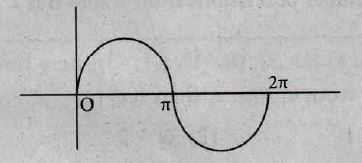
\(\text { Since } \sin 30^{\circ}=\frac{1}{2}\)
\(\sin 150^{\circ}=\frac{1}{2}\)
19.
(c)
n
20.
X = {a, b, c, d}
R = {(a, a), (b, b), (a, c)}
(i) To make R reflexive we need to include (c, c) and (d, d)
(ii) To make R symmetric we need to include (c, a)
(iii) R is transitive
(iv) To make R reflexive we need to include (c, c)
To make R symmetric we need to include (c, c) and (c, a) for transitive
∴ The relation now becomes
R = {(a, a), (b, b), (a, c), (c, c), (c, a)}
∴ R is equivalence relation.
21.
(i) \(y=-x^{ \left( \frac { 1 }{ 3 } \right) }\)
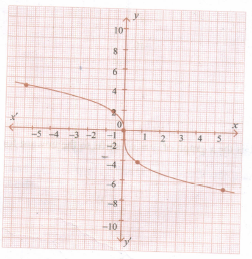
\(Let \ y=-x^{ ^{ \frac { 1 }{ 3 } } }\)
\(Then \ y=-x^{ ^{ \frac { 1 }{ 3 } } }\) is the reflection of the graph of \(y=x^{ ^{ \frac { 1 }{ 3 } } }\) about the x-axis.
(ii) \(y=x^{1\over 3}+1\)
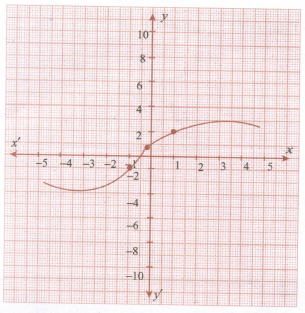
Let \(y=x^{ ^{ \frac { 1 }{ 3 } } }\)
Then \(y=x^{ ^{ \frac { 1 }{ 3 } } }+1\) is the x graph of \(y=x^{ ^{ \frac { 1 }{ 3 } } }\) shifts to the upward for one unit
(iii) \(y=x^{1\over 3}-1\)
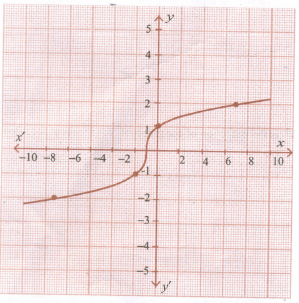
Let \(y=x^{1\over 3}\)
Then \(y=x^{1\over 3}\)-1 is the graph of \(x^{ ^{ \frac { 1 }{ 3 } } }\) shifts to the downward for one unit.
(iv) \(y=(x+1)^{1\over 3}\)
| x | 0 | 1 | 7 | -9 |
| y | 1 | 1 | 2 | -2 |
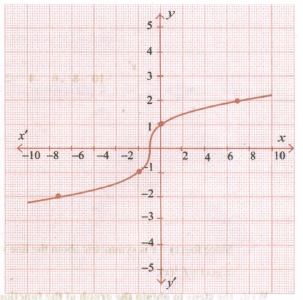
\(y=(x+1)^{1\over 3}\) causes the graph of \({x}^{\frac{1}{3}}\), shifts to the left for one unit.
22.
Step 1 :
Draw the Graph of y = x2
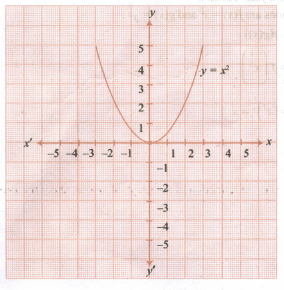
Step 2 :
The graph of y =(x -1)2, shifts to the right for one unit.
Step 3 :
The graph of y = 3 (x - 1)2, compresses towards the Y-axis that is moves away from the X-axis since the multiplying factor is 3 which is greater than 1.
Step 4:
The graph of y = 3 (x - 1)2+ 5, causes the shift to the upward for 5 units.

11th Standard Syllabus & Materials
11th Standard
TN 11th Tamil பீடு பெற நில் - செய்யுள் - காவடிச்சிந்து Important Questions And Answers Study Material - QB365 Set A
NEW11th Standard
TN 11th Tamil பீடு பெற நில் - உரைநடை - மலை இடப்பெயர்கள் : ஓர் ஆய்வு Important Questions And Answers Study Material - QB365 Set A
NEW11th Standard
TN 11th Tamil மாமழை போற்றுதும் - துணைப்பாடம் - யானை டாக்டர் Important Questions And Answers Study Material - QB365 Set A
NEW11th Standard
TN 11th Tamil மாமழை போற்றுதும் - செய்யுள் - ஐங்குறுநூறு Important Questions And Answers Study Material - QB365 Set A



Tamilnadu Stateboard 11th Standard Subjects
Maths

Commerce

Economics

Biology

Business Maths and Statistics

Accountancy

Computer Science

Physics

Chemistry
Maths
Biology
Economics
Physics
Chemistry

History
Business Maths and Statistics

Computer Science
Accountancy

Computer Applications
History
Computer Technology
Commerce
Computer Applications
Computer Technology

Tamil

English

French
Tamilnadu Stateboard Standards

