
 100% FREE ACCESS
11th Standard Syllabus & Materials
11th Standard
TN 11th Tamil இயற்கை வேளாண்மை,சுற்றுச்சூழல் -செய்யுள் - மனோன்மணீயம் Important Questions And Answers Study Material - QB365 Set A
NEW11th Standard
TN 11th Tamil என்னுயிர் என்பேன் -துணைப்பாடம் - இசைத்தமிழர் இருவர் Important Questions And Answers Study Material - QB365 Set A
NEW11th Standard
TN 11th Tamil மொழி கலை -செய்யுள் - ஒவ்வொரு புல்லையும் Important Questions And Answers Study Material - QB365 Set A
NEW11th Standard
TN 11th Tamil பீடு பெற நில் - இலக்கணம் - பகுபத உறுப்புகள் Important Questions And Answers Study Material - QB365 Set A
NEW11th Standard
TN 11th Tamil பீடு பெற நில் - துணைப்பாடம் - வாடிவாசல் Important Questions And Answers Study Material - QB365 Set A
NEW11th Standard
TN 11th Tamil பீடு பெற நில் - செய்யுள் - குறுந்தொகை Important Questions And Answers Study Material - QB365 Set A

Published on: 04/09/2019
Zoology - Tissue Level of Organisation
Download Tamil Nadu 11th Standard Biology question papers, model tests, one-mark questions, important questions, and public exam papers in PDF format. Free study materials and answer keys for TN State Board students.
Questions + Answers key
Take MCQ Biology Test1.
2.
Prevention of substances from leaking across the tissue is provided by ______.
Tight junction
Adhering junction
Gap junction
Elastic junction
3.
What type of fibres are found in connective tissue matrix?
Collagen
Areolar
Cartilage
Tubular
4.
The ciliated epithelium lines the _______.
Skin
Digestive tract
Gall bladder
Trachea
5.
6.
Why blood is considered as a typical connective tissue?
7.
8.
9.
What is an epithelium? Enumerate the characteristic features of different epithelia.
10.
Write the classification of connective tissue and their functions.
11.
1.
(b)
2.
(a)
Tight junction
3.
(a)
Collagen
4.
(d)
Trachea
5.
(d)
6.
(i) Blood is a typical fluid connective tissue because it functions as the transport medium for the cardiovascular system.
(ii) Eg: Transport of nutrients and wastes and transport of respiratory gases throughout the body.
7.
8.
9.
Epithelium:
A grouped sheet of cells which covers the body surface or lines the body cavity forming epithelial tissues constitute epithelium.
Characteristic features of different epithelia
(1) Simple epithelium:
(a) Common Features:-
(i) It is composed of a single layer of cells (uniseriate).
(ii) This cells are found in the organs of absorption, secretion and filtration. It is further classified into
(A) Squamous epithelium
Features:-
(1) flattened cells form a thin single layer
(i) Formed layer has irregular boundaries
(ii) It is located in kidney glomeruli, alveoli/air sacs of lungs, lining of heart, blood vessels and lymphatic vessels.
Function:-
(i) Involved in functions like forming a diffusion boundary and filtration in sites where protection is unimportant.
(B) Cuboidal epithelium
Features:-
(i) Cube like cells form a single layer.
(ii) It is found in kidney tubules, ducts and secretory parts of small glands and surface of the ovary.
Function:-
It promotes secretion and absorption.
(C) Columnar epithelium
Features:-
(i) Tall pillar like cells form a single layer.
(ii) Nuclei are round or oval shaped located at the base of the cytoplasm.
(iii) It lines the digestive tract from the stomach to rectum (gastro intestinal tract).
(iv) Its lining shows two types of modifications.
(a) Cells show microvilli at their apical surfaces for absorption.
(b) Goblet cells secrete the protective lubricating mucus.
Functions:-
(i) Absorption, secretion of mucus, enzymes and other substances.
(ii) Ciliated type propels mucus by ciliary actions which is found on lining of small bronchioles, fallopian tubes and uterus.
(iii) Non-ciliated type lines most of the digestive tract, gall bladder and secretory ducts of glands for secretion.
(D) Pseudo- stratified epithelium
(i) Unequal sized columnar cells form a single layer.
(ii) It is naturally single layered but appears to be multilayered due to the various locations of nuclei in cytoplasm.
Function:-
(i) Protection, secretion and absorption.
(ii) Ciliated forms line the trachea and the upper respiratory tract for the passage of air.
(iii) Non-ciliated forms line the epididymis, large ducts of glands and tracts of male urethra for secretion and protection.
(2) Compound Epithelium
Common Features:-
Glandular epithelium
(i) Specialized cuboidal and columnar cells constitute glandular epithelium for secretion.
(ii) Stratified epithelia are built for protection or to resist abrasion.
Types
(a) Unicellular:-
Eg: isolated glandular cells like goblet cells of alimentary canal.
(b) Multi cellular:-
Eg: Cluster of cells found in salivary glands.
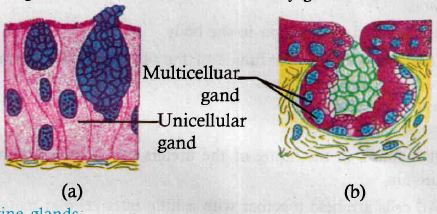
Exocrine glands
(i) Glands with ducts secrete mucus, saliva, ear wax, oil, milk, digestive enzymes and other cellular products.
Other features and functions of compound epithelium.
(i) Has a limited role in secretion and absorption.
(ii) It may be striated and transitional.
(iii) Cells form many layers (Strata).
Main functions:
(i) To provide protection against mechanical and chemical stresses.
(ii) Covers the dry surface of the skin, the moist surface of buccal cavity, pharynx, inner lining of salivary glands and pancreatic ducts.
Types:
There are four types
(a) Stratified squamous epithelium
(b) Stratified cuboidal epithelium
(c) Stratified columnar epithelium
(d) Transitional epithelium
(a) Stratified squamous epithelium Features:
Divisible into two types
(i) Keratinized
(ii) Non-keratinized
Functions:
(i) Keratinized:- forms the dry epidermis of the skin
(ii) Non- keratinized:- forms the moist lining of the oesophagus, mouth, conjunctiva of eyes and vagina.
(b) Stratified cuboidal epithelium:
Features:
(i) Cells are cubical forming multilayers mostly found in the ducts of sweat and mammary glands.
Function
(ii) Aids in protecting and promoting sweating and lactation.
(c) Stratified columnar epithelium Features:
(i) Has limited distribution in the body.
(ii) It is found around the lumen of the pharynx, male urethra and lining of some glandular ducts.
(d) Transitional epithelium Features:
(i) It is found in the lining of the ureters, urinary bladder and a part of urethra.
(ii) All cells are held together with a little inter cellular material.
(iii) There are specialised junctions link between the structural and functional activities between its individual cells.
| S.No. | Types of junctions | Functions |
| (1) | Tight junctions | Help to stop substances from leaking across a tissue |
| (2) | Adhering junctions | Perform cementing to keep neighbouring cells together |
| (3) | Gap junctions | Facilitate the cells to communicate with each other by connecting the cytoplasm of adjoining cells for rapid transfer of ions, many small molecules and some big molecules. |
10.
Classification of connective tissue and their functions Introduction:
(i) Connective tissue develops from the middle layer called mesoderm.
(ii) It is widely distributed in the body.
(iii) This tissue includes four classes.
(iv) The connective tissue includes fats and fibrous tissues
Four main classes are
i. Cartilage
ii. Bones
iii. Blood
iv. Other minor connective tissues
Components:
Main components are of three types, they are
1. Fibres
2. Ground substance or matrix
3. Cells
(i) Three fibres provide support in the matrix, they are collagen, elastic and reticular fibres.
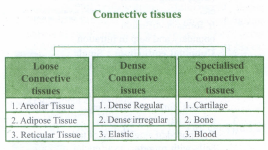
(ii) Main types of connective tissue are of three types
A) loose connective tissue
B) Dense connective tissue
C) Specialized connective tissue.
(A) Loose connective tissue:
(i) This tissue includes Areolar, Adipose and Reticular tissue.
(ii) Cells and fibres are loosely arranged in a semi fluid matrix.
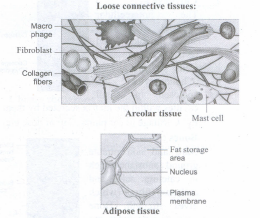
(i) Areolar tissue
(i) It acts as a support frame work for epithelium
(ii) It also acts as a reservoir of water and salts for the surrounding body tissues hence it is aptly called as tissue fluid.
(iii) It is a binding tissue.
(iv) Fibroblasts, macrophages and mast cells are its inclusions.
(ii) Adipose tissue
(i) It is found below the skin.
(ii) Cells are called as 'fat cells' or adipocytes.
(iii) 90% of this tissue mass is rich in fats.
(iv) This tissue stores fats which are unutilized nutrients for the metabolism of the body.
(v) This tissue is richly vascularised to exhibit high metabolic activity.
(vi) Under starvation this tissue provides fuel as energy rich substance.
(vii) It is found surrounding the kidneys, eyeball, heart, etc.
Divisions
(a) White fat or white adipose tissue: Cells contain less mitochondria, stores fat.
(b) Brown fat or Brown adipose tissue: Cells contain more mitochondria, oxidise fats to release heat energy (it is called as non-shivering thermogenesis)
(iii) Reticular:
(i) It forms an internal frame work (stroma) that supports the blood cells like lymphocytes in the lymph nodes, spleen and bone marrow.
(B) Dense connective tissue
(i) Fibres and fibroblasts are compactly packed
(ii) Divisible into i) Regular ii) Irregular iii) Elastic
i) Dense regular connective tissue:
(i) Regular type mainly contains collagen fibres in rows between parallel bundles of tissues.
(ii) It contains few elastic fibres.
(iii) Its major cell type is fibroblast which attaches to muscles.
(iv) It also withstands great tensile stress when pulling force is applied in one direction.
(v) It is found in tendon (bone and muscle are connected) and ligament (bone and bone are connected).
ii) Dense irregular connective tissue:
(i) Irregular type contains thick collagen fibres and the major cell type is fibroblast.
(ii) It is able to withstand tension exerted in many directions.
(iii) It provides structural strength.
(iv) Its elastic fibres are found in the leathery dermis
(v) It forms fibrous capsules of organs like kidneys, bones, cartilages, muscles, nerves and joints
iii) Elastic connective tissue:
(i) Elastic connective tissue consists of bulk of elastic fibres
(ii) It permits recoil of tissues following stretching.
(iii) It maintains the pulsatile flow of blood through the arteries and the passive recoil of lungs following inspiration.
(iv) It is found in the walls of large arteries, ligaments associated with vertebral column and within the walls of the bronchial tubes.
(C) Specialised connective tissues
(i) Classified into 1) Cartilage 2) Bones 3) Blood
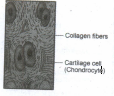
(i) Cartilage:
(i) It is solid and found as inter cellular material and it is pliable.
(ii) It resists compression.
(iii) Cells are chondrocytes found in the small cavities of matrix.
(iv) Chondrocytes secrete matrix.
(v) Found in vertebrate embryos and then it is replaced by bones in adults.
(vi) It is found in the tip of nose, outer ear joints, external ear pinna, between adjacent bones of vertebral column, limbs and hands in adults.
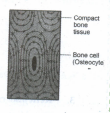
(ii) Bones:
(i) A hard and non-pliable matrix rich in calcium salts and collagen fibres.
(ii) Calcium salts strengthen the bones and teeth.
(iii) Collagen fibres give mechanical strength.
(iv) It mainly provides structural frame to the body
(v) Bones support and protect the soft tissues of visceral organs.
(vi) Osteocytes are bone cells found in the spaces called lacunae.
(vii) Bear the weight of the long bones of legs.
(viii) Bones interact with the skeletal muscles to bring about movements.
(ix) Bone marrow is the site of production of blood cells.
(iii) Blood:
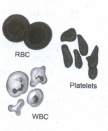
(i) It is a fluid connective tissue found with plasma, red blood cells, white blood cells and platelets.
(ii) It is a transportary medium of cardio vascular system.
(iii) It carries nutrients, wastes respiratory gases like O2 and CO2 throughout the body.
11.

11th Standard Syllabus & Materials
11th Standard
TN 11th Tamil பீடு பெற நில் - செய்யுள் - காவடிச்சிந்து Important Questions And Answers Study Material - QB365 Set A
NEW11th Standard
TN 11th Tamil பீடு பெற நில் - உரைநடை - மலை இடப்பெயர்கள் : ஓர் ஆய்வு Important Questions And Answers Study Material - QB365 Set A
NEW11th Standard
TN 11th Tamil மாமழை போற்றுதும் - துணைப்பாடம் - யானை டாக்டர் Important Questions And Answers Study Material - QB365 Set A
NEW11th Standard
TN 11th Tamil மாமழை போற்றுதும் - செய்யுள் - ஐங்குறுநூறு Important Questions And Answers Study Material - QB365 Set A



Tamilnadu Stateboard 11th Standard Subjects

Maths

Commerce

Economics
Biology

Business Maths and Statistics

Accountancy

Computer Science

Physics

Chemistry
Maths
Biology
Economics
Physics
Chemistry

History
Business Maths and Statistics

Computer Science
Accountancy

Computer Applications
History
Computer Technology
Commerce
Computer Applications
Computer Technology

Tamil

English

French
Tamilnadu Stateboard Standards

