
 100% FREE ACCESS
11th Standard Syllabus & Materials
11th Standard
TN 11th Tamil இயற்கை வேளாண்மை,சுற்றுச்சூழல் -செய்யுள் - மனோன்மணீயம் Important Questions And Answers Study Material - QB365 Set A
NEW11th Standard
TN 11th Tamil என்னுயிர் என்பேன் -துணைப்பாடம் - இசைத்தமிழர் இருவர் Important Questions And Answers Study Material - QB365 Set A
NEW11th Standard
TN 11th Tamil மொழி கலை -செய்யுள் - ஒவ்வொரு புல்லையும் Important Questions And Answers Study Material - QB365 Set A
NEW11th Standard
TN 11th Tamil பீடு பெற நில் - இலக்கணம் - பகுபத உறுப்புகள் Important Questions And Answers Study Material - QB365 Set A
NEW11th Standard
TN 11th Tamil பீடு பெற நில் - துணைப்பாடம் - வாடிவாசல் Important Questions And Answers Study Material - QB365 Set A
NEW11th Standard
TN 11th Tamil பீடு பெற நில் - செய்யுள் - குறுந்தொகை Important Questions And Answers Study Material - QB365 Set A

Published on: 15/02/2019
Vegetative Morphology Important Questions
Download Tamil Nadu 11th Standard Biology question papers, model tests, one-mark questions, important questions, and public exam papers in PDF format. Free study materials and answer keys for TN State Board students.
Questions + Answers key
Take MCQ Biology Test1.
Prop root is seen in __________.
Banyan
Mango
Neem
Coconut
2.
Plants grow on land is called ________.
Aquatic
Amphibian
Terrestrial
Both a & b
3.
Fibrous root in ficus benghalensis develop from __________
stem
node
internode
none of the above
4.
Match the following:
| (i) Conical root | (a) Mechanical support |
| (ii) Tuberous root | (b) Orchids |
| (iii) Climbing root | (c) Food storage |
| (iv) Epiphytic root | (d) Daucus carota |
(i)-(d), (ii)-(b), (iii)-(a), (iv)-(c)
(i)-(d), (ii)-(c), (iii)-(a), (iv)-(b)
(i)-(b), (ii)-(a), (iii)-(d), (iv)-(c)
(i)-(b), (ii)-(c), (iii)-(a), (iv)-(d)
5.
Bulbophyllum is an example for ____
Rhizome
Bulb
Pseudobulb
Tuber
6.
Stilt roots are seen in _____
Zea mays
Delonix regia
Begonia
Ficus
7.
Roots that grow from any part of the plant body other than the radicle are called _____
Tap root
Adventitious root
Modified roots
Aerial roots
8.
The stem is modified to cladode and leaves are modified as scales in ____
Lily
Opuntia
Asparagus
Gloriosa
9.
In Nymphaea the stem is a ___________
rhizome
bulb
tuber
corm
10.
Roots are ______.
Descending, negatively geotrophic, positively phototropic
Descending, positively geotrophic, negatively phototrophic
Ascending, positively geotrophic, negatively phototrophic
Ascending, negatively geotrophic, positively phototrophic
11.
What is meant by Liana?
12.
Mention the modifications of Rhizome.
13.
Explain about Terrestrial plants.
14.
Write any two characteristic features of the stem.
15.
What is primary root?
16.
Tabulate terrestrial habitat with examples.
17.
What is plant morphology? Explain the types of morphology.
18.
What is pulvinus?
19.
How are buds classified?
20.
What are Stilt / Brace roots?
21.
How is the duration of leaf determined? Classify leaves according to duration.
22.
Compare the location, cellular types and the functions of different zones of root.
23.
What are the vital functions of root? Explain each function with suitable example.
1.
(a)
Banyan
2.
(c)
Terrestrial
3.
(a)
stem
4.
(b)
(i)-(d), (ii)-(c), (iii)-(a), (iv)-(b)
5.
(c)
Pseudobulb
6.
(a)
Zea mays
7.
(b)
Adventitious root
8.
(c)
Asparagus
9.
(a)
rhizome
10.
(b)
Descending, positively geotrophic, negatively phototrophic
11.
Liana is a vine that is perennial and woody. Liana's are major components in the tree canopy layer of some tropical forests. Example: Venti/ago, Entada, Bougainvillea.
12.
i) This is a underground stem grows horizontally with several lateral growing tips.
ii) Rhizome posses conspiquous nodes and internodes covered by scale leaves.
Example: Zingiber officinaIe, Canna, Curcuma longa, Maranta arundinacea, Nymphaea, Nelumbo.
13.
Plants growing on land are called terrestrial plants. The following table illustrate the types of terrestrial plants classified based on their environmental adaptation.
14.
1. Stem is positively phototropic and negatively geotropic.
2. Stem has well-developed nodes and internodes.
15.
Primary root is direct prolongation of the radicle. In most dicots it persists and forms the main root of the plant or tap root forming the tap root system.
16.
| Terrestrial habitat | ||
| Types | Nature of environmental adaptation | Example |
| Mesophytes | Growing in soils with sufficient water | Azadirachta indica |
| Xerophytes | Growing on dry habitats | Opuntia, Euphorbia |
| Psammophytes | Growing on sand | Ipomoea pes-caprae, Spinifex littoralis |
| Lithophytes | Growing on rock | Many algae and lichens, Ficus spp |
17.
The study of various external features of the organism is known as morphology. Plant morphology also known as external morphology deals with the study of shape, size and structure of plants and their parts (roots, stems, leaves, flowers, fruits and seeds). Study of morphology is important in taxonomy. Morphological features are important in determining productivity of crops. Morphological characters indicate the specific habitats of living as well as the fossil plants and help to correlate the distribution in space and time of fossil plants. Morphological features are also significant for phylogeny.
Plant Morphology can be studied under two broad categories:
(i) Vegetative morphology - It includes shoot system and root system.
(ii) Reproductive morphology - It includes Flower / inflorescence, Fruit and Seed.
18.
In legumes, leaf base becomes broad, thick and swollen which is known as pulvinus. Eg: Clitoria, Lablab
19.
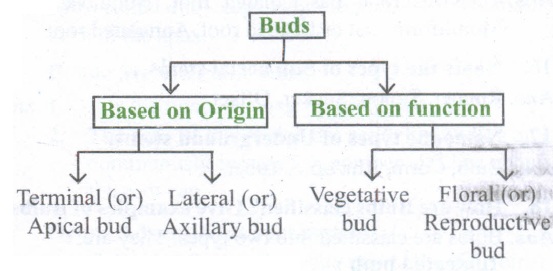
20.
These are thick roots growing obliquely from the basal nodes of the main stem. These provide mechanical support. Eg: Saccharum officinarum, Zea mays.
21.
Leaves may stay and function for few days to many years, largely determined *y the adaptations to climatic conditions. Cauducuous (Fagaceous): Falling off soon after formation. e.g., Opuntia and Cissus quadrangularis.
Deciduous: FaIling at the end of growing season so that the plant (tree or shrub) is leafless in winter/summer season. e.g., Maple, Plumeria, Launea and Erythrina. Evergreen: Leaves persist throughout the year, falling regularly so that tree is never leafless. e.g., Mimusops and Calophyllum. Marcescent: Leaves not falling but withering on the plant as in several members of Fagaceae.
22.
| S.No | Feature | Meristematic Zone | Zone of elongation | Zone of maturation |
| 1 | Position | It lies just above the root cap | It lies just above the meristematic zone | It lies above the zone of elongation. |
| 2 | Types of cells | Meristematic cells, actively divide and continuously increase a number |
Elongated cells | Mature differentiated cells |
| 3 | Functions | This is the main growing tip of the root | The cells increase the length and cause enlargement of the root. | The cells differentiate into various tissues like epidermis, cortex and vascular bundles. It also produces root hairs which absorb water and minerals from the soil |
23.
Epiphytic or velamen root: Some epiphytic orchids develop a special kind of aerial roots which hang freely in the air. These roots develop a spongy tissue called velamen which helps in absorption of moisture from the surrounding air. eg. Vanda, Dendrobium, Aerides.
Foliar root: Roots are produced from the veins or lamina of the leaf for the formation of new plant. eg. Bryophyllum, Begonia, Zamioculcas.
Sucking or Haustorial roots: These roots are found. in parasitic plants. Parasites develop adventitious roots from stem which penetrate into the tissue of the host plant and suck nutrients. eg. Cuscuta (dodder), Cassytha, Orobanche (broomrape), Viscum(mistletoe), Dendrophthoe.
Photosynthetic or assimilatory roots: Roots of some climbing or epiphytic plants develop chlorophyll and turn green which help in photosynthesis. eg. Tinospora, Trapa natans (water chestnut), Taeniophyllum.

11th Standard Syllabus & Materials
11th Standard
TN 11th Tamil பீடு பெற நில் - செய்யுள் - காவடிச்சிந்து Important Questions And Answers Study Material - QB365 Set A
NEW11th Standard
TN 11th Tamil பீடு பெற நில் - உரைநடை - மலை இடப்பெயர்கள் : ஓர் ஆய்வு Important Questions And Answers Study Material - QB365 Set A
NEW11th Standard
TN 11th Tamil மாமழை போற்றுதும் - துணைப்பாடம் - யானை டாக்டர் Important Questions And Answers Study Material - QB365 Set A
NEW11th Standard
TN 11th Tamil மாமழை போற்றுதும் - செய்யுள் - ஐங்குறுநூறு Important Questions And Answers Study Material - QB365 Set A



Tamilnadu Stateboard 11th Standard Subjects

Maths

Commerce

Economics
Biology

Business Maths and Statistics

Accountancy

Computer Science

Physics

Chemistry
Maths
Biology
Economics
Physics
Chemistry

History
Business Maths and Statistics

Computer Science
Accountancy

Computer Applications
History
Computer Technology
Commerce
Computer Applications
Computer Technology

Tamil

English

French
Tamilnadu Stateboard Standards

