
 100% FREE ACCESS
11th Standard Syllabus & Materials
11th Standard
TN 11th Tamil இயற்கை வேளாண்மை,சுற்றுச்சூழல் -செய்யுள் - மனோன்மணீயம் Important Questions And Answers Study Material - QB365 Set A
NEW11th Standard
TN 11th Tamil என்னுயிர் என்பேன் -துணைப்பாடம் - இசைத்தமிழர் இருவர் Important Questions And Answers Study Material - QB365 Set A
NEW11th Standard
TN 11th Tamil மொழி கலை -செய்யுள் - ஒவ்வொரு புல்லையும் Important Questions And Answers Study Material - QB365 Set A
NEW11th Standard
TN 11th Tamil பீடு பெற நில் - இலக்கணம் - பகுபத உறுப்புகள் Important Questions And Answers Study Material - QB365 Set A
NEW11th Standard
TN 11th Tamil பீடு பெற நில் - துணைப்பாடம் - வாடிவாசல் Important Questions And Answers Study Material - QB365 Set A
NEW11th Standard
TN 11th Tamil பீடு பெற நில் - செய்யுள் - குறுந்தொகை Important Questions And Answers Study Material - QB365 Set A

Published on: 14/12/2018
HSC Board Exams are fast approaching and students are getting anxious about how to prepare for their HSC Board Exams. This question paper exclusively designed for the chapter Oscillations from plus one Physics. The latest sample papers have been designed as per the latest syllabus and examination trends.
Now you can use this model question paper for 11th Physics to practice on your own and score more on your board exams. By practicing with this important model question paper from the chapter Oscillations from plus one Physics, students can gain more knowledge and confidence to crack the exams. Our aim is to bring out the best scores on board exams. Creative questions were added in this question paper in order to enhance the student's knowledge and get the idea that how to answer strategic questions asked in the board exams.
By practicing repeatedly you will get the idea of answering the questions and this improves the speed of answering. This will save the time and you can complete all the questions without any tension. Get more model question papers and practice for the board examination.
It's the right time to grab the model question papers on chapter wise and practice for the board exams. This question paper is designed based on the academic syllabus. It will be more helpful for the Matriculation and state board students to prepare for their exams. The best way to prepare exams is to simply do one thing at a time. Using the model question papers, every student can get an idea about the exam questions in a subject wise and collect more information to score high marks on the board.
Download Tamil Nadu 11th Standard Physics question papers, model tests, one-mark questions, important questions, and public exam papers in PDF format. Free study materials and answer keys for TN State Board students.
Questions + Answers key
Take MCQ Physics Test1.
Why the amplitude of the vibrating pendulum should be small?
2.
A piece of wood of mass m is floating erect in a liquid whose density is ρ. If it is slightly pressed down and released, then executes simple harmonic motion. Show that its time period of oscillation is \(T=2 \pi \sqrt{\frac{m}{A g \rho}}\)
3.
Define frequency of simple harmonic motion.
4.
Write down the kinetic energy and total energy expressions in terms of linear momentum, For one-dimensional case.
5.
A mass m moves with a speed v on a horizontal smooth surface and collides with a nearly massless spring whose spring constant is k. If the mass stops after collision, compute the maximum compression of the spring.
6.
Calculate the amplitude, angular frequency, frequency, time period and initial phase for the simple harmonic oscillation given below
a. y = 0.3 sin (40\(\pi\)t + 1.1)
b. y = 2 cos (\(\pi\)t)
c. y = 3 sin (2\(\pi\)t − 1.5)
7.
A small body of mass 50 g is undergoing SHM of amplitude 100 cm and period 0.2 s. What is the maximum value of the force acting on the body?
86.4 N
98.5 N
102.1 N
71.2 N
8.
A body of mass 1 kg is executing SHM given by, x = 4 Cos\(\left( 100t+\frac { \pi }{ 2 } \right) \)cm. Whatis the velocity?
200 sin t(100 t+\(\frac{\pi}{2}\))
-200 sin t(100 t+\(\frac{\pi}{2}\))
400 sin t(100 t+\(\frac{\pi}{2}\))
-400 sin t(100 t+\(\frac{\pi}{2}\))
9.
When the maximum k.E of a simple pendulum is k, then what is its displacement in terms of amplitude a when its K.E. is k/2 ____________.
a/\(\sqrt{2}\)
a/2
a/\(\sqrt{3}\)
a/3
10.
The simple harmonic motions are respresented by the equation. y1 = 0.1 sin (100πt + π/3) & Y2= 0.1 cos π the phase difference of the velocity of particle is _________________.
-\(\frac { \pi }{ 6 } \)
\(\frac { \pi }{ 3 } \)
-\(\frac { \pi }{ 6 } \)
\(\frac { \pi }{ 6 } \)
11.
The x-t graph of a particle undergoing simple harmonic motion is shown. The acceleration of the particle at t =\(\frac{4}{3}\) is ______________.
\(\frac { \sqrt { 3 } }{ 32 } \pi \) cm/s2
\(\frac { -{ \pi }^{ 2 } }{ 32 } \) cm/s2
\(\frac { { \pi }^{ 2 } }{ 32 } \) cm/s2
\(\frac { -\sqrt { 3 } }{ 32 } \)
12.
A mass of 3 kg is attached at the end of a spring moves with simple harmonic motion on a horizontal frictionless table with time period 2π and with amplitude of 2m, then the maximum fore exerted on the spring is
1.5 N
3 N
6 N
12 N
13.
When a damped harmonic oscillator completes 100 oscillations, its amplitude is reduced to \(\frac{1}{3}\) of its initial value. What will be its amplitude when it completes 200 oscillations?
\(\frac{1}{5}\)
\(\frac{2}{3}\)
\(\frac{1}{6}\)
\(\frac{1}{9}\)
14.
A hollow sphere is filled with water. It is hung by a long thread. As the water flows out of a hole at the bottom, the period of oscillation will
first increase and then decrease
first decrease and then increase
increase continuously
decrease continuously
15.
A simple pendulum has a time period T1. When its point of suspension is moved vertically upwards according as y = k t2, where y is vertical distance covered and k = 1 ms−2, its time period becomes T2. Then, \(\frac { { T }_{ 1 }^{ 2 } }{ { T }_{ 2 }^{ 2 } } \) is (g = 10 m s−2).
\(\frac{5}{6}\)
\(\frac{11}{10}\)
\(\frac{6}{5}\)
\(\frac{5}{4}\)
16.
In a simple harmonic oscillation, the acceleration against displacement for one complete oscillation will be
an ellipse
a circle
a parabola
a straight line
17.
A particle executes SHM with a time period of 16 s. At time t = 2 s, the particle crosses the mean position while at t = 4 s, its velocity is 4 ms-1, Find its amplitude of motion.
18.
In forced oscillation of a particle, the amplitude is maximum for a frequency \({ \omega }\), of the force, while the energy is maximum for a frequency \({ \omega }_{ 2 }\) of the force, what is relation between \({ \omega }_{ 1 }\) and \({ \omega }_{ 2 }\)?
19.
Every simple harmonic motion is periodic motion but every periodic motion need not be simple harmonic motion. Do you agree? Give example.
20.
State five characteristics of SHM.
21.
What is meant by free oscillation?
22.
Explain briefly about oscillations.
23.
Write short notes on the oscillations of liquid column in U-tube.
1.
(i) When amplitudes of the vibrating pendulum is small then pendulum is small. Here the restoring force F = mg sin θ = mg θ = mgx/l .
(ii) Where x is the displacement of the bob and I is the length of pendulum. Hence F x x. Since F is directed towards mean position.
(ill) Therefore the motion of the bob of simple pendulum will be S.H.M. if θ is small.
2.
When a piece of wood is pressed and released,
\(\mathrm{F}=\mathrm{ma}, \quad \mathrm{m} =\text { volume } \times \text { density }=\mathrm{A} \times \rho
\)
\(\text { Change in force } =\mathrm{mg}=\mathrm{A} \times \rho \mathrm{g}
\)
\(\therefore \text { Acceleration a } =\frac{F}{m}
\)
\(a =\left(\frac{A \rho g}{m}\right) x
\) .....(1)
For SHM, \(a =\omega^{2} x\) .....(2)
From equation (1) & (2) we get
\(\omega^{2}=\frac{A \rho g}{m} \quad \therefore \omega=\sqrt{\frac{A \rho g}{m}}\)
Time period \(\mathrm{T}=\sqrt{\frac{2 \pi}{\omega}} \quad \therefore \mathrm{T}=2 \pi \sqrt{\frac{m}{A \rho g}}\)
3.
Frequency of simple harmonic motion is defined as the number of oscillations produced by the Particle.
4.
Kinetic energy is KE\(=\frac { 1 }{ 2 } { mv }_{ x }^{ 2 }\)
Multiply numerator and denominator by m
\(KE=\frac { 1 }{ 2m } { m^{ 2 }v }_{ x }^{ 2 }=\frac { 1 }{ 2m } \left( { mv }_{ x } \right) ^{ 2 }=\frac { 1 }{ 2m } { P }_{ x }^{ 2 }\)
where, Px is the linear momentum of the particle executing simple harmonic motion.
Total energy can be written as sum of kinetic energy and potential energy, therefore, from equation (10.73) and also from equation (10.75), we get
E = KE + U(x) \(=\frac { 1 }{ 2m } { P }_{ x }^{ 2 }+\frac { 1 }{ 2m } { m\omega ^{ 2 }v }_{ x }^{ 2 }\) = constant
5.
When the mass collides with the spring, from the law of conservation of energy “the loss in kinetic energy of mass is gain in elastic potential energy by spring”.
Let x be the distance of compression of spring, then the law of conservation of energy
\(\frac { 1 }{ 2 } { mv }^{ 2 }=\frac { 1 }{ 2 } kx^{ 2 }\Rightarrow x=v\sqrt { \frac { m }{ k } } \)
6.
Simple harmonic oscillation equation is
y = A sin(\(\omega\)t + \(\varphi_{0}\)) or y = A cos(\(\omega\)t + \(\varphi_{0}\))
a. For the wave, y = 0.3 sin(40\(\pi\)t +1.1)
Amplitude is A = 0.3 unit
Angular frequency \(\omega\) = 40\(\pi\) rad s−1
Frequency f = \(\frac { \omega }{ 2\pi } =\frac { 40\pi }{ 2\pi } =20Hz\)
Time period T= \(\frac { 1 }{ f } =\frac { 1 }{ 20 } =0.05s\)
Initial phase is \(\varphi_{0}\) = 1.1 rad
b. For the wave, y = 2cos(\(\pi\)t)
Amplitude is A = 2 unit
Angular frequency \(\omega\) = \(\pi\) rad s−1
Frequency f = \(\frac { \omega }{ 2\pi } =\frac { \pi }{ 2\pi } =0.5Hz\)
Time period T= \(\frac { 1 }{ f } =\frac { 1 }{ 0.5 } =2s\)
Initial phase is \(\varphi_{0}\) = 0 rad
c. For the wave, y = 3 sin(2\(\pi\)t + 1.5)
Amplitude is A = 3 unit
Angular frequency \(\omega\) = 2\(\pi\) rad s−1
Frequency f =\(\frac { \omega }{ 2\pi } =\frac { 2\pi }{ 2\pi } =1Hz\)
Time period T= \(\frac { 1 }{ f } =\frac { 1 }{ 1 } =1s\)
Initial phase is \(\varphi_{0}\) = 1.5 rad
7.
(b)
98.5 N
8.
(d)
-400 sin t(100 t+\(\frac{\pi}{2}\))
9.
(a)
a/\(\sqrt{2}\)
10.
(a)
-\(\frac { \pi }{ 6 } \)
11.
(d)
\(\frac { -\sqrt { 3 } }{ 32 } \)
12.
(c)
6 N
13.
Amplitude at any instant is given by
\(a=a_{0} e^{-b t}\)
\(\mathrm{a}_{0}=\text { initial amplitude }\)
b = damping constant
Case 1:
\(t =100 \mathrm{~T} \)
\(a =\frac{a_{0}}{3} \)
\(\therefore \frac{a_{0}}{3} =a_{0} e^{-b 100 T} \)
\(e^{-b 100 T}=\frac{1}{3}\) ....(1)
Case 2:
\(a=a_{0} e^{-200 b T} \)
\(a=a_{0}^{(-100 b T) 2} e=a_{0}\left(\frac{1}{3}\right)^{2} \)
\(a=\frac{a_{0}}{9} \)
14.
Initially when the sphere in completely filled with water, its centre of gravity (C.G) lies at its centre. As water flows out, the centre of gravity begins to shift below the centre of the sphere. The effective length of the pendulum increases and hence the time period increases. When the sphere is half empty C.G begins to rise up. As the length of pendulum decreases T decreases.
15.
\(\mathrm{T}= \mathrm{T}_{1}=2 \pi \sqrt{\frac{l}{g}} \)
\(T_{1}^{2}=4 \pi^{2} \frac{l}{g} \)
\(\mathrm{y}=\mathrm{kt}^{2} \quad \mathrm{k}=1 \mathrm{~m} \mathrm{~s}^{-2} \)
\(\therefore \mathrm{y}=\mathrm{t}^{2} \quad \mathrm{y} \propto \mathrm{t}^{2} \)
\(\frac{y_{1}}{y_{2}}=\frac{t_{1}^{2}}{t_{2}^{2}} \)
\(\frac{T_{1}^{2}}{T_{2}^{2}}=\frac{y_{1}}{y_{2}}=\frac{6}{5} \)
16.
The sketch between cause (magnitude of acceleration) and effect (magnitude of displacement) is a straight line.
17.
Here,
T = 25 s , At t = 2 s y = 0 and at t = 5 s v = 4 ms-1,
a =?
For simple harmonic motion, y = a sin wt = a sin \(\frac{2\pi}{2}\)t when t = 4 s, the time taken by particle to travel from the mean position to a given position
= 4 - 2 = 2 s the displacement.
y = a sin\(\left( \frac { 2\pi }{ 16 } \times 2 \right) \) = a sin\(\left( \frac { \pi }{ 4 } \right) =\frac { a }{ \sqrt { 2 } } \)
Velocity v = w\(\sqrt { { a }^{ 2 }-{ y }^{ 2 } } \)
4 =\(\left( \frac { 2\pi }{ 16 } \right) \sqrt { { a }^{ 2 }-\frac { { a }^{ 2 } }{ 2 } } \)
=\(\frac { \pi }{ 8 } \times \frac { a }{ \sqrt { 2 } } \)
a = \(\frac { 32\sqrt { 2 } }{ \pi } \) = 14.4 m
18.
Only incase of resonance, both amplitudes and energy of oscillation are maximum in the conduction of resonance
\({ \omega }_{ 1 }={ \omega }_{ 2 }\)
19.
Yes, every periodic motion need not be simple harmonic motion explain the motion of the earth round the sun is a period motion, but not simple harmonic motion as the back and forth motion is not taking place.
20.
(i) Displacement:
The displacement of a particle executing linear SHM, at an instant is defined as the distance of the particle from the mean position at that instant.
(ii) Velocity:
Is defined as the time rate of change of the displacement of the particle at the given instant.
(iii) Amplitude: The maximum displacement on either side of mean position.
(iv) Acceleration:
It is defined as the time rate of change of the velocity of the particle at the given instant.
(v) Time period:
It is defined as the time taken by the particle executing S.H.M to complete one vibration.
21.
When the oscillator is allowed to oscillate by displacing its position from equilibrium position, it oscillates with a frequency which is equal to the natural frequency of the oscillator. Such an oscillation or vibration is known as free oscillation or free vibration.
22.
(1) Free oscillation:
(i) The oscillation of a particle with fundamental frequency under the influence of restoring force are defined as free oscillation.
(ii) The amplitude, frequency, and energy of oscillation remains constant.
(iii) Frequency of oscillation is called natural frequency because it depends upon the nature and structure of the body.
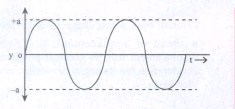
(2) Damped oscillation:
(i) The oscillation of a body whos amplitude goes on decreasing with time are defined as damped oscillation.
(ii) In these oscillation the amplitude oscillation decreases exponentially due to damping forces like frictional fore viscouse force, etc.
(iii) Due to decrease in amplitude the energy of the oscillator also goes on decreasing exponentially.
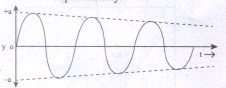
(iv) The force produces a resistance to the oscillation is called damping force.
If the velocity of oscillator is v then Damping force Fd=-bv, b = damping constant.
(v) Resultant force on a damped oscillator is given by
F = FR+Fd= -kx-kv ⇒ \(\frac { md^{ 2 }x }{ dt^{ 2 } } +b\frac { dx }{ dt } +kx\) = 0
(vi) Displacement of damped oscillator given by
x = \({ x }_{ m }e^{ \frac { bt }{ 2m } }sin(w't+\psi )\)
where w' = angular frequency of the damped oscillator = \(\sqrt { { W }_{ 0 }^{ 2 }-\left( \frac { b }{ 2m } \right) ^{ 2 } } \)
The amplitude decreases continuously with time according to x =\(x_{ m }e^{ \left( \frac { b }{ 2m } \right) t }\)
(vii) For a damped oscillator if the damping is small then the mechanical energy decreases exponentially with time as
E = \(\frac { 1 }{ 2 } kx_{ m }^{ 2 }e^{ \frac { ht }{ m } }\) .
23.
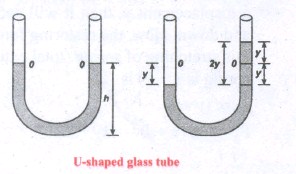
Consider a U -shaped glass tube which consists of two open arms with uniform cross-sectional area A. Let us pour a non-viscous uniform incompressible liquid of density p in the U- shaped tube to a height h as shown in the figure. If the liquid and tube are not disturbed then the liquid surface will be in equilibrium position O. It means the pressure as meazured at any point on the liquid is the same and also at the surface on the arm (edge of the tube on either side), which balances with the atmospheric pressure. Due to this the level of liquid in each arm will be the same. by blowing air one can provide sufficient force in one arm, and the liquid gets disturbed from equilibrium position O which means, the pressure at blown arm is higher than the other arm. This created difference in pressure which will cause the liquid to oscillate for a very short duration of time about the mean or equilibrium position and finally comes to rest
Time period of the oscillation is
T = \(2\pi \sqrt { \frac { 1 }{ 2g } } \) second ......(1)

11th Standard Syllabus & Materials
11th Standard
TN 11th Tamil பீடு பெற நில் - செய்யுள் - காவடிச்சிந்து Important Questions And Answers Study Material - QB365 Set A
NEW11th Standard
TN 11th Tamil பீடு பெற நில் - உரைநடை - மலை இடப்பெயர்கள் : ஓர் ஆய்வு Important Questions And Answers Study Material - QB365 Set A
NEW11th Standard
TN 11th Tamil மாமழை போற்றுதும் - துணைப்பாடம் - யானை டாக்டர் Important Questions And Answers Study Material - QB365 Set A
NEW11th Standard
TN 11th Tamil மாமழை போற்றுதும் - செய்யுள் - ஐங்குறுநூறு Important Questions And Answers Study Material - QB365 Set A



Tamilnadu Stateboard 11th Standard Subjects

Maths

Commerce

Economics

Biology

Business Maths and Statistics

Accountancy

Computer Science
Physics

Chemistry
Maths
Biology
Economics
Physics
Chemistry

History
Business Maths and Statistics

Computer Science
Accountancy

Computer Applications
History
Computer Technology
Commerce
Computer Applications
Computer Technology

Tamil

English

French
Tamilnadu Stateboard Standards

