
 100% FREE ACCESS
11th Standard Syllabus & Materials
11th Standard
TN 11th Tamil இயற்கை வேளாண்மை,சுற்றுச்சூழல் -செய்யுள் - மனோன்மணீயம் Important Questions And Answers Study Material - QB365 Set A
NEW11th Standard
TN 11th Tamil என்னுயிர் என்பேன் -துணைப்பாடம் - இசைத்தமிழர் இருவர் Important Questions And Answers Study Material - QB365 Set A
NEW11th Standard
TN 11th Tamil மொழி கலை -செய்யுள் - ஒவ்வொரு புல்லையும் Important Questions And Answers Study Material - QB365 Set A
NEW11th Standard
TN 11th Tamil பீடு பெற நில் - இலக்கணம் - பகுபத உறுப்புகள் Important Questions And Answers Study Material - QB365 Set A
NEW11th Standard
TN 11th Tamil பீடு பெற நில் - துணைப்பாடம் - வாடிவாசல் Important Questions And Answers Study Material - QB365 Set A
NEW11th Standard
TN 11th Tamil பீடு பெற நில் - செய்யுள் - குறுந்தொகை Important Questions And Answers Study Material - QB365 Set A

Published on: 28/09/2019
Zoology - Body Fluids and Circulation
Download Tamil Nadu 11th Standard Biology question papers, model tests, one-mark questions, important questions, and public exam papers in PDF format. Free study materials and answer keys for TN State Board students.
Questions + Answers key
Take MCQ Biology Test1.
Tabulate the distribution of antigens and antibodies is different blood groups
2.
What is aneurysm? How much it is dangerous?
3.
How varicose veins ore formed? Where are they usually located?
4.
Write a few lines about the two types of lymphocytes.
5.
Which type of WBC increase in its amount during allergic reactions? Write a few words of it.
6.
Name the three types of extracellular fluids.
7.
Why vasovagal syncope (fainting) occurs?
8.
What is heparin?
9.
What are basophils?
10.
Give the schematic representation to show classification of WBC.
11.
Name the two sources of blood supply to the liver.
12.
Name the two opposing pressures which helps in formation of tissue fluid.
13.
Name the different types of extracellular fluids in our body.
14.
Right ventricular wall is thinner than the left ventricular wall. Why?
15.
Distinguish between mitral valve and semilunar valve.
1.
Distribution of antigens and antibodies in different blood groups
| Blood Group | Agglutinogens (antigens) on the RBC | Agglutinin (antibodies)in the plasma |
|---|---|---|
| A | A | Anti B |
| B | B | Anti A |
| AB | AB | No antibodies |
| O | No antigens | Anti A and Anti B |
2.
Aneurysm the weakened regions of the wall of the artery or veins bulges to form a balloon like sac. Unruptured aneurysm may exert pressure on the adjacent tissues or may burst causing massive haemorrhage.
3.
Varicose veins The veins are so dilated that the valves prevent back flow of blood. The veins lose their elasticity and become congested. Common sites are legs, rectalanal regions (haemorrhoids), the oesophagus and the spermatic cord.
4.
The two types of lymphocytes are B and T cells. Both Band T cells are responsible for the immune responses of the body. B cells produce antibodies to neutralize the harmful effects of foreign substances and T cells are involved in cell mediated immunity.
5.
(i) Eosinophils increase during certain types of parasitic infections and allergic reactions.
(ii) Eosinophils have distinctly bilobed nucleus and the lobes are joined by thin strands. They are non - phagocytic and constitute about 2 - 3% of the total WBCs.
6.
The three types of extracellular fluids are the interstitial fluid or tissue fluid (surrounds the cell), the plasma (fluid component of the blood) and lymph.
7.
Signals from the nervous system cause a sudden decrease in blood pressure, and the individual faints from lack of oxygen to the brain.
8.
Heparin is an anticoagulant produced in small quantities by mast cells of connective tissue which prevents coagulation in small blood vessels
9.
They are a type of WBC (granulocytes).
1. Basophils secrete substances such as heparin, serotonin, and histamines.
2. They are also involved in inflammatory reactions.
10.
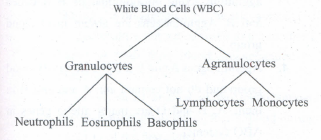
11.
1. The hepatic artery brings oxygenated blood from the heart.
2. The hepatic portal vein brings blood from intestine and other abdominal organs.
12.
1. Water potential
2. Hydrostatic pressure
13.
1. Interstitial fluid/Tissue fluid
2. Blood
3. Lymph
14.
(i) Right ventricular wall is thinner because the pulmonary artery transports deoxygenated blood to lungs so that much force/pressure is not needed.
(ii) Left ventricular wall is thicker because the aorta has to pump out the blood from the heart to supply oxygenated blood to all the parts of the body and needs more pressure.
15.
| S.No. | Mitral Valve | semilunar Valve |
| 1. | Found between left atrium and left ventricle. | Found at the entry of pulmonary artery and aorta. |
| 2. | Has two flaps or cusps. | Has three flaps or cusps. |
| 3. | Appear as flaps. | Appear as half moon shaped. |
| 4. | Prevents the backword flow of oxygenated blood from left ventricle to left atrium. |
Prevents the backward flow of deoxygenated blood into right ventricle and oxygenated blood into left ventricle. |
| 5. | Also called as bicuspid valve. | Also called as pulmonary or aortic valves. |

11th Standard Syllabus & Materials
11th Standard
TN 11th Tamil பீடு பெற நில் - செய்யுள் - காவடிச்சிந்து Important Questions And Answers Study Material - QB365 Set A
NEW11th Standard
TN 11th Tamil பீடு பெற நில் - உரைநடை - மலை இடப்பெயர்கள் : ஓர் ஆய்வு Important Questions And Answers Study Material - QB365 Set A
NEW11th Standard
TN 11th Tamil மாமழை போற்றுதும் - துணைப்பாடம் - யானை டாக்டர் Important Questions And Answers Study Material - QB365 Set A
NEW11th Standard
TN 11th Tamil மாமழை போற்றுதும் - செய்யுள் - ஐங்குறுநூறு Important Questions And Answers Study Material - QB365 Set A



Tamilnadu Stateboard 11th Standard Subjects

Maths

Commerce

Economics
Biology

Business Maths and Statistics

Accountancy

Computer Science

Physics

Chemistry
Maths
Biology
Economics
Physics
Chemistry

History
Business Maths and Statistics

Computer Science
Accountancy

Computer Applications
History
Computer Technology
Commerce
Computer Applications
Computer Technology

Tamil

English

French
Tamilnadu Stateboard Standards

