
 100% FREE ACCESS
11th Standard Syllabus & Materials
11th Standard
TN 11th Tamil இயற்கை வேளாண்மை,சுற்றுச்சூழல் -செய்யுள் - மனோன்மணீயம் Important Questions And Answers Study Material - QB365 Set A
NEW11th Standard
TN 11th Tamil என்னுயிர் என்பேன் -துணைப்பாடம் - இசைத்தமிழர் இருவர் Important Questions And Answers Study Material - QB365 Set A
NEW11th Standard
TN 11th Tamil மொழி கலை -செய்யுள் - ஒவ்வொரு புல்லையும் Important Questions And Answers Study Material - QB365 Set A
NEW11th Standard
TN 11th Tamil பீடு பெற நில் - இலக்கணம் - பகுபத உறுப்புகள் Important Questions And Answers Study Material - QB365 Set A
NEW11th Standard
TN 11th Tamil பீடு பெற நில் - துணைப்பாடம் - வாடிவாசல் Important Questions And Answers Study Material - QB365 Set A
NEW11th Standard
TN 11th Tamil பீடு பெற நில் - செய்யுள் - குறுந்தொகை Important Questions And Answers Study Material - QB365 Set A

Published on: 10/10/2019
Zoology - Living World
Download Tamil Nadu 11th Standard Biology question papers, model tests, one-mark questions, important questions, and public exam papers in PDF format. Free study materials and answer keys for TN State Board students.
Questions + Answers key
Take MCQ Biology Test1.
What is natural system of classification?
2.
What are the limitations of Aristotle's classification?
3.
How did Aristotle classify organisms?
4.
Name the kingdom in Five Kingdom Classification in which organisms lack a nuclear membrane.
5.
Reproduction cannot be considered as a character to define living organism. Do you agree with this statement
6.
Why are sparrows listed as endangered species?
7.
What is the Significance of Bhupathy's purple frog?
8.
What is meant by Extremophiles?
9.
What is systematics?
10.
List any five salient features of the family Felidae.
1.
Linnaeus considered a few characters of organisms for classifying them. Later many characters were considered for classifying organisms. Morphological, anatomical, embryological characters were considered.
2.
Many organisms were not fitting into his classification. Frogs have lungs and they are amphibians while their larva, tadpole is aquatic and respires through gills. It is difficult to classify frogs according to his method. All flying organisms such as birds, bats, flying insects were grouped together. Ostrich, emu and penguin are flightless birds and hence they cannot be classified by his method.
3.
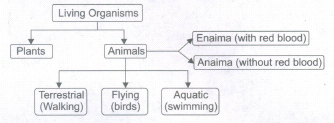
Aristotle classified living organisms into plants and animals. Animals were classified into walking (terrestrial), flying (birds) and swimming {aquatic) based on their locomotion. Based on the presence or absence of red blood animals were classified into Enaima and Anaima.
4.
Kingdom Monera includes bacteria which are prokaryotic organisms lacking a nuclear membrane.
5.
There are many organisms like the Mules, worker bees etc. which are sterile but they show the characteristics of living organism. Hence, Reproduction cannot be considered as a character to define living organisms
6.
Reasons for reduction in Population of sparrows:
1. Absence of native plants which provide habitats (shelter, insects as food etc.)
2. Grocery stores being replaced with Supermarkets (gunny bags were pecked by sparrows for grains earlier.)
3. Cell phone radiation from Towers. Sparrow population is disappearing. fast. Thus it is important to conserve sparrows which is becoming endangered because every animal is an important link is an ecosystem.
7.
1. Purple pig-nosed Frog was discovered in the Western Ghats.
2. It has shiny purple skin and spends its entire adult life underground.
3. It is called Bhupathy's purple frog by the scientists in memory of Subramaniam Bhupathy a respectable herpetologist who lost his life is the Western Ghats.
8.
Prokaryotes which have the ability to grow in extreme conditions like volcano vents, hot springs and polar ice caps are called extremophiles. They have adaptations such as :
1. Capacity to synthesize their food without sunlight and oxygen by utilizing hydrogen sulphide and other chemicals from the volcanic vents.
2. Some of them produce methane (Methanogens).
3. Some live in salty environments (Halophiles).
4. Some are thermoacidophiles which thrive in acidic environments and at high temperature.
9.
1. The main criteria of systematics is identifying, describing, naming, arranging, preserving and documenting the organisms.
2. Evolutionary history of the species and the environmental adaptations and interrelationship between species are also being investigated in systematics
10.
(i) This family consists of more than one species in the genus it is known as polytypic genus.
(ii) Species are intrageneric
(iii) A single genus is Felis which has a number of closely related species.
(iv) Different species of a single genus show the same morphological characteristics but their behavior varies
(v) Eg: Felis domestica (Domestic cat)
Felis margarita (Jungle cat)
Felis silvestris (Wild cat)

11th Standard Syllabus & Materials
11th Standard
TN 11th Tamil பீடு பெற நில் - செய்யுள் - காவடிச்சிந்து Important Questions And Answers Study Material - QB365 Set A
NEW11th Standard
TN 11th Tamil பீடு பெற நில் - உரைநடை - மலை இடப்பெயர்கள் : ஓர் ஆய்வு Important Questions And Answers Study Material - QB365 Set A
NEW11th Standard
TN 11th Tamil மாமழை போற்றுதும் - துணைப்பாடம் - யானை டாக்டர் Important Questions And Answers Study Material - QB365 Set A
NEW11th Standard
TN 11th Tamil மாமழை போற்றுதும் - செய்யுள் - ஐங்குறுநூறு Important Questions And Answers Study Material - QB365 Set A



Tamilnadu Stateboard 11th Standard Subjects

Maths

Commerce

Economics
Biology

Business Maths and Statistics

Accountancy

Computer Science

Physics

Chemistry
Maths
Biology
Economics
Physics
Chemistry

History
Business Maths and Statistics

Computer Science
Accountancy

Computer Applications
History
Computer Technology
Commerce
Computer Applications
Computer Technology

Tamil

English

French
Tamilnadu Stateboard Standards

