
 100% FREE ACCESS
11th Standard Syllabus & Materials
11th Standard
TN 11th Tamil இயற்கை வேளாண்மை,சுற்றுச்சூழல் -செய்யுள் - மனோன்மணீயம் Important Questions And Answers Study Material - QB365 Set A
NEW11th Standard
TN 11th Tamil என்னுயிர் என்பேன் -துணைப்பாடம் - இசைத்தமிழர் இருவர் Important Questions And Answers Study Material - QB365 Set A
NEW11th Standard
TN 11th Tamil மொழி கலை -செய்யுள் - ஒவ்வொரு புல்லையும் Important Questions And Answers Study Material - QB365 Set A
NEW11th Standard
TN 11th Tamil பீடு பெற நில் - இலக்கணம் - பகுபத உறுப்புகள் Important Questions And Answers Study Material - QB365 Set A
NEW11th Standard
TN 11th Tamil பீடு பெற நில் - துணைப்பாடம் - வாடிவாசல் Important Questions And Answers Study Material - QB365 Set A
NEW11th Standard
TN 11th Tamil பீடு பெற நில் - செய்யுள் - குறுந்தொகை Important Questions And Answers Study Material - QB365 Set A

Published on: 21/01/2020
Download Tamil Nadu 11th Standard Physics question papers, model tests, one-mark questions, important questions, and public exam papers in PDF format. Free study materials and answer keys for TN State Board students.
Questions + Answers key
Take MCQ Physics Test1.
Audible frequencies have a range of 20 Hz to 20 x 103 Hz. Express 't' is range in terms of
(i) period T
(ii) wavelength air at
(iii) angular frequency w (Given velocity of sound in O°C = 331 m/s)
2.
What is meant by coefficient of linear expansion superficial & cubical expansion?
3.
An deal gas is expanded such that ρT2 = a constant find the coefficient of volume expansion of the gas.
4.
Derive the expression for Carnot engine efficiency.
5.
Explain Joule’s Experiment of the mechanical equivalent of heat.
6.
A massless right tangled triangle is suspended with its right angle corner. A mass of 100 kg is suspended from another corner B which subtends an angle \(53^{0}\). Find the mass m that should be suspended from other corner C so that BC (hypotenuse) remains horizontal.
7.
A three storey building of height 100m is located on Earth and a similar building is also located on Moon. If two people jump from the top of these buildings on Earth and Moon simultaneously, when will they reach the ground and at what speed? (g = 10m s-2)
8.
Describe Galileo's experiments concerning motion of objects on inclined planes?
9.
A body starting from rest has an acceleration of 25 ms-2. Find the distance travelled by it in 20th second.
10.
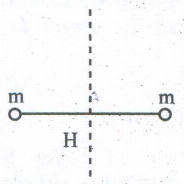
Find the moment of inertia of a hydrogen molecule about an axis passing through its center of mass and perpendicular to the interatomic axis. Given: mass of hydrogen atom 1.7\(\times\)10-27 kg and inter atomic distance is equal to 4\(\times\)10-10m.
11.
A body of mass 500 g initially at rest is moved by a horizontal force of 1 N. Calculate the work done by the force in 20s and show that is equal to the change in kinetic energy of the body.
12.
What do you mean by propagation of errors? Explain the propagation of errors in addition and multiplication.
13.
Moon is the natural satellite of Earth and it takes 27 days to go once around its orbit. Calculate the distance of the Moon from the surface of the Earth assuming the orbit of the Moon as circular.
14.
Consider four masses m1, m2, m3, and m4 arranged on the circumference of a circle as shown in figure below.
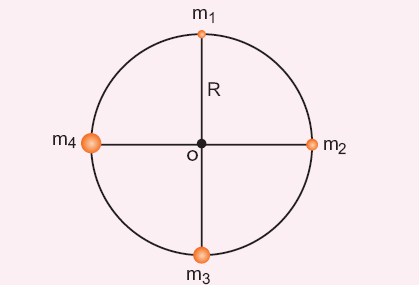
Calculate
(a) The gravitational potential energy of the system of 4 masses shown in figure.
(b) The gravitational potential at the point O due to all the 4 masses
15.
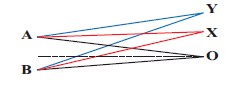
Consider two sources A and B as shown in the figure below. Let the two sources emit simple harmonic waves of same frequency but of different amplitudes, and both are in phase (same phase). Let O be any point equidistant from A and B as shown in the figure. Calculate the intensity at points O, Y and X. (X and Y are not equidistant from A & B)
16.
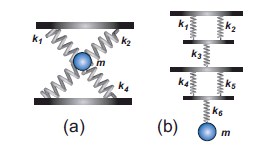
Calculate the equivalent spring constant for the following systems and also compute if all the spring constants are equal:
17.
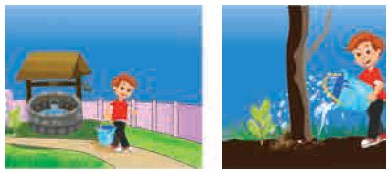
A student had a breakfast of 200 food calories. He thinks of burning this energy by drawing water from the well and watering the trees in his school. Depth of the well is about 25 m. The pot can hold 25L of water and each tree requires one pot of water. How many trees can he water? (Neglect the mass of the pot and the energy spent by walking. Take g = 10 ms-2)
18.
Two vectors \(\vec A\) and \(\vec B\) of magnitude 5 units and 7 units respectively make an angle 60° with each other as shown below. Find the magnitude of the resultant vector and its direction with respect to 7 unit the vector \(\vec A\).
.png)
19.
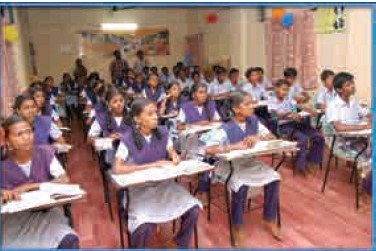
Estimate the mass of air in your class room at NTP. Here NTP implies normal temperature (room temperature) and 1 atmospheric pressure.
20.
A student comes to school by a bicycle whose tire is filled with air at a pressure 240 kPa at 27°C. She travels 8 km to reach the school and the temperature of the bicycle tire increases to 39°C. What is the change in pressure in the tire when the student reaches school?
1.
Velocity of sound in air at 0°C = 331 mls.
Audible frequencies, V1 = 20 Hz, V2 = 20 x 103 Hz.
(i) Period (T):
T·tme penod \(T={1\over V}\), we get
\(∵\ T_1={1\over V_1}={1\over 20}=0.05s\)
\(T_2={1\over V_2}={1\over 20\times10^3}=0.055\times 10^{-3}s\)
∴ Time period range is 0.05 to 0.055 \(\times\)10-3 s.
(ii) Wavelength ⋋:
From the formula \(\lambda ={v\over \lambda}\)
∴ \(\lambda_1={v\over V_1}={331\over 20}=16.55m\)
and
\(\lambda _2={v\over V_2}={331\over 20\times10^3}=0.0165m\)
∴ Wave length range is 16.55 m to 0.0165 m
(iii) Angular frequency ω:
From the formula, 0 = 27tV
∴ ω = 2πV1= 2π \(\times\)20
= 40π rads-1
and ω2 = 2πV2= 2π\(\times\)20\(\times\)103
= 40π\(\times\)103 rad/s.
∴ Angular frequency range is 40π to 40π\(\times\)103 rad/s
2.
Linear:
When a: solid rod of initial length I is heated through a temperature \(\triangle\)T, its final length (increased) is given by
L1 = L + \(\triangle\)L = L (1 + \(\alpha\)\(\triangle\)T)
Where
\(\alpha\) is coefficient of linear expansion, It is given by
\(\alpha =\frac { \triangle L }{ L } \times \frac { 1 }{ \triangle T } \)
\(\alpha\) is defined as the increase in length per unit length per degree rise in temperature.
Superficial expansion:
When a solid, sheet of initial surface area A is heated through a temperature J). T, its final area (increased) is given by
A1 = A + \(\triangle\)A = A (1 + \(\beta\)\(\triangle\)T)
\(\beta\) - coefficient of superficial expansion. It is given by
\(\beta\) = \(\beta =\frac { \triangle A }{ A } \times \frac { 1 }{ \triangle T } \)
It is defined as the increase in surface area per unit area per degree rise in temperature.
Cubical expansion:
When a solid of initial volume V is heated through a temperature. J). T, its final volume is given by
V1 = V + \(\triangle\)V = V (1 + \(\gamma \)\(\triangle\)T)
\(\gamma \) - coefficient of cubical expansion and it is defined as the increase in volume per unit volume per degree rise in temperature.
\(\gamma =\frac { \triangle V }{ V } \times \frac { 1 }{ \triangle T } \)
3.
From ideal gas equation
pV = nRT (or) \(r=\frac{nRT}{V}\)
As gas expands such that
ρT2 = a constant = C
So \((\frac{nRT}{V})T^{2}\) = C (or) T3 α V
(or) T3 = kV
differentiating it w.r.t.T, we have
\(3T^{2}=k \frac{dV}{dT}\)
Dividing it by T3=kV
\(\frac{3}{T}=\frac{1}{V}.\frac{dV}{dT}\)
Coefficient of volume expansion r = \(\frac{1}{V}.\frac{dV}{dT}=\frac{3}{T}\)
4.
Efficiency of a Carnot engine:
(i) Efficiency is defined as the ratio of work done by the working substance. in one cycle to the amount of heat extracted from the source. work done
\(\eta =\frac { work \ done }{ Heat \ extracted } =\frac { W }{ { Q }_{ H } } \)
(ii) From the first law of thermodynamics, W=QH-QL
\(\therefore \quad \eta -\cfrac { { Q }_{ H }-{ Q }_{ L } }{ { Q }_{ H } } =1-\cfrac { { Q }_{ L } }{ { Q }_{ H } } \)
(iii)Applying isothermal conditions, we get,
QH = mRTH In \(\left( { { V }_{ 2 } }/{ { V }_{ 4 } } \right) \)
\({ Q }_{ L }=\mu RT_{ L }\quad ln\left( { { V }_{ 3 } }/{ { V }_{ 4 } } \right) \) ...(3)
(iv) Here we omit the negative sign. Since we are interested in only the amount of heat (QL) ejected into the sink, we have
\(\cfrac { { Q }_{ L } }{ { Q }_{ H } } =\frac { { T }_{ L }ln\left( { { V }_{ 3 } }/{ { V }_{ 4 } } \right) }{ { T }_{ H }ln\left( { { V }_{ 2 } }/{ { V }_{ 1 } } \right) } \) ...(4)
By applying adiabatic conditions, we get,
\({ T }_{ H }{ V }_{ 2 }^{ \gamma -1 }={ T }_{ L }{ V }_{ 3 }^{ \gamma -1 }\)
\({ T }_{ H }{ V }_{ 1 }^{ \gamma -1 }={ T }_{ L }{ V }_{ 4 }^{ \gamma -1 }\)
By dividing the above two 'equations, we get
\(\left( \cfrac { { V }_{ 2 } }{ { V }_{ 1 } } \right) ^{ \gamma -1 }=\left( \cfrac { { V }_{ 3 } }{ { V }_{ 4 } } \right) ^{ \gamma -1 }\)
Which implies that \(\cfrac { { V }_{ 2 } }{ { V }_{ 1 } } =\cfrac { { V }_{ 3 } }{ { V }_{ 4 } } \) ...(5)
Substituting equation (5) in (4), we get
\(\cfrac { { Q }_{ L } }{ { Q }_{ H } } =\cfrac { { T }_{ L } }{ { T }_{ H } } \)
\(\therefore \)The efficiency \(\eta =1-\cfrac { { T }_{ L } }{ { T }_{ H } } \)
Note: TL and TH should be expressed in Kelvin, scale.
5.
James Prescott Joule showed that mechanical energy can be converted into internal energy and vice versa. In his experiment, two masses were attached with a rope and a paddle wheel as shown in Figure. When these masses fall through a distance h due to gravity both the masses lose potential energy equal to 2 mgh. When the masses fall, the paddle wheel turns. Due to the turning of wheel inside water, frictional force comes in between the water and the paddle wheel. This causes
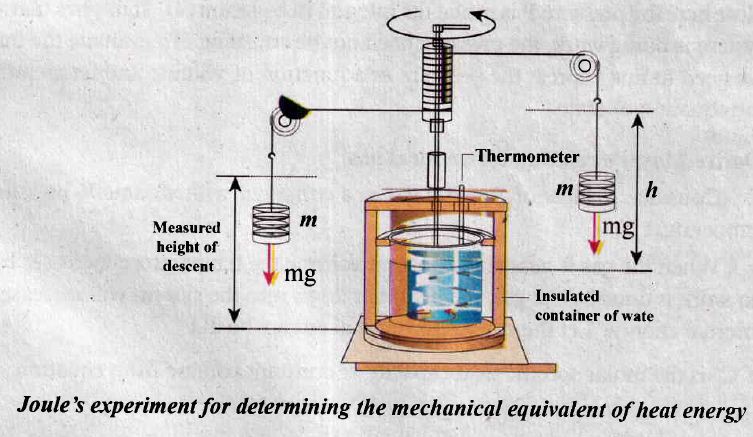
a rise in temperature of the water. This implies that gravitational potential energy is converted to internal energy of water. The temperature of water increases due to the work done by the masses. In fact, Joule was able to show that the mechanical work has the same effect as giving heat. He found that to raise 1 g of an object by 1°C, 4.186 J of energy is required. In earlier days the heat was measured in calorie.
1 cal = 4.186 J
This is called Joule's mechanical equivalent of heat.
6.
From the principle of moments,
\(100 \times g \times x_{1}=m\times g \times x_{2}\)
\(100 \times cos 53^{0}=m\times cos 37^{0}\) .................(1)
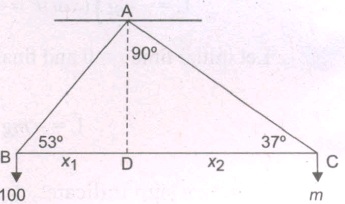
Where, x1 and x2 are the arm lengths.
The right angle triangle with angles \(37^{0}, 53 ^{0} \ and \ 90^{0}\) is a special triangle which has the respective sides in the ratio, 3:4:5 as shown in the diagram.
Substituting the values in equation (1),
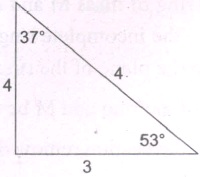
\(100 \times cos 53^{0}=3\times cos 37^{0}\)
\(100 \times \frac{3}{5}=m\times \frac{4}{5}\)
\(m=100\times \frac{3}{4}\)
m = 75 kg
7.
.png)
For both persons, the Kinematic equations are the same, with u=0,ac =g and amoon =\(g\over 6\)
ae = g and am =\(g\over 6\)
For a person on earth, Vearth = \(\sqrt{2gh}=\sqrt{2\times 10\times 100}\)
Hence, Vearth =\(\sqrt{2000} ms^{-1}\) gives the velocity at the ground, on earth.
Similarly, for a person on the moon,
Vearth =\(\sqrt{2gh\over6}={\sqrt{2000}\over \sqrt{6}}ms^{-1}\)
The person on earth reaches ground with greater velocity than the person on the moon.
8.
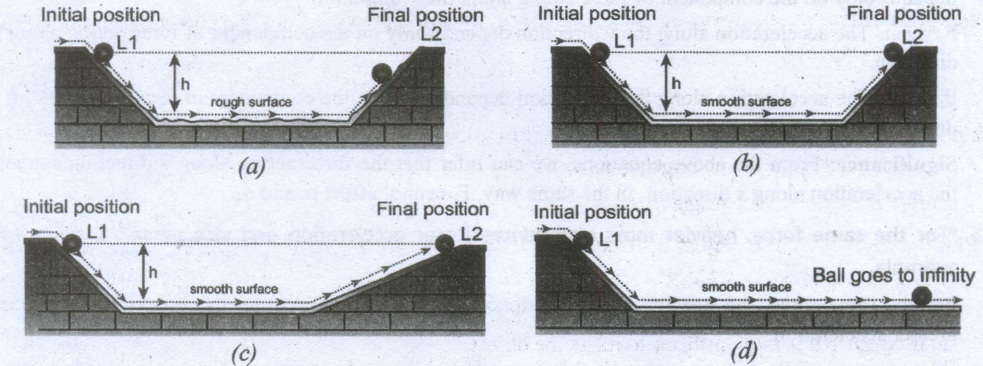
Galileo's experiment with. the second plane (a) at same inclination angle Cisthe first (b) with increased smoothness (c) with reduced angle of inclination (d) with zero angle of inclination
When a ball rolls from the top of an inclined plane to its bottom, after reaching the ground it moves some distance and continues to move on to another inclined plane of same angle of inclination as shown in the Figure (a). By increasing the smoothness of both the inclined planes, the ball reach almost the same height (h) from where it was released (L1) in the second plane (L2) [figure (b)]. The motion of the ball is then observed by varying the angle of inclination of the second plane keeping the same smoothness. If the angle of inclination is reduced, the ball travels longer distance in the second plane to reach the same height [figure (c)). When the angle of inclination is made zero, the ball moves forever in the horizontal direction [figure (d)]. If the Aristotelian idea were true, the ball would not have moved in the second plane even if its smoothness is made maximum since no force acted on it in the horizontal direction.
9.
Acceleration of a body 'a' = 25 ms-2
Distance travelled during nth Second
\(=u+\frac { a }{ 2 } (2n-1)\)
\(\because\) Distance travelled during 20th Second
\(=u+\frac { a }{ 2 } (2n-1)\)
Initial velocity u =0, a = 25 ms-2
Distance travelled = 0 +\(\frac { 25 }{ 2 } (2\times 20-1)\)
\(=\frac { 25 }{ 2 } (40-1)\)
\(=\frac { 25 }{ 2 } (139)\)
= 487.5 metre.
10.
M.I. of a H2 molecule about an axis passing through Center of Mass.
I = 2m.\(\frac{a^{2}}{4}\)
\(=\frac { 2\times 1.7\times { 10 }^{ -27 }\times { (4\times { 10 }^{ -10 }) }^{ 2 } }{ 4 } \)
\(=\frac { (3.4\times { 10 }^{ -27 })\times (16\times { 10 }^{ -20 }) }{ 4 } \)
= 13.6 \(\times\)10-47 (or) 1.36\(\times\)10-46 kg m2
11.
Mass of a body(m) =\(\frac{500}{1000}\)kg = 0.5 kg
Horizontal Force (F) = 1N
Time(t) = 20s.
Therefore, acceleration of a body.
a = F/m =\(\frac{1}{0.5}=2ms^{-2}\)
Distance travelled s = ut+\(\frac{1}{2}+at^{2}\)
S =0 x 20 +\(\frac{1}{2}\times2\times(20)^{2}\)
= 0+\(\frac{1}{2}\times400\times2\)
Displacement s1= 400 m
Workdone = F\(\times\)s = 1\(\times\)400
\(\boxed{=400}\) J; v = u+at = 0+2\(\times\)20
v = 40
Change in k.E =\(\frac{1}{2}m(v^{2}-u^{2})\)
=\(\frac{1}{2}\times0.5\times(40^{2}-0)\)
=\(=\frac{1}{2}\times 0.5\times 1600\)
\(\boxed{=400\ J}\)
12.
Propagation of errors
A number of measured quantities may be involved in the final calculation of an experiment. Different types of instruments might have been used for taking readings. Then we may have to look at the errors in measuring various quantities, collectively.
The error in the final result depends on
(i) The errors in the individual measurements
(ii) On the nature of mathematical operations performed to get the final result. So we should know the rules to combine the errors.
The various possibilities of the propagation or combination of errors in different mathematical operations are discussed below:
(i) Error in the sum of two quantities:
Let A\(\triangle\) and \(\triangle\)B be the absolute errors in the two quantities A and B respectively. Then,
Measured value of A = A \(\pm\triangle\) A
Measured value of B = B \(\pm\triangle\) B
Consider the sum, Z = A + B
The error \(\triangle\) Z in Z is the given by
Z \(\pm\triangle\) Z = (A \(\pm\triangle\)A) + ( B \(\pm\triangle\) B)
= ( A + B ) \(\pm\) (\(\triangle\)A+ \(\triangle\) B)
= Z \(\pm\) ( \(\triangle\) A + \(\triangle\) B )
(or) \(\triangle\)Z = \(\triangle\) A+ \(\triangle\) B
The maximum possible error in the sum of two quantities is equal to the sum of the absolute errors in the individual quantities.
(ii) Error in the difference of two quantities:
Let \(\triangle\)A and \(\triangle\)B be the absolute errors in the two quantities, A and B, respectively. Consider the product Z = AB
Let \(\triangle\)A and \(\triangle\)B be the absolute errors in the two quantities, A and B, respectively. Consider the product Z = AB
The error \(\triangle\)Z in Z is given by \(Z \pm \Delta Z=(A \pm \Delta A)(B \pm \Delta B)\)
\(=(A B) \pm(A \Delta) \pm(B \Delta A) \pm(\Delta A . \Delta B)\)
Dividing L.H.S by Z and R.H.S by AB, we get,
\(1 \pm \frac{\Delta Z}{Z} \cdot 1 \pm \frac{\Delta B}{B} \pm \frac{\Delta A}{A} \pm \frac{\Delta A}{A} \cdot \frac{\Delta B}{B}\)
As \(\triangle\)A/A, \(\triangle\)B/B are both small quantities, their product term \(\frac{\Delta A}{A} \cdot \frac{\Delta B}{B}\) can be neglected. The maximum fractional error in Z is
\(\frac{\Delta Z}{Z}=\pm\left(\frac{\Delta A}{A}+\frac{\Delta B}{B}\right)\)
The maximum error in difference of two quantities is equal to the sum of the absolute errors in the individual quantities.
(iii) Error in the division or quotient of two quantities
Let \(\triangle\)A and \(\triangle\)B be the absolute errors in the two quantities A and B respectively.
Consider the quotient, \(\mathrm{Z}=\frac{A}{B}\)
The error \(\triangle\)Z in Z is given by
\(Z \pm \Delta Z =\frac{A \pm \Delta A}{B \pm \Delta B}=\frac{A\left(1 \pm \frac{\Delta A}{A}\right)}{B\left(1 \pm \frac{\Delta B}{B}\right)} \)
\(=\frac{A}{B}\left(1 \pm \frac{\Delta A}{A}\right)\left(1 \pm \frac{\Delta B}{B}\right)^{-1}\)
or \(Z \pm \Delta Z=Z\left(1 \pm \frac{\Delta A}{A}\right)\left(1 \pm \frac{\Delta B}{B}\right)\)
[using (1+x) n \(\approx\) 1+n x, when x<1]
Dividing both sides by Z, we get,
\(1 \pm \frac{\Delta Z}{Z} =\left(1 \pm \frac{\Delta A}{A}\right)\left(1 \pm \frac{\Delta B}{B}\right)
\)
\(=1 \pm \frac{\Delta Z}{Z} \pm \frac{\Delta B}{B} \pm \frac{\Delta A}{A} \cdot \frac{\Delta B}{B}\)
As the terms \(\triangle\)A /A and \(\triangle\)B/ B are small, their product term can be neglected. The maximum fractional error in Z is given by
\(\frac{\Delta Z}{Z}=\left(\frac{\Delta A}{A}+\frac{\Delta B}{B}\right)\)
The maximum fractional error in the quotient of two quantities is equal to the sum of their individual fractional errors.
13.
We can use Kepler’s third law,
T2 c (RE + h)3
T2/3 = c1/3(RE + h)
\({ \left( \frac { { T }^{ 2 } }{ c } \right) }^{ 1/3 }\)(RE + h)
\({ \left( \frac { { T }^{ 2 }{ GM }_{ E } }{ 4\pi ^{ 2 } } \right) }^{ \frac { 1 }{ 3 } }=\left( { R }_{ E }+h \right) ;\)
\(c=\frac { { 4\pi }^{ 2 } }{ { GM }_{ E } } \)
\(h={ \left( \frac { { T }^{ 2 }{ GM }_{ E } }{ 4\pi ^{ 2 } } \right) }^{ 1/3 }-{ R }_{ E }\)
Here h is the distance of the Moon from the surface of the Earth. Here,
RE - radius of the Earth = 6.4\(\times\)106 m
ME - mass of the Earth = 6.02\(\times\)1024 kg
G – Universal gravitational
constant = 6.67\(\times\)10−11 \(\frac { { Nm }^{ 2 } }{ { kg }^{ 2 } } \)
By substituting these values, the distance to the Moon from the surface of the Earth is calculated to be 3.77\(\times\)105 km
14.
The gravitational potential energy U(r) can be calculated by finding the sum of gravitational potential energy of each pair of particles.
\(U=-\frac { { Gm }_{ 1 }m_{ 2 } }{ { r }_{ 12 } } -\frac { { Gm }_{ 1 }m_{ 3 } }{ { r }_{ 13 } } -\frac { { Gm }_{ 1 }m_{ 4 } }{ { r }_{ 14 } } -\frac { { Gm }_{ 2 }m_{ 3 } }{ { r }_{ 23 } } -\frac { { Gm }_{ 2 }m_{ 4 } }{ { r }_{ 24 } } -\frac { { Gm }_{ 3 }m_{ 4 } }{ { r }_{ 34 } } \)
Here r12, r13 ... are distance between pair of particles
\({ r }_{ 14 }^{ 2 }={ R }^{ 2 }+{ R }^{ 2 }=2{ R }^{ 2 }\)
\({ r }_{ 14 }=\sqrt { 2 } R={ r }_{ 12 }={ r }_{ 23 }={ r }_{ 34 }\)
r13 = r =24 = 2R
\(U=-\frac { { Gm }_{ 1 }m_{ 2 } }{ \sqrt { 2 } R } -\frac { { Gm }_{ 1 }m_{ 3 } }{ { 2R } } -\frac { { Gm }_{ 1 }m_{ 4 } }{ { \sqrt { 2 } R } } -\frac { { Gm }_{ 2 }m_{ 3 } }{ \sqrt { 2 } R } -\frac { { Gm }_{ 2 }m_{ 4 } }{ 2R } -\frac { { Gm }_{ 3 }m_{ 4 } }{ \sqrt { 2 } R } \)
\(U=-\frac { G }{ R } \left[ \frac { { Gm }_{ 1 }m_{ 2 } }{ \sqrt { 2 } } -\frac { { Gm }_{ 1 }m_{ 3 } }{ { 2 } } -\frac { { Gm }_{ 1 }m_{ 4 } }{ { \sqrt { 2 } } } -\frac { { Gm }_{ 2 }m_{ 3 } }{ \sqrt { 2 } } -\frac { { Gm }_{ 2 }m_{ 4 } }{ 2 } -\frac { { Gm }_{ 3 }m_{ 4 } }{ \sqrt { 2 } } \right] \)
If all the masses are equal, then m1 = m2 = m3 = m4 = M
\(U=-\frac { G{ M }^{ 2 } }{ R } \left[ \frac { 1 }{ \sqrt { 2 } } +\frac { 1 }{ { 2 } } +\frac { 1 }{ { \sqrt { 2 } } } +\frac { 1 }{ \sqrt { 2 } } +\frac { 1 }{ 2 } +\frac { 1 }{ \sqrt { 2 } } \right] \)
\(U=-\frac { G{ M }^{ 2 } }{ R } \left[ 1+\frac { 4 }{ \sqrt { 2 } } \right] \)
\(U=-\frac { G{ M }^{ 2 } }{ R } \left[ 1+2\sqrt { 2 } \right] \)
The gravitational potential V(r) at a point O is equal to the sum of the gravitational potentials due to individual mass. Since potential is a scalar, the net potential at point O is the algebraic sum of potentials due to each mass.
\({ V }_{ o }(r)\frac { { Gm }_{ 1 } }{ R } -\frac { { Gm }_{ 2 } }{ { R } } -\frac { { Gm }_{ 3 } }{ { R } } -\frac { { Gm }_{ 4 } }{ R } \)
If m1 = m2 = m3 = m4 = M
\({ V }_{ o }(r)\frac { { 4GM } }{ R } \)
15.
The distance between OA and OB are the same and hence, the waves starting from A and B reach O after covering equal distances (equal path lengths). Thus, the path difference between two waves at O is zero.
OA − OB = 0
Since the waves are in the same phase, at the point O, the phase difference between two waves is also zero. Thus, the resultant intensity at the point O is maximum.
Consider a point Y, such that the path difference between two waves is λ. Then the phase difference at Y is \(\Delta \varphi=\frac{2 \pi}{\lambda} \times \Delta r=\frac{2 \pi}{\lambda} \times \lambda=2 \pi\)
Therefore, at the point Y, the two waves from A and B are in phase, hence, the intensity will be maximum.
Consider a point X, and let the path difference the between two waves be \(\frac { \lambda }{ 2 } \) Then the phase difference at X is
\(\Delta \varphi =\frac { 2\pi }{ \lambda } \frac { \lambda }{ 2 } \pi \)
Therefore, at the point X, the waves meet and are in out of phase, Hence, due to destructive interference, the intensity will be minimum.
16.
a. Since k1 and k2 are parallel, ku = k1 + k2 Similarly, k3 and k4 are parallel, therefore, kd = k3 + k4 But ku and kd are in series,
therefore, \({ k }_{ eq }=\frac { { k }_{ u }{ k }_{ d } }{ { k }_{ u }+{ k }_{ d } } \)
If all the spring constants are equal then, k1 = k2 = k3 = k4 = k
Which means, ku = 2k and kd = 2k
Hence, \({ k }_{ eq }=\frac { { 4k }^{ 2 } }{ 4k } =k\)
b. Since k1 and k2 are parallel, kA = k1 + k2 Similarly, k4 and k5 are parallel,
therefore, kB = k4 + k5
But kA, k3, kB, and k6 are in series,
therefore, \(\frac { 1 }{ { k }_{ eq } } =\frac { 1 }{ { K }_{ A } } +\frac { 1 }{ { K }_{ 3 } } +\frac { 1 }{ { K }_{ B } } +\frac { 1 }{ { K }_{ 6 } } \)
If all the spring constants are equal
then, k1 = k2 = k3 = k4 = k5 = k6 = k
which means, kA = 2k and kB = 2k
\(\frac { 1 }{ { k }_{ eq } } =\frac { 1 }{ { 2K } } +\frac { 1 }{ { K } } +\frac { 1 }{ { 2K } } +\frac { 1 }{ { K } } =\frac { 3 }{ { K } } \)
\({ k }_{ eq }=\frac { k }{ 3 } \)
17.
To draw 25 L of water from the well, the student has to do work against gravity by burning his energy.
Mass of the water = 25 L = 25 kg (1L = 1kg )
The work required to draw 25 kg of water = gravitational potential energy gained by water.
W = mgh = 25\(\times\)10\(\times\)25 = 6250 J
The total energy gained from the food = 200 food cal = 200 kcal.
= 200\(\times\)103\(\times\)4.186 J = 8.37\(\times\)105 J
If we assume that by using this energy the student can drawn ‘n’ pots of water from the well, the total energy spent by him = 8.37\(\times\)105 J = nmgh
\(n=\frac{8.37 \times 10^{5} \mathrm{~J}}{6250 \mathrm{~J}} \approx 134\)
This n is also equal to the number of trees that he can water. Is it possible to draw 134 pots of water from the well just by having breakfast? No. Actually the human body does not convert entire food energy into work. It is only approximately 20% efficient. It implies that only 20% of 200 food calories is used to draw water from the well. So 20% of the 134 is only 26 pots of water. It is quite meaningful. So he can water only 26 trees. The remaining energy is used for blood circulation and other functions of the body. It is to be noted that some energy is always ‘wasted’.
18.
By following the law of triangular addition, the resultant vector is given by \(\vec R\) = \(\vec A\) + \(\vec B\) as illustrated below.
The magnitude of the resultant vector \(\vec R\) is given by
\(R=|\vec R|=\sqrt{5^2+7^2+2\times 5\times 7\cos 60^o}\)
\(R=\sqrt{25+49+\frac{70\times 1}{2}}=\sqrt{109}\) units
i.png)
The angle \(\alpha\) between \(\vec R\) and \(\vec A\) is given by
\(\tan\alpha=\frac{B\sin\theta}{A+B\cos\theta}\)
\(\tan\alpha=\frac{7\times\sin60^o}{5+7\cos60^o}=\frac{7\sqrt{3}}{10+7}=\frac{7\sqrt{3}}{17}\) = 0.713
\(\therefore\alpha=35^o\)
ii.png)
19.
The average size of a class is 6m length, 5 m breadth and 4 m height. The volume of the room V = 6\(\times\)5 \(\times\)4 = 120m3. We can determine the number of mole. At room temperature 300K, the volume of a gas occupied by any gas is equal to 24.6L.
The number of mole \(\mu =\frac { 120{ m }^{ 2 } }{ 24.6\times { 10 }^{ -3 }{ m }^{ 3 } } \approx 4878mol\)
Air is the mixture of about 20% oxygen, 79% nitrogen and remaining one percent are argon, hydrogen, helium, and xenon. The molar mass of air is 29 g mol-1.
So the total mass of air in the room m = 4878\(\times\)29 = 141.4kg
20.
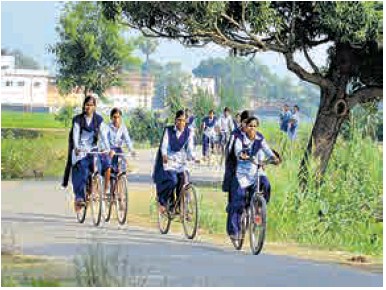
We can take air molecules in the tire as an ideal gas. The number of molecules and the volume of tire remain constant. So the air molecules at 27°C satisfies the ideal gas equation P1V1 = NkT1 and at 39°C it satisfies P2V2 = NkT2
But we know
V1 = V2 = V
\(\frac { { P }_{ 1 }V }{ { P }_{ 2 }V } =\frac { Nk{ T }_{ 1 } }{ Nk{ T }_{ 2 } } \)
\(\frac { { P }_{ 1 } }{ { P }_{ 2 } } =\frac { { T }_{ 1 } }{ { T }_{ 2 } } \)
\( { P }_{ 2 } =\frac { { T }_{ 1 } }{ { T }_{ 2 } } { P }_{ 1 }\)
\({ P }_{ 2 }=\frac { 312K }{ 300K }\times 240\times{ \ 10 }^{ 3 }Pa=249.6Pa\qquad \)

11th Standard Syllabus & Materials
11th Standard
TN 11th Tamil பீடு பெற நில் - செய்யுள் - காவடிச்சிந்து Important Questions And Answers Study Material - QB365 Set A
NEW11th Standard
TN 11th Tamil பீடு பெற நில் - உரைநடை - மலை இடப்பெயர்கள் : ஓர் ஆய்வு Important Questions And Answers Study Material - QB365 Set A
NEW11th Standard
TN 11th Tamil மாமழை போற்றுதும் - துணைப்பாடம் - யானை டாக்டர் Important Questions And Answers Study Material - QB365 Set A
NEW11th Standard
TN 11th Tamil மாமழை போற்றுதும் - செய்யுள் - ஐங்குறுநூறு Important Questions And Answers Study Material - QB365 Set A



Tamilnadu Stateboard 11th Standard Subjects

Maths

Commerce

Economics

Biology

Business Maths and Statistics

Accountancy

Computer Science
Physics

Chemistry
Maths
Biology
Economics
Physics
Chemistry

History
Business Maths and Statistics

Computer Science
Accountancy

Computer Applications
History
Computer Technology
Commerce
Computer Applications
Computer Technology

Tamil

English

French
Tamilnadu Stateboard Standards

