
 100% FREE ACCESS
11th Standard Syllabus & Materials
11th Standard
TN 11th Tamil இயற்கை வேளாண்மை,சுற்றுச்சூழல் -செய்யுள் - மனோன்மணீயம் Important Questions And Answers Study Material - QB365 Set A
NEW11th Standard
TN 11th Tamil என்னுயிர் என்பேன் -துணைப்பாடம் - இசைத்தமிழர் இருவர் Important Questions And Answers Study Material - QB365 Set A
NEW11th Standard
TN 11th Tamil மொழி கலை -செய்யுள் - ஒவ்வொரு புல்லையும் Important Questions And Answers Study Material - QB365 Set A
NEW11th Standard
TN 11th Tamil பீடு பெற நில் - இலக்கணம் - பகுபத உறுப்புகள் Important Questions And Answers Study Material - QB365 Set A
NEW11th Standard
TN 11th Tamil பீடு பெற நில் - துணைப்பாடம் - வாடிவாசல் Important Questions And Answers Study Material - QB365 Set A
NEW11th Standard
TN 11th Tamil பீடு பெற நில் - செய்யுள் - குறுந்தொகை Important Questions And Answers Study Material - QB365 Set A

Published on: 21/01/2020
Download Tamil Nadu 11th Standard Physics question papers, model tests, one-mark questions, important questions, and public exam papers in PDF format. Free study materials and answer keys for TN State Board students.
Questions + Answers key
Take MCQ Physics Test1.
If the length of the simple pendulum is increased by 44% from its original length, calculate the percentage increase in time period of the pendulum.
2.
Two vectors \(\vec A\) and \(\vec B\) are given in the component form as \(\overrightarrow { A } =5\hat { i } +7\hat { j } -4\hat { k } \) and \(\overrightarrow { B } =6\hat { i } +3\hat { j } +2\hat { k } \). Find \(\vec { A } +\vec { B } ,\vec { B } +\vec { A } ,\vec { A } -\vec { B } ,\vec { B } -\vec { A } \)
3.
Write the rules for determining significant figures.
4.
Derive the expression for resultant spring constant when two springs having constant k1 and k2 are connected in series.
5.
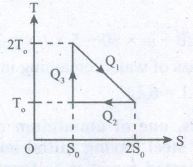
The temperature - entropy diagram of a reversible engine cycle is given in figure. Calculate its efficiency.
6.
Alcohol in a U tube executes S.H.M of time period T. Now, alcohol is replaced by water upto the same height in the U-tube. What will be the effect on the time period?
7.
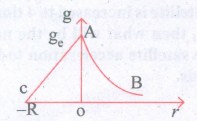
Draw graphs showing the variation of acceleration due to gravity with
(i) height above the earth's surface
(ii) depth below the earth's surface.
8.
How are sound waves-classified?
9.
A body floats in water with 40% of its volume outside water. When the same body floats in oil 60% of its volume, remains outside oil. What is the relative density of the oil?
10.
Write about the formation of waves in a tuning fork.
11.
Describe the formation of beats.
12.
A jester in a circus is standing with his arms extended on a turn table rotating with angular velocity \(\omega\). He brings his arms closer to his body so that his moment of inertia is reduced to one third of the original value. Find his new angular velocity. [Given: There is no external torque on the turn table in the given situation.]
13.
A block of mass m is pushed momentarily along a horizontal surface with an initial velocity u. If uk is the coefficient of kinetic friction between the object and surface, find the time at which the block comes to rest.
14.
Consider an object travelling in a semi-circular path from point O to point P in 5 second, as is shown in the Figure. Calculate the average velocity and average speed.
.png)
15.
Calculate the number of times a human heart beats in the life of 100 years old man. Time of one heart beat = 0.8s.
16.
A rope of negligible mass is wound round a hollow cylinder of mass 3 kg and radius 40 cm. What is angular acceleration of the cylinder if the rope is pulled with a force of 30N? What is the linear acceleration of the rope? Assume that there is no slipping.
17.
Explain the meaning of law of conservation of linear momentum.
18.
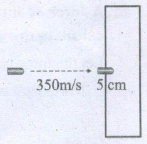
A bullet going with speed 350 m/s enters in a concrete wall and penetrates a distance of 5 cm before coming to rest. Find the deceleration.
19.
How many parallactic second are there in one Astronomical unit?
Given data:
1 parallactic second = 3.08\(\times\)1016m
1 Astronomical unit = 1.496\(\times\)1011m
20.
What is mechanical energy? What are its two types?
1.
Since, \(T=\propto \sqrt { l } \)
Therefore,
T = constant\(\sqrt{l}\)
\(\frac { { T }_{ f } }{ { T }_{ i } } =\sqrt { \frac { l+\frac { 44 }{ 100 } l }{ l } } =\sqrt { 1.44 } =1.2\)
Therefore, Tf = 1.2 Ti = Ti + 20% Ti
2.
\(\vec { A } +\vec { B } =\left( 5\hat { i } +7\hat { j } -4\hat { k } \right) +\left( 6\hat { i } +3\hat { j } +2\hat { k } \right) =11\hat { i } +10\hat { j } -2\hat { k } \)
\(\vec { B } +\vec { A } =\left( 6\hat { i } +3\hat { j } +2\hat { k } \right) +\left( 5\hat { i } +7\hat { j } -4\hat { k } \right) =\left( 6+5 \right) \hat { i } +\left( 3+7 \right) \hat { j } +\left( 2-4 \right) \hat { k } =11\hat { i } +10\hat { j } -2\hat { k } \)
\(\vec { A } -\vec { B } =\left( 5\hat { i } +7\hat { j } -4\hat { k } \right) -\left( 6\hat { i } +3\hat { j } +2\hat { k } \right) =-\hat { i } +4\hat { j } -6\hat { k } \)
\(\vec { B } -\vec { A } =-\hat { i } +4\hat { j } -6\hat { k } \)
Note that the vector \(\vec A+\vec B\) and \(\vec B+\vec A \) are same and the vectors \(\vec A-\vec B\) and \(\vec B-\vec A \) are opposite to each other.
3.
| Rule | Example |
| (i) All non-zero digits are significant | 1342 has four significant figures |
| (ii) All zeros between two non-zero digits are significant | 2008 has four significant figures |
| (iii) All zeros to the right of a non-zero digit but to the left of a decimal point are significant. | 30700 has five significant figures |
| (iv) a) The number without a decimal point, the terminal or trailing zero(s) are not significant. | 30700 has three significant figures |
| b) All zeros are significant if they come from a measurement | 30700 has three significant figures |
| (v) If the number is less than 1, the zero (s) on the right of the decimal point but to the left of the first non-zero digit are not significant. | 0.00345 has three significant figures |
| (vi) All zeros to the right of a decimal point and to the right of non-zero digit are significant. | 40.00 has four significant figures and 0.030400 has five significant figures |
| (vii) The number of significant figures does not depend on the system of units used | 1.53 cm, 0.0153 m, 0.0000153 km, all have three significant figures. |
4.
Let x1 and x2 be the elongation of springs from their equilibrium position (un-stretched position) due to the applied force F. Then, the net displacement of the mass point is
x = x1 +x2
Prom Hooke's law, the net force
\(F=-{ k }_{ S }\left( { x }_{ 1 }+{ x }_{ 2 } \right) \Rightarrow { x }_{ 1 }+{ x }_{ 2 }=-\cfrac { F }{ { k }_{ s } } \)
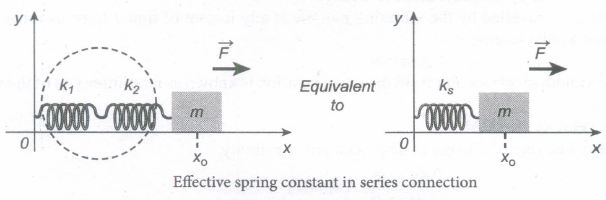
For springs in series connection
- k1x1 = - k2r2 = P
\(\Rightarrow { x }_{ 1 }=-\cfrac { F }{ { k }_{ 1 } } \) and \({ x }_{ 2 }=-\cfrac { F }{ { k }_{ 2 } } \)
Therefore, substituting equation (3) in equation (2), the effective spring constant can be calculated as
\(-\cfrac { F }{ { k }_{ 1 } } -\cfrac { F }{ { k }_{ 2 } } =\cfrac { F }{ k_{ s } } \)
\(\cfrac { 1 }{ { k }_{ s } } =\cfrac { 1 }{ { k }_{ 1 } } +\cfrac { 1 }{ { k }_{ 2 } } \) (or) \({ k }_{ s }=\cfrac { { k }_{ 1 }{ k }_{ 2 } }{ { k }_{ 1 }+{ k }_{ 2 } } \)
Suppose we have n springs connected in series, the effective spring constant in series is
\(\cfrac { 1 }{ { k }_{ s } } =\cfrac { 1 }{ { k }_{ 1 } } +\cfrac { 1 }{ { k }_{ 2 } } +\cfrac { 1 }{ { k }_{ 3 } } +...+\cfrac { 1 }{ { k }_{ n } } =\sum _{ i=1 }^{ n }{ \cfrac { 1 }{ { k }_{ i } } } \)
If all spring constants are identical i.e., k1 = k2 = ...= kn = k then
\(\cfrac { 1 }{ { K }_{ s } } =\cfrac { n }{ k } \Rightarrow { k }_{ s }=\cfrac { k }{ n } \)
This means that the effective spring constant reduces by the factor n. Hence, for springs in series connection, the effective spring constant is lesser than the individual spring constants. From equation (3), we have,
k1x1 = k2xx2
Then the ratio of compressed distance or elongated distance x1 and x2 is
\(\cfrac { { x }_{ 2 } }{ { x }_{ 1 } } =\cfrac { { k }_{ 1 } }{ { k }_{ 2 } } \)
The elastic potential energy stored in first and second springs are \({ v }_{ 1 }=\cfrac { 1 }{ 2 } { k }_{ 1 }{ x }_{ 1 }^{ 2 }\) and \({ v }_{ 2 }=\cfrac { 1 }{ 2 } { k }_{ 2 }{ x }_{ 2 }^{ 2 }\) respectively. Then, their ratio is
\(\cfrac { { V }_{ 1 } }{ { V }_{ 2 } } =\cfrac { \frac { 1 }{ 2 } { k }_{ 1 }{ x }_{ 1 }^{ 2 } }{ \frac { 1 }{ 2 } { k }_{ 2 }{ x }_{ 2 }^{ 2 } } =\cfrac { { k }_{ 1 } }{ { k_{ 2 } } } \left( \cfrac { { x }_{ 1 } }{ x_{ 2 } } \right) ^{ 2 }=\cfrac { { k }_{ 2 } }{ k_{ 1 } } \)
5.
Heat produced by the system, Q1 = T0S0+\({1\over2}\)
T0S0+\({1\over2}\)T0S0
Q2 = To (2So - So) = ToSo
Q3 = 0
∴ Efficiency, \(η=1-{Q_2\over Q_1}\)
\(=1-{T_0S_0\over {3\over2}T_0S_0}\)
\(=1-{2T_0S̶_0\over 3T_0 S̶_0}⇒1-{2\over3}={3-2\over3}={1\over 3}\)
∴ Efficiency, η = \(1\over 3\) .
6.
Time period T remains same, this is cos the period of oscillation of a liquid in a U-tube does not depend on the density of the liquid.
7.
(i) The value of g varies with height has
g a\(\frac { 1 }{ { \left( R+h \right) }^{ 2 } } \ or\ g\ a\ \frac { 1 }{ { r }^{ 2 } } \)
Thus the graph of g versus V is the parabolic curve AB
(ii) The value of g varies with depth d as
\(g=g\left( 1-\frac { d }{ R } \right) \)i.e g\(\alpha \)(R-d)
Thus the graph of g versus depth d is the straight line AB.
8.
Sound waves can be classified in three groups according to their range of frequencies:
(1) Infrasonic waves : Sound waves having frequencies below 20. Hz are called infrasonic waves. These waves are produced during earthquakes. Human beings cannot hear these frequencies. Snakes can hear these frequencies.
(2) Audible waves : Sound waves having frequencies between 20 Hz to 20,000 Hz (20kHz) are called audible waves. Human beings can hear these frequencies.
(3) Ultrasonic waves : Sound waves having frequencies greater than 20 kHz are known as ultrasonic waves. Human beings cannot hear these frequencies. Bats can produce and hear these frequencies.
9.
Let V be the total volume of body
When body is floating in water, then
\(V {\rho_{body}} g =0.6\)
\(V \rho _{water }g \ \ (or) \rho _{water} = \frac{\rho _{body}}{0.6}\)
When body is floating in oil, then
\(V \rho_{body} g = 0.4 V \rho \ oil \ g\)
or \(\rho_{oil}=\frac{\rho_{body}}{0.4}\)
relative density of oil
\(= \frac{\rho_{oil}}{\rho _{water}}= \frac{\rho _{body }/0.4}{\rho_{body}/0.6}=\frac{6}{4}\)=1.5
10.
(i) A tuning fork is struck on a rubber pad, the prongs of the tuning fork vibrate about their mean positions.
(ii) The prong vibrating about a mean position means moving outward and inward.
(iii) When a prong moves outward, it pushes the layer of air in its neighbourhood which means there is more accumulation of air molecules in this region.
(iv) Hence, the density and also the pressure increase. These regions are known as compressed regions or compressions.
(v) This compressed air layer moves forward and compresses the next neighbouring layer in a similar manner. Thus a wave of compression advances or passes through air.
(vi) When the prong moves inwards, the particles of the medium are moved to the right. In this region both density and pressure are low. It is known as a rarefaction or elongation.
11.
When two or more waves. superimpose each other with slightly different frequencies, then a sound of periodically varying amplitude at a point is observed. This phenomenon is known as beats. The number of amplitude maxima per second is called beat frequency. If we have two sources, then their difference in frequency gives the beat frequency.
Number of beats per second
n = |f1 - f2| per second
12.
Let the moment of inertia of the jester with his arms extended be I. As there is no external torque acting on the jester and the turn table, his total angular momentum is conserved. We can write the equation,
\(I_i \omega_i=I_f \omega_f\)
\(I \omega=\frac{1}{3} I\omega_f\) \(\because (I_f=\frac{1}{3}I)\)
\(\omega_f=3\omega\)
The above result tells that the final angular velocity is three times that of initial angular velocity.
13.
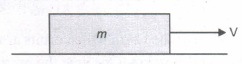
When the block slides, the force acting on the block is kinetic friction which is equal to fk= μsmg.
From Newton's second law ma = -μsmg
The negative sign implies that force acts on the opposite direction of motion.
The acceleration of the block while sliding a =-μkg
The negative sign implies that the acceleration is in opposite direction of the velocity. Note that the acceleration depends only on g and the coefficient of kinetic friction μk. We can apply the following kinematic equation
v=u+at
The final velocity is zero
0=u-ukgt
t=\(\frac { u }{ { \mu }_{ k }g } \).
14.
Average velocity
\(\vec v_{avg}=\frac{\vec r_p-\vec r_O}{\Delta t}\)
Here \(\Delta t=5s\)
\(\vec r_0-i ;\vec r_p=10\hat i\)
\(\vec v_{avg}=\frac{10\hat i}{5 sec}=2\hat icms^{-1}\)
The average velocity is in the positive x-direction.
The average speed total path length/time taken (the path is semi-circular)
= \(\frac{5\pi cm}{5s}=\pi cms^{-1}=3.14 cms^{-1}\)
Note that the average speed is greater than the magnitude of the average velocity.
15.
Life of the man = 100 years
100 years includes 76 normal years and 24 leap years
Total no of days = 76\(\times\)365 + 24\(\times\)366 = 36524 days
Number of seconds = 36524\(\times\)24\(\times\)3600 = 3.155\(\times\)10° second
\(\text{Number of hearts beats}=\frac{Total\ no\ of\ seconds}{Time\ period\ of\ heart\ beat}=\frac{3.155\times10^9}{0.8s}=3.94\times10^9\)
16.
Here M = 3 kg, R = 40 cm = 0.40 m, F = 30 N
Torque, \(\tau \)= F \(\times\) R = 30 \(\times\) 0.40 = 12 Nm
M.l. of the hollow cylinder about its own axis,
I = MR2 = 3 \(\times\) (0.40)2 = 0.48 kgm2
Angular acceleration, \(\alpha =\frac { \tau }{ I } \)= \(\frac {12}{0.48}\)= 25 rad s-2
Linear acceleration, \(\alpha\) = R\(\alpha\) = 0.40\(\times\)25= 10 ms-2
17.
(i) The Law of conservation of linear momentum is a vector law. It implies that both the magnitude and direction of total linear momentum are constant. In some cases, this total momentum can also be zero.
(ii) To analyse the motion of a particle, we can either use Newton's second law or the law of conservation of linear momentum. Newton's second law requires us to specify the forces involved in the process. This is difficult to specify in real situations. But conservation of linear momentum does not require any force involved in the process. It is convenient and hence important.
18.
Given: Speed of the bullet = 350 m/s
i.e., u = 350 m/s
s = 5 cm
v = 0 m/s
a = ?
Formula: v2 = u2 + 2as
\(\Rightarrow\) 0 = u2 + 2as
(or) u2 = -2as (or) a = \(\frac{-u^2}{2s}\)
(or) a = \(\frac{-350\times 350}{2\times 0.5}\) = -12.25\(\times\)105 m/sec2.
19.
\({{1\ AU}\over{1\ parsec}}={{1.496\times{10}^{11}}\over{3.08\times {10}^{16}}}\)
\(={{1.496\times{10}^{11}\times{10}^{-16}}\over{3.08}}\)
\(={{1.496\times{10}^{-5}}\over{3.08}}\)
= 0.485\(\times\)10-5
= 4.85\(\times\)10-6 par sec.
4.85\(\times\)10-6 parsec present in one astronomical unit.
20.
(i) The energy produced by mechanical means is called mechanical energy.
(ii) It is classified into 2 types : (1) Kinetic energy (2) Potential energy.
(iii) The energy possessed by a body due to its motion is called kinetic energy. The energy possessed by the body by virtue of its position is called potential energy. SI unit of energy: N m (or) joule (J).

11th Standard Syllabus & Materials
11th Standard
TN 11th Tamil பீடு பெற நில் - செய்யுள் - காவடிச்சிந்து Important Questions And Answers Study Material - QB365 Set A
NEW11th Standard
TN 11th Tamil பீடு பெற நில் - உரைநடை - மலை இடப்பெயர்கள் : ஓர் ஆய்வு Important Questions And Answers Study Material - QB365 Set A
NEW11th Standard
TN 11th Tamil மாமழை போற்றுதும் - துணைப்பாடம் - யானை டாக்டர் Important Questions And Answers Study Material - QB365 Set A
NEW11th Standard
TN 11th Tamil மாமழை போற்றுதும் - செய்யுள் - ஐங்குறுநூறு Important Questions And Answers Study Material - QB365 Set A



Tamilnadu Stateboard 11th Standard Subjects

Maths

Commerce

Economics

Biology

Business Maths and Statistics

Accountancy

Computer Science
Physics

Chemistry
Maths
Biology
Economics
Physics
Chemistry

History
Business Maths and Statistics

Computer Science
Accountancy

Computer Applications
History
Computer Technology
Commerce
Computer Applications
Computer Technology

Tamil

English

French
Tamilnadu Stateboard Standards

