
 100% FREE ACCESS
11th Standard Syllabus & Materials
11th Standard
TN 11th Tamil இயற்கை வேளாண்மை,சுற்றுச்சூழல் -செய்யுள் - மனோன்மணீயம் Important Questions And Answers Study Material - QB365 Set A
NEW11th Standard
TN 11th Tamil என்னுயிர் என்பேன் -துணைப்பாடம் - இசைத்தமிழர் இருவர் Important Questions And Answers Study Material - QB365 Set A
NEW11th Standard
TN 11th Tamil மொழி கலை -செய்யுள் - ஒவ்வொரு புல்லையும் Important Questions And Answers Study Material - QB365 Set A
NEW11th Standard
TN 11th Tamil பீடு பெற நில் - இலக்கணம் - பகுபத உறுப்புகள் Important Questions And Answers Study Material - QB365 Set A
NEW11th Standard
TN 11th Tamil பீடு பெற நில் - துணைப்பாடம் - வாடிவாசல் Important Questions And Answers Study Material - QB365 Set A
NEW11th Standard
TN 11th Tamil பீடு பெற நில் - செய்யுள் - குறுந்தொகை Important Questions And Answers Study Material - QB365 Set A

Published on: 21/01/2020
Download Tamil Nadu 11th Standard Physics question papers, model tests, one-mark questions, important questions, and public exam papers in PDF format. Free study materials and answer keys for TN State Board students.
Questions + Answers key
Take MCQ Physics Test1.
A block whose mass is 1 kg is fastened to a spring. The spring has a spring constant of 50 Nm-1. The block is pulled to a distance x = 10 cm from its equilibrium position at x = 10 on a frictionless surface from rest at t = 0. Calculate the kinetic, potential and total energies of the block when it is 5 cm away from the mean position.
2.
A body of mass m is attached to lower end of a spring whose upper end is fixed. The spring has negligible mass. When the mass m is slightly pulled down and released, it oscillates with a time period of 3s. When the mass m is increased by 1 kg, the time period of oscillations becomes 5s. Find the value of m is kg.
3.
A train moves towards a stationary observer with speed 34 m/s. The train' sounds a whistle and its frequency registered by the observer is f1. the train's speed is reduced to 17 m/s, the frequency registered is f2. If the speed of sound is 340 m/s, then find the ratio f1/f2.
4.
If the rms speed of hydrogen molecules at 300 K is 1930 ms-1. Then what is the rms speed of oxygen molecules at 1200 K.
5.
For a gas the difference between the two specific heats is 4150 J/Kg K. What is the specific heat of the gas at constant volume if the ratio of specific heat is 1.4?
6.
What is sphere of influence?
7.
A wire elongates by Imm when a load w is hanged from it if the wire goes over a pulley and 2 weights w each are hung at the 2 ends, what will be the elongation of wire in mm?
8.
What is Phase of SHM?
9.
Define molar specific heat capacities.
10.
What are the factors which effect Brownian motion?
11.
What are transverse waves? Give one example.
12.
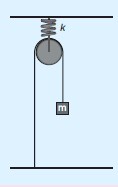
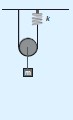
Compute the time period for the following system if the block of mass m is slightly displaced vertically down from its equilibrium position and then released. Assume that the pulley is light and smooth, strings and springs are light.
13.
State Pascal’s law in fluids.
14.
Why is the energy of a satellite (or any other planet) negative?
15.
A car is moving along X-axis. As shown in figure it moves from O to P in 18 seconds and return from P to Q in 6 second. What are the average velocity and average speed of the car in going from
(I)O to P
(II) From O to P and back to Q

16.
When an object be in mechanical equilibrium?
17.
Round off the following numbers as indicated 19.45 up to 3 digits
18.
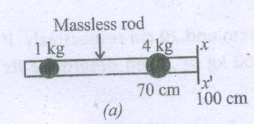
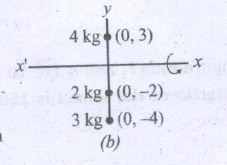
Calculate moment of inertia with respect to rotational axis xx' in following figures (a) and (b).
19.
A charged particle moves towards another charged particle. Under what conditions the total momentum and the total energy of the system conserved?
20.
An object is thrown with initial speed 5 ms-1 with an angle of projection 30\(\gamma \) . What is the height and range reached by the particle?
21.
The radius of the circle is 3.12 m. Calculate the area of the circle with regard to significant figures.
22.
An object of mass m is projected from the ground with initial speed v0. Find the speed at height h.
23.
Two resistances R1 = (100 ± 3) \(\Omega\), R2 = (150 ± 2)\(\Omega\), are connected in series. What is their equivalent resistance?
24.
In a series of successive measurements in an experiment, the readings of the period of oscillation of a simple pendulum were found to be 2.63s, 2.56s, 2.42s, 2.71s, and 2.80s.
Calculate
(i) the mean value of the period of oscillation
(ii) the absolute error in each measurement
(iii) the mean absolute error
(iv) the relative error
(v) the percentage error.
(vi) Express the result in proper form.
25.
Assuming that the frequency \(\gamma\) of a vibrating string may depend upon
(i) applied force (F)
(ii) length (I)
(ill) mass per unit length (m), prove that \(\gamma\alpha{{1}\over{l}}\sqrt{{{F}\over{m}}}\) using dimensional analysis.
1.
Here m = 1 kg, k = 50 Nm-1, A = 10 cm = 0.10 m. y = 5 cm = 0.05 m
Kinetic energy: \({ E }_{ K }=\cfrac { 1 }{ 2 } K\left( { A }^{ 2 }-{ Y }^{ 2 } \right) =\cfrac { 1 }{ 2 } \times 50\left[ \left( 0.10 \right) ^{ 2 }-\left( 0.05 \right) ^{ 2 } \right] =0.1875J\)
Potential energy, \({ E }_{ P }=\cfrac { 1 }{ 2 } { ky }^{ 2 }=\cfrac { 1 }{ 2 } \times 50\times \left( 0.05 \right) ^{ 2 }=0.0625J\)
Total energy, E = EK + EP = 0.1875 + 0.0625 = 0.25
2.
\({ T }_{ 1 }=3=2\pi \sqrt { \cfrac { m }{ k } } \)
\({ T }_{ 2 }=5=2\pi \sqrt { \cfrac { m+1 }{ k } } \)
\(\cfrac { { T }_{ 1 } }{ { T }_{ 2 } } =\cfrac { 3 }{ 5 } =\sqrt { \cfrac { m }{ m+1 } } \)
\(\cfrac { 9 }{ 25 } =\cfrac { m }{ m+1 } \Rightarrow 9m+9=25m\)
\(m=\cfrac { 9 }{ 16 } kg\)
3.
For the stationary observer \({ f }_{ 1 }=\cfrac { v }{ v-{ v }_{ g } } \times f\)
\(\therefore { f }_{ 1 }=\cfrac { 340 }{ 340-34 } \times f_{ 2 }=\cfrac { 340 }{ 340-17 } \times f\)
Hence,\(\cfrac { { f }_{ 2 } }{ { f }_{ 1 } } =\cfrac { 340-17 }{ 340-34 } =\cfrac { 19 }{ 18 } \Rightarrow f_{ 1 }:{ f }_{ 2 }=19:18\)
4.
From rms speed, \({ v }_{ rms }=\sqrt { \cfrac { 3RT }{ M } } \)
\({ V }_{ O_{ 322 } }=\sqrt { \cfrac { 3RT{ O }_{ 2 } }{ { M }_{ { O }_{ 2 } } } } ;v_{ { H }_{ 2 } }=\sqrt { \cfrac { 3RT{ H }_{ 2 } }{ { M }_{ { H }_{ 2 } } } } \)
\(\cfrac { { V }_{ { O }_{ 2 } } }{ { V }_{ H_{ 2 } } } =\sqrt { \cfrac { { T }_{ O_{ 2 } } }{ { T }_{ { H }_{ 2 } } } ,\cfrac { { M }_{ { H }_{ 2 } } }{ { M }_{ { O }_{ 2 } } } } \)
\({ v }_{ { O }_{ 2 } }=\left( \sqrt { \cfrac { 1200 }{ 300 } \times \cfrac { 2 }{ 32 } } \right) \times 1930=\cfrac { 1930 }{ 2 } \)
\({ v }_{ { O }_{ 2 } }=965{ ms }^{ -1 }\)
5.
From Mayer's equation, Cp - Cv = R
CP-Cv=4150
\(\cfrac { { C }_{ P } }{ { C }_{ V } } =1.4\Rightarrow { C }_{ P }=1.4{ C }_{ V }\)
\(1.4{ C }_{ v }-{ C }_{ V }=4150\)
\(\therefore { C }_{ V }=\cfrac { 4150 }{ 0.4 } \Rightarrow { C }_{ V }=10375J/kg\)
6.
It is a sphere drawn around a particular molecule as centre and molecular range as radius.
7.
Young's modulus, Y = \(\frac{W}{A}\times \frac{L}{l}\)
∴ elongation, I = \(\frac{WL}{Ay}\)
on either side of wire, tension is w but length is \(\frac{l}{2}\)
∴ elongation produced along either side = \(\frac{l}{2}\)mm
Total elongation produced = \(\frac{l}{2}\)+\(\frac{l}{2}\)=1 mm
8.
(i) The phase of a vibrating particle at any instant completely specifies the state of the particle.
(ii) It expresses the position and direction of motion of the particle at that instant with respect to its mean position.
(iii) where ωt+ φ0 = φ is called the phase of the vibrating particle. y =A sin (ωt +φ0 )
(iv) The displacement acquired by an oscilleting body when time t = 0 s (initial time), the phase φ = φ0 is called epoch (initial phase) where φ0 is called the angle of epoch.
9.
(i) The amount of heat required to raise the temperature of one mole of a substance by 1K Dr 1°C at constant volume is called molar specific heat capacity at constant volume (Cv).
(ii) If a pressure is kept constant, it is called molar specific heat capacity at constant pressure (Cp)
10.
The Brownian motion increases
(i) with the decrease in single of the suspended particle
(ii) with the increases in temperature of the fluid
(iii) with the decrease indensity of the fluid
(iv) with the decrease in viscosity of the fluid
11.
In transverse wave motion, the constituents of the medium oscillate or vibrate about their mean positions in a direction perpendicular to the direction of propagation (direction of energy transfer) of waves.
Example: light (electromagnetic waves)
12.
Case(a):
Pulley is fixed rigidly here.
When the mass displace by y and the spring will also stretch by y.
Hence, F = T = ky
\(T=2\pi \sqrt { \frac { m }{ k } } \)
Case(b):
Mass displace by y, pulley also displaces by y.
T = 4ky.
\(T=2\pi \sqrt { \frac { m }{ 4k } } \)
13.
Pascal's law states that, if the pressure in a liquid is changed at a particular point, the change is transmitted to the entire liquid without being diminished in magnitude.
14.
(i) Implies that the satellite is bound to the Earth and it cannot escape from the Earth
(ii) As h approaches ∝ the total energy tends to zero. Its physical meaning is that the satellite is completely free from the influence of Earth's gravity and is not bound to Earth at large distances.
15.
(i) O to P, Average velocity = 20 ms-1
(ii) O to P and back to Q
Average velocity = 10ms-1
Average speed = 20 ms-1
16.
A rigid body is said to be in mechanical equilibrium when both its linear momentum and angular momentum remain constant.
17.
19.4
18.
(a) Ixx' = 4 \(\times\) (0.3)2 + 1 \(\times\) (0.8)2 = 1 kgm2
(b) Ixx'= 4 \(\times\) (3)2 + 2 \(\times\) (2)2 + 3 \(\times\) (4)2 = 92 kgm2
19.
(i) Both charged particles shall be dissimilar charge. (i.e. positive and negative)
(ii) After collision the charged particles should stick together permanent.
(iii) They should move with common velocity.
20.
Initial speed u = 5 ms-1
Angle of projection = 30°; g = 9.8 ms-2
Heightmax=?
Range R = ?
Height, \({ h }_{ max }=\frac { { u }^{ 2 }{ sin }^{ 2 }\theta }{ 2g } ;R=\frac { { u }^{ 2 }sin2\theta }{ g } \)
\({ h }_{ max }=\frac { { 5 }^{ 2 }{ sin }^{ 2 }30° }{ 2\times 9.8 } =\frac { 25\times \frac { 1 }{ 4 } }{ 19.6 } =\frac { 25 }{ 19.6 } \times \frac { 1 }{ 4 } \)
hmax = 0.318 m
Range, \(R=\frac { 25\quad sin60° }{ 9.8 } =\frac { 25\times \sqrt { 3 } }{ 19.6 } =\frac { 25\times 1.732 }{ 19.6 } \)
Range, R = 2.209 m.
21.
Radius of the circle r = 3.12 m
Area of the circle A = \(\pi\) r2
= 3.14\(\times\)3.12\(\times\)3.12
= 30.566016 m2
According to the rule of significant
A = 30.6 m2
22.
Since the gravitational force is conservative; the total energy is conserved throughout the motion.
| Initial | Final | |
|---|---|---|
| Kinetic energy | \(\frac { 1 }{ 2 } { mv }_{ 0 }^{ 2 }\) | \(\frac { 1 }{ 2 } { mv }^{ 2 }\) |
| Potential energy | 0 | mgh |
| Total energy | \(\frac { 1 }{ 2 } { mv }_{ 0 }^{ 2 }+0=\frac { 1 }{ 2 } { mv }_{ 0 }^{ 2 }\) | \(\frac { 1 }{ 2 } { mv }^{ 2 }+mgh\) |
Final values of potential energy, kinetic energy and total energy are measured at the height h.
By law of conservation of energy, the initial and final total energies are the same.
\(\frac { 1 }{ 2 } { mv }_{ 0 }^{ 2 }=\frac { 1 }{ 2 } { mv }^{ 2 }+mgh\)
\({ v }_{ 0 }^{ 2 }={ v }^{ 2 }+2gh\)
\(v=\sqrt { { v }_{ 0 }^{ 2 }-2gh } \)
23.
R1 = 100 ± = 3\(\Omega\); R2 = 150 ± 2\(\Omega\)
Equivalent resistance R =?
Equivalent resistance R = R1+ R2 = (100 ± 3) + (150 ± 2) = (100 + 150) ± (3 + 2)
R = (250 ± 5) \(\Omega\)
24.
t1 = 2.63s, t2 = 2.56s,
t3 = 2.42s, t4 = 2.71s, t5 = 2.80s
(i) Tm =\({t_1+t_2+t_3+t_4+t_5\over 5}={2.63+2.56+2.42+2.71+2.80\over 5}\)
Tm = 2.62s (Rounded off to 2nd decimal place)
(ii) Absolute error
\(\triangle\)T = Tm - t
\(\triangle\)TI = 2.62 - 2.63 = +0.01s
\(\triangle\)T2 = 2.62 - 2.56 = +0.06s
\(\triangle\)T3 = 2.62 - 2.42 = +0.20s
\(\triangle\)T4 = 2.62 - 2.71 = +0.09s
\(\triangle\)T5 = 2.62 - 2.80 = +0.18s
(iii) Mean absolute error = \({\sum |\triangle T_1|\over n}\)
\(\triangle\)Tm = \({0.01+0.06+0.20+0.09+0.18\over 5}\)
\(\triangle\)Tm=\({0.54\over 5}=0.108s=0.11s\) (Rounded off to 2nd decimal place)
(iv) Relative error: ST =\({\triangle T_m\over T_m}={0.11\over 2.62}=0.0419\)
ST = 0.04
(v) Percentage error in T = 0.04\(\times\)100% = 4%
(vi) Time period of simple pendulum = T = (2.62 ± 4%)s
25.
Frequency of a vibrating body \(\gamma \alpha \frac{1}{l} \sqrt{\frac{F}{M}}\)
\( a\text { Dimension of frequency } =\mathrm{M}^{0} \mathrm{~L}^{0} \mathrm{~T}^{-1} \)
\(\text {Dimension of length } =\mathrm{L}=\mathrm{M}^{0} \mathrm{LT}^{0} \)
\(\text {Dimension of Force } =\mathrm{MLT}^{-2} \)
\(\text {Dimension of Mass } =\mathrm{M}^{1} \mathrm{~L}^{0} \mathrm{~T}^{0} \)
\(\text {Frequency } \gamma =x \)
\(\gamma =\mathrm{K}\left[\mathrm{F}^{x}\right][\mathrm{M}]^{y}[\mathrm{~L}]^{z}\)
Using dimensions we get
\(\mathrm{M}^{0} \mathrm{~L}^{0} \mathrm{~T}^{-1}=\left[\mathrm{MLT}^{-2}\right]^{x}[\mathrm{M}]^{y}[\mathrm{~L}]^{z} \)
\(\mathrm{M}^{0} \mathrm{~L}^{0} \mathrm{~T}^{-1}=\mathrm{M}^{x+y} \mathrm{~L}^{x+z} \mathrm{~T}^{-2 x}\)
Comparing the powers we get
x + y = 0 z = -x = \(\frac{1}{2} \)
x + z = 0 y = -x = \(\frac{-1}{2} \)
-2 x = -1
\(\therefore x =\frac{-1}{-2}=\frac{1}{2} \)
\(\therefore \gamma =1 \times[\mathrm{F}]^{1 / 2}[\mathrm{M}]^{-1 / 2}[\mathrm{~L}]^{-1 / 2} \)
\(\gamma =\frac{1}{l} \sqrt{\frac{F}{m}}\)

11th Standard Syllabus & Materials
11th Standard
TN 11th Tamil பீடு பெற நில் - செய்யுள் - காவடிச்சிந்து Important Questions And Answers Study Material - QB365 Set A
NEW11th Standard
TN 11th Tamil பீடு பெற நில் - உரைநடை - மலை இடப்பெயர்கள் : ஓர் ஆய்வு Important Questions And Answers Study Material - QB365 Set A
NEW11th Standard
TN 11th Tamil மாமழை போற்றுதும் - துணைப்பாடம் - யானை டாக்டர் Important Questions And Answers Study Material - QB365 Set A
NEW11th Standard
TN 11th Tamil மாமழை போற்றுதும் - செய்யுள் - ஐங்குறுநூறு Important Questions And Answers Study Material - QB365 Set A



Tamilnadu Stateboard 11th Standard Subjects

Maths

Commerce

Economics

Biology

Business Maths and Statistics

Accountancy

Computer Science
Physics

Chemistry
Maths
Biology
Economics
Physics
Chemistry

History
Business Maths and Statistics

Computer Science
Accountancy

Computer Applications
History
Computer Technology
Commerce
Computer Applications
Computer Technology

Tamil

English

French
Tamilnadu Stateboard Standards

