
 100% FREE ACCESS
11th Standard Syllabus & Materials
11th Standard
TN 11th Tamil இயற்கை வேளாண்மை,சுற்றுச்சூழல் -செய்யுள் - மனோன்மணீயம் Important Questions And Answers Study Material - QB365 Set A
NEW11th Standard
TN 11th Tamil என்னுயிர் என்பேன் -துணைப்பாடம் - இசைத்தமிழர் இருவர் Important Questions And Answers Study Material - QB365 Set A
NEW11th Standard
TN 11th Tamil மொழி கலை -செய்யுள் - ஒவ்வொரு புல்லையும் Important Questions And Answers Study Material - QB365 Set A
NEW11th Standard
TN 11th Tamil பீடு பெற நில் - இலக்கணம் - பகுபத உறுப்புகள் Important Questions And Answers Study Material - QB365 Set A
NEW11th Standard
TN 11th Tamil பீடு பெற நில் - துணைப்பாடம் - வாடிவாசல் Important Questions And Answers Study Material - QB365 Set A
NEW11th Standard
TN 11th Tamil பீடு பெற நில் - செய்யுள் - குறுந்தொகை Important Questions And Answers Study Material - QB365 Set A

Published on: 12/10/2019
Inheritance
Download Tamil Nadu 11th Standard Computer Science question papers, model tests, one-mark questions, important questions, and public exam papers in PDF format. Free study materials and answer keys for TN State Board students.
Questions + Answers key
Take MCQ Computer Science Test
1.
Write the syntax for derived and base class.
2.
Write the syntax of creating derived class.
3.
List the types of inheritance.
4.
What is the difference between public and private visibility mode?
5.
Why derived class is called power packed class?
6.
What is a base class?
7.
What is inheritance?
8.
Explain the uses of private, protected and public inheritance.
9.
Why do you need for inheritance?
10.
What do you mean by overriding?
11.
What is the difference between polymorphism and inheritance though are used for reusability of code?
12.
What are the points to be noted while deriving a new class?
13.
Write the output of the following program
#include< iostream >
using namespace std;
class A
{
protected:
int x;
public:
void show()
{
cout<<"x = "<<x<<endl;}
A()
{
cout<<endl<<" I am class A "<<endl;}
~A( )
{
cout<<endl<<" Bye ";} };
};
class B : public A
{
protected:
int y;
public:
B(int x, int y)
{ x = x1;
y = y1; }
B( )
{
cout<<endl<<" I am class B "<<endl; }
~B( )
{
void show( )
{
cout<<"y = "<<y<<endl; }
};
int main( )
{
A objA;
B objB(30, 20);
objB.show( );
return 0;
}
14.
Consider the following c++ code and answer the questions
class Personal
{
int Class,Rno;
char Section;
protected:
char Name[20];
public:
personal();
void pentry();
voidPdisplay();
};
class Marks:private Personal
{
float M{5};
protected:
char Grade[5];
public:
Marks();
void M entry();
void M display();
};
class Result:public Marks
{
float Total,Agg;
public:
char FinalGrade, Commence[20];
Result();
void R calculate();
void R display();
}:
(i) Which type of Inheritance is shown in the program?
15.
Explain the different types of inheritance.
16.
A class that inherits from a super class is called________.
sub class
nested class
super class
base class
17.
A class that is used to derive another class is called________.
sub class
super class
nested class
derived class
18.
Which of the following feature of oops acquires the properties of the existing class?
polymorphism
Encapsulation
Inheritance
Data abstraction
19.
Which amongst the following is executed in the order of inheritance?
Destructor
Member function
Constructor
Object
20.
Which of the following derives a class student from the base class school
school: student
class student: public school
student: public school
class school: public student
21.
Which of the following is the process of creating new classes from an existing class
Polymorphism
Inheritance
Encapsulation
super class
1.
class derived_class _name :visibility _mode base_class _name
{
// members of derivedclass
};
2.
class derived_class_name :visibility _mode base_
class name
{
// members of derived class
};
3.
(i) Single Inheritance
(ii) Multiple Inheritance
(iii) Multilevel Inheritance
(iv) Hierarchical Inheritance
(v) Hybrid Inheritance
4.
| Private visibility mode | Public visibility mode |
| When a base class is inherited with private visibility mode the public and protected members of the base class become 'private' members of the derived class. | When a base class is inherited with public visibility mode, the protected members of the base class will be inherited as protected members of the derived class and the public members of the base class will be inherited as public members of the derived class. |
5.
The derived class is a power packed class, as it can add additional attributes and methods and thus enhance its functionality.
6.
A class that is used as the basis for inheritance is called a superclass or base class.
7.
Inheritance is one of the most important features of Object Oriented Programming. In object- oriented programming, inheritance enables new class and its objects to take on the properties of the existing classes.
8.
(i) Private inheritance should be used when you want the features of the base class to be available to the derived class but not to the classes that are derived from the derived class.
(ii) Protected inheritance should be used when features of base class to be available only to the derived class members but not to the outside world.
(iii) Public inheritance can be used when features of base class to be available the derived class members and also to the outside world.
9.
(i) Inheritance is an important feature of object oriented programming used for code reusability. It is a process of creating new classes called derived classes, from the existing or base classes.
(ii) Inheritance allows us to inherit all the code (except declared as private) of one class to another class. The class to be inherited is called base class or parent class and the class which inherits the other class is called derived class or child class.
(iii) The derived class is a power packed class, as it can add additional attributes and methods and thus enhan e its functionality.
10.
When a derived class member function has the same name as that of its base class member function, the derived class member function shadows/hides the base class's inherited function. This situation is called function overriding.
11.
| Polymorphism | Inheritance |
| Reusability of code is implemented through functions (or) methods. | Reusability of code is implemented through classes. |
| Polymorphism is the ability of a function to respond differently to different message. | Inheritance is the process of creating derived classes from the base class or classes. |
| Polymorphism is achieved through overloading. | Inheritance is achieved by various types of inheritances namely single, multiple, multilevel, hybrid and hierarchical inheritances. |
12.
The following points should be observed for defining the derived class:
(i) The keyword class has to be used.
(ii) The name of the derived class is to be given after the keyword class.
(iii) A single colon.
(iv) The type of derivation (the visibility mode), namely private, public or protected. If no visibility mode is specified, then by default the visibility mode is considered as private.
(v) The names of all base classes (parent classes) separated by comma.
13.
I am class A
I am class B
x = 30
y = 20
Bye
Bye
Bye
14.
Multiple Inheritance
15.
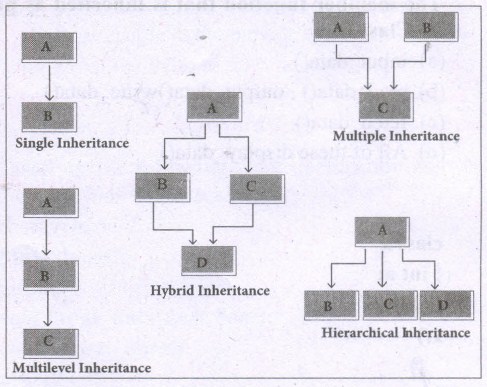
Types of Inheritance
There are different types of inheritance viz., Single inheritance, Multiple inheritance, Multilevel inheritance, hybrid inheritance and hierarchical inheritance.
1. Single Inheritance: When a derived class inherits only from one base class, it is known as single inheritance.
2. Multiple Inheritance: When a derived class inherits from multiple base classes it is known as multiple inheritance.
3. Hierarchical inheritance: When more than one derived classes are created from a single base class, it is known as Hierarchical inheritance.
4. Multilevel Inheritance: The transitive nature of inheritance is itself reflected by this form of inheritance. When a class is derived from a class which is a derived class - then it is referred to as multilevel inheritance.
5. Hybrid inheritance: When there is a combination of more than one type of inheritance, it is known as hybrid inheritance. Hence, it may be a combination of Multilevel and Multiple inheritance or Hierarchical and Multilevel inheritance or Hierarchical, Multilevel and Multiple inheritance.
16.
(a)
sub class
17.
(b)
super class
18.
(d)
Data abstraction
19.
(c)
Constructor
20.
(d)
class school: public student
21.
(b)
Inheritance

11th Standard Syllabus & Materials
11th Standard
TN 11th Tamil பீடு பெற நில் - செய்யுள் - காவடிச்சிந்து Important Questions And Answers Study Material - QB365 Set A
NEW11th Standard
TN 11th Tamil பீடு பெற நில் - உரைநடை - மலை இடப்பெயர்கள் : ஓர் ஆய்வு Important Questions And Answers Study Material - QB365 Set A
NEW11th Standard
TN 11th Tamil மாமழை போற்றுதும் - துணைப்பாடம் - யானை டாக்டர் Important Questions And Answers Study Material - QB365 Set A
NEW11th Standard
TN 11th Tamil மாமழை போற்றுதும் - செய்யுள் - ஐங்குறுநூறு Important Questions And Answers Study Material - QB365 Set A



Tamilnadu Stateboard 11th Standard Subjects

Maths

Commerce

Economics

Biology

Business Maths and Statistics

Accountancy
Computer Science

Physics

Chemistry
Maths
Biology
Economics
Physics
Chemistry

History
Business Maths and Statistics

Computer Science
Accountancy

Computer Applications
History
Computer Technology
Commerce
Computer Applications
Computer Technology

Tamil

English

French
Tamilnadu Stateboard Standards
