
 100% FREE ACCESS
11th Standard Syllabus & Materials
11th Standard
TN 11th Tamil இயற்கை வேளாண்மை,சுற்றுச்சூழல் -செய்யுள் - மனோன்மணீயம் Important Questions And Answers Study Material - QB365 Set A
NEW11th Standard
TN 11th Tamil என்னுயிர் என்பேன் -துணைப்பாடம் - இசைத்தமிழர் இருவர் Important Questions And Answers Study Material - QB365 Set A
NEW11th Standard
TN 11th Tamil மொழி கலை -செய்யுள் - ஒவ்வொரு புல்லையும் Important Questions And Answers Study Material - QB365 Set A
NEW11th Standard
TN 11th Tamil பீடு பெற நில் - இலக்கணம் - பகுபத உறுப்புகள் Important Questions And Answers Study Material - QB365 Set A
NEW11th Standard
TN 11th Tamil பீடு பெற நில் - துணைப்பாடம் - வாடிவாசல் Important Questions And Answers Study Material - QB365 Set A
NEW11th Standard
TN 11th Tamil பீடு பெற நில் - செய்யுள் - குறுந்தொகை Important Questions And Answers Study Material - QB365 Set A

Published on: 13/03/2019
11th Public Exam March 2019 Important Creative Questions and Answers
Download Tamil Nadu 11th Standard Business Maths and Statistics question papers, model tests, one-mark questions, important questions, and public exam papers in PDF format. Free study materials and answer keys for TN State Board students.
Questions + Answers key
Take MCQ Business Maths and Statistics Test
1.
Find the second order derivative of the following functions with respect to x, 3 cos x + 4 sin x
2.
If tan A = m tanB, prove that \(\frac { sin(A+B) }{ sin(A-B) } =\frac { m+1 }{ m-1 } \)
3.
Using binomial theorem, expand \({ \left( { x }^{ 2 }+\frac { 1 }{ { x }^{ 2 } } \right) }^{ 4 }\)
4.
Develop a network based on the following information.
| Activity | A | B | C | D | B | E |
| Immediate Predecessor | - | - | A | C | E | F |
5.
Solve the following LPP graphically. Minimize\(Z=-3{ x }_{ 1 }+4{ x }_{ 2 }\)
Subject to the constraints \({ x }_{ 1 }+2{ x }_{ 2 }\le 8\quad ,{ 3x }_{ 1 }+{ 2x }_{ 2 }\le 12\quad and\quad \quad { x }_{ 1 }\ge 0,{ x }_{ 2 }\ge 2.\)
6.
Solve the following LPP graphically. Maximize Z =−x1 + 2x2
Subject to the constraints −x1 + 3x2 ≤ 10, x1 + x2 ≤ 6,x1 − x2 ≤ 2 and x1,x2 ≥ 0
7.
Find the amount of an ordinary annuity of 12 monthly payments of Rs.1000 that earn interset at 12% per year compounded monthly.
8.
Find the harmonic mean of 6, 14, 21, 30
9.
Two phychologist ranked 12 candidates in the selection list as below:
| X | 1 | 2 | 3 | 4 | 5 | 6 | 7 | 8 | 9 | 10 | 11 | 12 |
| Y | 12 | 9 | 6 | 10 | 3 | 5 | 4 | 7 | 8 | 2 | 11 | 1 |
Find the rank correlation co-efficient.
10.
Calculate the covariance of the following pairs of observation of two variates X and Y. (1, 5)(2, 4)(3, 3)(4, 2)(5, 1)
11.
A die is thrown. Find the probability of getting
(i) a prime number
(ii) a number greater than or equal to 3
12.
The price of a commodity increased by 5% from 2004 to 2005, 8% from 2005 to 2006 and 77% from 2006 to 2007. Calculate the average increase from 2004 to 2007?
13.
A cash prize of Rs. 1,500 is given to the student standing first in examination of Business Mathematics by a person every year. Find out the sum that the person has to deposit to meet this expense. Rate of interest is 12% p.a
14.
There are two series of index numbers P for price index and S for stock of the commodity. The mean and standard deviation of P are 100 and 8 and of S are 103 and 4 respectively. The correlation coefficient between the two series is 0.4. With these data obtain the regression lines of P on S and S on P.
15.
Let u = x cos y + y cos x. Verify \(\frac { { \partial }^{ 2 }u }{ { \partial x }\partial y } +\frac { { \partial }^{ 2 }u }{ { \partial y }{ \partial x } } \)
16.
If u = log(x2+y2), then show that \(\frac { { \partial }^{ 2 }u }{ { \partial x }^{ 2 } } +\frac { { \partial }^{ 2 }u }{ \partial { y }^{ 2 } } =0\)
17.
Draw a network diagram for the project whose activities and their predecessor relationships are given below:
| Activity: | A | B | C | D | E | F | G | H | I | J | K |
| Predecessor activity: | - | - | - | A | B | B | C | D | F | H,I | F,G |
18.
If \(y={2x+1\over 3x+2}\) then, obtain the value of elasticity at x = 1.
19.
Prove that \(\frac{\sin(x+y)}{\sin(x-y)}=\frac{\tan x+\tan y}{\tan x-\tan y}\)
20.
Differentiate: sin x.sin 2x. sin 3x with respect to 'x'.
21.
Prove that the lines (b - c) x + (c - a) y + (a - b) = 0, (c - a) x + (a - b) y + (b - c) = 0, and (a - b) x + (b - c) y+c-a=0 are concurrent.
22.
Solve : \(\frac { (2x+1)! }{ (x+2)! } .\frac { (x-1)! }{ (2x-1)! } =\frac { 3 }{ 5 } \)
23.
Find y2 of the following function x = a cos \(\theta\), y = a sin \(\theta\)
24.
Find the center and radius of the circle x2 + y2 - 22x - 4y + 25 = 0
25.
Show that \(\sin ^{-1}\left(-\frac{3}{5}\right)-\sin ^{-1}\left(-\frac{8}{17}\right)=\cos ^{-1} \frac{84}{85}\)
26.
Find the inverse of \(\begin{bmatrix}-1 & 5 \\-3 & 2 \end{bmatrix}\).
27.
Prove that \(\left| \begin{matrix} x & sin\theta & cos\theta \\ -sin\theta & -x & 1 \\ cos\theta & 1 & x \end{matrix} \right| \) is independent of \(\theta\)
28.
If \(f(x)={ x }^{ 3 }-\frac { 1 }{ { x }^{ 3 } } \), x \(\neq\) 0, then show that \(f(x)+f\left( \frac { 1 }{ x } \right) =0\)
29.
Find |AB| if \(A=\begin{bmatrix} 3&-1\\2&1 \end{bmatrix} \) and \(B =\begin{bmatrix} 3&0\\1&-2 \end{bmatrix}\)
30.
Find the minors and cofactors of all the elements of the following determinants. \(\begin{bmatrix} 1&-3&2\\4&-1&2\\3&5&2 \end{bmatrix}\)
31.
Expand the following by using binomial theorem. (2a - 3b)4
32.
Evaluate: \(\underset { x\rightarrow 2 }{ lim } \frac { { x }^{ 2 }-4x+6 }{ x+2 } \)
33.
Evaluate the following tan\(\left(\cos ^{-1} \frac{8}{17}\right)\)
34.
Show that \(\frac { sin2\theta }{ 1+cos2\theta } =tan\theta \)
35.
Find the equation of the circle with centre at (3, –1) and radius is 4 units.
36.
From a class of 32 students, 4 students are to be chosen for a competition. In how many ways can this be done?
37.
Find the values of A and B if \(\frac { 1 }{ \left( { x }^{ 2 }-1 \right) } =\frac { A }{ x-1 } +\frac { B }{ x+1 } \)
38.
Show that \(\left[ \begin{matrix} 8 & 2 \\ 4 & 3 \end{matrix} \right] \)is non – singular.
39.
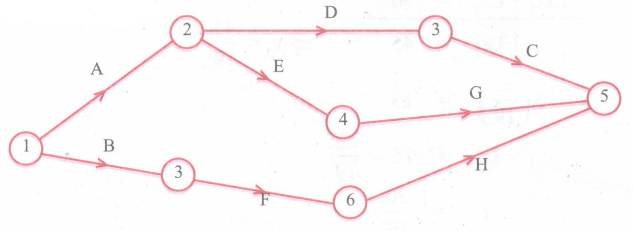
Construct the network for the projects consisting of various activities and their precedence relationships are as given below: A, B can start simultaneously
A < D, E; B < F; E < G, D < C, F < H.
40.
A dealer whises to purchase a number of fans and sewing machines. He has only Rs.5760 to invest and has a space for atmost 20 items. A fan costs him Rs.360 and a sewing machine Rs. 240. His expectation is he can sell a fan at a profit of Rs.22 and a sewing machine at a profit of ns. Formulate this as an LPP to maximize his profit?
41.
A producer has 30 and 17 units of labour and capital respectively which he can use to produce two types of goods X and Y. To produce one unit of X, 2 unit of labour and 3 units of capital are required. Similarly, 3 units of labour and 1 unit of capital is required to produce one unit of Y. If X and Yare priced at HOO and H20 per unit respectively, how should the producer use his resources to maximize the total revenue? Formulate the LPP for the above.
42.
What is the amount of perpetual annuity of Rs. 50 at 5% compound interest per year?
43.
From the following data calculate the correlation coefficient Σxy = 120, Σx2 = 90, Σy2 = 640
44.
The profit function of a firm in producing x units of a product is given by\(p(x)=\frac { { x }^{ 3 } }{ 3 } +{ x }^{ 2 }+x\). Check whether the firm is running a profitable business or not.
45.
Evaluate: cos 20° + cos 100° + cos 140°
46.
Prove that : \(\frac { \cos 2A-\cos 3A }{ \sin 2A-\sin 3A } =\tan\frac { A }{ 12 } \)
47.
Differentiate \(\frac { { x }^{ 2 }cos\frac { \pi }{ 4 } }{ sinx } \)
48.
Prove that \(\frac{\tan 69^o+\tan 66^o}{1-\tan 69^o\tan 66^o}=-1\)
49.
Prove that \(sin^2\left(\frac{\pi}{8}+\frac x2\right)-sin^2\left(\frac{\pi}{8}-\frac x2\right)=\frac{1}{\sqrt2}\sin x.\)
50.
Find the angle between the pair of lines represented by the equation 3x2+10xy+8y2+14x+22y+15=0.
51.
Find the length of the tangent from (1,2) to the circle x2 + y2 - 2x + 4y + 9 = 0
52.
Show that 10P3 = 9 P3 + 3. 9P2
53.
Prove that \(\tan^{-1}\left(\frac mn\right)-\tan^{-1}\left(\frac{m-n}{m+n}\right)=\frac{\pi}{4}\)
54.
Evaluate the following : \(\frac { 7! }{ 6! } \)
55.
Find the values of each of the following trigonometric ratios. \(\sin { { 300 }^{ o } } \)
56.
Using the property of determinant, evaluate \(\begin{vmatrix} 6 &5 &12 \\ 2 & 4 &4 \\2 & 1 & 4 \end{vmatrix}.\)
57.
If A \(=\begin{bmatrix} 1 \\ -4\\3 \end{bmatrix}\) and B = [-1 2 1], verify that (AB)T = BT. AT
58.
Prove that \(2\tan^{-1}(x)=\sin^{-1}\left(\frac{2x}{1+x^2}\right)\)
59.
The technology matrix of an economic system of two industries is\(\begin{bmatrix} 0.50 & 0.30 \\ 0.41 & 0.33 \end{bmatrix}\). Test whether the system is viable as per Hawkins Simon conditions.
60.
Differentiate: \(\sqrt{\frac{(x-3)(x^2+4)}{3x^2+4x+5}}\)
61.
Prove that 75-12x+6x2-x3 always decreases as x increases.
62.
Babu sold some Rs. 100 shares at 10% discount and invested his sales proceeds in 15% of Rs. 50 shares at Rs. 33. Had he sold his shares at 10% premium instead of 10% discount, he would have earned Rs. 450 more. Find the number of shares sold by him.
63.
A certain manufacturing concern has total cost function C = 15 + 9x - 6x2 + x3 . find Find x, when the total cost is minimum
64.
Maximize Z = 3x1 + 4x2 subject to x1 – x2 ≤ –1; –x1 + x2 ≤ 0 and x1, x2 ≥ 0
65.
The cost function of a firm is \(C={1\over3}x^3-3x^2+9x\). Find the level of output (x > 0) when average cost is minimum.
66.
If X \(=\begin{bmatrix} 8 &-1&-3 \\-5 &1&2\\10&-1&-4 \end{bmatrix}\) and Y = \(\begin{bmatrix} 2 & 1 & -1\\0 & 2 & 1\\ 5& p & q \end{bmatrix}\) then, find p, q if Y = X-1
67.
If\(A=\begin{bmatrix}1&3&3\\1&4&3\\1&3&4 \end{bmatrix}\)then verify that A (adj A) = |A| I and also find A-1.
68.
Show that the middle term in the expansion of (1 + x)2n is \(\frac { 1.3.5....(2n-1){ 2 }^{ n }.{ x }^{ n } }{ n! } \)
69.
Prove that \(\begin{vmatrix} -a^{ 2 } & ab & ac \\ ab & -b^{ 2 } & bc \\ ac & bc & -c^{ 2 } \end{vmatrix}=4a^{ 2 }b^{ 2 }{ c }^{ 2 }\)
70.
Resolve into partial fractions for the following : \(\frac{x^2-6 x+2}{x^2(x+2)}\)
1.
y = 3cosx + 4sinx
y1 = –3 sin x + 4 cos x
y2 = –3 cos x – 4 sin x
y2 = – (3 cos x + 4 sin x)
y2 = –y (or) y2 + y = 0
2.
Given tanA = m tanB
\(\cfrac { sinA }{ cosA } =m\cfrac { sinB }{ cosB } \)
\(\cfrac { sinAcosB }{ cosAsinB } =m\)
Applying componendo and dividendo rule, we get
\(\cfrac { sinAcosB+cosAsinB }{ sinAcosB-cosAsinB } =\cfrac { m+1 }{ m-1 } \)
\(\cfrac { sin(A+B) }{ sin(A-B) } =\cfrac { m+1 }{ m-1 } \)
which completes the proof.
3.
\(\left( { x }^{ 2 }+\cfrac { 1 }{ { x }^{ 2 } } \right) ^{ 4 }=\left( { x }^{ 2 } \right) ^{ 4 }+4{ C }_{ 1 }\left( { x }^{ 2 } \right) ^{ 3 }\cfrac { 1 }{ { x }^{ 2 } } +{ 4C }_{ 2 }\left( { x }^{ 2 } \right) ^{ 2 }\left( \cfrac { 1 }{ { x }^{ 2 } } \right) ^{ 2 }+4{ C }_{ 3 }\left( { x }^{ 2 } \right) \left( \cfrac { 1 }{ { x }^{ 2 } } \right) ^{ 3 }+4{ C }_{ 4 }\left( \cfrac { 1 }{ { x }^{ 2 } } \right) ^{ 4 }\)
\(={ x }^{ 8 }+4{ x }^{ 4 }+6+\cfrac { 4 }{ { x }^{ 2 } } +\cfrac { 4 }{ { x }^{ 4 } } +\cfrac { 1 }{ { x }^{ 8 } } \)
4.
Using the immediate precedence relationship and following the rules of network construction, the required network is shown in the diagram.
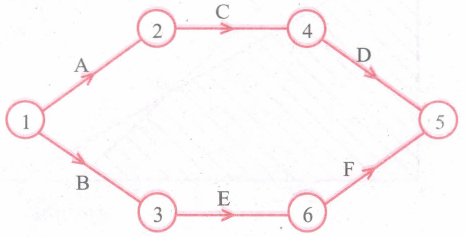
5.
Since the decision variables are non-negative, the solution lies in the I-quadrant of the plane. Consider the equations
\({ x }_{ 1 }+2{ x }_{ 2 }= 8\)
| \({ x }_{ 1 }\) | 0 | 8 |
| \({ x }_{ 2 }\) | 4 | 0 |
\({ 3x }_{ 1 }+{ 2x }_{ 2 }=12\)
| \({ x }_{ 1 }\) | 0 | 4 |
| \({ x }_{ 2 }\) | 6 | 0 |
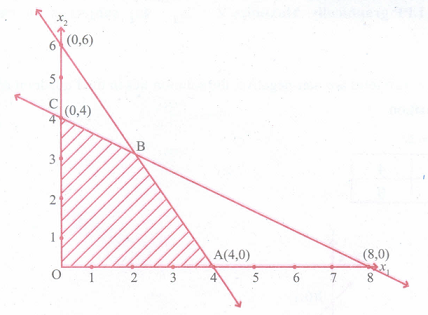
The feasible region is OABC and its co-ordinates are 0(0, 0) A( 4, 0) qo, 4) and B is the point of intersection of the lines
\({ x }_{ 1 }+2{ x }_{ 2 }=8\) ... (1) \(and\quad { 3x }_{ 1 }+{ 2x }_{ 2 }=12\) ...(2)
Verification of B:
\((1)\Rightarrow { x }_{ 1 }+2{ x }_{ 2 }=8\\ \quad \quad (-)\quad (-)\quad \quad (-)\\ (2)\Rightarrow 3{ x }_{ 1 }+2{ x }_{ 2 }=12\\ -----------\\ -2{ x }_{ 1 }=-4 \Rightarrow { x }_{ 1 }=2\)
\(From(1), 2+2{ x }_{ 2 }=8\Rightarrow 2{ x }_{ 2 }=6\Rightarrow { x }_{ 2 }=3\)
∴ B is (2,3)
| Corner Points | \(Z=-3{ x }_{ 1 }+4{ x }_{ 2 }\) |
|---|---|
| O(0,0) | 0 |
| A(4, 0) | -12 |
| B (2, 3) | 6 |
| C(0,4) | 16 |
Minimum of Z occurs at A(4, 0).
Hence, the solution is x1= 4, x2 = 0 and Zmin = - 12.
6.
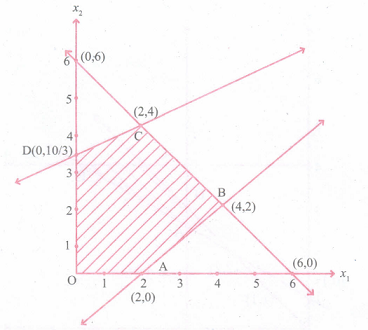
Since the decision variables x1 ,x2 are non-negative, the solution lies in the I quadrant of the plane.
Consider the equations
\(-{ x }_{ 1 }+3{ x }_{ 2 }=10\)
| \({ x }_{ 1 }\) | 0 | 2 |
|---|---|---|
| \({ x }_{ 2 }\) | 10/3 | 4 |
\({ x }_{ 1 }+{ x }_{ 2 }=6\)
| \({ x }_{ 1 }\) | 0 | 6 |
|---|---|---|
| \({ x }_{ 2 }\) | 6 | 6 |
\({ x }_{ 1 }{ -x }_{ 2 }=2\)
| \({ x }_{ 1 }\) | 4 | 2 |
|---|---|---|
| \({ x }_{ 2 }\) | 2 | 0 |
The feasible region is OABCD and its co-ordinates are O(0, 0)A(2, 0) B(4, 2) C(2, 4) and D(0, 10/3)
| Corner Points | \(Z=-{ x }_{ 1 }+2{ x }_{ 2 }\) |
|---|---|
| 0(0,0) | 0 |
| A(2, 0) | -2 |
| B (4, 2) | 0 |
| C(2,4) | 6 |
| D\(\left( 0,\frac { 10 }{ 3 } \right) \) | \(\frac { 20 }{ 3 } \) |
Maximum of Z occurs at\(D\left( 0,\frac { 10 }{ 3 } \right) \). Hence, the solution is \({ x }_{ 1 }=0,{ x }_{ 2 }=\frac { 10 }{ 3 } \quad and\quad { Z }_{ max }=\frac { 20 }{ 3 } \)
7.
Given a = Rs.1000,i =\(\cfrac { 12 }{ 12 } \)% = 1% = 0.01,n =12
A = \(\cfrac { a }{ i } \left[ \left( 1+i \right) ^{ n }-1 \right] \)
= \(\cfrac { 1000 }{ 0.01 } \left[ \left( 1.01 \right) ^{ 12 }-1 \right] \)
= 100000[1.127-1]
= Rs.12,700
(1.01)12=12 log (1.01)
=12(0.0043)
= 0.0516
Antilog of 0.0516 is 1.127
8.
| x | 1/x |
| 6 | 0.1667 |
| 14 | 0.0714 |
| 21 | 0.0476 |
| 30 | 0.0333 |
| \(\sum { 1/x=0.3190 } \) |
Harmonic Mean = \(\frac { n }{ \sum { \frac { 1 }{ x } } } \)
\(=\frac { 4 }{ 0.3190 } =12.54\)
\(\therefore\) HM = 12.54
9.
| RX | RY | d=RX-RY | d2 |
| 1 | 12 | -11 | 121 |
| 2 | 9 | -7 | 49 |
| 3 | 6 | -3 | 9 |
| 4 | 10 | -6 | 36 |
| 5 | 3 | 2 | 4 |
| 6 | 5 | 1 | 1 |
| 7 | 4 | 3 | 9 |
| 8 | 7 | 1 | 1 |
| 9 | 8 | 1 | 1 |
| 10 | 2 | 8 | 64 |
| 11 | 11 | 0 | 0 |
| 12 | 1 | 11 | 121 |
| \(\sum\)d2=416 |
n=12
Rank correlation co-efficient
\(\rho =1-\frac { 6\sum { { d }^{ 2 } } }{ N({ N }^{ 2 }-1) } \)
=1-\(\frac { 6\times 416 }{ 12({ 12 }^{ 2 }-1) } =1-\frac { 16 }{ 11 } =\frac { -5 }{ 11 } \)
\(\rho\)=-0.45
10.
| X | Y | XY |
| 1 | 5 | 5 |
| 2 | 4 | 8 |
| 3 | 3 | 9 |
| 4 | 2 | 8 |
| 5 | 1 | 5 |
| 15 | 15 | 35 |
cov(X, Y) =\(\frac { 1 }{ n } \left[ \sum { XY-\frac { 1 }{ n } (\sum { X)(\sum { Y) } } } \right] \)
=\(\frac { 1 }{ 5 } \left[ 35-\frac { 1 }{ 5 } (15)(15) \right] \)
= \(\frac { 1 }{ 5 } [35-45]=\frac { -10 }{ 5 } \)=-2
11.
(i) S = {1, 2, 3, 4, 5, 6}
n(S) = 6
(i) Let A be the event of getting a prime number
A = {2, 3, 5}
n(A) = 3
\(P(A)=\frac { 3 }{ 6 } =\frac { 1 }{ 2 } \)
(ii) Let B be the event that the number is greater than or equal to 3.
B = {3, 4, 5, 6}
n(B) = 4
\(P(B) =\frac { 4 }{ 6 } =\frac { 2 }{ 3 } \)
12.
| % Rise | x | log x |
|---|---|---|
| 5 | 105 | 2.0212 |
| 8 | 108 | 2.0334 |
| 77 | 177 | 2.2480 |
| \(\sum logx\) = 6.3026 |
GM = Antilog\(\left( \frac { \sum { logx } }{ n } \right) =Anitlog\left( \frac { 6.3026 }{ 3 } \right) =Antilog(2.1009)\)
GM = 126.2
\(\therefore\) Average increase of the commodity from 2004 to 2007
= 126.1 - 100 = 26.1%
13.
a = Rs.1500; i = 12/100 = 0.12
P = \(\frac { a }{ i } =\frac { 1500 }{ 0.12 } \) = Rs.12,500
The person has to deposit Rs.12,500 to meet this expense.
14.
Let us consider X for price P and Y for stock S. Then the mean and SD for P is considered as \(\bar { X } \) = 100 and σx = 8 respectively and the mean and SD of S is considered as \(\bar { Y } \) = 103 and σy = 4. The correlation coefficient between the series is r(X, Y) = 0.4
Let the regression line X on Y be
\(X-\bar { X } =r\frac { { \sigma }_{ x } }{ { \sigma }_{ y } } (Y-\bar { Y } )\)
X-100 = (0.4)\(\frac{8}{4}\)(Y-103)
X–100 = 0.8(Y–103 )
X–0.8Y–17.6 = 0 (or) X = 0.8Y+17.6
The regression line Y on X be \(Y-\bar { Y } =r\frac { { \sigma }_{ y } }{ { \sigma }_{ x } } (X-\bar { X } )\)
Y-103 = (0.4)\(\frac{4}{8}\)(X-100)
Y–103 = 0.2 (X–100 )
Y–103 = 0.2 X–20
Y = 0.2 X + 83 (or) 0.2 X–Y + 83 = 0
15.
u = x cos y + y cos x
\(\frac { { \partial }u }{ \partial x } =\cos \ y - y \sin x\)
\(\frac { { \partial }u }{ \partial y } =-x \sin y +\ cos \ x\)
\(L H S=\frac{\partial^2 u}{\partial x \partial y}=\frac{\partial}{\partial x}\left(\frac{\partial u}{\partial y}\right) =\frac{\partial}{\partial x}(-x \sin y+\cos x) =-\sin y-\sin x \)
\(R H S=\frac{\partial^2 u}{\partial y \partial x}=\frac{\partial}{\partial y}\left(\frac{\partial u}{\partial x}\right) =\frac{\partial}{\partial y}(\cos y-y \sin x) =-\sin y-\sin x \)
\(\therefore \frac{\partial^2 u}{\partial x \partial y}=\frac{\partial^2 u}{\partial y \partial x} \)
16.
u = log(x2+y2)
\(\frac { \partial u }{ \partial x } =\frac { 1 }{ { x }^{ 2 }+{ y }^{ 2 } } (2x)=\frac { 2x }{ { x }^{ 2 }+{ y }^{ 2 } } \)
\(\frac { { \partial }^{ 2 }u }{ \partial { x }^{ 2 } } =\frac { \left( { x }^{ 2 }+{ y }^{ 2 } \right) . 2-2x.2x }{ \left( { x }^{ 2 }+{ y }^{ 2 } \right) ^{ 2 } } =\frac { 2\left( { y }^{ 2 }-{ x }^{ 2 } \right) }{ \left( { x }^{ 2 }+{ y }^{ 2 } \right) ^{ 2 } } \)
\(\frac { \partial u }{ \partial y } =\frac { 1 }{ { x }^{ 2 }+{ y }^{ 2 } } (2y)=\frac { 2y }{ { x }^{ 2 }+{ y }^{ 2 } } \)
\(\frac { { \partial }^{ 2 }u }{ \partial y^{ 2 } } =\frac { \left( { x }^{ 2 }+{ y }^{ 2 } \right) . 2-2y.2y }{ \left( { x }^{ 2 }+{ y }^{ 2 } \right) ^{ 2 } } =\frac { 2\left( { y }^{ 2 }-{ x }^{ 2 } \right) }{ \left( { x }^{ 2 }+{ y }^{ 2 } \right) ^{ 2 } } \)
\(\therefore \frac { { \partial }^{ 2 }u }{ { 2x }^{ 2 } } +\frac { { \partial }^{ 2 }u }{ \partial { y }^{ 2 } } =0\)
17.
Using the precedence relationships and following the rules of network construction, the required network diagram is shown in following figure.
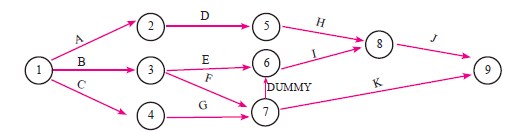
18.
\(y={2x+1\over 3x+2}\)
\({dy\over dx}={(3x+2)(2)-(2x+1)(2)\over (3x+2)^2}\)\(={1\over (3x+2)^2}\)
Elasticity: \(η={x\over y}.{dx\over dx}\)\(={x\over \left(2x+1\over 3x+2\right)}.{1\over (3x+2)}\)
\(={x\over (2x+1)(3x+2)}\)
When x = 1, \(η={1\over15}\)
19.
LHS=\(\frac{\sin(x+y)}{\sin(x-y)}=\frac{\sin x\cos y+\cos x+sin y}{\sin x\cos y-\cos x\sin y}\)
Dividing the numerator and denominator by cos x cos y,
We get LHS,
\(\frac{\frac{\sin x\cos y}{\cos x\cos y}+\frac{\cos x\sin y}{\cos x\cos y}}{\frac{\sin x\cos y}{\cos x\cos y}-\frac{\cos x\sin y}{\cos x\cos y}}=\frac{\tan x+\tan y}{\tan x-\tan y}=RHS\)
Hence proved.
20.
Let y = sin x. sin 2x. sin 3x
Taking logarithms on both sides we get,
log y = log (sin x. sin 2x. sin 3x)
= log (sin x) + log (sin 2x) + log (sin 3x) [\(\therefore\) log ab = log a + log b]
Differentiating with respect to 'x' we get,
\(\frac { 1 }{ y } \frac { dy }{ dx } =\frac { 1 }{ sin\quad x } .\frac { d }{ dx } (sin\quad x)+\frac { 1 }{ sin\quad 2x } .\frac { d }{ dx } (sin\quad 2x)+\frac { 1 }{ sin\quad 3x } .\frac { d }{ dx } (sin\quad 3x)\)
\(\frac { 1 }{ y } \frac { dy }{ dx } =\frac { cos\quad x }{ sin\quad x } +\frac { 2cos2x }{ sin\quad 2x } =3.\frac { cos\quad 3x }{ sin\quad 3x } \)
= cot x + 2 cot 2x + 3 cot 3x
\(\Rightarrow \frac { dy }{ dx } =y[cotx+2cot2x+3cot3x]\)
\(\Rightarrow \frac { dy }{ dx } \)= sin x sin 2x sin 3x [cot x + 2 cot 2x + 3 cot 3x]
21.
Given lines are (b - c) x + (c - a) y + (a - b) = 0
(c - a) x + (a - b) y + (b - c) = 0
(a - b) x + (b - c) y + (c - a) = 0.
The condition for the given lines to be concurrent is
\(\left| \begin{matrix} b-c & c-a & a-b \\ c-a & a-b & b-c \\ a-b & b-c & c-a \end{matrix} \right| =0\)
Applying the elementary gains formation C1⟶C1+C2+C3
We get \(\left| \begin{matrix} 0 & c-a & a-b \\ 0 & a-b & b-c \\ 0 & b-c & c-a \end{matrix} \right| =0\)
Expanding along C1 we get
\(\left| \begin{matrix} 0 & c-a & a-b \\ 0 & a-b & b-c \\ 0 & b-c & c-a \end{matrix} \right| =0\)
Hence the given lines are Concurrent
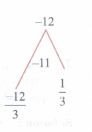
22.
\({{(2x+1)!}\over{(x+2)!}}.{{(x-1)!}\over{(2x-1)!}}={{3}\over{5}}\)
\(\Rightarrow\) \({{(2x+1)(2x)(2x-1)!}\over{(x+2)(x+1)(x-1)!}}.{{(x-1)!}\over{(2x-1)!}}={{3}\over{5}}\)
\(\Rightarrow\) \({{(2x+1)(2)}\over{(x+2)(x+1)}}={{3}\over{5}}\)
\(\Rightarrow\) 10 (2x+1) = 3 (x+2) (x+1)
\(\Rightarrow\) 20x+10=3 (x2+3x+2)
\(\Rightarrow\) 20x+10+3x2-9x-6=0
\(\Rightarrow\) -3x2+11x+4 = 0
\(\Rightarrow\) -3x2-11x-4=0
\(\Rightarrow\) (x-4)(3x+1)=0
\(\Rightarrow\) x = 4 or x \(={{-1}\over{3}}\)
Since \(x={{-1}\over{3}}\) is not possible, x = 4.
23.
x = a cos \(\theta\), y = a sin \(\theta\)
\(\frac {dx }{ d\theta } =-a\sin { \theta } \) ; \(\frac {dy }{ d\theta } =a\cos { \theta } \)
\(= { \frac { dy }{ dx} } =\frac { a\cos { \theta } }{ -a\sin { \theta } } =-\cot { \theta } \)
\(\frac{d^2 y}{d x^2}=\frac{d}{d x}\left(\frac{d y}{d x}\right)=\frac{d}{d x}(-\cot \theta)\)
\(=\frac{d}{d \theta}(-\cot \theta) \frac{d \theta}{d x}\)
\(=\operatorname{cosec}^2 \theta\left(\frac{-1}{a \sin \theta}\right)=\frac{-1}{a} \operatorname{cosec}^3 \theta\)
24.
x2 + y2 - 22x - 4y + 25 = 0
2g = - 22 \(\Rightarrow \) g = -11
2f = -4 \(\Rightarrow\) f = -2
c = 25
\(\left|\begin{array}{lll} a & h & g \\ h & b & f \\ g & f & c \end{array}\right|=0\)
Center of the circle is (-g, -f) = ( 11, 2)
Radius of the circle is \(\sqrt { { g }^{ 2 }+{ f }^{ 2 }-c } =\sqrt { \left( -11 \right) ^{ 2 }+({ -2 })^{ 2 }-25 } \)
\(r= \sqrt { 121+4-25 } =\sqrt { 100 } \) = 10 units
25.
\( \sin ^{-1}\left(\frac{-3}{5}\right)-\sin ^{-1}\left(\frac{-8}{17}\right) =-\sin ^{-1} \frac{3}{5}+\sin ^{-1} \frac{8}{17} \quad\left(\sin ^{-1}(-x)=-\sin ^{-1} x\right) \)
\(=\cos ^{-1} \frac{15}{17}-\cos ^{-1} \frac{4}{5} \ \sin ^{-1} \frac{3}{5}=\cos ^{-1} \frac{4}{5}\)
\(\sin ^{-1} \frac{8}{17}=\cos ^{-1} \frac{15}{17}\)
\(=\cos ^{-1}\left[\frac{15}{17} \times \frac{4}{5}+\sqrt{1-\frac{225}{289}} \sqrt{1-\frac{16}{25}}\right]\)
\(=\cos ^{-1}\left[\frac{60}{85}+\frac{8}{17} \times \frac{3}{5}\right]=\cos ^{-1}\left[\frac{60+24}{85}\right]\)
\(=\cos ^{-1} \frac{84}{85}\)
26.
Let A = \(\begin{bmatrix} -1 & 5 \\ -3 & 2 \end{bmatrix}\)
\(\therefore |A|=\begin{bmatrix} -1 &5 \\-3 & 2 \end{bmatrix}=-2+15=13\)
Now, A11 = 2, A12 = (-3) = 3, A21 = -5, A22 = -1
\(\therefore\) adj A = \({\begin{bmatrix}2 & 3 \\-5 &-1 \end{bmatrix}}^{T}=\begin{bmatrix}2 & -5 \\3 & -1 \end{bmatrix}\)
Now \({A}^{-1}={{1}\over{|A|}}\) adj A = \({{1}\over{13}}\begin{bmatrix} 2& -5\\3 & -1 \end{bmatrix}\)
27.
Let A = \(\left| \begin{matrix} x & sin\theta & cos\theta \\ -sin\theta & -x & 1 \\ cos\theta & 1 & x \end{matrix} \right| \)
Expanding along R1 we get
|A| = x\(\left| \begin{matrix} -x & 1 \\ 1 & x \end{matrix} \right| -sin\theta \left| \begin{matrix} -sin\theta & 1 \\ cos\theta & x \end{matrix} \right| +cos\theta \begin{vmatrix} -sin\theta & -x \\ cos\theta & 1 \end{vmatrix}\)
= x(-x2 - 1) - sin \(\theta\) (-x sin \(\theta\) - cos \(\theta\)) + cos \(\theta\) (-sin \(\theta\) + x cos \(\theta\))
\(=-x^{ 3 }-x+xsin^{ 2 }\theta +sin\theta cos\theta +xcos^{ 2 }\theta \)
= -x3 - x + x(sin2\(\theta\) + cos2\(\theta\))
= -x3 - x + x(1) [\(\because\) sin2\(\theta\) + cos2\(\theta\) ] = -1
= -x3 which is independent of \(\theta\)
28.
\(f(x)={ x }^{ 3 }-\frac { 1 }{ { x }^{ 3 } } \)
\(f\left( \frac { 1 }{ x } \right) \)= \(=\frac { 1 }{ { x }^{ 3 } } -{ x }^{ 3 }\)
\(f(x)+f{ \left( \frac { 1 }{ x } \right) }={ x }^{ 3 }-\frac { 1 }{ x^{ 3 } } +\frac { 1 }{ x^{ 3 } } -{ x }^{ 3 }=0\).
29.
\(AB=\begin{bmatrix} 3&-1\\2&1 \end{bmatrix}\begin{bmatrix} 3&0\\1&-2 \end{bmatrix}=\begin{bmatrix} 9-1&0+2\\6+1&0-2 \end{bmatrix}=\begin{bmatrix} 8&2\\7&-2 \end{bmatrix}\)
= -16 - 14 = -30
\(\therefore\) |AB| = -30
30.
Let B = \(\begin{vmatrix} 1 &-3 &2 \\4 &-1&2\\3&5&2 \end{vmatrix}\)
Minor of 1 = M11 = \(\begin{vmatrix} -1 & 2 \\ 5 & 2 \end{vmatrix}=-2-10=-12\)
Minor of -3 = M12 = \(\begin{vmatrix}4 &2 \\ 3 & 2 \end{vmatrix}=8-6=2\)
Minor of 2 = M13 = \(\begin{vmatrix} 4 & -1 \\ 3 & 5\end{vmatrix}=20+3=23\)
Minor of 4 = M21 = \(\begin{vmatrix} -3 & 2 \\5 & 2 \end{vmatrix}=-6+10=-16\)
Minor of -1 = M22 = \(\begin{vmatrix}1 & 2 \\ 3 & 2 \end{vmatrix}=2-6=-4\)
Minor of 2 = M23 = \(\begin{vmatrix} 1& -3 \\3 &5 \end{vmatrix}=5+9=14\)
Minor of 3 = M31 = \(\begin{vmatrix} -3 &2 \\ -1 & 2 \end{vmatrix}=-6+2=-4\)
Minor of 3 = M32 = \(\left|\begin{array}{ll} 1 & 2 \\ 4 & 2 \end{array}\right|=2-8=-6\)
Minor of 2 = M33 = \(\begin{vmatrix} 1 & -3 \\4 & -1 \end{vmatrix}=-1+12=11\)
Co-factor of 1 = A11 = (-1)1+1 M11 = -12
Co-factor of -3 = A12= (-1)1+2 M12 = -2
Co-factor of 2 = A13= (-1)1+3 M13 = 23
Co-factor of 4 = A21 = (-1)2+1 M21 = 16
Co-factor of -1 = A22 = (-1)2+2 M22 = -4
Co-factor of 2 = A23 = (-1)2+3 M23 = -14
Co-factor of 3 = A31 = (-1)3+1 M31 = -4
Co- factor of 5 = A32 = (-1)3+2 M32 = 6
Co-factor of 2 = A33 = (-1)3+3 M33 = 11
31.
(2a - 3b)4
\( (x+a)^n=n C_0 x^n+n C_1 x^{n-1} a+n C_2 x^{n-2} a^2 +\ldots n C_{n-1} x a^{n-1}+n C_n a^n \)
\((2 a-3 b)^4= 4 C_0(2 a)^4-4 C_1(2 a)^3(3 b) +4 C_2(2 a)^2(3 b)^2 -4 C_3(2 a)(3 b)^3+4 C_4(3 b)^4\)
= 16a4 - 4 (8a3) (3b) + 6 (4a2) (9b2) - 4 (2a)(27b3) + 81b4
= 16a4 - 96 a3 b + 216 a2 b2 - 216 ab3 + 81b4
32.
\(\underset { x\rightarrow 2 }{ lim } \frac { { x }^{ 2 }-4x+6 }{ x+2 } =\cfrac { \underset { x-2 }{ lim } \left( { x }^{ 2 }+4x+6 \right) }{ \underset { x\rightarrow 2 }{ lim } \left( x+2 \right) } \)
\( =\cfrac { \left( 2 \right) ^{ 2 }-4\left( 2 \right) +6 }{ 2+2 } =\cfrac { 1 }{ 2 } \)
33.
Let \(\left(\cos ^{-1} \frac{8}{17}\right)=\theta\)
\(\cos \theta=\frac{8}{17}\)
\(\sin\theta =\sqrt { 1-{ \cos }^{ 2 }\theta } \)
= \(\sqrt { 1-\cfrac { 64 }{ 289 } } \)
= \(\cfrac { 15 }{ 17 } \) ...(2)
From (1) and (2), we get
Now \(\tan\left( \cos\cfrac { 8 }{ 17 } \right) =\tan\theta =\cfrac { \sin\theta }{ \cos\theta } \)
\(=\cfrac { \frac { 15 }{ 17 } }{ \frac { 8 }{ 17 } } =\cfrac { 15 }{ 8 } \)
34.
\(\cfrac { sin2\theta }{ 1+cos2\theta } =\cfrac { 2sin\theta cos\theta }{ { 2cos }^{ 2 }\theta } =\cfrac { sin\theta }{ cos\theta } =tan\theta \)
35.
Equation of circle is
\(\left( x-h \right) ^{ 2 }+\left( y-k \right) ^{ 2 }={ r }^{ 2 }\)
Here \(\left( h,k \right) =(3,-1)\) and r = 4
Equation of circle is
\(\left( x-3 \right) ^{ 2 }+\left( y+1 \right) ^{ 2 }=16\)
\({ x }^{ 2 }-6x+9+{ y }^{ 2 }+2y+1=16\)
\({ x }^{ 2 }+{ y }^{ 2 }-6x+2y-6=0\)
36.
The number of combination = \({ 32C }_{ 4 }\)
\( =\cfrac { 32! }{ 4!(32-4)! } \)
\(=\cfrac { 32! }{ 4!\left( 28 \right) ! } \)
37.
Let \(\frac { 1 }{ \left( { x }^{ 2 }-1 \right) } =\frac { A }{ x-1 } +\frac { B }{ x+1 } \)
Multiplying both sides by (x - 1)(x + 1), we get
1 = A(x +1) + ( Bx -1) ... (1)
Put x =1 in (1) we get, 1 = A(2)
\(\therefore\) A = \(\frac{1}{2}\)
Put x = -1 in (1) we get, 1 = A(0) + B(-2)
\(\therefore\) B = - \(\frac{1}{2}\)
38.
Let A = \(\left[ \begin{matrix} 8 & 2 \\ 4 & 3 \end{matrix} \right] \)
|A| = \(\left| \begin{matrix} 8 & 2 \\ 4 & 3 \end{matrix} \right| \)
= 24 – 8 = 16 ≠ 0
\(\therefore\) A is a non-singular matrix
39.
Using the precedence relationship and following the rules of network construction, the required network is shown in the following diagram
40.
(i) Variables:
Let x1 and x2 represent the number of fans and sewing machines.
(ii) Objective functions:
Let Z be the profit of the dealer.
∴ Maximize Z = 22x1 + 18x2 is the objective function.
(iii) Constraints:
\({ x }_{ 1 }+{ x }_{ 2 }\le 20\)
\({ 360x }_{ 1 }+{ 240x }_{ 2 }\le 5760\)
(iv) Non-negative restrictions:
Since the number of fans and sewing machine cannot be negative, we have x1, x2 ≥ 0.
Hence, mathematical formulation of the LPP is
Maximize \(Z=22{ x }_{ 1 }+18{ x }_{ 2 }\)
Subject to the constraints
\({ x }_{ 1 }+{ x }_{ 2 }\le 20\)
\({ 360x }_{ 1 }+{ 240x }_{ 2 }\le 5760\)
and x1, x2 ≥ 0.
41.
(i) Variables:
Let x1, x2 represent the number of units of X and Y.
(ii) Constraints:
| Labour | Capital | |
|---|---|---|
| X | 2 | 3 |
| Y | 3 | 1 |
∴ 2x1 + 3x2 ≤ 30 and 3x1 + x2 ≤ 17
(iii) Non-negative restrictions:
Since the number of units of X and Y cannot be negative,x1, x2 ≥ 0.
Hence, the mathematical formulation of the LPP is maximize \(Z=100{ x }_{ 1 }+120{ x }_{ 2 }\)
Subject to the constraints
\( { 2x }_{ 1 }+3{ x }_{ 2 }\le 30\)
\({ 3x }_{ 1 }+{ x }_{ 2 }\le 17\)
and x1, x2 ≥ 0.
42.
a = 50, i = \(\frac{5}{100}\) = .05
A = \(\cfrac { a }{ i } =\cfrac { 50 }{ 0.05 } \) Rs.1000
43.
Given Σxy = 120, Σx2 = 90, Σy2 = 640
Then r = \(\frac { \Sigma xy }{ \sqrt { \Sigma { x }^{ 2 }\Sigma { y }^{ 2 } } } =\frac { 120 }{ \sqrt { 90(640) } } =\frac { 120 }{ \sqrt { 57600 } } =\frac { 120 }{ 240 } \) = 0.5
44.
\(p(x)=\frac { { x }^{ 3 } }{ 3 } +{ x }^{ 2 }+x\)
p(x) = x2 + 2x + 1 = (x +1)2
It is clear that P'(x)>0 for all x.
\(\therefore\) The firm is running a profitable business.
45.
\(\cos 20^{\circ}+\cos 100^{\circ}+\cos 140^{\circ}\)
\(\cos 20^{\circ}+\left(\cos 100^{\circ}+\cos 140^{\circ}\right) =\cos 20^{\circ}+2 \cos \left(\frac{100^{\circ}+140^{\circ}}{2}\right) \cos \left(\frac{100^{\circ}-140^{\circ}}{2}\right) \)
\(=\cos 20^{\circ}+2 \cos 120^{\circ} \cos \left(-20^{\circ}\right)\)
\(=\cos 20^{\circ}+2 \cos \left(180^{\circ}-60\right) \cos 20^{\circ}\)
\(=\cos 20^{\circ}-2 \cos 60^{\circ} \cos 20^{\circ}\)
\(=\cos 20^{\circ}-2\left(\frac{1}{2}\right) \cos 20^{\circ}\)
\(=\cos 20^{\circ}-\cos 20^{\circ}=0\)
46.
\(\mathrm{LHS}=\frac{\cos 2 A-\cos 3 A}{\sin 2 A+\sin 3 A}\)
\(=\frac{-2 \sin \frac{2 A-3 A}{2} \sin \frac{2 A+3 A}{2}}{2 \sin \frac{2 A+3 A}{2} \cos \frac{2 A-3 A}{2}}\)
\(=\frac{\sin A / 2}{\cos A / 2}=\tan A / 2\)
= RHS
Hence proved.
47.
\(lety=\frac { { x }^{ 2 }cos\frac { \pi }{ 4 } }{ sinx } ={ x }^{ 2 }\times \frac { 1 }{ \sqrt { 2 } sinx } \)
\(\therefore y=\frac { 1 }{ \sqrt { 2 } } \frac { { x }^{ 2 } }{ sinx } \)
Differentiating with respect to 'x' we get
\(\frac { dy }{ dx } =\frac { 1 }{ \sqrt { 2 } } \left[ \frac { sinx.(2x)-{ x }^{ 2 }cosx }{ sin^{ 2 }x } \right] \)[by quotient rule]
= \(\frac { x }{ \sqrt { 2 } } \left[ \frac { 2sinx-xcosx }{ { sin }^{ 2 }x } \right] \)
= \(\frac { x }{ \sqrt { 2 } } \left[ \frac { 2sinx }{ { sin }^{ 2 }x } -\frac { xcosx }{ sin^{ 2 }x } \right] =\frac { x }{ \sqrt { 2 } } \)[cosec x-x cot x cosec x]
\(\frac { x }{ \sqrt { 2 } } cosecx[2-cotx]\)
48.
LHS=\(\frac{\tan 69^o+\tan 66^o}{1-\tan 69^o\tan 66^o}\left[\because\frac{\tan A+\tan B}{1-\tan A\tan B}=\tan(A+B)\right]\)
= tan (69° + 66°) = tan (135°)
= tan (180 - 45°) = - tan 45° = -1 = RHS.
Hence proved.
49.
Using \(\sin^2A-\sin^2B=\sin(A+B)\sin(A-B)\), we get
\(LHS=\sin^2\left(\frac{\pi}{8}+\frac{x}{2}\right)-\sin^2\left(\frac{\pi}{8}-\frac{x}{2}\right)=\sin\left(\frac{\pi}{8}+\frac x2+\frac{\pi}{8}-\frac x2\right).\sin\left(\frac{\pi}{8}+\frac x2-\frac{\pi}{8}+\frac x2\right)\)
\(=\sin\left(\frac{2\pi}{8}\right).\sin\left(\frac{2x}{2}\right)=\sin\left(\frac{\pi}{4}\right).\sin x=\frac{1}{\sqrt2}.\sin x=RHS\)
Hence proved.
50.
Given pair of lines is
3x2+10xy+8y2+14x+22y+15=0
2h=10
Here a=3, h=5, b=8,
Let \(\theta\) be the angle between the pair of lines
Then \(tan\quad \theta =\frac { \pm 2\sqrt { { h }^{ 2 }-ab } }{ a+b } =\frac { \pm 2\sqrt { 25-3(8) } }{ 3+8 } =\frac { \pm 2\sqrt { 1 } }{ 11 } =\frac { \pm 2 }{ 11 } \)
\(\therefore \quad tan\quad \theta =\frac { 2 }{ 11 } \Rightarrow \theta ={ tan }^{ -1 }\left( \frac { 2 }{ 11 } \right) \)
51.
The length of the tangent to the circle x2 + y2 +2gx + 2fy + C = 0 from a point
(x1, y1) is \(\sqrt { { x }_{ 1 }^{ 2 }+{ y }_{ 1 }^{ 2 }+2g{ x }_{ 1 }+2{ fy }_{ 1 }+C } \)
Length of tangent = \(\sqrt { { x }_{ 1 }^{ 2 }+{ y }_{ 1 }^{ 2 }+2{ x }_{ 1 }+4{ y }_{ 1 }+9 } \)
= \(\sqrt { 1+4-2+8+9 } \)
= \(\sqrt{20}\) units
[Here (x1, y1) = (1, 2)]
52.
LHS 10P3 = 10 x 9 x 8 = 720
RHS 9P3 + 3. 9P2 = 9 x 8 x 7 + 3 x 9 x 8
= 9 x 8 (7 + 3) = 72 (10) = 720
LHS= RHS Hence proved.
53.
LHS\(=\tan^{-1}\left(\frac mn\right)-\tan^{-1}\left(\frac{m-n}{m+n}\right)=\tan^{-1}\left(\frac{\frac{m}{n}-\frac{m-n}{m+n}}{1+\left(\frac mn\right)\left(\frac{m-n}{m+n}\right)}\right)\)
\(=\tan^{-1}\left(\frac{\frac{m^2+mn-mn+n^2}{n(m+n)}}{\frac{n(m+n)+m(m-n)}{n(m+n)}}\right)\)
\(=\tan ^{-1}\left(\frac{m^2+n^2}{m^2+n^2}\right)=\tan ^{-1}(1)=\frac{\pi}{4}=\mathrm{RHS}\)
Hence proved.
54.
\(\frac { 7! }{ 6! } =\frac { 7\times 6! }{ 6! } =7\)
55.
\(\sin { { 300 }^{ o } } \)
\(=\sin { 300 }^{ o } =\sin { \left( { 360 }^{ o }-{ 60 }^{ o } \right) } \) (IV quad)
\(= \sin 60^o=-\frac { \sqrt { 3 } }{ 2 } \)
56.
Let |A| = \(\begin{vmatrix} 6 &5 &12 \\ 2 & 4 &4 \\2 & 1 & 4 \end{vmatrix}\)
Taking 2 common from C1 and 4 common from C3, we get,
\(|A|=2\times4\begin{vmatrix} 3 & 5&3 \\ 1 & 4 & 1\\1 &1 &1\end{vmatrix}=8\times 0\ [\because C_1\equiv C_3]=0\)
57.
AB = \(\begin{bmatrix} 1 \\ -4 \\3 \end{bmatrix}\begin{bmatrix} -1 &2 & 1 \end{bmatrix}=\begin{bmatrix} -1 & 2 & 1 \\ 4 & -8 & -4 \\-3 & 6 & 3 \end{bmatrix}\)
\(\therefore\) \({(AB)}^{T}=\begin{bmatrix} -1 &4&-3 \\ 2 & -8&6\\1&-4&3 \end{bmatrix}\) ....(1)
\({B}^{T}=\begin{bmatrix} -1 & 2 & 1 \end{bmatrix}^{T}=\begin{bmatrix} -1\\2\\1\end{bmatrix}\)and \({A}^{T}={\begin{bmatrix} 1\\-4\\3\end{bmatrix}}^{T}=\begin{bmatrix} 1&-4&3 \end{bmatrix}\)
\(\therefore\) \({B}^{T}{A}^{T}=\begin{bmatrix} -1\\2\\1 \end{bmatrix}\begin{bmatrix} 1&-4&3 \end{bmatrix}=\begin{bmatrix} -4 & 4&-3 \\ 2&-8 &6\\1&-4&3 \end{bmatrix}\) ....(2)
From (1) and (2), (AB)T = BT . AT
58.
\(\mathrm{RHS}=\sin ^{-1}\left(\frac{2 x}{1+x^2}\right)\)
Let \(x=\tan \theta \Rightarrow \theta=\tan ^{-1} x\)
\(=\sin ^{-1}\left(\frac{2 \tan \theta}{1+\tan ^2 \theta}\right)=\sin ^{-1}(\sin 2 \theta)\)
\(=2 \theta=2 \tan ^{-1} x=\text { LHS }\)
Hence proved.
59.
B \(=\begin{bmatrix} 0.50 & 0.30 \\ 0.41 & 0.33 \end{bmatrix}\)
I - B = \(\begin{bmatrix} 1 & 0 \\ 0 & 1 \end{bmatrix}-\begin{bmatrix} 0.50 & 0.30 \\ 0.41 & 0.33 \end{bmatrix}=\begin{bmatrix} 0.50 & -0.30 \\ -0.41 & 0.67 \end{bmatrix}\)
= (0.50) (0.67) - (0.30) (0.41)
\(|I-B|\) = 0.335 - 0.123 = 0.212 > 0
Since the main diagonal elements of I - B are positive and |I-B| is positive. Hawkins Simon conditions are satisfied. Therefore given system is viable
60.
Let \(y=\sqrt { \cfrac { \left( x-3 \right) \left( { x }^{ 2 }+4 \right) }{ { 3x }^{ 2 }+4x+5 } } \)
= \(\left| \cfrac { \left( x-3 \right) \left( { x }^{ 2 }+4 \right) }{ { 3x }^{ 2 }+4x+5 } \right| ^{ \frac { 1 }{ 2 } }\)
Taking logarithm on both sides,
\(logy=\cfrac { 1 }{ 2 } \left[ log\left( x-3 \right) +log\left( { x }^{ 2 }+4 \right) -log\left( { 3x }^{ 2 }+4x+5 \right) \right] \)\({[\because \log a b} =\log a+\log b \text { and } \log \frac{a}{b} =\log a-\log b]\)
Differentiating with respect to x
\(\cfrac { 1 }{ y } .\cfrac { dy }{ dx } =\cfrac { 1 }{ 2 } \left[ \cfrac { 1 }{ x-3 } +\cfrac { 2x }{ { x }^{ 2 }+4 } -\cfrac { 6x+4 }{ { 3x }^{ 2 }+4x+5 } \right] \)
\(\cfrac { dy }{ dx } =\cfrac { 1 }{ 2 } \sqrt { \cfrac { \left( x-3 \right) \left( { x }^{ 2 }+4 \right) }{ { 3x }^{ 2 }+4x+5 } } \)\( \left[ \cfrac { 1 }{ x-3 } +\cfrac { 2x }{ { x }^{ 2 }+4 } -\cfrac { 6x+4 }{ { 3x }^{ 2 }+4x+5 } \right] \)
61.
Let y= 75-12x+6x2-x3
Differentiating w.r.t. 'x' we get,
\({dy\over dx}=0-12+12x-3x^2=-3(x^2-4x+4)=-3(x-2)^2\)
\(\Rightarrow{dy\over dx}\le 0\) for all \(x \in (-\infty , \infty)\)
\(\therefore \) y decreases as x increases.
62.
Let the number of shares be x.
Market value of 1 share = 100 - 10 = 90
Market value of x shares = 90x
Income from 10% discount shares
If Investment = 33, Income = 15
If Investment = 90x, Income \(=\cfrac { 15 \times90x }{ 33 } \)
Income from 10% premium shares
= \(\cfrac { 110x }{ 33 } \times 15\)
\(\cfrac { 110x }{ 33 } \times 15-\cfrac { 90x }{ 33 } \times 15=450\)
\(\cfrac { 15x }{ 33 } {( 110 - 90) } =450\)
x = \(\cfrac { 450\times 33 }{ 15\times 20 } \) = 49.5~50 shares
63.
C = 15 + 9x - 6x2 + x3
\({dC\over dx}=9-12x+3x^2\)
\({dC\over dx}=-12x+6x\)
For minimum cost \({dC\over dx}=0\)
\(\Rightarrow 3x^2-12x+9=0\)
\(\Rightarrow x^2-4x+3=0\) (Divided by 3)
\(\Rightarrow (x-1)(x-3)=0\)
\(\Rightarrow x=1,3\)
At x = 1, \({d^2C\over dx^2}=-12+6 = -6 < 0\)
At x = 3, \({d^2C\over dx^2}=-12+6 = -6 > 0\)
At x = 3 cost is minimum.
64.
Since both the decision variables x1, x2 are non-negative, the solution lies in the first quadrant of the plane.
Consider the equations x1 – x2 = –1 and – x1 + x2 = 0
x1 – x2 = –1 is a line passing through the points (0,1) and (–1,0)
–x1 + x2 = 0 is a line passing through the point (0,0)
Now we draw the graph satisfying the conditions x1 – x2 ≤ –1; –x1 + x2 ≤ 0 and x1, x2 ≥ 0
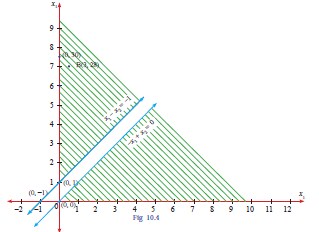
There is no common region(feasible region) satisfying all the given conditions. Hence the given LPP has no solution.
65.
We know that average cost [AC] is minimum when average cost [AC] = marginal cost [MC].
Cost: \(C={1\over3}x^3-3x^2+9x\)
AC = \({1\over3}-3x^2+9\) and MC = x2 - 6x + 9
Now, AC = MC ⇒ \({1\over 3}x^2-3x+9-x^2-6x+9\)
⇒ 2x2 - 9x = 0 ⇒ \(x={9\over 2}\) unit (∵ x > 0)
66.
\(X=\left(\begin{array}{ccc} 8 & -1 & -3 \\ -5 & 1 & 2 \\ 10 & -1 & -4 \end{array}\right)\)
\(|X|=8(-4+2)+1(20-20)-3(5-10)\)
\(=-16+15=-1 \neq 0\)
\(X^{-1} \text { exists }\)
\(A_{11}=\text {Co-factor of } 8=-4+2=-2 \)
\(A_{12}=\text {Co-factor of }-1=-(20-20)=0\)
\(A_{13}=\text {Co-factor of }-3=5-10=-5\)
\(\mathrm{A}_{21}=\text {Co-factor of }-5=-(4-3)=-1 \)
\(\mathrm{A}_{22}=\text {Co-factor of } 1=-32+30=-2 \)
\(\mathrm{A}_{23}=\text {Co-factor of } 2=-(-8+10)=-2\)
\(\mathrm{A}_{31}=\text {Co-factor of } 10=-2+3=1 \)
\(\mathrm{A}_{32}=\text {Co-factor of }-1=-(16-15)=-1 \)
\(\mathrm{A}_{33}=\text {Co-factor of }-4=8-5=+3\)
\(\text {Co-factor matrix }=\left(\begin{array}{ccc} -2 & 0 & -5 \\ -1 & -2 & -2 \\ 1 & -1 & +3 \end{array}\right)\)
\(\operatorname{Adj} X=\left(\begin{array}{ccc} -2 & -1 & 1 \\ 0 & -2 & -1 \\ -5 & -2 & +3 \end{array}\right)\)
\(X^{-1}=\frac{1}{|X|} \operatorname{adj} X\)
\(=\frac{-1}{1}\left(\begin{array}{ccc} -2 & -1 & 1 \\ 0 & -2 & -1 \\ -5 & -2 & +3 \end{array}\right)\)
\(\text {Given } Y=X^{-1}\)
\(\left(\begin{array}{ccc} 2 & 1 & -1 \\ 0 & 2 & 1 \\ 5 & p & q \end{array}\right)=\left(\begin{array}{ccc} 2 & 1 & -1 \\ 0 & 2 & 1 \\ 5 & 2 & -3 \end{array}\right)\)
\(\mathrm{p}=2 ; \mathrm{q}=-3\)
67.
Given A = \(\begin{bmatrix}1 &3&3 \\1 &4&3\\1&3&4 \end{bmatrix} \)
\(A_{11}=\text {Cofactor of } 1=16-9=7\)
\(A_{12}=\text {Cofactor of } 3=-(4-3)=-1\)
\(A_{13}=\text {Cofactor of } 3=3-4=-1\)
\(A_{21}=\text {Cofactor of } 1=-(12-9)=-3 \)
\(A_{22}=\text {Cofactor of } 4=4-3=1 \)
\(A_{23}=\text {Cofactor of } 3=-(3-3)=0 \)
\( A_{31}=\text {Cofactor of } 1=9-12=-3 \)
\(A_{32}=\text {Cofactor of } 3=3-3=0 \)
\(A_{33}=\text {Cofactor of } 4=4-3=1\)
\(\text {Co-factor matrix }=\left(\begin{array}{ccc} 7 & -1 & -1 \\ -3 & 1 & 0 \\ -3 & 0 & 1 \end{array}\right)\)
A-1 = \(\begin{bmatrix} 7&-3&-3\\-1&1&0\\-1&0&1 \end{bmatrix}\)
\(|A| =1(16-9)-3(4-3)+3(3-4) \)
\(=7-3-3=1 \neq 0\)
\(\therefore \mathrm{A}^{-1} \text { exists }\)
\(\mathrm{A}(\operatorname{adj} \mathrm{A})=\left(\begin{array}{lll} 1 & 3 & 3 \\ 1 & 4 & 3 \\ 1 & 3 & 4 \end{array}\right)\left(\begin{array}{ccc} 7 & -3 & -1 \\ -1 & 1 & 0 \\ -1 & 0 & 1 \end{array}\right)\)
\(=\left(\begin{array}{lll} 7-3-3 & -3+3+0 & -3+0+3 \\ 7-4-3 & -3+4+0 & -3+0+3 \\ 7-3-4 & -3+3+0 & -3+0+4 \end{array}\right)\)
\(=\left(\begin{array}{lll} 1 & 0 & 0 \\ 0 & 1 & 0 \\ 0 & 0 & 1 \end{array}\right)=|A| I\)
\(=\mathrm{A}(\operatorname{adj} \mathrm{A})=|A| I\)
\(\mathrm{A}^{-1}=\frac{1}{|A|} \operatorname{adj} A=\left(\begin{array}{ccc} 7 & -3 & -3 \\ -1 & 1 & 0 \\ -1 & 0 & 1 \end{array}\right)\)
68.
(1 + x)2n
2n is even
Middle term is \(t_{\frac{n}{2}+1}=t_{\frac{2 n}{2}+1}=t_{n+1}\)
\(r=n\)
\(t_{r+1}=n C_r x^{n-r} a^r\)
\(t_{n+1}=2 n C_n(1)^{2 n-n} x^n\)
\(=2 n C_n \cdot x^n\)
\(n C_r=\frac{n !}{r !(n-r) !}\)
\(=\frac{(2 n) !}{n !(2 n-n) !} x^n\)
\(=\frac{(2 n)(2 n-1)(2 n-2)(2 n-3) \ldots 5 \cdot 4 \cdot 3 \cdot 2.1}{n ! n !} x^n\)
\(=\frac{(2 n)(2 n-2) \ldots 4.2(2 n-1)(2 n-3) \ldots 5.3 .1}{n ! n !} x^n\)
\(=\frac{2^n(n(n-1) \ldots 2.1)(2 n-1)(2 n-3) \ldots 5.3 .1}{n ! n !} x^n\)
\(=\frac{2^n \cdot n !(2 n-1)(2 n-3) \ldots 5 \cdot 3 \cdot 1}{n ! n !} x^n\)
\(=\frac{1.3 .5 \ldots(2 n-3)(2 n-1) 2^n x^n}{n !}\)
69.
LHS = \(\begin{vmatrix}-a^2&ab&ac\\ab&-b^2&bc\\ac&bc&-c^2 \end{vmatrix}\)
Taking a, b, c common from R1, R2 and R3 respectively we get.
LHS = \(abc\begin{vmatrix}-a&b&c\\a&-b&c\\a&b&-c \end{vmatrix}\)
Again taking a, b, c common from C1 C2 and C3 respectively.
LHS = \(a^2b^2c^2\begin{vmatrix}-1&1&1\\1&-1&1\\1&1&-1 \end{vmatrix}\)
\(R_2 \rightarrow R_2+R_1, R_3 \rightarrow R_3+R_1\)
\(=a^2b^2c^2\begin{vmatrix}0&0&2\\1&-1&1\\1&1&-1 \end{vmatrix}\)
\(=a^2 b^2 c^2[-1(0-4)]=4 a^2 b^2 c^2\)
= RHS Hence proved.
70.
\(\frac { { x }^{ 2 }-6x+2 }{ { x }^{ 2 }(x+2) } =\frac { A }{ x } +\frac { B }{ { x }^{ 2 } } +\frac { C }{ x+2 } \)
⇒ \(\frac { { x }^{ 2 }-6x+2 }{ { x }^{ 2 }(x+2) } =\frac { Ax(x+2)+B(x+2)+Cx^{ 2 } }{ { x }^{ 2 }(x+2) } \)
⇒ x2 - 6x + 2 = Ax (x + 2) + B (x + 2)+ Cx2 ..(1)
x = -2 in (1) we get,
4 + 12+ 2 = \(C(-2)^2\) = C(4)
⇒ 18 = 4C ⇒ C = \(\frac { 18 }{ 4 } =\frac { 9 }{ 2 } \)
x = 0 in (1) we get,
2 = B (2) ⇒ B = 1
Equating co-efficient of x2 on both sides of (1)
1 = A + C ⇒ = A + \(\frac { 9 }{ 2 } \) [∵ C=\(\frac { 9 }{ 2 } \)]
⇒ A = \(1-\frac { 9 }{ 2 } =\frac { 2-9 }{ 2 } =\frac { -7 }{ 2 } \)
\(\frac{x^2-6 x+2}{x^2(x+2)}=\frac{-7}{2 x}+\frac{1}{x^2}+\frac{9}{2(x+2)}\).

11th Standard Syllabus & Materials
11th Standard
TN 11th Tamil பீடு பெற நில் - செய்யுள் - காவடிச்சிந்து Important Questions And Answers Study Material - QB365 Set A
NEW11th Standard
TN 11th Tamil பீடு பெற நில் - உரைநடை - மலை இடப்பெயர்கள் : ஓர் ஆய்வு Important Questions And Answers Study Material - QB365 Set A
NEW11th Standard
TN 11th Tamil மாமழை போற்றுதும் - துணைப்பாடம் - யானை டாக்டர் Important Questions And Answers Study Material - QB365 Set A
NEW11th Standard
TN 11th Tamil மாமழை போற்றுதும் - செய்யுள் - ஐங்குறுநூறு Important Questions And Answers Study Material - QB365 Set A



Tamilnadu Stateboard 11th Standard Subjects

Maths

Commerce

Economics

Biology
Business Maths and Statistics

Accountancy

Computer Science

Physics

Chemistry
Maths
Biology
Economics
Physics
Chemistry

History
Business Maths and Statistics

Computer Science
Accountancy

Computer Applications
History
Computer Technology
Commerce
Computer Applications
Computer Technology

Tamil

English

French
Tamilnadu Stateboard Standards
