100% FREE ACCESS
9th Standard CBSE Syllabus & Materials
9th Standard CBSE
CBSE 9th Science Is matter around us pure? - New Model Questions Papers Study Material - QB365 Set A
NEW9th Standard CBSE
CBSE 9th Science Matter in our surroundings - New Model Questions Papers Study Material - QB365 Set A
NEW9th Standard CBSE
CBSE 9th Mathematics Heron's Formula Sample Question Papers Study Material - QB365 Set A
NEW9th Standard CBSE
CBSE 9th Mathematics Circles Sample Question Papers Study Material - QB365 Set A
NEW9th Standard CBSE
CBSE 9th Mathematics Quadrilaterals Sample Question Papers Study Material - QB365 Set A
NEW9th Standard CBSE
CBSE 9th Mathematics Triangles Sample Question Papers Study Material - QB365 Set A

Published on: 03/10/2019
Areas of Parallelograms and Triangles
Download CBSE Class 9th Standard CBSE Mathematics question papers, sample papers, important questions, and previous year solved papers in PDF format. Get free study materials, NCERT solutions, and exam preparation resources for Class 9th Standard CBSE Mathematics
Questions + Answers key
Take MCQ Mathematics Test
1.
A villager had a plot of land in the shape of a quadrilateral. The Gram Panchayat decided to take come portion of his plot from one of the corners to construct a Health Centre. He reluctantly agrees but with a condition that he will be given equal amount of land in lieu of his plot so as to form a triangular plot.
Answer the following questions:
(i) Explain how could this be implemented with figure?
(ii) what value of the villager is depicted hare?
(iiii) Do you thick constructing a Health Centre in the village is justified.If so, why?
2.
In \(\Delta\)ABC, E is the mid-point of median AD. show that ar(\(\Delta\)BED) = \(\frac { 1 }{ 4 } ar(\Delta ABC)\)
3.
PQRS is a parallelogram and O is a point in the interior of the parallelogram. Show that ar(POS) + ar(QOR)=\(\frac { 1 }{ 2 } ar(PQRS)\).
4.
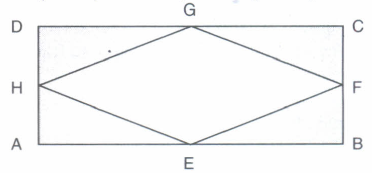
ABCD is a rectangle. E, F, G and H are mid-point of sides AB. BC, CD and DA, respectively. If ar(EFGH)=16 cm2, find ar (ABCD).
5.
Prove that the diagonals of a rectangle are equal in length.
6.
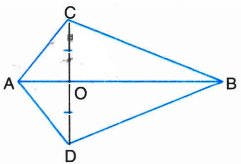
\(\Delta \)ABC and \(\Delta \) ABD are two triangles on the same base AB. If line segment CD is bisected by AB at O, show that ar (\(\Delta \) ABC) = ar (\(\Delta \)ABD)
7.
The diagonals of a parallelogram ABCD intersect at a point O. Through O, a line is drawn to intersect AD at P and BC at Q. Show that PQ divides the parallelogram into two parts of equal area.
8.
Prove that the area of a trapezium is equal to half of the product of its height and sum of parallel sides.
9.
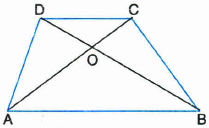
In the figure, diagonals AC and BD of a trapezium ABCD with AB || CD intersect each other at O. Show that ar (\(\Delta \) AOD)= ar(\(\Delta \) BOC).
10.
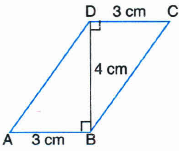
ABCD is a quadrilateral and BD is one of its diagonals as shown in figure. Show that ABCD is a parallelogram and find its area.
1.
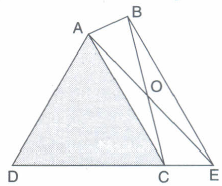
(i) Let the plot be ABCD.
Construction: Join AC. Draw BE||AC.
Proof: ar(\(\Delta\)ADE) = ar(Quad.ABCD)
Health centre can be constructed in triangular plot (\(\Delta\)AOB) and the farmer can have the triangular plot \(\Delta\)ADE.
Proof:
ar(\(\Delta\)ADE) = ar(\(\Delta\)ADC) + ar(\(\Delta\)ACE)
= ar(\(\Delta\)ADC) + ar(\(\Delta\)ABC)
= ar(Quad.ABCD)
(ii) Helpful, wise, and co-operating.
(iii) Yes, constructing a Health Centre is justified and essential also, because Health is Wealth.
2.
In figure, AD is the median of \(\Delta\)ABC.
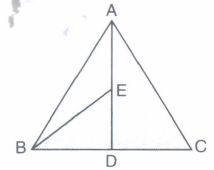
\(\therefore \ ar(\triangle ABD)=\frac { 1 }{ 2 } ar(\triangle ABC)\) ...........(i)
Now, BE is the median of \(\Delta\)ABD
\(\therefore \ ar(\triangle BED)=\frac { 1 }{ 2 } ar(\Delta ABD)\) ..............(ii)
From (i) and (ii), we get
ar(\(\Delta\)BED) = \(\frac { 1 }{ 2 } ar(\triangle ABC)\)
3.
Through O, draw AB || PS
Also PA || BS
PABS is a parallelogram.
ar(POS) =\(\frac { 1 }{ 2 } ar(PABS)\)
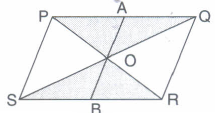
(Triangle and a parallelogram are on the same base and between the same parallels)
Similarly, ar(QOR )= \(\frac { 1 }{ 2 } \)ar(QABR)
\(\therefore \ ar(POS)+ar(QOR)=\frac { 1 }{ 2 } [ar(PABS)+ar(QABR)]\)
\(=\frac { 1 }{ 2 } ar(PQRS)\)
4.
Construction: Join HF
H and F are the mid-points of AD and BC, respectively
\(\Rightarrow\) HD = FC [AD||BC]
\(\therefore\) HD || FC
\(\Rightarrow\) HDFC is a rectangle.
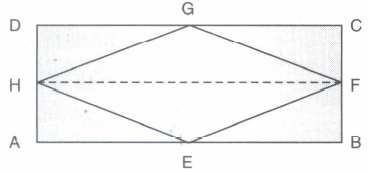
Now, \(\Delta\) HFG and rectangle HFCD are on the same base HF and lie between the same parallels HF and DC.
\(\therefore \ ar(\Delta HFG)=\frac { 1 }{ 2 } ar(\Box HFCD)\quad \quad \quad ......(i)\)
Similarly, ar(\(\Delta EHF)=\frac { 1 }{ 2 } ar(\Box ABFH)\) ...........(ii)
Adding (i) and (ii), we get
ar(\(\Delta\)HFG) + ar(\(\Delta\)EHF) = \(\frac { 1 }{ 2 } ar(\Box HFCD)+ar(\Box ABFH)\)
\(\Rightarrow \ ar(\Box EFGH)=\frac { 1 }{ 2 } ar(\Box ABCD)\)
\(16=\frac { 1 }{ 2 } ar(\Box ABCD)\)
\(\therefore \ ar(\Box ABCD)=32\ { cm }^{ 2 }\)
5.
Given: A rectangle ABCD.
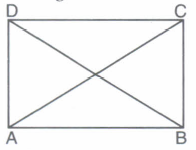
To prove: AC= BD
Consider, \(\Delta\)DAC and \(\Delta\)CBD,
\(\angle \)D =\(\angle \)C
AD = BC
(opp. sides are equal)
DC=DC (Common)
\(\therefore\) \(\Delta\)DAC\(\cong \)\(\Delta\)CBD (By SAS)
\(\Rightarrow\) AC = BD (c.p.c.t)
Hence proved.
6.
Given:\(\Delta \) ABC and \(\Delta \) ABD are two triangles on the same base AB. Line segment CD is bisected by AB at O.
To Prove: ar(ABC) = ar(ABD)
Proof: Line segment CD is bisected by AB at O
CO = DO
\(\Rightarrow \) O is the midpoint of CD.
\(\Rightarrow \) AO is a median of \(\Delta \)ACD and BO is a median of \(\Delta \)BCD
AO is a median of \(\Delta \)ACD
ar(\(\Delta \) AOC) = ar(\(\Delta \) AOD) ... (1)
| A median of a triangle divides it into two triangles of equal areas
BO is a median of \(\Delta \) BCD
ar(\(\Delta \) BOC) = ar(\(\Delta \) BOD) ... (2)
| A median of a triangle divides it into two triangles of equal areas
Adding (1) and (2), we get,
\(ar(\Delta AOC)+ar(\Delta BOC)\)
\(\\ =ar(\Delta AOD)+ar(\Delta BOD)\)
\(\\ \Rightarrow ar(\Delta ABC)=ar(\Delta ABD)\)
7.
Given: The diagonals of a parallelogram ABCD intersect at a point O. Through O, a line is drawn to intersect AD at P and BC at Q.
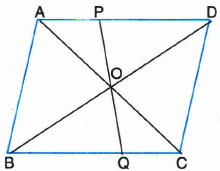
\(ar(\Box PDCQ)=ar(\Box PQBA)\)
Proof: AC is diagonal pf || gm ABCD
\(ar(\Delta ABC)=ar(\Delta ACD)\) ........(i)
\(\\ =\frac { 1 }{ 2 } ar(||gm\ ABCD)\)
In \(\Delta AOP\) and \(\Delta COQ\)
AO + CO
|Diagonals of a parallelogram bisect each other
\(\angle AOP=\angle COQ\) |Vertically opposite angles
\(\angle OAP=\angle OCQ\) |Alternate interior angles
\(\Delta AOP=\Delta COQ\) |By ASA Congruence Rule
\(ar(\Delta AOP)=ar(\Delta COQ)\) |Congruent figures have equal areas
\(\Rightarrow \ ar(\Delta AOP)+ar(\Box OPDC)\)
\(\\ ar(\Delta ACD)=ar(\Box PDCQ)\)
\(\\ \Rightarrow \frac { 1 }{ 2 } ar(||\ gm\ ABCD)=ar(\Box PDCQ)\quad \quad \ from(i)\)
\(\\ \Rightarrow ar(\Box PQBA)=ar(\Box PDCQ)\)
\(\\ \Rightarrow ar(\Box PDCQ)=r(\Box PQBA)\)
8.
Given: ABCD is a trapezium with AB || CD. AM is its height.
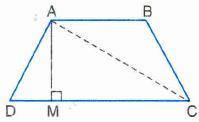
To Prove: ar(trapezium ABCD)
\(=\frac { 1 }{ 2 } (AB+DC)(AM)\)
Construction: Join AC
Proof:ar(trapezium ABCD)
\(ar(\Delta \ ADC)+ar(\Delta \ ABC)\)
\(\\ =\frac { 1 }{ 2 } \times DC\times AM+\frac { 1 }{ 2 } \times AB\times AM\)
\(\\ =\frac { 1 }{ 2 } \times (DC+AB)\times AM\)
\(\\ =\frac { 1 }{ 2 } (AB+Dc)(AM)\)
9.
Given: Diagonals AC and BD of a trapezium ABCD with AB || CD intersect each other at O.
To Prove: ar(\(\Delta \)AOD) = ar(\(\Delta \) BOC)
Proof: \(\Delta \)ADB and \(\Delta \)ACB are on the same base AB and between the same parallels AB and DC
ar(\(\Delta \)ADB) = ar(\(\Delta \) ACB)
|Two triangles on the same base and between the same parallels are equal in area
\(\Rightarrow \) ar(\(\Delta \) ADB) - ar(\(\Delta \) AOB)
\(\Rightarrow \) ar(\(\Delta \) ACB) - ar(\(\Delta \)AOB)
I Subtracting ar( \(\Delta \)AOB) from both sides
\(\Rightarrow \) ar(\(\Delta \) AOD) = ar(\(\Delta \)BOC)
10.
Given: ABCD is a quadrilateral and BD is one of its diagonals.
To Prove: ABCD is a parallelogram and to determine its area.
Proof:\(\angle ABD=\angle BDC(=90°)\) |Given
But these angles form a pair of equal alternate.interior angles for lines AB, DC and a transversal BD
AB || DC
Also, AD = DC (= 3 cm) I Given
Hence, quadrilateral ABCD is a parallelogram.
I A quadrilateral is a parallelogram if its one pair of opposite sides are parallel and equal
Now,
\(ar(||gm\ ABCD)=base\times Corresponding\ altitude\)
\(\\ =3\times 4\)
\(\\ =12{ cm }^{ 2 }\)

9th Standard CBSE Syllabus & Materials
9th Standard CBSE
CBSE 9th Mathematics Lines and Angles Sample Question Papers Study Material - QB365 Set A
NEW9th Standard CBSE
CBSE 9th Mathematics Introduction to Euclid's Geometry Sample Question Papers Study Material - QB365 Set A
NEW9th Standard CBSE
CBSE 9th Mathematics Linear Equations in Two Variables Sample Question Papers Study Material - QB365 Set A
NEW9th Standard CBSE
CBSE 9th Mathematics Coordinate Geometry Sample Question Papers Study Material - QB365 Set A



CBSE 9th Standard CBSE Subjects
CBSE Standards