100% FREE ACCESS
9th Standard CBSE Syllabus & Materials
9th Standard CBSE
CBSE 9th Science Is matter around us pure? - New Model Questions Papers Study Material - QB365 Set A
NEW9th Standard CBSE
CBSE 9th Science Matter in our surroundings - New Model Questions Papers Study Material - QB365 Set A
NEW9th Standard CBSE
CBSE 9th Mathematics Heron's Formula Sample Question Papers Study Material - QB365 Set A
NEW9th Standard CBSE
CBSE 9th Mathematics Circles Sample Question Papers Study Material - QB365 Set A
NEW9th Standard CBSE
CBSE 9th Mathematics Quadrilaterals Sample Question Papers Study Material - QB365 Set A
NEW9th Standard CBSE
CBSE 9th Mathematics Triangles Sample Question Papers Study Material - QB365 Set A

Published on: 24/09/2019
Coordinate Geometry
Download CBSE Class 9th Standard CBSE Mathematics question papers, sample papers, important questions, and previous year solved papers in PDF format. Get free study materials, NCERT solutions, and exam preparation resources for Class 9th Standard CBSE Mathematics
Questions + Answers key
Take MCQ Mathematics Test
1.
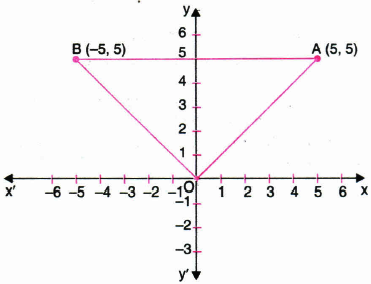
Plot the points A(5,5) and B(-5,5) in Cartesian plane.Join AB, OA and OB.Name the figure obtained.
2.
Plot the points A(2,0), B(2,2), C(0,2) and D(0,0) and draw line segments OA, AB, BC and CO.What figure do you obtain?
3.
Plot the following points on a graph sheet and join them in order B(-5,3), E(-3,-2), S(4,-2), T(1,3).Also mention the quadrants in which the points lie.
4.
Plot the following points on the graph.
| Points | A | B | C | D | E | F |
|---|---|---|---|---|---|---|
| x | 1 | 0 | -2 | -3 | -3 | 5 |
| y | -7 | -5 | 0 | -4 | 2 | 3 |
Write the points which lie on x-axis and y-axis.
5.
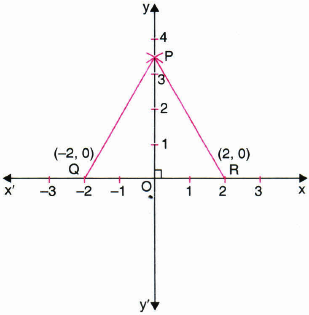
In figure, \(\triangle PQR\) is an equilateral triangle with coordinates of vertices Q and R as (-2,0) and (2,0).Find the coordinates of the vertex P.
6.
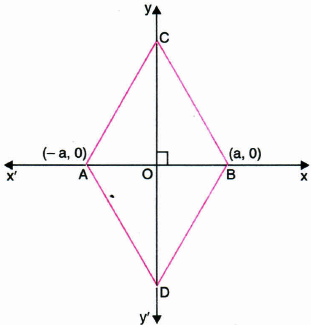
In figure, \(\triangle ABC\) and \(\triangle ABD\) are equilateral triangles.Find the coordinates of points C and D.
7.
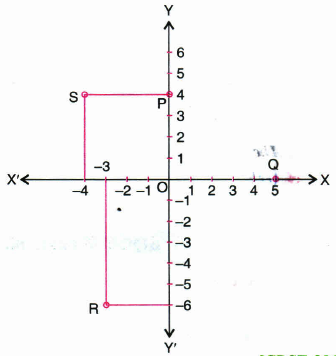
See figure and write the following:
(i) Coordinates of point P
(ii) Abscissa of point Q
(iii) The point identified by the coordinates (-4,4)
(iv) The point identified by the coordinates (-3,-6)
8.
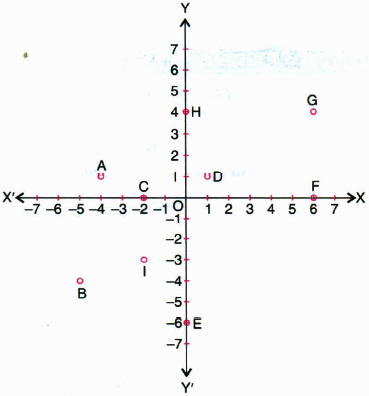
From the given figure, write
(i) The coordinates of the points B and F
(ii) The abscissae of points A and C
(iii) The ordinates of the points A and C.
(iv) The perpendicular distance of the point G from the x-axis.
9.
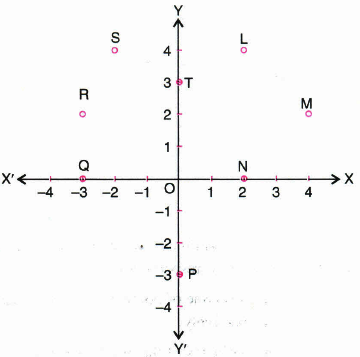
From the given figure, write the points whose
(a) ordinate = 0
(b) abscissa = 0
(c) abscissa = -3
(d) ordinate = 4
10.
In which quadrant, can a point have:
(i) abscissa equal to its ordinate
(ii) ordinate equal in magnitude to abscissa
(iii) ordinate equal and opposite of abscissa
(iv) abscissa twice that of the ordinate.
1.
The figure obtained is a right angled triangle.
2.
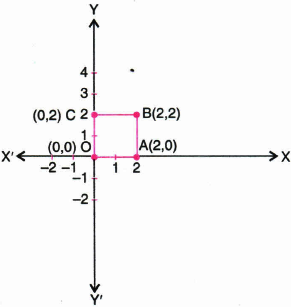
The figure obtained is a square.
3.
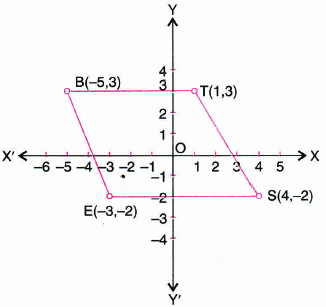
(i) The point B lies in II quadrant.
(ii) The point E lies in III quadrant.
(iii) The point S lies in IV quadrant.
(iv) The point T lies in I quadrant.
4.
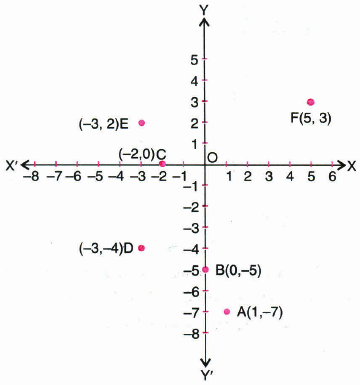
The point which lies on x-axis is C.
The point which lies on y-axis is B.
5.
\(\triangle PQR\) is an equilateral triangle
PQ = PR = QR
\(\Rightarrow \) PQ = QR
\(\Rightarrow \) PQ = 4
\(\Rightarrow \) OQ = 2
In right triangle POQ
OP2 + OQ2 = PQ2
\(\Rightarrow \) OP + (2)2 = (4)2 \(\Rightarrow \) OP = \(2\sqrt { 3 } \)
\(P\rightarrow \left( 0,2\sqrt { 3 } \right) \)
6.
\(\triangle ABC\) is an equilateral triangle
AC = BC = AB
\(\Rightarrow \) BC = AB
\(\Rightarrow \) BC = 2a
In right triangle COB,
OB2 + OC2 = BC2 [By pathagoras Theorem]
\(\Rightarrow \) a + OC = (2a)2 \(\Rightarrow \) OC2 = 3a2
\(\Rightarrow \) OC = \(\sqrt { 3 } a\) \(\therefore \ C\rightarrow \left( 0,-\sqrt { 3 } a \right) \)
Similarly, \(D\rightarrow \left( 0,-\sqrt { 3 } a \right) \)
7.
(i) Coordinates of point P are (0,4)
(ii) Abscissae of point Q is 5.
(iii) The point identified by the coordinates (-4,4) is S.
(iv) The point identified by the coordinates (-3,-6) is R.
8.
(i) The coordinates of the points B and F are (-5,-4) and (6,0) respectively.
(ii) The abscissae of points D and H are 1 and 0 respectively.
(iv) The ordinates of the points A and C are 1 and 0 respectively.
(iv) The perpendicular distance of the point G from the x-axis is 4 units.
9.
(a) The points whose ordinates are O and Q and N.
(b) The points whose abscissae are 0 are T and P.
(c) The points whose abscissae are -3 are Q and R.
(d) The points whose ordinates are 4 are S and L.
10.
(i) I, III
(ii) I, II, III, IV
(iii) II, IV
(iv) I, III

9th Standard CBSE Syllabus & Materials
9th Standard CBSE
CBSE 9th Mathematics Lines and Angles Sample Question Papers Study Material - QB365 Set A
NEW9th Standard CBSE
CBSE 9th Mathematics Introduction to Euclid's Geometry Sample Question Papers Study Material - QB365 Set A
NEW9th Standard CBSE
CBSE 9th Mathematics Linear Equations in Two Variables Sample Question Papers Study Material - QB365 Set A
NEW9th Standard CBSE
CBSE 9th Mathematics Coordinate Geometry Sample Question Papers Study Material - QB365 Set A



CBSE 9th Standard CBSE Subjects
CBSE Standards