100% FREE ACCESS
9th Standard CBSE Syllabus & Materials
9th Standard CBSE
CBSE 9th Science Is matter around us pure? - New Model Questions Papers Study Material - QB365 Set A
NEW9th Standard CBSE
CBSE 9th Science Matter in our surroundings - New Model Questions Papers Study Material - QB365 Set A
NEW9th Standard CBSE
CBSE 9th Mathematics Heron's Formula Sample Question Papers Study Material - QB365 Set A
NEW9th Standard CBSE
CBSE 9th Mathematics Circles Sample Question Papers Study Material - QB365 Set A
NEW9th Standard CBSE
CBSE 9th Mathematics Quadrilaterals Sample Question Papers Study Material - QB365 Set A
NEW9th Standard CBSE
CBSE 9th Mathematics Triangles Sample Question Papers Study Material - QB365 Set A

Published on: 10/10/2019
Heron's Formula
Download CBSE Class 9th Standard CBSE Mathematics question papers, sample papers, important questions, and previous year solved papers in PDF format. Get free study materials, NCERT solutions, and exam preparation resources for Class 9th Standard CBSE Mathematics
Questions + Answers key
Take MCQ Mathematics Test
1.
A triangle and a parallelogram have the same base and the same area.If the sides of the triangle are 15 cm, 14 cm, and 13 cm, and the parallelogram stands on the base 15 cm, find the height of the parallelogram.
2.
Find the area of a quadrilateral ABCD whose sides in meters are 9, 40, 28, and 15 respectively and the angle between first two sides is a right angle.
3.
Find the area of a quadrilateral ABCD whose sides AB = 13 cm, BC = 12 cm, CD = 9 cm, DA = 14 cm and diagonal BD = 15 cm.
4.
Find the area of a rhombus whose perimeter is 200 m and one of the diagonals is 80 m.
5.
The adjacent sides of a parallelogram ABCD measure 34 cm and 20 cm and the diagonal AC measures 42 cm. Find the area of the parallelogram.
6.
Black and white coloured triangular sheets are used to make a toy as shown in figure. Find the total area of black and white colour sheets used for making the toy.
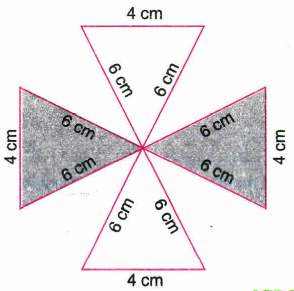
7.
The sides of a triangular park are 8 m, 10 m, and 6 m respectively. A small circular area of diameter 2 m is to be left out and the remaining area is to be used for growing roses. How much area is used for growing roses? (Use \(\pi \) = 3.14).
8.
In the following figure, calculate the area of the shaded portion:
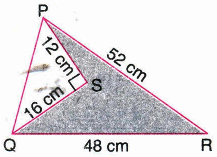
9.
The perimeter of a right triangle is 24 cm. If its hypotenuse is 10 cm, find its area.
10.
The perimeter of a triangle field is 300 cm and its sides are in the ratio 5:12:13.Find the length of the perpendicular from the opposite vertex to the side whose length is 130 cm.
11.
Sides of a triangle are in the ratio 13:14:15 and its perimeter is 84 cm.Find its area.
12.
An isosceles triangle has perimeter 30 m and each of the equal sides is 12 cm.Find area of the triangle.
13.
The base of an isosceles triangle measures 24 cm and its area is 60 cm2, Find its perimeter.
14.
lf the area of an equilateral triangle is \(81\sqrt { 3 } \)cm2, find its perimeter.
15.
Find the area of a right-angled \(\Delta \)ABC, right angled at B in which AB = 24 metre and BC = 10 metre.
1.
For triangle a = 15 cm, b = 14 cm, c = 13 cm
\( \therefore \ =\frac { a+b+c }{ 2 } s=\frac { 15+14+13 }{ 2 } =21\)c m
\(\therefore \) Area = \(\sqrt { s(s-a)(s-b)(s-c) } \)
\(=\sqrt { 21(21-15)(21-14)(12-13) } \)
\(=\sqrt { 21(6)(7)(8) } =84\) cm2
Let the height of the parallelogram be h cm.
Then, area of the parallelogram = Base \(\times \) Height = 15 \(\times \) h = 15 cm2
According to the question, Area of the parallelogram = Area of the triangle
\(\Rightarrow \) 15h = 84
\(\Rightarrow \) \(\frac { 84 }{ 15 } \) = 5.6 cm
Hence, the height of the parallelogram is 5.6 cm.
2.
For \(\Delta \) ABC
Area of right triangle ABC = \(\frac { 1 }{ 2 } \times \) Base\(\times \) Height = \(\frac { 1 }{ 2 } \times \) 9 \(\times \)40 = 180 m2
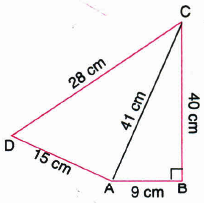
For \(\Delta \) ACD
a = 28cm, b = 41 m, c = 15 m
\( \therefore s=\frac { a+b+c }{ 2 } s=\frac { 28+41+15 }{ 2 } =\frac { 84 }{ 2 } \) = 42 m
\(\therefore \) Area of \(\Delta \)ACD = \(\sqrt { s(s-a)(s-b)(s-c) } \)
= \(\sqrt { 42(42-28)(42-41)(42-15) } \)
=\(\sqrt { 42(14)(1)(27) } =\sqrt { (14\times 3)(14)(1)(9\times 3) } \)
=\(14\times 3\times 3=126\) m2
\(\therefore \) Area of the quadrilateral ABCD = Area of \(\Delta \) ABC +Area of \(\Delta \) ACD
= 180 m2 + 126 m2 = 306 m2
3.
For \(\Delta \)ABD
a = 13 cm, b = 14 cm, c = 15 cm
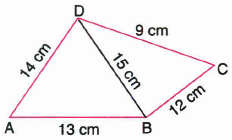
\(\therefore s=\frac { a+b+c }{ 2 } s=\frac { 13+14+15 }{ 2 } \) = 21 cm
\(\therefore \) Area = \(=\sqrt { s(s-a)(s-b)(s-c) } \)
\(=\sqrt { 21(21-13)(21-14)(21-15) } \)
\(\sqrt { 21\times 8\times 7\times 6 } =84\) cm2
For\(\Delta \) BCD
1 = 9 cm, b = 12 cm, c = 15 cm
\( \therefore s=\frac { a+b+c }{ 2 } s=\frac { a+12+15 }{ 2 } \)=18 cm
\(\therefore \)Area \(=\sqrt { s(s-a)(s-b)(s-c) } \)
\(=\sqrt {18(18-9)(18-12)(18-15) } \)
\(\sqrt { 18\times 9\times 6\times 3 } =54\) cm2
Now, area of quadrilateral ABCD = Area of \(\Delta \)ABD + Area of \(\Delta \)BCD
= 84 cm2 + 54 cm2 = 138 cm2
4.
Let each of the equal sides of the rhombus be a cm.
Then, Perimeter = a + a + a + a = 4a m
According to the question, 4a = 200
\(\Rightarrow \) a= \(\frac { 200 }{ 4 } \) = 50 m
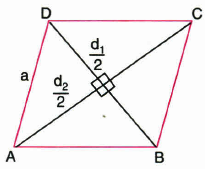
d1= 80 m
a2=\({ \left( \frac { { d }_{ 1 } }{ 2 } \right) }^{ 2 }+{ \left( \frac { { d }_{ 2 } }{ 2 } \right) }^{ 2 }\)
\(\Rightarrow \) (50)2 =( 40)2+\({ \left( \frac { { d }_{ 2 } }{ 2 } \right) }^{ 2 }\)
\(\Rightarrow \) \({ \left( \frac { { d }_{ 2 } }{ 2 } \right) }^{ 2 }\)= (50)2-(40)2 = 900= (30)2
\(\Rightarrow \) \(\frac { { d }_{ 2 } }{ 2 } \) = 30
\(\Rightarrow \) d2 = 60 m
\(\therefore \) Area of the rhombus = \(\frac { 1 }{ 2 } \) d1d2=\(\frac { 1 }{ 2 } \)\(\times \)80\(\times \)60 = 2400 m2
5.
For \(\Delta \) ABC
a = 34 cm, b = 42 cm, c = 20 cm
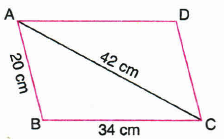
\(\therefore s=\frac { a+b+c }{ 2 } =\frac { 34+42+20 }{ 2 } =48\) cm
\(\therefore \) Area of \(\Delta \) ABC = \(\sqrt { s(s-a)(s-b)(s-c) } \)
\(=\sqrt { 48(48-34)(48-42)(48-20) } \)
\(=\sqrt { 48(14)(6)(28) } =\quad 336\) cm2
\(\therefore \) Area of parallelogram ABCD = 2 area of triangle ABC
= 2\(\times \) 336 cm2 = 672 cm2
6.
For one black colour sheet a= 4 cm, b = 6 cm
\(\therefore \) Area \(=\frac { a }{ 4 } \sqrt { 4{ b }^{ 2 }-{ a }^{ 2 } } \) | Sheet is an isosceles triangle
\(=\frac { 4 }{ 4 } \sqrt { 4{ (6) }^{ 2 }-4^{ 2 } } \) \(=\sqrt { 128 } =8\sqrt { 2 } \) cm2
\(\therefore \) Area of 2 black colour sheets = 2\(\times 8\sqrt { 2 } \) = \( 16\sqrt { 2 } \) cm2
Similarly, area of 2 white colour sheets = \( 16\sqrt { 2 } \) cm2
\(\therefore \) Total area of black and white colour sheets = \( 16\sqrt { 2 } \) + \( 16\sqrt { 2 } \) = \( 32\sqrt { 2 } \) cm2
7.
For triangular park
\(\because \) 62 + 82 = 102
\(\therefore \) Angular between sides of length 6 m and 8 m = \(90°\)
\(\therefore \) Area of the triangular park = \(\frac { 6\times 8 }{ 2 } \) = 24 m2
Radius of circular area (r) = \(\frac { 2 }{ 2 } \) m = 1m
\(\therefore \) Circular area = \(\pi \)r2 = \(\pi \)(1)2=\(\pi \)=3.14 m2
\(\therefore \) Area used for growing roses = Area of the triangular part - Circular area
= 24 - 3.14 = 20.86 m2
8.
In right triangle PSQ, PQ\(\frac { 1 }{ 2 } \)2 = PS2 + QS2 |By Pythagoras Theorem
= (12)2 + (16)2
= 144 + 256 =400
\(\Rightarrow \) PQ = \(\sqrt { 400 } \) = 20 cm
Now, for \(\Delta \)PQR
a = 20cm, b = 48cm, c = 52cm
\(\therefore s=\frac { a+b+c }{ 2 } =\frac { 20+48+52 }{ 2 } =60\) cm
\(\therefore \) Area of \(\Delta \)PQR \(=\sqrt { s(s-a)(s-b)(s-c) } \)
\(=\sqrt { 60(60-20)(60-48)(60-52) }\)
\( \\ =\sqrt { (60)(40)(12)(8) } \)
\(=\sqrt { \left( 6\times 10 \right) \left( 4\times 10 \right) \left( 6\times 2 \right) \left( 8 \right) } \)
\(=6\times 10\times 8=480\) cm2
Area of \(\Delta \) PSQ = \(\frac { 1 }{ 2 } \)\(\times \)Base\(\times \)Altitude
=\(\frac { 1 }{ 2 } \)\(\times \)16\(\times \)12=96 cm2
\(\therefore \) Area of the shaded portion =Area of \(\Delta \)PQR - Area of \(\Delta \)PSQ
= 480 - 96 = 384 cm2
9.
Let the sides forming the right angle be a cm and b cm. Then,
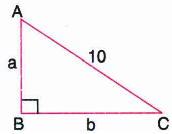
a + b + 10 = 24
\(\Rightarrow \) a + b = 14 ....(1)
Also, a2 + b2 = (10)2 |By Pythagoras Theorem
\(\Rightarrow \) a2 + b2 = 100 ...(2)
We know that (a + b)2 = a2 + b2 + 2ab
\(\Rightarrow \) (14)2 = 100+2ab
\(\Rightarrow \) 2ab = 96
\(\Rightarrow \) ab=48 ...(3)
Also, (a - b)2 = a2 + b2- 2ab
= 100 - 2\(\times \)48
= 100 - 96 = 4 | if a>b
\(\Rightarrow \) a- b = 2
Solving (1) and (4), we get a=8cm, b=6cm
\(\therefore \) Area = \(\frac { 1 }{ 2 } \)ab = \(\frac { 1 }{ 2 } \).8.6 = 24 cm2
10.
a:b:c = 5:12:13
5+12+13 = 30
a+b+c = 300 cm
\(\therefore a=\frac { 5 }{ 30 } \times 300=50\) cm
\(b=\frac { 12 }{ 30 } \times 300=120\) cm
\(c=\frac { 13 }{ 30 } \times 300=130\)
\(\therefore s=\frac { a+b+c }{ 2 } =\frac { 50+120+130 }{ 2 } =150\) cm
\(\therefore \) Area of the triangular field \(=\sqrt { s(s-a)(s-b)(s-c) } \)
\(=\sqrt { 150(150-50)(150-120)(150-130) } \)
\(\\ =\sqrt { 150\times 100\times 30\times 20 } \)
= 3000 cm2 ----(1)
Let the length of the perpendicular from the opposite vertex to the side whose length is 130 cm be h cm.Then,
Area of the triangular field \(=\frac { 130\times h }{ 2 } \) = 65h cm2 ...(2)
From (1) and (2)
65h = 3000
\(\Rightarrow h=\frac { 3000 }{ 65 } =\frac { 600 }{ 13 } \) cm = 46.15 cm
11.
Let the sides of the triangle be 13k, 14k, and 15k (in cm).Then,
Perimeter = a + b + c = 13K + 14k + 15k = 42k cm
According to the question, 42k = 84
\(\Rightarrow k=\frac { 84 }{ 42 } =2\)
\(\therefore \) Sides are 26 cm, 28 cm, and 30 cm.
\(\therefore s=\frac { a+b+c }{ 2 } =\frac { 26+28+30 }{ 2 } \)
= 42 cm
\(\therefore \) Area \(=\sqrt { s(s-a)(s-b)(s-c) } \)
\(=\sqrt { 42(42-26)(42-28)(42-30) } \)
\(\\ =\sqrt { (42)(16)(14)(12) } \)
= 336 cm2
12.
Let the third side be x cm. Then, 12 + 12 + x = 30
24 + x = 30
x = 6 cm
So, a = 12 cm, b = 12 cms, c = 6 cm
\(\therefore s=\frac { a+b+c }{ 2 } =\frac { 12+12+6 }{ 2 } \)
= 15 cm
\(\therefore \) Area \(=\sqrt { s(s-a)(s-b)(s-c) } \)
\(=\sqrt { 15(15-12)(15-12)(15-6) } \)
\(=9\sqrt { 15 } \) cm2
13.
Area = \(=\frac { a }{ 4 } \sqrt { 4{ b }^{ 2 }-{ a }^{ 2 } } \)
\(\Rightarrow 60=\frac { 24 }{ 4 } \sqrt { 4{ b }^{ 2 }-{ (24) }^{ 2 } } \)
\(\Rightarrow 10=\sqrt { 4{ b }^{ 2 }-576 } \)
\(\Rightarrow 100=4{ b }^{ 2 }-576\) | Squaring
\(\Rightarrow 4{ b }^{ 2 }=676\)
\(\\ \Rightarrow { b }^{ 2 }=\frac { 676 }{ 4 } =169\)
\(\Rightarrow b=\sqrt { 169 } \) = 13 cm
\(\therefore\) Perimeter = a + b + b
= 24 + 13 + 13 = 50 cm
14.
Let the side of the equilateral triangle be a cm.
Then it's area = \(\frac { \sqrt { 3 } }{ 4 } \) a2 cm2
\(\frac { \sqrt { 3 } }{ 4 } \) a2 = \(81\sqrt { 3 } \) \(\Rightarrow \) a2= 81\(\times \)4
\(\Rightarrow \) a = \(\sqrt { 81\times 4 } \)
\(\Rightarrow \) a = 9\(\times \)2 = 18 cm
\(\therefore \) Perimeter of the equilateral triangle = 31 = 3 \(\times \)18 = 54 cm
15.
Area of \(\Delta \)ABC = \(=\frac { AB\times BC }{ 2 } =\frac { 24\times 10 }{ 2 } \) = 120 m2.

9th Standard CBSE Syllabus & Materials
9th Standard CBSE
CBSE 9th Mathematics Lines and Angles Sample Question Papers Study Material - QB365 Set A
NEW9th Standard CBSE
CBSE 9th Mathematics Introduction to Euclid's Geometry Sample Question Papers Study Material - QB365 Set A
NEW9th Standard CBSE
CBSE 9th Mathematics Linear Equations in Two Variables Sample Question Papers Study Material - QB365 Set A
NEW9th Standard CBSE
CBSE 9th Mathematics Coordinate Geometry Sample Question Papers Study Material - QB365 Set A



CBSE 9th Standard CBSE Subjects
CBSE Standards