100% FREE ACCESS
9th Standard CBSE Syllabus & Materials
9th Standard CBSE
CBSE 9th Science Is matter around us pure? - New Model Questions Papers Study Material - QB365 Set A
NEW9th Standard CBSE
CBSE 9th Science Matter in our surroundings - New Model Questions Papers Study Material - QB365 Set A
NEW9th Standard CBSE
CBSE 9th Mathematics Heron's Formula Sample Question Papers Study Material - QB365 Set A
NEW9th Standard CBSE
CBSE 9th Mathematics Circles Sample Question Papers Study Material - QB365 Set A
NEW9th Standard CBSE
CBSE 9th Mathematics Quadrilaterals Sample Question Papers Study Material - QB365 Set A
NEW9th Standard CBSE
CBSE 9th Mathematics Triangles Sample Question Papers Study Material - QB365 Set A

Published on: 06/12/2018
When preparing for your exams or even when you are working towards mastering the board examination, most experts recommend that you dedicate time and effort into solving question papers from the previous year or CBSE sample papers for class 9. This practice not only will familiarise you with the format of the question paper, but it will also teach you the discipline of answering the entire question paper within the time allotted to you at the examination. Learning how much time to allot for different questions of different weightage will give you an advantage in the exam. The time that you allot to answer a five-mark question will be different from the time you take to answer a one mark answer. Be sure to answer the last year sample paper CBSE class 9 as this will have the format according to the latest syllabus.
Get 100 percent accurate NCERT Solutions for Class 9 Maths Chapter 12 (Heron's Formula) solved by expert Maths teachers. We provide step by step solutions for questions given in class 9 maths text-book as per CBSE Board guidelines from the latest NCERT book for class 9 maths.
NCERT Grade 9 Chapter 12, Heron’s Formula is a part of Unit V, Mensuration. This chapter is in continuation with what the students have learned in lower grades related to the area of the triangle. Students are advised to go through the solutions given for the questions in this chapter to score well in the exams.
The topic Introduction depicts about finding area of triangle, areas of equilateral triangle, area of an isosceles triangle using Pythagoras Theorem. This topic is accompanied by interactive activity and some revision questions. The guided solutions for these questions are provided herein in an easy and point to point manner
Grade 9 CBSE has questions for total of 13 marks in the final examination paper as per the latest pattern.
Download CBSE Class 9th Standard CBSE Mathematics question papers, sample papers, important questions, and previous year solved papers in PDF format. Get free study materials, NCERT solutions, and exam preparation resources for Class 9th Standard CBSE Mathematics
Questions + Answers key
Take MCQ Mathematics Test
1.
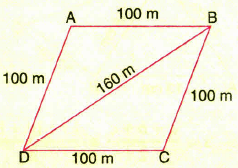
Sanya has a piece of land which is in the shape of a rhombus. She wants her one daughter and one son to work on the land and produce different crops to suffice the needs of their family. She divided the land in two equal parts. If the perimeter of the land is 400 m and one of the diagonals is 160 m, how much area each of them will get?
2.
A triangle and a parallelogram have the same base and the same area. If the sides of the triangle are 26 cm, 28 cm and 30 cm, and the parallelogram stands on the base 30 cm, find the height of the parallelogram.
3.
The perimeter of a triangular ground is 900 m and its sides are in the ratio 3: 5 : 4. Using Heron's formula, find the area of the ground.
4.
The unequal side of an isosceles triangle is 6 cm and its perimeter is 24 cm. Find its area.
5.
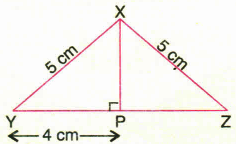
Find the area of an isosceles triangle with two equal sides as 5 cm each and unequal side as 8 cm.
6.
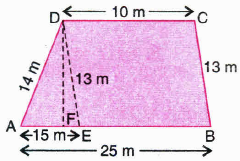
A field is in the shape of a trapezium whose parallel sides are 25 m and 10 m. The non-parallel sides are 14 m and 13 m. Find the area of the field.
7.
\(\triangle \)ABC is an isosceles triangle with AB = AC.The perimeter of the triangle is 36 cm and AB = 10 cm. What is the area of the triangle?
8.
The sides of a triangle are in the ratio 4: 5 : 5 and its perimeter is 168.m. Find the area of the triangle.
9.
Find the area of an equilateral triangle whose perimeter is 60 cm. (Using Heron's formula).
10.
A traffic signal board, indicating 'SCHOOL AHEAD', is an equilateral triangle with side 'a'.Find the area of the signal board, using Heron's Formula.If its perimeter is 180 cm, what will be the area of the signal board?
11.
A triangle and a parallelogram have the same base and the same area.If the sides of the triangle are 15 cm, 14 cm, and 13 cm, and the parallelogram stands on the base 15 cm, find the height of the parallelogram.
12.
The sides of a triangular field are 51 m, 37 m, and 20 m.Find the number of rose beds that can be prepared in the field if each rose bed occupies a space of 6 sq.cm.
13.
lf the area of an equilateral triangle is \(81\sqrt { 3 } \)cm2, find its perimeter.
14.
Area of a quadrilateral =
\(\frac { 1 }{ 2 } \times \) a diagonal \(\times \) sum of the perpendicular on the diagonal
a diagonal \(\times \) sum of the perpendicular on the diagonal
\(\frac { 1 }{ 3 } \times \) a diagonal \(\times \) sum of the perpendicular on the diagonal
\(\frac { 1 }{ 4 } \times \) a diagonal \(\times \) sum of the perpendicular on the diagonal
15.
Area of a parallelogram =
\(\frac { 1 }{ 2 } \times \)Base \(\times \) Height
Base \(\times \) Height
\(\frac { 1 }{ 4 } \times \)Base \(\times \) Height
\(\frac { 1 }{ 3 } \times \)Base \(\times \) Height
16.
The areas of a rectangle and a parallelogram are equal.If the length and breadth of the rectangle are 8 cm and 4.5 cm respectively and the base of the parallelogram is 9 cm, then find the altitude to the base of the parallelogram.
1 cm
2 cm
3 cm
4 cm
17.
If the area of a square is 625 ares, then its perimeter is
250 m
500 m
1000 m
25 m
18.
1 are =
10 m2
100 m2
1000 m2
10000 m2
19.
The area of an isosceles triangle is 12 cm2 .The lengths of its equal sides are 5 cm each.Find its base.
5 cm
3 cm
4 cm
6 cm or 8 cm
20.
Find the perimeter of the triangle whose sides are 17 cm, 33 cm, and 20 cm.
70 cm
50 cm
53 cm
37 cm
21.
The area of an equilateral triangle with side Area \(4\sqrt { 3 } \) cm is (\(\sqrt { 3 } \) = 1.732)
20 cm2
20 \(\sqrt { 3 } \) cm2
18.784 cm2
20.784 cm2
22.
Area of a triangle is 60 cm2.Its base is 15 cm.Its altitude is
30 cm
4 cm
8 cm
10 cm
23.
Area of a triangle =
\(\frac { 1 }{ 2 } \times\) Base \( \times\) Height
Base \( \times\) Height
\(\frac { 1 }{ 3} \times\) Base \( \times\) Height
\(\frac { 1 }{ 4 } \times\) Base \( \times\) Height
1.
Let ABCD be the field.
Perimeter = 400 m
So, each side = 400 m ÷ 4 = 100 m.
i.e. AB = AD = 100 m.
Let diagonal BD = 160 m.
Then semi-perimeter s of D ABD is given by
\(s=\frac{100+100+160}{2} \mathrm{~m}=180 \mathrm{~m}\)
Therefore, area of \(\Delta \mathrm{ABD}=\sqrt{180(180-100)(180-100)(180-160)}\)
\(=\sqrt{180 \times 80 \times 80 \times 20} \mathrm{~m}^{2}=4800 \mathrm{~m}^{2}\)
Therefore, each of them will get an area of 4800 m2.
2.
11.2 cm
3.
33750 cm2
4.
\(18\sqrt { 2 } \)cm2
5.
12 cm2
6.
Let the given field be in the shape of a trapezium ABCD in which AB=25 m, CD= 10 m, BC = 13 m and AD = 14 m.
From D, draw DE 11 BC meeting AB at E. Also, draw DF \(\bot \) AB.
\(\therefore \) DE = BC =13 m
AE = AB - EB = AB - DC
= 25 - 10 = 15 m
For AED
a = 14 m, b = 13 m, c= 15 m
\(\therefore s=\frac { a+b+c }{ 2 } =\frac { 14+13+15 }{ 2 } =\frac { 42 }{ 2 } =21\) m
\(\therefore \) Area of the \(\Delta \)AED \(=\sqrt { s(s-a)(s-b)(s-c) } \)
\(=\sqrt { 21(21-14)(21-13)(21-15) }\)
\( \\ =\sqrt { 21(7)(8)(6) } =\sqrt { \left( 7\times 3 \right) (7)\left( 4\times 2 \right) \left( 2\times 3 \right) } \)
\(=7\times 3\times 2\times 2=84\) m2
\(\Rightarrow \frac { 1 }{ 2 } \times \)AE\(\times \)DE = 84
\(\Rightarrow \ \frac { 1 }{ 2 } \times \)15\(\times \)DF = 84
\(\Rightarrow \) DF = \(\frac { 84\times 2 }{ 15 } \)
\(\Rightarrow \) DF= \(\frac { 56 }{ 5 } \) m = 11.2 m
\(\Rightarrow\) Height of the trapezium is 11.2 m.
\(\therefore \) Area of parallelogram EBCD = Base \(\times \) Height
= EB\(\times \) DF = 10 \(\times \)\(\frac { 56 }{ 5 } \) = 112 m2
\(\therefore \) Area of the field = Area of AED + Area of parallelogram EBCD = 84 m2 + 112 m2 = 196 m2.
7.
48 cm2
8.
\(288\sqrt { 21 } \) cm2
9.
\(100\sqrt { 3 } \) cm2
10.
'a' = a, 'b' =a, 'c' =a
\(s=\frac { 'a'+'b'+'c' }{ 2 } =\frac { a+a+a }{ 2 } =\frac { 3a }{ 2 } \)
\(\therefore \) Area of the signal board
\(=\sqrt { s(s-'a')(s-'b')(s-'c') } \)
\(\\ =\sqrt { \frac { 3a }{ 2 } \left( \frac { 3a }{ 2 } -a \right) \left( \frac { 3a }{ 2 } -a \right) \left( \frac { 3a }{ 2 } -a \right) } \)
\(\\ =\sqrt { \frac { 3a }{ 2 } \left( \frac { a }{ 2 } \right) \left( \frac { a }{ 2 } \right) \left( \frac { a }{ 2 } \right) } =\sqrt { \frac { { 3a }^{ 4 } }{ 16 } } =\frac { \sqrt { 3 } }{ 4 } { a }^{ 2 }\)
Perimeter = 180 cm
\(\Rightarrow 'a'+'b'+'c'\ =\ 180\)
\(\\ \Rightarrow a+a+a=180\)
\(\\ \Rightarrow 3a=180\)
\(\\ \Rightarrow a=\frac { 180 }{ 3 } \)
\(\Rightarrow \) a = 60 cm
\(\therefore \) Area of the signal board
\(=\frac { \sqrt { 3 } }{ 4 } \) a2 =\( \frac { \sqrt { 3 } }{ 4 } \) (60)2 = \(900\sqrt { 3 } \) cm2
Alternatively,
\(s=\frac { 3a }{ 2 } =\frac { 3 }{ 2 } (60)=90\)cm
Area of the signal board
\(=\sqrt { s(s-'a')(s-'b')(s-'c') } \)
\(=\sqrt { 90(90-60)(90-60)(90-60) } \)
\(\\ =\sqrt { 90(30)(30)(30) } =900\sqrt { 3 } \) cm2.
11.
For triangle a = 15 cm, b = 14 cm, c = 13 cm
\( \therefore \ =\frac { a+b+c }{ 2 } s=\frac { 15+14+13 }{ 2 } =21\)c m
\(\therefore \) Area = \(\sqrt { s(s-a)(s-b)(s-c) } \)
\(=\sqrt { 21(21-15)(21-14)(12-13) } \)
\(=\sqrt { 21(6)(7)(8) } =84\) cm2
Let the height of the parallelogram be h cm.
Then, area of the parallelogram = Base \(\times \) Height = 15 \(\times \) h = 15 cm2
According to the question, Area of the parallelogram = Area of the triangle
\(\Rightarrow \) 15h = 84
\(\Rightarrow \) \(\frac { 84 }{ 15 } \) = 5.6 cm
Hence, the height of the parallelogram is 5.6 cm.
12.
Let a = 51 m, b = 37 m, and c = 20 m
Then, s= \(\frac { a+b+c }{ 2 } \) = \(\frac { 51+37+20 }{ 2 } =\frac { 108 }{ 2 } \) = 54 m
\(\therefore \) Area of the triangular field = \(\sqrt { s(s-a)(s-b)(s-c) } \)
= \(\sqrt { 54(54-51)(54-37)(54-20) } \)
=\(\sqrt { 54\times 3\times 17\times 34 } =\sqrt { 2\times 3\times 3\times 3\times 3\times 17\times 2\times 17 } \)
= \(2\times 3\times 3\times 17=306\)m2
Space occupied by one rose bed = 6 m2
Number of rose beds that can be prepared in the field = \(\frac { Area\ of\ the\ field }{ Space\ occupied\ by\ one\ rose\ bed } \)
\(=\frac { 306 }{ 6 } =51\)
13.
Let the side of the equilateral triangle be a cm.
Then it's area = \(\frac { \sqrt { 3 } }{ 4 } \) a2 cm2
\(\frac { \sqrt { 3 } }{ 4 } \) a2 = \(81\sqrt { 3 } \) \(\Rightarrow \) a2= 81\(\times \)4
\(\Rightarrow \) a = \(\sqrt { 81\times 4 } \)
\(\Rightarrow \) a = 9\(\times \)2 = 18 cm
\(\therefore \) Perimeter of the equilateral triangle = 31 = 3 \(\times \)18 = 54 cm
14.
Formula
15.
Formula
16.
8\(\times \)4.5 = 9 \(\times \) altitude
\(\Rightarrow \) Altitude = 4 cm
17.
(c)
1000 m
18.
Formula
19.
(d)
6 cm or 8 cm
20.
Perimeter = 17+33+20 = 70 cm
21.
(d)
20.784 cm2
22.
(c)
8 cm
23.
Formula

9th Standard CBSE Syllabus & Materials
9th Standard CBSE
CBSE 9th Mathematics Lines and Angles Sample Question Papers Study Material - QB365 Set A
NEW9th Standard CBSE
CBSE 9th Mathematics Introduction to Euclid's Geometry Sample Question Papers Study Material - QB365 Set A
NEW9th Standard CBSE
CBSE 9th Mathematics Linear Equations in Two Variables Sample Question Papers Study Material - QB365 Set A
NEW9th Standard CBSE
CBSE 9th Mathematics Coordinate Geometry Sample Question Papers Study Material - QB365 Set A



CBSE 9th Standard CBSE Subjects
CBSE Standards