100% FREE ACCESS
9th Standard CBSE Syllabus & Materials
9th Standard CBSE
CBSE 9th Science Is matter around us pure? - New Model Questions Papers Study Material - QB365 Set A
NEW9th Standard CBSE
CBSE 9th Science Matter in our surroundings - New Model Questions Papers Study Material - QB365 Set A
NEW9th Standard CBSE
CBSE 9th Mathematics Heron's Formula Sample Question Papers Study Material - QB365 Set A
NEW9th Standard CBSE
CBSE 9th Mathematics Circles Sample Question Papers Study Material - QB365 Set A
NEW9th Standard CBSE
CBSE 9th Mathematics Quadrilaterals Sample Question Papers Study Material - QB365 Set A
NEW9th Standard CBSE
CBSE 9th Mathematics Triangles Sample Question Papers Study Material - QB365 Set A

Published on: 26/09/2019
Lines and Angles
Download CBSE Class 9th Standard CBSE Mathematics question papers, sample papers, important questions, and previous year solved papers in PDF format. Get free study materials, NCERT solutions, and exam preparation resources for Class 9th Standard CBSE Mathematics
Questions + Answers key
Take MCQ Mathematics Test
1.
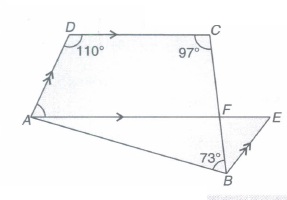
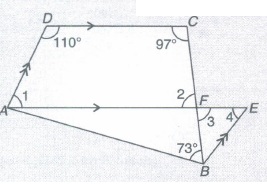
In the above figure ABCD is a quadrilateral in which \(\angle ABC=73^o,\angle C=97^o\) and \(\angle D=110^o\). If AE||DC and BE||AD and AE intersects BC at F, find the measure of \(\angle EBF.\)
2.
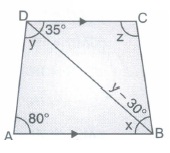
In the given figure, AB||DC, \(\angle BDC=35^o\) and \(\angle BAD=80^o.\) Find x,y,z
3.
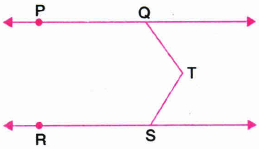
In figure PQ || RS and T is any point as shown in the figure then show that
\(\angle PQT+\angle QTS+\angle RST=360^{ 0 }\)
4.
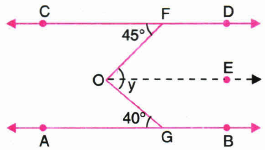
In figure if AB || CD then find the value of y.
5.
If l,m,n are three lines such that l || m and n \(\bot \) l , then prove that n \(\bot \)m
6.
If two lines are perpendicular to the same line prove that they are parallel to each other.
7.
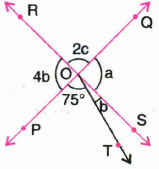
In the given figure , two straight lines PQ and RS intersect each other at O
If \(\angle \)POT =\(75^{ 0 }\) Find the values of a,b,c
8.
If two lines intersect each other, then the vertically opposite angles are equal. prove it
9.
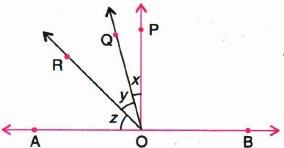
In the given figure PO \(\bot \) AB If x:y:z=1:3:5 then find the degree measure of x,y and z
1.
Let \(\angle DAF=\angle 1\)
\(\angle CFA=\angle 2,\)
\(\angle BFE=\angle 3\)
\(\angle BEF=\angle 4\)
Since, AE||DC
\(\angle D+\angle 1=180^o\)
(Angles on the same side of transversal)
\(\angle 1=180^o-110^o=70^o\)
\(\angle 4=\angle 1=70^o\) (Alternate angle)
Again, \(97^o+\angle2=180^o\) (Angle on the same side of transversal)
\(\angle 2=180^o-97^o=83^o\)
\(\angle 3=\angle2=83^o\)
(Vertically opp.angles)
In \(\triangle BEF,\)
\(\angle 3+\angle 4+\angle EBF=180^o\)
(Angle sum property)
\(\Rightarrow 83^o+70^0+\angle EBF=180^o\)
\(\Rightarrow \angle EBF=180^o-153^o\)
\(\Rightarrow \angle EBF=27^o\)
2.
AB||DC
\(\angle CDB=\angle ABD\)
=x=35o[alternate angles]
x+y+80o=180o
\(\angle ADB=y=180^o-35^o-80^o\)
=65[angle sum property]
\(\angle DCB=z=180^o-[35^o+35^o]\)
=110o
3.
Given PQ || RS and T is any point
To prove \(\angle PQT+\angle QTS+\angle RST=360^{ 0 }\)
Construction Through T, draw TU || PQ || RS
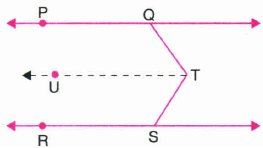
PQ || UT |By construction and a transversal QT intersects then
\(\therefore \angle PQT+\angle QTU=180^{ 0 }\)
The Sum of consecutive interior angles on the same sides of a transversal is \(180^{ 0 }\)
UT || RS
| By construction and a transversal TS intersect them
\(\therefore \angle UTS+\angle RST=180^{ 0 }\)
The Sum of consecutive interior angles on the same side of a transversal is \(180^{ 0 }\)
Adding (1) and (2) ,we get
\(\angle PQT+(\angle QTU+\angle UTS)+\angle RST=360^{ 0 }\)
\(\Rightarrow \angle PQT+\angle QTS+\angle RST=360^{ 0 }\)
4.
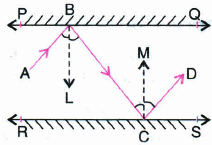
Through O draw OE || AB || CD
Now y= \(\angle FOG\)
=\(\angle \)FOE + \(\angle GOE\)
=\(\angle \)CFO+\(\angle \) AGO
=\(\angle \)FOE ==\(\angle \) CFO (Alternate Interior angles)
=\(\angle \)GOE=\(\angle \)AGO (Alternate Interior Angles)
=\(45^{ 0 }\)+\(40^{ 0 }\)=\(85^{ 0 }\)
5.
Given l,m,n are three lines such that l || m and n \(\bot \)m
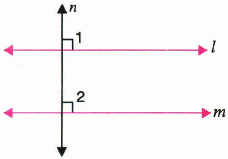
\(\therefore \)l || m and n is a transversal
\(\therefore \) \(\angle \)1=\(\angle \)2 |Corresponding angles
But \(\angle \)1=\(90^{ 0 }\)
\(\therefore \) \(\angle \) 2= \(90^{ 0 }\)
\(\Rightarrow \) n \(\bot \) m
6.
Let the two lines m and n each be perpendicular to the same line L
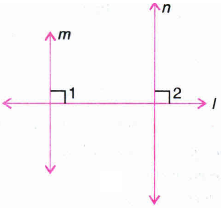
Then,
\(\angle \)1=\(90^{ 0 }\)
\(\angle \)2=\(90^{ 0 }\)
\(\angle \)1=\(\angle \)2
But these angles form a pair of equal corresponding angles
\(\therefore \) m||n
7.
\(\therefore \) ROS is a line
\(\therefore \) 4b+\(75^{ 0 }\)+b=\(180^{ 0 }\)
\(\Rightarrow 5b=180^{ 0 }-75^{ 0 }=105^{ 0 }\)
\(\Rightarrow \) b=\(\frac { 105^{ 0 } }{ 5 } =21^{ 0 }\)
2c=\(75^{ 0 }\)+b
|Vertically opposite angles
\(\Rightarrow 2c=75^{ 0 }+21^{ 0 }\)
\(\Rightarrow 2c=96^{ 0 }\)
\(\Rightarrow \)\(c=\frac { 96^{ 0 } }{ 2 } =48^{ 0 }\)
a=4b
|Vertically opposite angkes
\(\Rightarrow a=4X21^{ 0 }=84^{ 0 }\)
Thus \(a=84^{ 0 },b=21^{ 0 },c=48^{ 0 }\)
8.
Let AB and CD two lines intersecting at O
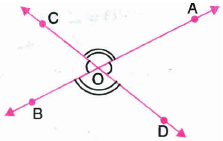
This leads to two pairs of vertically opposite angles,namely
(i) \(\angle \)AOC and \(\angle \)BOD
(II) \(\angle \)AOD and \(\angle \)BOC
We are to prove that
(i) \(\angle \)AOC and \(\angle \)BOD
(II) \(\angle \)AOD and \(\angle \)BOC
\(\therefore \) Ray OA stands on line CD
Therefore (i) \(\angle \)AOC and \(\angle \)AOD=\(180^{ 0 }\)
|Linear Pair Axiom
From (1) and (2)
\(\angle \)AOC and \(\angle \)AOD= \(\angle \)AOD and \(\angle \)BOD \(\angle \)AOC and \(\angle \)BOD
\(\Rightarrow \) Similarly we can prove that
\(\angle \)AOD and \(\angle \)BOC
9.
\(\therefore \) PO \(\bot \) AB
\(\therefore \angle AOP=90^{ 0 }\)
x:y:z=1:3:5=9
\(\therefore \angle x=\frac { 1 }{ 9 } x90^{ 0 }=10^{ 0 }\)
\(y=\frac { 3 }{ 9 } x90^{ 0 }=30^{ 0 }\)
\(y=\frac { 5 }{ 9 } x90^{ 0 }=50^{ 0 }\)

9th Standard CBSE Syllabus & Materials
9th Standard CBSE
CBSE 9th Mathematics Lines and Angles Sample Question Papers Study Material - QB365 Set A
NEW9th Standard CBSE
CBSE 9th Mathematics Introduction to Euclid's Geometry Sample Question Papers Study Material - QB365 Set A
NEW9th Standard CBSE
CBSE 9th Mathematics Linear Equations in Two Variables Sample Question Papers Study Material - QB365 Set A
NEW9th Standard CBSE
CBSE 9th Mathematics Coordinate Geometry Sample Question Papers Study Material - QB365 Set A



CBSE 9th Standard CBSE Subjects
CBSE Standards