100% FREE ACCESS
9th Standard CBSE Syllabus & Materials
9th Standard CBSE
CBSE 9th Science Is matter around us pure? - New Model Questions Papers Study Material - QB365 Set A
NEW9th Standard CBSE
CBSE 9th Science Matter in our surroundings - New Model Questions Papers Study Material - QB365 Set A
NEW9th Standard CBSE
CBSE 9th Mathematics Heron's Formula Sample Question Papers Study Material - QB365 Set A
NEW9th Standard CBSE
CBSE 9th Mathematics Circles Sample Question Papers Study Material - QB365 Set A
NEW9th Standard CBSE
CBSE 9th Mathematics Quadrilaterals Sample Question Papers Study Material - QB365 Set A
NEW9th Standard CBSE
CBSE 9th Mathematics Triangles Sample Question Papers Study Material - QB365 Set A

Published on: 05/08/2019
Triangles
Download CBSE Class 9th Standard CBSE Mathematics question papers, sample papers, important questions, and previous year solved papers in PDF format. Get free study materials, NCERT solutions, and exam preparation resources for Class 9th Standard CBSE Mathematics
Questions + Answers key
Take MCQ Mathematics Test
1.
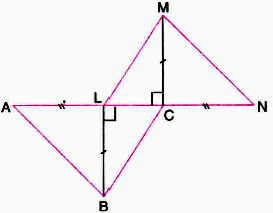
In the given figure \(BL\bot AC,MC\bot LN\), AL = CN and BL = CM. Prove that \(\triangle ABC\cong \triangle NML\)
2.
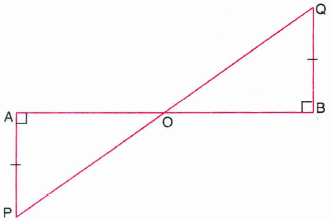
In figure, AP and BQ are perpendiculars to the line-segment AB and AP = BQ. Prove that O is the mid-point of line segments AB and PQ.
3.
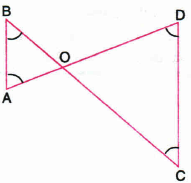
In figure, ㄥB < ㄥA and ㄥC < ㄥD. Show that AD < BC.
4.
Show that the angles of an equilateral triangle are 60° each.
5.
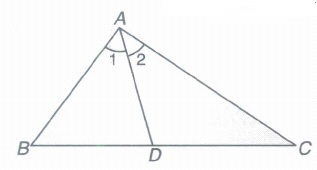
In the figure, given AC > AB and AD is the bisector of \(\angle\)A. Show that \(\angle\)ADC > \(\angle\)ADB.
6.
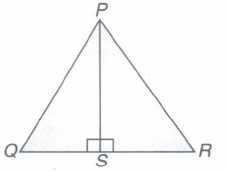
PS is an altitude of an isosceles triangle PQR in which PQ = PR. Show that PS bisects \(\angle\)P.
7.
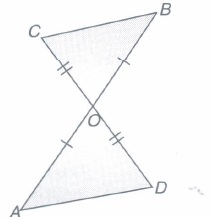
In the figure, OA = OB and OD = OC Show that:
(i) \(\triangle AOD\cong \triangle BOC\),
(ii) AD II BC.
8.
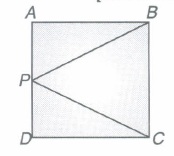
In the figure below, ABCD is a square and P is the mid-point of AD. BP and CP are joined. Prove that \(\angle\)PCB = \(\angle\)PBC.
9.
In ΔABC, if ㄥA = 50° and ㄥB = 60°, determine the shortest and the longest side of the triangle.
10.
In ΔABC, if AB > BC then:
ㄥC < ㄥA
ㄥC=ㄥA
ㄥC > ㄥA
ㄥA=ㄥB
11.
Two sides of a triangle are of lengths 7 cm and 3.5 em. The length of the third side of the triangle cannot be
3.6cm
4.1cm
3.4cm
3.8cm
12.
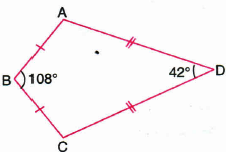
In figure, ABCD is a quadrilateral in which AB = BC and AD = DC.Measure of ㄥBCD is:
1500
300
1050
720
13.
If AB = QR, BC = PR and CA = PQ then:
ΔABC ≅ ΔPQR
ΔCBA ≅ ΔPRQ
ΔBAC ≅ ΔRPQ
ΔPQR ≅ ΔBCA
14.
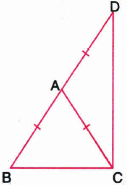
In an isosceles triangle AB = AC and side BA is extended to D such that AB = AD.Then, the measure of ㄥBCD is:
700
900
600
450
15.
In ΔABC, BC = AB and L B = 800, then ㄥA is equal to:
800
400
500
1800
16.
In the given figure, OA = OB, OD = OC, then ΔAOD ≌ BOC by congruency rule:
SAS
ASA
SAS
RHS
17.
If the side of a square is a cm, what is the side of a congruent square?
1 cm
2 cm
a cm
2a cm
18.
The symbol for correspondence is
⟶
⇔
↔
≡
19.
The symbol for congruence is
=
~
0
≅
20.
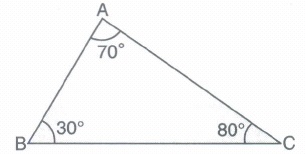
In \(\triangle\)ABC, \(\angle\)B = 30°, \(\angle\)C = 80° and \(\angle\)A = 70°, then prove that AB >BC>AC.
21.
Is it possible to construct a triangle, when its sides are 5.4 cm, 2.3 cm, 3.1 cm?
22.
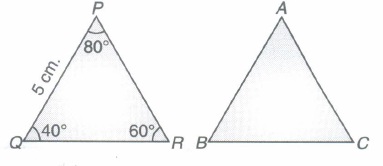
\(\triangle PQR\cong \triangle ABC\), if PQ = 5 cm, \(\angle\)Q = 40° and \(\angle\)P = 80°, calculate the value of \(\angle\)C.
23.
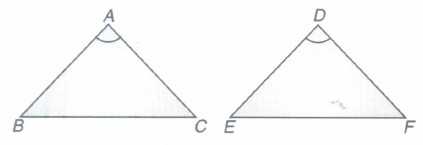
In \(\triangle\)ABC and \(\triangle\)DEF, AB=DE, \(\angle\)A=\(\angle\)D. What will be the condition in which the two triangles will be congruent by SAS axiom?
24.
Write ASA congruence rule for two triangles.
1.
In \(\triangle MCL\) and \(\triangle BLC\)
MC = BL
\(\angle MCL=\angle BLC\)
CL = LC
\(\triangle MCL\cong \triangle BLC\)
ML = BC | C.P.C.T
and \(\angle MLC=\angle BCL\) | C.P.C.T
In \(\triangle ABC\) and \(\triangle NML\)
BC = ML
\(\angle BCL=\angle MLN\)
AL = CN
AL + LC = LC + CN
AC = NL
\(\triangle ABC\cong \triangle NML\) | SAS congruence rule
2.
In \(\triangle OAP\) and \(\triangle OBQ\)
AP = BQ
\(\angle OAP=\angle OBQ\)
\(\angle AOB=\angle BOQ\) | Vertically opposite angles
\(\triangle OAP\cong \triangle OBQ\) | AAS Rule
OA = OB | C.P.C.T
OP = OQ | C.P.C.T
O is the mid-point of line segments AB and PQ.
3.
Given: In figure,
ㄥB < ㄥA and ㄥC < ㄥD.
To Prove: AD < BC
Proof: ㄥB < ㄥA
ㄥA > ㄥB
OB> OA ...(1)
ㄥC < ㄥD
ㄥD > ㄥC
OC > OD ..(2)
| Side opposite to greater angle is longer
From (1) and 2), we get
OB+OC > OA+OD
⇒ BC> AD
⇒ AD < Be.
4.
Given: An equilateral triangle ABC
To prove: \(\angle A+\angle B+\angle C={ 60 }^{ 0 }\)
Proof: ABC is an equilateral triangle
AB = BC = CA ....... (1) |
AB = BC
\(\angle A=\angle C\) .......... (2) | Angles opposite to equal sides of a triangle are equal
BC = CA
\(\angle A=\angle B\) ......... (3) | Angles opposite to equal sides of a triangle are equal
From (2) and (3), we obtain
\(\angle A=\angle B=\angle C\) ........ (4)
In \(\triangle ABC\)
\(\angle A+\angle B+\angle C={ 180 }^{ 0 }\) ...... (5) | Sum of all the angles of a triangle is 180°
Let \(\angle A={ x }^{ 0 }\) then, \(\angle B=\angle C={ x }^{ 0 }\)
From (5)
\({ x }^{ 0 }+{ x }^{ 0 }+{ x }^{ 0 }={ 180 }^{ 0 }\)
\(3{ x }^{ 0 }={ 180 }^{ 0 }\)
\({ x }^{ 0 }={ 60 }^{ 0 }\)
\(\angle A=\angle B=\angle C={ 60 }^{ 0 }\)
5.
In \(\triangle\)ABC, AC >AB
\(\therefore\) \(\angle\) ABC > \(\angle\)ACB
(Angles opposite to larger side is greater)
\(\therefore\) \(\angle\)ABC + \(\angle\)1 > \(\angle\)ACB + \(\angle\)1
(Adding \(\angle 1\)on both sides) Y.
\(\therefore\) \(\angle\)ABC + \(\angle\)1 > \(\angle\)ACB + \(\angle\)2
(AD bisects \(\angle\)A, \(\angle\)1 = \(\angle\)2)
\(\therefore\) \(\angle\)ADC > \(\angle\)ADB.
(Exterior angle property of triangle)
6.
In \(\triangle\)PQS and \(\triangle\)PRS,
PQ = PR (Given)
PS = PS (Common)
\(\angle\)PSQ = \(\angle\)PSR = 90°
(PS is altitude)
By R.H.S. rule,
\(\triangle PQS\cong \triangle PRS\)
\(\angle\)QPS = \(\angle\)RPS (By c.p.c.t.)
Hence, PS bisects \(\angle\)P.
7.
(i) In \(\triangle\) AOD and \(\triangle\)BOC,
OA =OB (Given)
OD = OC (Given)
\(\angle\)AOD = \(\angle\)BOC
(Vertically opposite angles)
So, by SAS criteria,
\(\triangle AOD\cong \triangle BOC\)
(ii) \(\angle\)CBA = \(\angle\)DAB (By c.p.c.t.)
AD and BC are two lines intersected by AB such that \(\angle\)CBA = \(\angle\)DAB and they form a pair of alternate angles.
Hence, AD II BC
8.
In \(\triangle\)PAB and \(\triangle\)PDC,
PA = PD (Given)
(P is the mid-point of AD)
AB = CD (Side of a square)
\(\angle\)PAB = \(\angle\)PDC = 90°
By R.H.S., \(\triangle PAB\cong \triangle PDC\)
\(\therefore\) PB = PC (By c.p.c.t.)
(Angles opp. to equal sides are equal)
\(\Rightarrow\) \(\angle\)PCB = \(\angle\)PBC. Proved.
9.
BC, AB
10.
AB > BC
ㄥC > ㄥA
11.
The sum of the lengths of any two sides of a triangle is greater than the length of the third side.
12.
(c)
1050
13.
AB=QR
BC=PR=RP
CA=PQ
∴ A ↔ Q
B ↔ R
C ↔ P
∴ ΔCBA ≅ ΔPRQ
14.
(b)
900
15.
ㄥA+ㄥB+ㄥC=1800
⇒ ㄥA+800+ㄥC=1800
⇒ ㄥA+ㄥC=1000
∵ BC=AB
∴ ㄥA=ㄥC
| Angles opposite to equal sides of a triangle are equal
16.
In ΔAOD and ΔBOC
OA=OB
OD=OC
ㄥAOD=ㄥBOC
∴ ΔAOD≅ΔBOC
17.
Two squares of the same side length ar congruent
18.
↔ denotes correspondence
19.
≌ represents congruence.
20.
()
Since \(\angle\)C > \(\angle\)A > \(\angle\)B, .. AB > BC > AC
21.
()
No, Because, 2.3 + 3.1 = 5.4 cm (third side)
\(\therefore\) Not possible to construct a triangle.
22.
()
\(\angle\)R= 180° - 80° - 40° = 60°
\(\triangle PQR\cong \triangle ABC\)
\(\therefore\) \(\angle\)R = \(\angle\)C = 60°
23.
()
Since AB = DE, \(\angle\)A =\(\angle\)D and \(\triangle\)ABC\(\cong \)\(\triangle\)DEF by SAS.
Therefore AC = DF.
24.
()
ASA congruence: Two triangles are congruent, if two angles and the included side of one triangle are equal to two angles and the included side of other triangle.

9th Standard CBSE Syllabus & Materials
9th Standard CBSE
CBSE 9th Mathematics Lines and Angles Sample Question Papers Study Material - QB365 Set A
NEW9th Standard CBSE
CBSE 9th Mathematics Introduction to Euclid's Geometry Sample Question Papers Study Material - QB365 Set A
NEW9th Standard CBSE
CBSE 9th Mathematics Linear Equations in Two Variables Sample Question Papers Study Material - QB365 Set A
NEW9th Standard CBSE
CBSE 9th Mathematics Coordinate Geometry Sample Question Papers Study Material - QB365 Set A



CBSE 9th Standard CBSE Subjects
CBSE Standards