100% FREE ACCESS
9th Standard CBSE Syllabus & Materials
9th Standard CBSE
CBSE 9th Science Is matter around us pure? - New Model Questions Papers Study Material - QB365 Set A
NEW9th Standard CBSE
CBSE 9th Science Matter in our surroundings - New Model Questions Papers Study Material - QB365 Set A
NEW9th Standard CBSE
CBSE 9th Mathematics Heron's Formula Sample Question Papers Study Material - QB365 Set A
NEW9th Standard CBSE
CBSE 9th Mathematics Circles Sample Question Papers Study Material - QB365 Set A
NEW9th Standard CBSE
CBSE 9th Mathematics Quadrilaterals Sample Question Papers Study Material - QB365 Set A
NEW9th Standard CBSE
CBSE 9th Mathematics Triangles Sample Question Papers Study Material - QB365 Set A

Published on: 31/07/2019
Introduction to Euclid's Geometry
Download CBSE Class 9th Standard CBSE Mathematics question papers, sample papers, important questions, and previous year solved papers in PDF format. Get free study materials, NCERT solutions, and exam preparation resources for Class 9th Standard CBSE Mathematics
Questions + Answers key
Take MCQ Mathematics Test
1.
(i) Why is Axiom 5, in the list of Euclid's axioms, considered a 'universal truth'? (Note that the question is not about the fifth postulate).
(ii) How would you rewrite Eulid's fifth postulate so that it would be easier to understand?
2.
Point C is called a mid-point of line segment AB. Prove that every line segment has one and only one mid-point.
3.
Give a definition for each of the following terms. Are there other terms that need to be defined first? What are they, and how might you define them?
(i) parallel lines
(ii) perpendicular lines
(iii) line segment
(iv) radius of a circle
(v) square.
4.
Which of the following statements are true and which are false? Give reasons for your answers:
(i) Only one line can pass through a single point.
(ii) There are an infinite number of lines which pass through two distinct points.
(iii) A terminated line can be produced indefinitely on both the sides.
(iv) If two circles are equal, then their radii are Equal.
5.
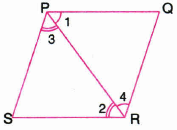
In the given figure, it is given that \(\angle \)1 = \(\angle \)4 and \(\angle \)3 = \(\angle \)2. By which Euclid's axiom, it can be shown that if \(\angle \)2 = \(\angle \)4, then \(\angle \)1 = \(\angle \)3.
6.
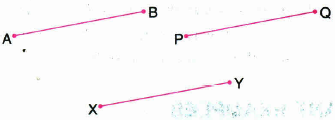
In the given figure, if AB = CD, then prove that AC = BD. Also, write the Euclid's Axiom used for proving it.

7.
Solve the equation x -15 = 25 and state Euclid's Axiom used here.
8.
Ram and Ravi have the same weight. If they each gain weight by 2kg, how will their new weights be compared?
9.
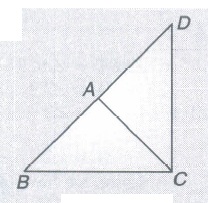
In the given figure, we have AB=AD and AC=AD. Prove that AB=AC. State the Euclid's axiom to support this.
10.
State any two Euclid's axioms.
11.
State any two Eulis's axioms.
12.
Consider the following statement: There exists a pair of straight lines that are everywhere equidistant from one another. Is this statement a
13.
Two planes intersect each other to form a:
plane
Point
straight line
angle
14.
The number of line segments determined by three collinear points is:
two
Three
Only one
Four
15.
The number of lines that can pass through a given point is:
two
none
only one
infinite many
16.
In ancient India, alters with combination of shapes like rectangles, triangles and trapeziums were used for
public workship
household rituals
both (a) and (b)
none of the above
17.
In Indus Valley Civilisation (about 300 b.C), The brick used for construction work were having dimension in the ration
1 : 3 : 4
4 : 2 : 1
4 : 4 : 1
4 : 3 : 2
18.
How can we identify parallel lines?
19.
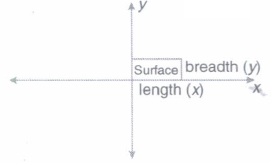
Write the number of dimension(s) of a surface.
20.
What is a surface?
21.
Give any one example of a geometrical line from your surroundings.
22.
What is a straight line?
1.
(i) Since this is true for anything in any part of the world, this is a universal truth.
(ii) If the sum of the cointerior angles made by a transversal intersect two straight lines at distinct points is less than 180o, then the lines cannot be parallel.
2.
Let a line AB have two mid-points, say, C and D. Then,
AC = \(1\over2\) AB ...(1)
AD = \(1\over2\)AB ...(2)
From (1) and (2),
AC = AD.
Things which are equal to the same thing are equal to one another
3.
(i) Parallel lines. Lines which do not intersect anywhere are called parallel lines.
(ii) Perpendicular lines. Two lines which are at a right angle to each other are called perpendicular lines.
(iii) Line segment. It is a terminated line.
(iv) Radius. The length of the line segment joining the centre of a circle to any point on its circumference is called its radius.
(v) Square. A quadrilateral with all the four sides equal and all the four angles of measure 90° each is called a square.
4.
(i) False. This can be seen visually.
(ii) False. This contradicts the Axiom.
[Given two distinct points, there is a unique line that passes through them.]
(iii) True by Euclid's Postulate
[A terminated line can be produced indefinitely.]
(iv) True. If we superimpose the region bounded by one circle on the other, then they coincide. So, their centres and boundaries coincide, therefore, their radii will coincide.
(v) True by the first Axiom of Euclid.
[Things which are equal to the same thing are equal to one another.]
5.
\(\angle \)2 = \(\angle \)4 ,,,,,,,(1) | Given
\(\angle \)1= \(\angle \)4 ........(2) | Given
\(\angle \)3 =\(\angle \)2 .......(3) | Given
From (1), \(\angle \)4 = \(\angle \)2 ......(4)
From (3) and (4),
\(\angle \)3 = \(\angle \)4 .....(5)
I Things which are equal to the same thing are equal to one another
From (2) and (4),
\(\angle \)1 = \(\angle \)3
I Things which are equal to the same thing are equal to one another
6.
We have, AX=CY
AB=CD
\(\Rightarrow \) AB + BC = CD + BC
| If equals are added to equals, the wholes are equal (Euclid's Axiom (ii))
AC= BD
I AB + BC coincides with AC;
CD + BC coincides with BD
[Things which coincide with one another are equal to one another (Euclid's Axiom (iv))]
7.
We have,
x - 15 = 25
\(\Rightarrow \) x - I5 + 15 = 25 + 15 | If equals are added to equals, the wholesare equal (Euclid's Axiom (ii))
\(\Rightarrow \) x = 40
8.
Let x be the weight of Ram and Ravi each. On gaining 2 kg, weight of Ram and Ravi will be (x+2) kg each. According to Euclid's second axiom, when equals are added to equals, the wholes are equal. So, weights of Ram and Ravi are again equal.
9.
Things which are equal to the same thing are equal to one another.
10.
Euclid's axioms
(i) Things which are equal to the same thing are equal to one another.
(ii) If equals are added to equals, the wholes are equal.
11.
Euclid's axioms
(i) Things which are equal to the same thing are equal to one another.
(ii) If equals are added to equals, the wholes are equal.
12.
Take any line l and a point P not on l. Then, by Playfair’s axiom, which is equivalent to the fifth postulate, we know that there is a unique line m through P which is parallel to l.
13.
(c)
straight line
14.
(b)
Three
15.
(d)
infinite many
16.
(a)
public workship
17.
(b)
4 : 2 : 1
18.
()
Lines are parallel if they do not intersect on being extended.
For example:
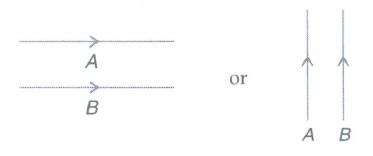
Lines A and B are parallel lines.
19.
()
Dimension of surface= Length and Breadth (which is 2)
20.
()
A surface is that which has length and breadth.
21.
()
Meeting place of two walls.
22.
()
Two planes intersect each other to form a straight line.

9th Standard CBSE Syllabus & Materials
9th Standard CBSE
CBSE 9th Mathematics Lines and Angles Sample Question Papers Study Material - QB365 Set A
NEW9th Standard CBSE
CBSE 9th Mathematics Introduction to Euclid's Geometry Sample Question Papers Study Material - QB365 Set A
NEW9th Standard CBSE
CBSE 9th Mathematics Linear Equations in Two Variables Sample Question Papers Study Material - QB365 Set A
NEW9th Standard CBSE
CBSE 9th Mathematics Coordinate Geometry Sample Question Papers Study Material - QB365 Set A



CBSE 9th Standard CBSE Subjects
CBSE Standards