100% FREE ACCESS
9th Standard CBSE Syllabus & Materials
9th Standard CBSE
CBSE 9th Science Is matter around us pure? - New Model Questions Papers Study Material - QB365 Set A
NEW9th Standard CBSE
CBSE 9th Science Matter in our surroundings - New Model Questions Papers Study Material - QB365 Set A
NEW9th Standard CBSE
CBSE 9th Mathematics Heron's Formula Sample Question Papers Study Material - QB365 Set A
NEW9th Standard CBSE
CBSE 9th Mathematics Circles Sample Question Papers Study Material - QB365 Set A
NEW9th Standard CBSE
CBSE 9th Mathematics Quadrilaterals Sample Question Papers Study Material - QB365 Set A
NEW9th Standard CBSE
CBSE 9th Mathematics Triangles Sample Question Papers Study Material - QB365 Set A

Published on: 05/03/2019
Atoms and Molecules Important Questions
Download CBSE Class 9th Standard CBSE Science question papers, sample papers, important questions, and previous year solved papers in PDF format. Get free study materials, NCERT solutions, and exam preparation resources for Class 9th Standard CBSE Science
Questions + Answers key
Take MCQ Science Test
1.
Calculate the number of molecules of sulphur (S8) present in 16 g of solid sulphur.
2.
Calculate the number of particles in each of the following:
(a) 48 g of Mg
(b) 8 g of O
(c) 0.1 mole of carbon (Atomic mass of Mg = 24u, O=16u., C=12u, Avogadro's number constant N =6.022 x 10²³)
3.
Write down the names of compounds represented by the following formulae:
(i) Al2(SO4)3
(ii) CaCl2
(iii) K2SO4
(vi) KNO3
(v) CaCO3
4.
How does an atom differ from a molecule?
5.
Carbon and oxygen combine in two different ways to form carbon dioxide and carbon monoxide.In carbon monoxide, 12 g carbon combines with 16 g oxygen.In carbon dioxide, 12g carbon combines with 32 g oxygen.Which law of combination is illustrated by this experiment?Explain
6.
Calculate the number of aluminium ions present in 0.051 g of aluminium oxide.(Atomic mass of Al = 27u)
7.
Which amongest the following has more number of atoms, 11.5 g of sodium or 15 g of calcium?How?(Given atomic mass of Na =23, ca=40)
8.
The mass of a single atom M is 3.05 x 10⁻²³ g.What is its atomic weight?What would this element be? Check table for possible answers.
9.
Give the symbol and valency of the following polyatomic ions:
Ammonium, hydroxide, nitrate, carbonate, sulphate, sulphite, bicarbonate, phosphate.
10.
Give the chemical name, chemical formulae for the following compounds.
Banking soda, washing soda, blue vitriol, green vitriol, gypsum, oil of vitriol or white vitriol, soda ash, marble chips, lime water.
11.
(i) One mole of carbon atom weighs 12 g.Find the mass in grams of one atom of carbon (Given C = 12u, No = 6.022 x 10²³ per mole)
(ii) Calculate the mass of the following:
(a) 0.5 mole of N2 gas
(b) 0.2 mole of O-atoms
(c) 4 moles of aluminium atom
[Given, N = 14 u, 0 = 16 u, Al = 27 u,
Avogadro's number = 6.022 x 10²³ per mole ]
12.
Verify by calculating that
(i) 5 moles of CO2 and 5 moles of H2O do not have the same mass.Atomic mass of carbon, oxygen and hydrogen are 12 u, 16 u, 14 u respectively.
(ii) 240 g of calcium and 240 g magnesium elements have a mole number ratio of 3 : 5.Atomic mass of calcium and magnesium are 40 u and 24 u respectively.
13.
One mole of sodium sulphate contains ............... atoms of sodium
14.
Formula mass and not molecular mass is used for substance whose constituent particles are ..............
15.
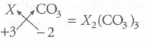
If an element X has its valency equal to 3, what will be its formula with carbonate ion?
16.
What is the mass of 1 mole of nitrogen atoms?
1.
1 mole of S8 = 32 x 8 = 256 g
1 mole of S8 = 6.023 x 10²³ molecules
256 g S8 has = 6.023 x 10²³ S8 molecules
16 g S has = \(\frac { 6.023\times { 10 }^{ 23 } }{ 256 } \times 16=3.76\times { 10 }^{ 22 }\)molecules
2.
(a) 24 g of Mg = 6.022 x 10²³ particles
48 g of Mg = 12.044 x 10²³ particles
(b) 32 g of O2 = 6.022 x 10²³ particles
8 g of O = 1.50 x 10²³ particles
(c) 1 mole of carbon = 6.022 x 10²³ particles
0.1 mole of carbon = 6.022 x 10²³ particles
3.
(i) Al2(SO4)3 - Aluminium sulphate
(ii) CaCl2 - Calcium chloride
(iii) K2SO4 - Potassium sulphate
(vi) KNO3 - Potassium nitrate
(v) CaCO3 - Calcium carbonate
4.
An atom is the smallest particle of an element which may or may not have independent existence.On the other hand,'molecule' is the smallest particle of the element or compound which is capable of independent existence.For example helium (He) is an atom and can exist as such, whereas hydrogen atom cannot exist as such but exists as a molecule, i.e H2 .A molecule may be made up of similar atoms or dissimilar atoms.
5.
The above experiment illustrates law of multiple proportions 16 g and 32 g of oxygen respectively are required to combine with a fixed weight, i.e 12 g of carbon to form carbon monoxide and carbon monoxide and carbon dioxide.The ratio of oxygen which combines with a fixed weight of carbon 16 : 32 or 1 : 2 a simple whole number.This is law of multiple proportions.
6.
1 mole of aluminium oxide, Al2O3 = 2 x 27 + 3 x 16 = 102 u = 102 g
102 g Al2O3 has = 6.023 x 10²³ Al2O3 molecules
0.051 g Al2O3 has = \(\frac { 6.023\times { 10 }^{ 23 } }{ 102 } \)
= 3.01 x 10²⁰ Al2O3 molecuels
1 molecule of Al2O3 gives = 2Al+++ ions
Hence 0.051 g Al2O3 gives = 2 x 3.01 x 1020 Al+++ ions
=6.023 x 10²³ aluminium ions.
7.
Number of atoms in 23 g of sodium =6.022 x 10²³
Number of atoms in 11.5 g of sodium = \(\frac { 11.5 }{ 23 } \times 6.022\times { 10 }^{ 23 }\)
=3.011 x 10²³ atoms
Number of atoms in 40 g of calcium = 6.022 x 10²³
Number of atoms in 15 g of calcium = \(\frac { 6.022\times { 10 }^{ 23 }\times 15 }{ 40 } \)
=2.25 x 10²³ atoms.
Therefore, 11.5g of sodium has more number of atoms than in 15g of calcium
8.
1 mole = atomic mass = 6.022 x 10²³ atoms
Now mass of one atom of M = 3.05 x 10⁻²²
Now mass of 6.022 x 10²³ atoms of M = 3.05 x 10-22 x 6.022 x 1023 g = 183.7 g
Mass of 1 mole or atomic mass of M = 183.7 g
This could be tungeten (W)
9.
| Polyatomic ion | Symbol | Valency |
|---|---|---|
| Ammonium | (NH4)+ | +1 |
| hydroxide | (OH)- | -1 |
| nitrate | (NO3)- | -1 |
| carbonate | (CO3)2- | -2 |
| sulphate | (SO4)2- | -2 |
| sulphite | (SO3)2- | -2 |
| bicarbonate | (HCO3)- | -1 |
| phosphate | (PO4)3- | -3 |
10.
| Compound name | chemical name | chemical formulae |
|---|---|---|
| Banking soda | Sodium bicarbonate | NaHCO3 |
| washing soda | Sodium carbonate | Na2CO3.10H2O |
| blue vitriol | Copper sulphate | CuSO4.5H2O |
| green vitriol | Ferrous sulphate | FeSO4.7H2O |
| gypsum | Calcium sulphate | CaSO4.2HO |
| oil of vitriol or white vitriol | Sulphuric acid | H2SO4 |
| soda ash | Sodium carbonate | Na2CO3 |
| marble chips | Calcium carbonate | CaCO3 |
| lime water | Calcium hydroxide | Ca(OH)2 |
11.
(i) 1 Mole of Carbon atom = 6.022 x 10²³ atoms
6.022 x 10²³ atoms of carbon weigh = 12 g
1 atom of carbon weighs = \(\frac { 12 }{ 6.022\times { 10 }^{ 23 } } \\ \)
= 1.99 x 10⁻²³
(ii) (a) n = 0.5 mol; M = 14 x 2 = 28 g; m = ?
m = n x M = 0.5 x 28 = 14.0 g
(b) n = 0.2 mol; M = 16 g; m = ?
m = n x M = 0.2 x 16 = 3.2 g
(c) n = 4 mol; M = 27 g; m = ?
m = n x M = 4 x 27 = 108 g
12.
(i) Mass of 1 mole CO2 = 12 + 32 = 44 u
Mass of 5 moles CO2 = 44 x 5 = 220 u
Mass of 1 mole of H2O = 2 + 16 = 18 u
Mass of 5 moles of H2O = 5 x 18 = 90 u
(ii) 40 g calcium make = 1 mole
240 g calcium make = \(\frac { 240 }{ 40 } \) = 6 moles
24 g magnesium make = 1 mole
240 g magnesium make = \(\frac { 240 }{ 24 } \) = 10 moles
Ratio of 240 g calcium and 240 g magnesium in moles = \(\frac { 6 }{ 10 } \) or 3 : 5
13.
()
12.046 x 10²³
14.
()
ions
15.
()
16.
The mass of 1 mole of nitrogen atoms is 14 g.

9th Standard CBSE Syllabus & Materials
9th Standard CBSE
CBSE 9th Mathematics Lines and Angles Sample Question Papers Study Material - QB365 Set A
NEW9th Standard CBSE
CBSE 9th Mathematics Introduction to Euclid's Geometry Sample Question Papers Study Material - QB365 Set A
NEW9th Standard CBSE
CBSE 9th Mathematics Linear Equations in Two Variables Sample Question Papers Study Material - QB365 Set A
NEW9th Standard CBSE
CBSE 9th Mathematics Coordinate Geometry Sample Question Papers Study Material - QB365 Set A



CBSE 9th Standard CBSE Subjects
CBSE Standards