
 100% FREE ACCESS
9th Standard Syllabus & Materials
9th Standard
TN 9th Tamil உள்ளத்தின் சீர் -கற்கண்டு (இலக்கணம்) - தொடர் இலக்கணம், ஆகுபெயர் Important Questions And Answers Study Material - QB365 Set A
NEW9th Standard
TN 9th Tamil உள்ளத்தின் சீர் -விரிவானம் (துணைப்பாடம்) - தாய்மைக்கு வறட்சி இல்லை! Important Questions And Answers Study Material - QB365 Set A
NEW9th Standard
TN 9th Tamil உள்ளத்தின் சீர் -கவிதை பேழை (செய்யுள்) - மார்கழி பெருவிழா Important Questions And Answers Study Material - QB365 Set A
NEW9th Standard
TN 9th Tamil உயிருக்கு வேர்-இலக்கணம் - பகுபத உறுப்பிலக்கணம் Important Questions And Answers Study Material - QB365 Set A
NEW9th Standard
TN 9th Tamil அமுதென்று பேர் - இலக்கணம்-எழுத்து -அளபெடை Important Questions And Answers Study Material - QB365 Set A
NEW9th Standard
TN 9th Tamil அமுதென்று பேர்-துணைப்பாடம் - ஆறாம்திணை Important Questions And Answers Study Material - QB365 Set A

Published on: 21/01/2020
Download Tamil Nadu 9th Standard Maths question papers, model tests, one-mark questions, important questions, and public exam papers in PDF format. Free study materials and answer keys for TN State Board students.
Questions + Answers key
Take MCQ Maths Test1.
A bag contains 3 red and 2 blue marbles. A marble is drawn at random. What is the probability of drawing a blue marble?
2.
If 3 cot\(\theta\) = 1, then find the value of \(\cfrac { 3cos\theta -4sin\theta }{ 5sin\theta +4cos\theta } \)
3.
Find the coordinates of the point which divides the line segment joining the points (3, 1) and (5, 13) internally in the ratio 3 : 5.
4.
The length, breadth and depth of a pond are 20.5 m, 16 m and 8 m respectively. Find the capacity of the pond in litres.
5.
Find the value of \(\theta\) if
(i) sin \(\theta\) = 0.9975
(ii) cos \(\theta\) = 0.6763
(iii) tan \(\theta\) = 0.0720
(iv) cos \(\theta\) = 0.0410
(v) tan \(\theta\) = 7.5958
6.
The monthly income of A and B are in the ratio 3 : 4 and their monthly expenditures are in the ratio 5 : 7. If each saves Rs. 5,000 per month, find the monthly income of each.
7.
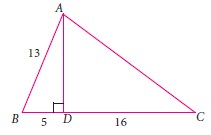
From the given figure, find the values of
(i) sin B
(ii) sec B
(iii) cot B
(iv) cos C
(v) tan C
(vi) cosec C
8.
Convert the following decimal numbers in the form of \(\frac { p }{ q } (p,q\in Z\ and\ q\neq 0)\)
(i) \(0.\overline { 3 } \)
(ii) \(2.\overline { 124 } \)
(iii) \(0.4\overline { 5 } \)
(iv) \(0.5\overline { 68 } \)
9.
Factorise the following : x4 - 9x2
10.
The radius of a circle 15 cm and the length of one of its chord is 24 cm. Find the distance of the chord from the centre.
11.
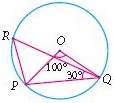
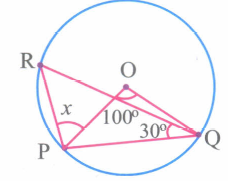
In the given figure, ㄥPOQ = 100o and ㄥPQR = 30o, then find ㄥRPO
12.
Factorise the following: m3+\(\frac{1}{m^2}\)-23
13.
Expand the following using identities: (m + 5)(m - 8)
14.
Find the value of \(\left( \frac { 64 }{ 125 } \right) ^{ \frac { -2 }{ 3 } }\)
15.
Without actual division classify the decimal expansion of the following numbers as terminating or non-terminating and recurring.
\({17\over 200}\)
16.
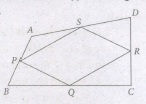
Procedure: Cut off a quadrilateral ABCD in a paper with prescribed dimensions. Mark the mid points P, Q, R and S of the sides AB, BC, CD and DA respectively. By folding the sides appropriately cut off the quadrilateral PQRS. Fold the quadrilateral (i) Does PQ lie on SR? similarly fold the other way and verify QR lies on PS.
Observation
(i) What do you conclude?
(ii) Name the resulting figure?
Draw the following quadrilaterals and join the mid points of all its sides. Find the resultant shape and complete the table.
| Name of the quadrilateral | Shape obtained by joining the midpoints |
| Parallelogram | |
| Rectangle | |
| Square | |
| Kite | |
| Trapezium | |
| Rhombus |
17.
Find A∪B, A∩B, A–B and B–A for the following sets.
A = {a, b, c, e, u} and B = {a, e, i, o, u}
18.
List the set of letters of the following words in Roster form.
PARALLELOGRAM
19.
Check whether –3 and 3 are zeros of the polynomial x2 – 9
20.
Identify which ones are trapeziums and which are not.

21.
Identify which ones are parallelograms and which are not.
22.
Draw Venn diagram and shade the region representing the following sets
(i) A′
23.
If A = {–3, –2, 1, 4} and B = {0, 1, 2, 4}, find
(i) A – B
(ii) B – A.
24.
Write the set of letters of the following words in Roster form
PRINCIPAL
25.
Let A and B be two overlapping sets and the universal set be U. Draw appropriate Venn diagram for each of the following,
(i) AUB
(ii) A∩B
(iii) (A∩B)′
(iv) (B–A)'
(v) A′UB′
(vi) A′∩B′
(vii) What do you observe from the Venn diagram (iii) and (v)?
1.
Probability = \(\frac{2}{5}\).
2.
\(cot\theta =1\)
\(cot\theta =\cfrac { 1 }{ 3 } \)
\(\cfrac { adjacent }{ opposite } =\cfrac { 1 }{ 3 } \)
\(\sqrt { { 3 }^{ 2 }+1 } =\sqrt { 10 } \)
\(\cfrac { 3cos\theta -4sin\theta }{ 5sin\theta +4cos\theta } =\cfrac { 3\times \cfrac { 1 }{ \sqrt { 10 } } -4\times \cfrac { 3 }{ \sqrt { 10 } } }{ 5\times \cfrac { 3 }{ \sqrt { 10 } } +4\times \cfrac { 1 }{ \sqrt { 10 } } } =\cfrac { 3-12 }{ 15+4 } =\cfrac { -9 }{ 19 } \)
3.
\(\left( \frac { 5(3)+3(5) }{ 5+3 } ,\frac { 5(1)+3(13) }{ 5+3 } \right) =\left( \frac { 15+15 }{ 8 } ,\frac { 5+39 }{ 8 } \right) =\left( \frac { 30 }{ 8 } ,\frac { 44 }{ 8 } \right) =\left( \frac { 15 }{ 4 } ,\frac { 11 }{ 2 } \right) \)
4.
l= 20.5 m b = 16 m h = 8 m
∴ Capacity = Volume =l × b × h
= (20.5 \(\times\) 16 \(\times\)8) m3 = 2624 m3
1m3 = 1000 litres
∴ 2624 m3 = 2624000 litres.
5.
(i) From the natural sines table
sin 85° 57' = 0.9975
\(\therefore\) \(\theta \) = 85° 57'
(ii) cos\(\theta \) = 0.6763
cos 47° 33' = 0.6762
\(\therefore\) \(\theta \) = 47° 33'
(iii) tan \(\theta \) = 0.0720
tan 4° 7' = 0.0720
\(\therefore\)\(\theta \) = 4°7'
(iv) cos \(\theta \) = 0.0410
cos 87° 45° = 0.0410
:\(\therefore\)\(\theta \) = 87°39'
(v) tan \(\theta \) = 7.5958
tan 82° 30' = 7.5958
\(\therefore\) \(\theta \) = 82° 30'
6.
Let the monthly income of A and B be 3x and 4x respectively.
Let the monthly expenditure of A and B be 5y and 7y respectively.
\(\therefore\) 3x - 5y = 5000 --------- (1)
4x - 7y = 5000 --------- (2)
(1) \(\times\)4 \(\Rightarrow\) 12x - 20y = 20000
(2) \(\times\) 37 \(\Rightarrow\) \(\cfrac { 12-21y=15000 }{ 1y\quad =\quad 5000 } \)
Substitute y = 5000 in (1)
3x - 5 (5000) = 5000
3x - 25000 = 5000
3x = 5000 + 25000
3x = 30000
x = 10000
\(\therefore\) Monthly income of A is 3x = 3\(\times\)1 0000 = Rs. 30000
Monthly income of B is 4x = 4 \(\times\) 10000 = Rs. 40000
7.
(i) \(sinB=\cfrac { 12 }{ 13 } \)
(ii) \(secB=\cfrac { 1 }{ cosB } \)
= \(\cfrac { 1 }{ 5/3 } =\cfrac { 13 }{ 5 } \)
(iii) \(cotB=\cfrac { 1 }{ tanB } =\cfrac { 1 }{ 12/5 } =\cfrac { 5 }{ 2 } \)
(iv)
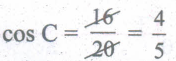
(v) \(\tan C=\cfrac { 12 }{ 16 } =\cfrac { 3 }{ 4 } \)
(vi) \(cosecC=\cfrac { 1 }{ sinC } =\cfrac { 1 }{ 12/20 } =\cfrac { 20 }{ 12 } =\cfrac { 5 }{ 3 } \)
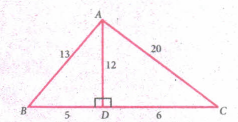
By the pythagoras theorem,
\(AD=\sqrt { { 13 }^{ 2 }-{ 5 }^{ 2 } } \)
= \(\sqrt { 169-25 } \)
= \(\sqrt { 144 } =12\)
AC =\(\sqrt { { 12 }^{ 2 }+{ 16 }^{ 2 } } \)
= \(\sqrt { { 144 }+{ 256 } } \)
= \(\sqrt { 400 } =20\)
8.
(i) Let \(x=0.\overline { 3 } \)= 0.3333 (1)
(Here period of decimal is 1, multiply equation (1) by 10)
10x = 3.3333.... (2)
(2) - (1) : 9x = 3 or \(x=\frac { 1 }{ 3 } \)
(ii) Let \(x=2.\overline { 124 } \) = 2.124124124… (1)
(Here period of decimal is 3, multiply equation (1) by 1000)
1000 x = 2124.124124124… (2)
(2)–(1): 999 x = 2122 \(x=\frac { 2122 }{ 999 } \)
(iii) Let x = \(0.4\overline { 5 } \) = 0.45555… (1)
(Here the repeating decimal digit is 5, which is the second digit after the decimal point, multiply equation (1) by 10)
10 x = 4.5555… (2)
(Now period of decimal is 1, multiply equation (2) by 10)
100 x = 45.5555… (3)
(3) – (2): 90 x = 41 or \(x=\frac { 41 }{ 90 } \)
(iv) Let x = \(0.5\overline { 68 } \)= 0.5686868… (1)
(Here the repeating decimal digit is 68, which is the second digit after the decimal point, so multiply equation (1) by 10)
10 x = 5.686868… (2)
(Now period of decimal is 2, multiply equation (2) by 100)
1000 x = 568.686868… (3)
3) – (2): 990 x = 563 or \(x=\frac { 563 }{ 990 } \)
9.
x4 - 9x2 = x2 (x2 - 9) = x2 (x2 - 32) = x2 (x - 3)(x + 3)
10.
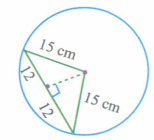
Distance of the chord from the centre
= \(\sqrt { { 15 }^{ 2 }-{ 12 }^{ 2 } } \)
= \(\sqrt { 225-144 } \)
= \(\sqrt { 89 } \)
= 9 cm
11.
In the figure\(\angle \)POQ = 1000
\(\angle \)PQR = 300
\(\angle \)PQR = \(\cfrac { 1 }{ 2 } \)\(\angle \)PQR = \(\cfrac { 1 }{ 2 } \)\(\times\)100 = 500
In\(\triangle \)OPQ = \(\angle \)OQP =\(\angle \)POQ = 1800
2\(\angle \)OPQ = 1800
2\(\angle \) OPQ = 800
\(\therefore \) \(\angle \)OPQ = 400
In \(\triangle \)PRQ,
\(\angle \)R+\(\angle \)P+\(\angle \)Q = 1800
500 + (40 + x) + 300 = 1800
(40 + x)0 = 1800 - 80 = 1000
x0 = 1000 - 400 = 600
\(\therefore \) \(\angle \)RPO = x = 600
12.
\(m^2+\frac{1}{m^2}-23=(m+\frac{1}{m})^2-2-23=(m+\frac{1}{m})^2-25\)
=\((m+\frac{1}{m})^2-5^2\)
\(\left( m+\frac { 1 }{ m } +5 \right) \left( m+\frac { 1 }{ m } -5 \right) \)
13.
(m + 5)(m - 8) [we have (x + a)(x - b) = x2- (a - b)x - ab]
(m + 5)(m - 8) = m2+(5 - 8)m - (5)(8) put [x = m, a = 5, b = 8]
= m2- 3m - 40
14.
\(\left( \frac { 64 }{ 125 } \right) ^{ \frac { -2 }{ 3 } }=(\frac{125}{64})^{\frac{2}{3}}=((\frac{5}{4})^3)^{\frac{2}{3}}=(\frac{5}{4})^{ ̶3̶\times\frac{2}{ ̶3̶}}=(\frac{5}{4})^2=\frac{25}{16}\)
15.
\({17\over 200}={17\over 2^3\times 5^2}\)
\(\therefore {17\over 200}\) has a terminating decimal expansion.
16.
17.
A\(\cup \)B = {a, b, c, e, u} \(\cup \) {a, e, i, o, u}
= {a, b, c, e, i, o, u}
A\(\cap\)B = {a, b, c, e, u} \(\cap\) {a, e, i, o, u}
= {a, e, u}
A-B = {a, b, c, e, u} - {a, e, i, o, u}
= {b, c}
B-A = {a, e, i, o, u} - {a, b, c, e, u}
= {i, o}
18.
{P, A, R, L, E, O, G, M}
19.
Let f(x) = x2 – 9
Then, f(–3) = (–3)2 – 9 = 9 – 9 = 0
f(+3) = 32 – 9 = 9 – 9 = 0
\(\therefore\) -3 and 3 are zeros of the polynomial x2 – 9
20.
It is a trapezium
21.
It is a parallelogram
22.
A′
.jpg)
23.
A – B = {–3, -2, 1, 4} – {0, 1, 2, 4} = { -3, -2}
B – A = {0, 1, 2, 4} – {–3, -2, 1, 4} = { 0, 2}.
24.
PRINCIPAL
B = {P, R, I, N, C, A, L}
25.
(i) AUB
.JPG)
(ii) A∩B
.JPG)
(iii) (A∩B)′
.JPG)
(iv) (B–A)'
.JPG)
(v) A′UB′
.JPG)
(vi) A′∩B′
a.JPG)
b.JPG)
(vii) From the venn diagram (iii) and (v), We have
\((A \cap B)^{\prime}=A^{\prime} \cup B^{\prime}\)
Now \(\mathrm{B} \cap \mathrm{C}=\left\{\frac{1}{4}, 2, \frac{5}{2}\right\}\)
\(A \cap(B \cap C)=\left\{\frac{1}{4}, 2\right\}\)............(1)
Then \(A \cap B=\left\{0, \frac{1}{4}, \frac{3}{4}, 2\right\}\)
\((A \cap B) \cap C=\left\{\frac{1}{4}, 2\right\}\).............(2)
From (1) and (2), it is verified that
\((A \cap B) \cap C=A \cap(B \cap C)\)

9th Standard Syllabus & Materials
9th Standard
TN 9th Tamil உள்ளத்தின் சீர் - திருக்குறள் Important Questions And Answers Study Material - QB365 Set A
NEW9th Standard
TN 9th Tamil உள்ளத்தின் சீர் - மணிமேகலை Important Questions And Answers Study Material - QB365 Set A
NEW9th Standard
TN 9th Tamil உள்ளத்தின் சீர் - ஏறு தழுவுதல் Important Questions And Answers Study Material - QB365 Set A
NEW9th Standard
TN 9th Tamil உயிருக்கு வேர் - தண்ணீர் Important Questions And Answers Study Material - QB365 Set A



Tamilnadu Stateboard 9th Standard Subjects
Tamilnadu Stateboard Standards





