
 100% FREE ACCESS
9th Standard Syllabus & Materials
9th Standard
TN 9th Tamil உள்ளத்தின் சீர் -கற்கண்டு (இலக்கணம்) - தொடர் இலக்கணம், ஆகுபெயர் Important Questions And Answers Study Material - QB365 Set A
NEW9th Standard
TN 9th Tamil உள்ளத்தின் சீர் -விரிவானம் (துணைப்பாடம்) - தாய்மைக்கு வறட்சி இல்லை! Important Questions And Answers Study Material - QB365 Set A
NEW9th Standard
TN 9th Tamil உள்ளத்தின் சீர் -கவிதை பேழை (செய்யுள்) - மார்கழி பெருவிழா Important Questions And Answers Study Material - QB365 Set A
NEW9th Standard
TN 9th Tamil உயிருக்கு வேர்-இலக்கணம் - பகுபத உறுப்பிலக்கணம் Important Questions And Answers Study Material - QB365 Set A
NEW9th Standard
TN 9th Tamil அமுதென்று பேர் - இலக்கணம்-எழுத்து -அளபெடை Important Questions And Answers Study Material - QB365 Set A
NEW9th Standard
TN 9th Tamil அமுதென்று பேர்-துணைப்பாடம் - ஆறாம்திணை Important Questions And Answers Study Material - QB365 Set A

Published on: 09/12/2019
Geometry
Download Tamil Nadu 9th Standard Maths question papers, model tests, one-mark questions, important questions, and public exam papers in PDF format. Free study materials and answer keys for TN State Board students.
Questions + Answers key
Take MCQ Maths Test1.
The perpendicular line from the centre of the circle to the chord divides the chord in the ratio________
1: 1
1: 2
2: 1
1: 3
2.
The distance between the longest chord of a circle and the centre is________
1
0
2
5
3.
The angle subtended by equal chords of a circle at the centre is________
Complementary
Supplementary
Equal
unequal
4.
Which of the following is a formula to find the sum of interior angles of a quadrilateral of n-sides?
\(\frac { n }{ 2 } \) \(\times\) 180
\(\left( \frac { n+1 }{ 2 } \right) \)1800
\(\left( \frac { n-1 }{ 2 } \right) \)180o
(n-2)180o
5.
In a parallelogram \(\angle{A}:\angle{B}=1:2\) Then ∠A ............
30°
60°
45°
90°
6.
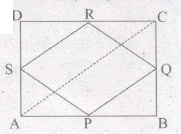
ABCD is a rectangle and P, Q, R and S are the mid-points of the sides AB, BC, CD and DA respectively. Show that the quadrilateral PQRS is a rhombus.
7.
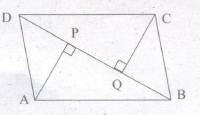
ABCD is a parallelogram and AP and CQ are perpendicular from vertex A and C on diagonal BD. Show that
(i) ΔAPB ≅ ΔCQD
(ii) AP = CQ
8.
The angles of quadrilateral are in the ratio 3 : 5 : 9 : 13. Find all the angles of the quadrilateral.
9.
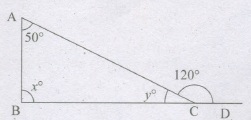
In the figure find x0 and y0.
10.
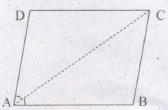
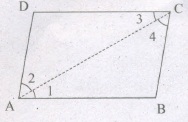
Diagonal AC of a parallelogram ABCD bisects ∠A. Show that
(i) it bisects ∠C also
(ii) ABCD is a rhombus.
11.
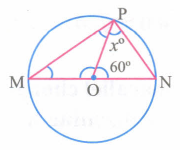
Find the value of Xo
12.
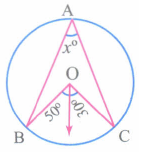
Find the value of Xo
13.
In a circle, AB and CD are two parallel chords with centre 0 and radius 5 cm such that AB = 8 cm and CD = 6 cm determine the distance between the chords?
14.
The radius of a circle 15 cm and the length of one of its chord is 24 cm. Find the distance of the chord from the centre.
15.
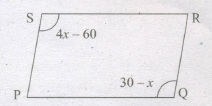
In the given diagram PQRS is a parallelogram.
ㄥS = 4x - 60, ㄥQ = 30 - x. Find the angles of P and R.
16.
Draw and locate the centroid of the triangle ABC where right angle at A, AB = 8 cm and AC = 6 cm.
17.
Construct \(\triangle\)ABC in which AB = BC = 8 cm and \(\angle \)B =70o. Locate its incentre and draw the incircle
18.
Draw an equilateral triangle of side 8 cm and locate its incentre. Also draw the incircle.
19.
Construct an equilateral triangle of side 6cm and locate its centroid and also its incentre. What do you observe from this?
1.
(a)
1: 1
2.
(b)
0
3.
(c)
Equal
4.
(d)
(n-2)180o
5.
(b)
60°
6.
In rectangle ABCD, P is the mid-point of AB.
Q is the mid-point of BC. R is the mid-point of CD
S is the mid-point of DA. AC is the diagonal
Now in ΔABC,
PQ = \(\frac { 1 }{ 2 } \)AC and PQ || AC .......(1)
Similarly in ΔACD,
SR = \(\frac { 1 }{ 2 } \) AC and SR || AC .......(2)
From (1) and (2) we get,
PQ = SR and PQ || SR
Similarly by joining BD, we have
PS = QR and PS || QR
i.e. Both pairs of opposite sides of quadrilateral PQRS are equal and parallel.
∴ PQRS is a parallelogram.
7.
(i) In ΔAPB and ΔCQD we have
∠APB = ΔCQD (90o each)
AB = CD (opposite sides of parallelogram ABCD)
∠ABP = ∠CDQ (AB II CD and AD is a transversal)
Using ASA congruency we have,
∠APB ≅ ΔCQD
(ii) Since ΔAPB ≅ ΔCQD
∴ Their corresponding parts are equal.
∴ AP = CQ.
8.
Let the angles of the quadrilateral be 3x, 5x, 9x and 13x.
Sum of all the angles of quadrilateral = 360°.
3x + 5x + 9x + 13x = 360°
30x = 360°
x = \(\frac { { 360 }^{ 0 } }{ 30 } \)
=120
3x =3 \(\times\) 12 = 36°
5x = 5 \(\times\) 12 = 60°
9x = 9 \(\times\) 12 = 108°
13x = 13 \(\times\) 12 = 156°
The required angles of quadrilateral are 36°, 60° 108° and 156°.
9.
∠ACD = ∠A + ∠B
(An exterior angle of a triangle is sum of its interior opposite angles)
120° = 50° + x0
x0 = 120° - 50°
= 70°
In the triangle ABC
∠A + ∠B + ∠ACB = 180° (Sum of the angles of a Δ)
50° +x + ∠ACB = 180°
50° + 70° + ∠ACB = 180°
∠ACB = 180° - 120°
y = 60° (OR)
∠ACD + ∠ACB = 1800(Angles of a linear pair)
∠ACB = 180° - 120°
= 60°
The value of x = 70° and y = 60°.
10.
We have a parallelogram ABCD in which diagonals AC bisect ㄥA.
ㄥDAC = ㄥBAC
(i) To prove that AC bisects ∠C
∵ ABCD is a parallelogram
∴ AB II DC and AC is a transversal
∴ ㄥ1 = ㄥ3 (Alternate interior angle) .........(1)
.Also BC II AD and AC is a transversal.
∴ ㄥ2 = ㄥ4 (Alternate interior angle) ...........(2)
But AC bisects ㄥA
∴ ㄥ1 = ㄥ2
From (1), (2) and (3) we get
ㄥ3 = ㄥ4
∴ AC bisects ㄥC.
(ii) To prove that ABCD is a rhombus.
In ΔABC, we have ㄥ1 = ㄥ4 [ ∵ ㄥ1 = ㄥ2 = ㄥ4]
∴ BC = AB (side opposite to equal angles are equal) (4)
Similarly AD = DC ....... (5)
But ABCD is a parallelogram AB = DC (Opposite sides of a parallelogram) .......(6)
From (4), (5) and (6) we have AB = BC = CD = DA.
Thus ABCD is a rhombus.
11.
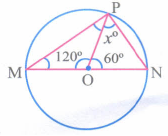
MPN = 90o(Angle subtended by the diameter is 90°)
\(\angle\)OMP +\(\angle\) OPM = 180o-120o = 60o
\(\angle\)MPO = \(\cfrac { 60^{ o } }{ 2 } \) = 30o
\(\therefore\)x = \(\angle \)OPN = 90o - 30o = 60o
12.
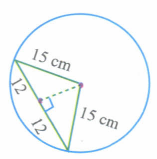
xo=\(\cfrac { 1 }{ 2 } \angle BOC\)
=\(\cfrac { 1 }{ 2 } \) (50o+30o)
=\(\cfrac { 1 }{ 2 } \) \(\times\) 80 =40o
13.
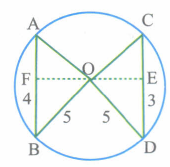
The distance between the two chord
FE = OF + OE
OE = \(\sqrt { { 5 }^{ 2 }-3^{ 2 } } =\sqrt { 25-9 } \)
= \(\sqrt { 16 } \) = 4 cm
OF = \(\sqrt { { 5 }^{ 2 }-{ 4 }^{ 2 } } =\sqrt { 25-16 } =\sqrt { 9 } \) = 3 cm
\(\therefore\) DE = 4 cm + 3 cm = 7 cm
Distance between the chord is 7 cm.
14.
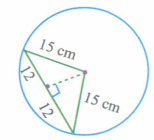
Distance of the chord from the centre
= \(\sqrt { { 15 }^{ 2 }-{ 12 }^{ 2 } } \)
= \(\sqrt { 225-144 } \)
= \(\sqrt { 89 } \)
= 9 cm
15.
ㄥP = ㄥR= 1680
16.
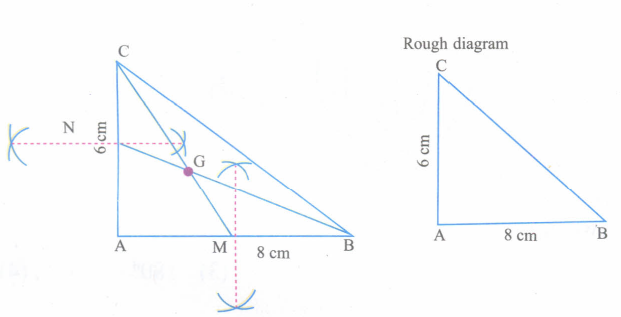
Construction:
Step 1: Draw ΔABC with the given measurements AB = 8 cm, \(\angle\)A = 90o and AC = 6 cm and construct the perpendicular bisector of any two sides (AB and AC) to find the mid points M and N of AB and BC respectively.
Step 2: Draw the medians (C and BN and let them meet at G. The point G is the centroid of the given ΔABC.
17.
In \(\triangle\)ABC, AB = BC = 8 cm, \(\angle\)B = 70°.
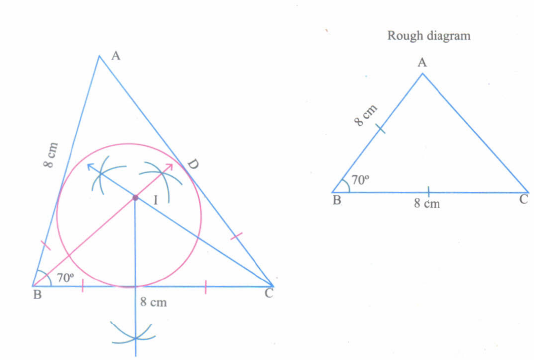
Construction :
Step 1: Draw \(\triangle\)ABC with BC = 8 cm, \(\angle\)B = 70°. AB = 8.
Step 2: Construct the angle bisectors of any two angles (B and C) and let them meet at I. Then I is the incentre of \(\triangle\)ABC. Draw perpendicular from I to anyone of the side (BC) to meet BC at D.
Step 3: With I as centre and ID as radius draw a circle. This circle touches all the sides of the triangle internally.
18.
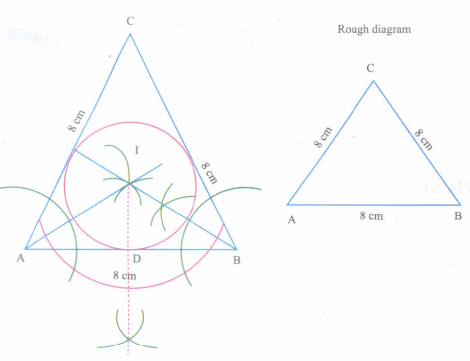
Construction :
Step 1: Draw \(\triangle\)ABC with AB = BC = CA = 8 cm
Step 2: Construct angle bisectors of any two angles (A and B) and let them meet at I. I is the incentre of \(\triangle\)ABC.
Step 3: Draw perpendicular from I to any one of the sides (AB) to meet AB at D.
Step 4: With I as centre, ID as radius draw the circle. This circle touches all the sides of triangle internally.
19.
In an equilateral \(\triangle \) on side = 6 cm,
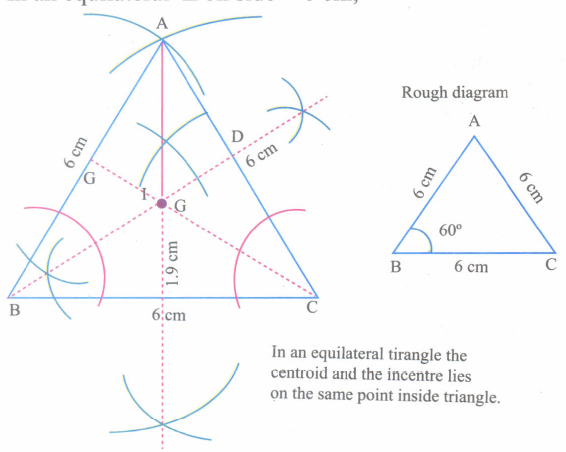
Construction :
Step 1: Draw ΔABC with equal sides of 6 cm length.
Step 2: Draw perpendicular bisectors of any two sides (BC and AC) to find the midpoints of BC and AC.
Step 3: Draw medians BD and CE. Let them meet at G.
Step 4: Draw angle bisectors of any two sides (ㄥB and ㄥC): Let them meet at I.
Step 5: G and I are concurrent point and G is the centroid, I is the incentre.
Step 6: In an equilateral triangle centroid and incentre lie on the same point.

9th Standard Syllabus & Materials
9th Standard
TN 9th Tamil உள்ளத்தின் சீர் - திருக்குறள் Important Questions And Answers Study Material - QB365 Set A
NEW9th Standard
TN 9th Tamil உள்ளத்தின் சீர் - மணிமேகலை Important Questions And Answers Study Material - QB365 Set A
NEW9th Standard
TN 9th Tamil உள்ளத்தின் சீர் - ஏறு தழுவுதல் Important Questions And Answers Study Material - QB365 Set A
NEW9th Standard
TN 9th Tamil உயிருக்கு வேர் - தண்ணீர் Important Questions And Answers Study Material - QB365 Set A



Tamilnadu Stateboard 9th Standard Subjects
Tamilnadu Stateboard Standards





