
 100% FREE ACCESS
9th Standard Syllabus & Materials
9th Standard
TN 9th Tamil உள்ளத்தின் சீர் -கற்கண்டு (இலக்கணம்) - தொடர் இலக்கணம், ஆகுபெயர் Important Questions And Answers Study Material - QB365 Set A
NEW9th Standard
TN 9th Tamil உள்ளத்தின் சீர் -விரிவானம் (துணைப்பாடம்) - தாய்மைக்கு வறட்சி இல்லை! Important Questions And Answers Study Material - QB365 Set A
NEW9th Standard
TN 9th Tamil உள்ளத்தின் சீர் -கவிதை பேழை (செய்யுள்) - மார்கழி பெருவிழா Important Questions And Answers Study Material - QB365 Set A
NEW9th Standard
TN 9th Tamil உயிருக்கு வேர்-இலக்கணம் - பகுபத உறுப்பிலக்கணம் Important Questions And Answers Study Material - QB365 Set A
NEW9th Standard
TN 9th Tamil அமுதென்று பேர் - இலக்கணம்-எழுத்து -அளபெடை Important Questions And Answers Study Material - QB365 Set A
NEW9th Standard
TN 9th Tamil அமுதென்று பேர்-துணைப்பாடம் - ஆறாம்திணை Important Questions And Answers Study Material - QB365 Set A

Published on: 13/11/2019
Download Tamil Nadu 9th Standard Maths question papers, model tests, one-mark questions, important questions, and public exam papers in PDF format. Free study materials and answer keys for TN State Board students.
Questions + Answers key
Take MCQ Maths Test1.
Solve by cross multiplication method : 3x + 5y = 21; −7x − 6y = −49
2.
If A = {2,5,6,7} and B = {3,5,7,8}, then verify the commutative property of union sets
3.
Expand the following using identities : (4m-3m)2
4.
Simplify :\(-2\sqrt [ 4 ]{ 768 } +5\sqrt [ 4 ]{ 1875 } +3\sqrt [ 4 ]{ 48 } \)
5.
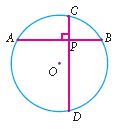
In the given figure, ㄥCAB = 25°, find ㄥBDC, ㄥDBA and ㄥCOB
6.
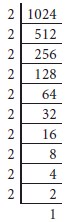
Express each of the following surds in its simplest form \(\sqrt [ 3 ]{ (1024)^{ -2 } } \) and find its order, radicand and coefficient.
7.
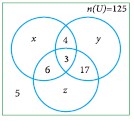
In the adjacent diagram, if n(U) = 125, y is two times of x and z is 10 more than x, then find the value of x,y and z.
8.
The angles of quadrilateral are in the ratio 3 : 5 : 9 : 13. Find all the angles of the quadrilateral.
9.
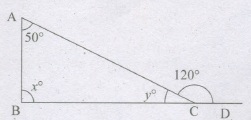
In the figure find x0 and y0.
10.
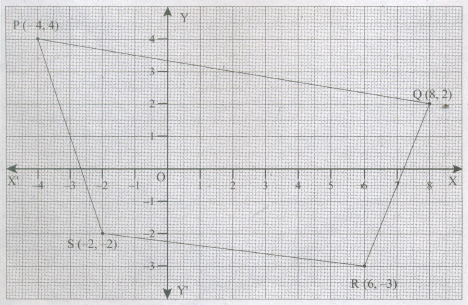
Write the coordinates of quadrilateral PQRS as shown in the following figure.
11.
Locate an irrational number between two rational numbers\(\frac { 23 }{ 10 } \) and\(\frac { 12 }{ 5 } \)
12.
Show that the following points taken in order form the vertices of a parallelogram.
A(–3, 1), B(–6, –7), C (3, –9) and D(6, –1)
13.
The radius of a circle with centre at origin is 30 units. Write the coordinates of the points where the circle intersects the axes. Find the distance between any two such points.
14.
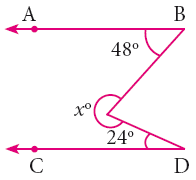
In the figure, AB is parallel to CD, find x
15.
Find the quotient and remainder when 4x3 + 6x2 + 7x + 2 is divided by x - 2
16.
Show that the point A (3,7) B (6, 5) and C (15, -1) are collinear.
17.
Find any two irrational numbers between\(\frac { 6 }{ 7 } \) and \(\frac { 12 }{ 13 } \)
18.
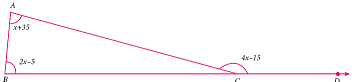
Find all the three angles of the ΔABC
19.
Find the centroid of the triangle whose vertices are (2, -5), (5, 11) and (9, 9)
20.
Find the value of s for the following system of equation has infinitely many
solutions. 2x - 3y = 7; (s +2) x - (2s + 1)y = 3(2s -1)
21.
If \(\left( \frac { 3 }{ 2 } ,5 \right) ,\left( 7,\frac { -9 }{ 2 } \right) \)and\((\frac{13}{2},\frac{-13}{2})\) are mid-points of the sides of a triangle, then find the centroid of the triangle.
22.
Find any 4 irrational numbers between \(\frac { 1 }{ 4 } \) and \(\frac { 1 }{ 3 } \)
23.
The centre of a circle is (−4, 2). If one end of the diameter of the circle is (−3, 7) then find the other end.
24.
Use a fractional index to write \(\left( 5\sqrt { 125 } \right) ^{ 7 }\)
25.
Express the following in the form 3n: \(\sqrt { 27 } \)
26.
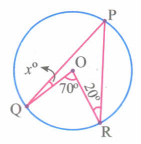
Find the value of Xo
27.
In a circle, AB and CD are two parallel chords with centre 0 and radius 5 cm such that AB = 8 cm and CD = 6 cm determine the distance between the chords?
28.
Expand: (2a + 3b)3
29.
In a class of 50 students, each of the students passed either in mathematics or in science or in both. 10 students passed in both and 28 passed in science. Find how many students passed in mathematics only
30.
If S = {square, rectangle, circle, rhombus, triangle}, list the elements of the following subset of S.
The set of shapes which have 5 sides.
31.
If p(x) = x2– 2\(\sqrt { 2 }\)x +1, find p(2\(\sqrt { 2 }\)) .
32.
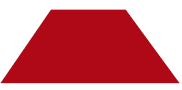
Identify which ones are trapeziums and which are not.
33.
AD is a diameter of a circle and AB is a chord If AD = 30 cm and AB = 24cm then the distance of AB from the centre of the circle is ______.
10cm
9cm
8cm
6cm
34.
Divide x3-4x2+6x by "x" the result is _____________________
\(x^{ 2 }+4x-6\)
\(x^{ 2 }-4x-6\)
\(x^{ 2 }-4x+6\)
\(x^{ 2 }+4x+6\)
35.
The value of the polynomial f(x) = 6x - 3x2+9 when x = -1 is _____________________
0
1
2
3
36.
Diagonal of which of the following quadrilaterals do not bisect it into two congruent triangles?
rhombus
trapezium
square
rectangle
37.
The set {x: x ∈ A, x ∈ B, x ∉ A ∩ B} is___________.
A ∩ B
A U B
A - B
A Δ B
38.
The product of \(2\sqrt { 5 } \) and \(6\sqrt { 5 } \) is_______________.
\(12\sqrt { 5 } \)
60
40
\(8\sqrt { 5 } \)
39.
The point (0, -3) lies on _______________
+ ve x-axis
+ ve y-axis
- ve x-axis
- ve y-axis
40.
The centre of a circle is (0, 0). One end point of a diameter is (5, -1), then ______________
\(\sqrt{24}\)
\(\sqrt{37}\)
\(\sqrt{26}\)
\(\sqrt{17}\)
41.
if \(\frac { 1 }{ 7 } \) = \(0.\overline { 142857 } \) then the value of \(\frac { 5 }{ 7 } \) ________.
\(0.\overline { 142857 } \)
\(0.\overline { 714285 } \)
\(0.\overline { 571428 } \)
0.714285
42.
The distance between the two points ( 2, 3 ) and ( 1, 4 ) is ______.
2
\(\sqrt { 56 } \)
\(\sqrt { 10 } \)
\(\sqrt { 2 } \)
43.
The value of \(0.\bar { 23 } +0.\bar { 22 } \) is ____________
\(0.\bar { 43 } \)
0.45
\(0.4\bar { 5 } \)
\(0.\bar { 45 } \)
44.
The root of the polynomial equation 2x + 3 = 0 is ________.
\(\frac{1}{3}\)
\(-\frac{1}{3}\)
\(-\frac{3}{2}\)
\(-\frac{2}{3}\)
45.
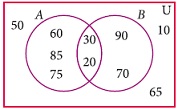
From the adjacent diagram n[P(AΔB)] is ________.
8
16
32
64
46.
The interior angle made by the side in a parallelogram is 90° then the parallelogram is a ________.
rhombus
rectangle
trapezium
kite
1.
The given system of equations are 3x + 5y − 21 = 0; −7x − 6y + 49 = 0
Now using the coefficients for cross multiplication, we get,
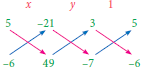
\(\Rightarrow \frac { x }{ (5)(49)-(-6)(-21) } =\frac { y }{ (-21)(-7)-(49)(3) } =\frac { 1 }{ (3)(-6)-(-7)(5) } \)
\(\frac { x }{ 119 } =\frac { y }{ 0 } =\frac { 1 }{ 17 } \)
\(\Rightarrow \frac { x }{ 119 } =\frac { 1 }{ 17 } ,\frac { y }{ 0 } =\frac { 1 }{ 17 } \)
\(\Rightarrow x=\frac { 119 }{ 17 } ,y=\frac { 0 }{ 17 } \)
\(\Rightarrow\) x = 7, y = 0
Verification :
3x + 5y = 21 ...(1)
3(7) + 5(0) = 21
21 + 0 = 21
21 = 21 True
-7x - 6y = -49 ...(2)
-7(7) - 6(0) = - 49
-49 = -49
-49 = -49 True
2.
Given, A = {2,5,6,7} and B = {3,5,7,8}
\(A\cup B\) = {2,3,5,6,7,8} ...........(1)
\(B\cup A\) = {2,3,5,6,7,8} ..............(2)
3.
(4m-3m)2 = (4m)2 - 2(4m) (3m) + (3m)2 = 16m2 - 24mn + 9n2
4.
\(-2\sqrt [ 4 ]{ 768 } +5\sqrt [ 4 ]{ 1875 } +3\sqrt [ 4 ]{ 48 } \) = \(-2\sqrt [ 4 ]{ 256\times 3 } +5\sqrt [ 4 ]{ 625\times 3 } +3\sqrt [ 4 ]{ 16\times 3 } \)
=\(-2\sqrt [ 4 ]{ { 4 }^{ 4 }\times 3 } +5\sqrt [ 4 ]{ { 5 }^{ 4 }\times 3 } +3\sqrt [ 4 ]{ { 2 }^{ 4 }\times 3 } \)
=\(-2\times 4\sqrt [ 4 ]{ 3 } -5\times 5\sqrt [ 4 ]{ 3 } +3\times 2\sqrt [ 4 ]{ 3 } \)
=\(-8\sqrt [ 4 ]{ 3 } +25\sqrt [ 4 ]{ 3 } +6\sqrt [ 4 ]{ 3 } =23\sqrt [ 4 ]{ 3 } \)
5.
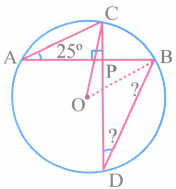
(i)\(\angle\)CAB = 250
\(\therefore\) \(\angle\)BDC = 250
(ii) \(\angle\)DBA = \(\angle\)DCA =180-(90+250)
= 1800 - 1150
= 65
(iii)\(\angle\)COB = 2\(\angle\)CAB = 2\(\times\)250 = 500
6.
\(\sqrt [ 3 ]{ (1024)^{ -2 } } =\left[ \sqrt [ 3 ]{ ({ 2 }^{ 3 }\times { 2 }^{ 3 }\times { 2 }^{ 3 }\times 2 } )^{ -2 } \right] \)
=\(\left[ \sqrt [ 3 ]{ ({ 2 }^{ 3 }\times { 2 }^{ 3 }\times { 2 }^{ 3 }\times 2 } )^{ -2 } \right] \) [Laws of radicals - (i)]
=\(\left[ \sqrt [ 3 ]{ 2^{ 3 } } \times \sqrt [ 3 ]{ { 2 }^{ 3 } } \times \sqrt [ 3 ]{ { 2 }^{ 3 } } \times \sqrt [ 3 ]{ { 2 } } \right] ^{ -2 }\) [Laws of radicals – (ii)]
= \(\left[ 2\times 2\times 2\times \sqrt [ 3 ]{ 2 } \right] ^{ -2 }\) [Laws of radicals – (i)]
=\(\left[ 8\times \sqrt [ 3 ]{ 2 } \right] ^{ -2 }=\left[ \frac { 1 }{ 8 } \right] ^{ 2 }\times \left( \frac { 1 }{ \sqrt [ 3 ]{ 2 } } \right) ^{ 2 }\)
=\(\frac { 1 }{ 64 } \sqrt [ 3 ]{ \frac { 1 }{ 4 } } \)
order = 3 ; radicand = \(\frac{1}{4}\); coefficient = \(\frac{1}{64}\)
(These results can also be obtained using index notation).
7.
n(U) = 125
y = 2x
z = x + 10
ஃ x + y + z + 4 + 17 + 6 + 3 + 5 = 125
x + 2x + x + 10 + 35 = 125
4x + 45 = 125
4x = 125 - 45
4x = 80
x = 20
ஃ y = 2x = 2 \(\times\) 20 = 40
z = x +10 = 20 + 10 = 30
Hence x = 20; y = 40; z = 30
8.
Let the angles of the quadrilateral be 3x, 5x, 9x and 13x.
Sum of all the angles of quadrilateral = 360°.
3x + 5x + 9x + 13x = 360°
30x = 360°
x = \(\frac { { 360 }^{ 0 } }{ 30 } \)
=120
3x =3 \(\times\) 12 = 36°
5x = 5 \(\times\) 12 = 60°
9x = 9 \(\times\) 12 = 108°
13x = 13 \(\times\) 12 = 156°
The required angles of quadrilateral are 36°, 60° 108° and 156°.
9.
∠ACD = ∠A + ∠B
(An exterior angle of a triangle is sum of its interior opposite angles)
120° = 50° + x0
x0 = 120° - 50°
= 70°
In the triangle ABC
∠A + ∠B + ∠ACB = 180° (Sum of the angles of a Δ)
50° +x + ∠ACB = 180°
50° + 70° + ∠ACB = 180°
∠ACB = 180° - 120°
y = 60° (OR)
∠ACD + ∠ACB = 1800(Angles of a linear pair)
∠ACB = 180° - 120°
= 60°
The value of x = 70° and y = 60°.
10.
P (- 4,4), Q (8, 2), R (6, -3) and S (-2, -2)
11.
\(\frac { 23 }{ 10 } \)is 2.3 and\(\frac { 12 }{ 5 } \) is 2.4
You need an irrational number greater than 2.3 but less than 2.4
One such irrational number is
2.301001000100001000001000000100000001……..
observe that it is non-terminating and non-recurring.
12.
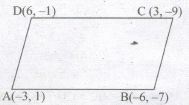
Distance =\(\sqrt { ({ x }_{ 2 }-{ x }_{ 1 })^{ 2 }+(y_{ 2 }-y_{ 1 })^{ 2 } } \)
AB =\(\sqrt { (-6+3)^{ 2 }+(-7-1)^{ 2 } } \)
= \(\sqrt { (-3)^{ 2 }+(-8)^{ 2 } } =\sqrt { 9+64 } =\sqrt { 73 } \)
BC = \(\sqrt { (3+6)^{ 2 }+(-9+7)^{ 2 } } \)
= \(\sqrt { { 9 }^{ 2 }+(-2)^{ 2 } } =\sqrt { 81+4 } =\sqrt { 85 } \)
CD = \(\sqrt { (6-3)^{ 2 }+(-1+9)^{ 2 } } \)
= \(\sqrt { (3)^{ 2 }+({ 8 })^{ 2 } } =\sqrt { 9+64 } =\sqrt { 73 } \)
AD = \(\sqrt { (6+3)^{ 2 }+(-1-1)^{ 2 } } \)
= \(\sqrt { (9)^{ 2 }+(-2)^{ 2 } } =\sqrt { 81+4 } =\sqrt { 85 } \)
AB = CD =\(\sqrt { 73 } \) and BC = AD = \(\sqrt { 85 } \)(Opposite sides are equal)
∴ ABCD is a parallelogram.
13.
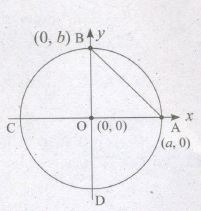
Radius of the circle = 30 units. The point O is (0, 0).
Let a intersect the x - axis and b intersect the y - axis
∴ The point A is (a, 0) and B is (0, b)
Distance = \(\sqrt { ({ x }_{ 2 }-{ x }_{ 1 })^{ 2 }+(y_{ 2 }-y_{ 1 })^{ 2 } } \)
OA =\(\sqrt { (a-0)^{ 2 }+(0-0)^{ 2 } } \)
30 = \(\sqrt { a^{ 2 } } \)
Squaring on both sides
302 = a2
∴ a = 30
The point A is (30, 0)
OB = \(\sqrt { (0-0)^{ 2 }+(b-0)^{ 2 } } \)
= \(\sqrt { 0+{ b }^{ 2 } } \)
30 = \(\sqrt {b^{ 2 } } \)
Squaring on both sides
302 = b2
∴ b = 30
The point B is (0, 30)
Distance AB =\(\sqrt { (30-0)^{ 2 }+(0-30)^{ 2 } } \)
= \(\sqrt { 30^{ 2 }+30^{ 2 } } =\sqrt { 900+900 } \)
= \(\sqrt { 1800 } =\sqrt { 2\times 900 } =30\sqrt { 2 } \)
∴ Distance between the two points = 30\(\sqrt { 2 } \)
14.
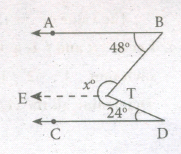
Draw TE || AB.
\(\angle ABT+\angle ETB=180^0(AB||TE)\)
\(48^0+\angle ETB=180^0\)
\(\angle ETB=180^0-48^0=132^0\)
Similarly \(\angle CDT+\angle DTE=180^0\)
\(24^0+\angle DTE=180^0\)
\(\therefore \angle DTE=180^0-24^0\) = 1560
\(\therefore \angle BTE+\angle ETD=132^0+156^0\) = 288°
x = 288°
15.
P (x) = 4x3 + 6x2 + 7x + 2
d(x) = x - 2
Standard form of p (x) 4x3 + 6x2 + 7x + 2 and
d(x) x - 2
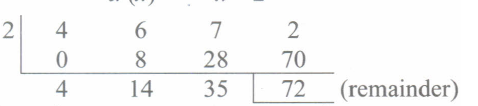
4x2 + 6x2 + 7x + 2 = (x - 2)(4x3 + 14x + 35) + 72
Hence the quotient is 4x3 + 14x + 35 and remainder is 72
16.
Distance = \(\sqrt{(x_2-x_2)^2+(y_2-y_1)^2}\)
AB =\(\sqrt{(6-3)^2+(5-7)^2}\)
\(\sqrt{3^2+(-2)^2}=\sqrt{9+4}=\sqrt{13}\)
BC=\(\sqrt{(15-6)^2+(-1-5)^2}=\sqrt{(9)^2+(-6)^2}\)
\(\sqrt{81+36}=\sqrt{117}\)
\(\sqrt{9\times 13}-3\sqrt{13}\)
AC =\(\sqrt{(15-3)^2+(-1-7)^2}\)
\(\sqrt{12^2+(-8)^2}=\sqrt{144+64}\)
\(=\sqrt{208}=\sqrt{16\times 13}=4\sqrt{13}\)

AB + BC =AC\(\Rightarrow \sqrt{13}+3\sqrt{13}=4\sqrt{13}\)
\(\therefore\)The points A,B,C are collinear.
17.
\({6\over 7}=0.\overline {857142}\)
\({12\over 13}=0.\overline{923076}\)
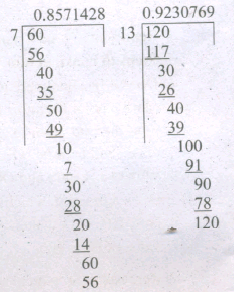
The two irrational numbers are 0.866142 ...and 0.903076.......
18.
\(\angle A+\angle B=\angle ACD\) (An exterior angle of a triangle is sum of its interior opposite angles)
x + 35 + 2x - 5 = 4x - 15
3x + 30 = 4x- 15
30+15 = 4x-3x
45° = x
\(\angle A=x+35^0\)
= 45°+ 35°
= 80°
\(\angle B=2x-5\)
= 2(45°) - 5°
= 90° - 5° = 85°
\(\angle ACD=4x-15\)
= 4(45°)-15°
= 180°-15° = 165°
\(\angle ACB=180^0-\angle ACD\)
=180° - 165° = 15°
\(\angle A=80^0,\angle B=85^0,\angle C=15^0\).
19.
\(G\left( \frac { { x }_{ 1 }+{ x }_{ 2 }+{ x }_{ 3 } }{ 3 } ,\frac { { y }_{ 1 }+{ y }_{ 2 }+{ y }_{ 3 } }{ 3 } \right) =\left( \frac { 2+5+9 }{ 3 } ,\frac { -5+11+9 }{ 9 } \right) =\left( \frac { 16 }{ 3 } ,5 \right) \)
20.
2x- 3y = 7
(s + 2) x - (2s + 1)y = 3 (2s - 1)
\(\cfrac { 2 }{ s+2 } =\cfrac { 3 }{ 2s+1 } =\cfrac { 7 }{ 3(2s-1) } \)
\(\cfrac { 2 }{ s+2 } =\cfrac { 3 }{ 2s+1 } \)
2(2s + 1 ) = 3 (s + 2)
4s + 2 = 3s + 6
4s - 3s = 6- 2
s = 4
21.
"The centroid of the triangle obtained by joining the mid points of the sides of a triangle is the same as the centroid of the original triangle."
\(\therefore\) The mid points of the sides of the triangle are given as
x1y1 , x2y, x3y3
\(\left( \frac { 3 }{ 2 } ,5 \right) \left( 7,\frac { -9 }{ 2 } \right) \left( \frac { 13 }{ 2 } ,\frac { -13 }{ 2 } \right) \)
\(\therefore\)Centroid \(=\left( \frac { { x }_{ 1 }+{ x }_{ 2 }+{ x }_{ 3 } }{ 3 } ,\frac { { y }_{ 1 }+{ y }_{ 2 }+{ y }_{ 3 } }{ 3 } \right) \)
\(=\left( \frac { \frac { 3 }{ 2 } +\frac { 7 }{ 1 } +\frac { 13 }{ 2 } }{ 3 } ,\frac { 5+\left( \frac { -9 }{ 2 } \right) +\frac { (-13) }{ 2 } }{ 3 } \right) =\left( \frac { \frac { 3+14+13 }{ 2 } }{ 3 } ,\frac { \frac { 10-9-13 }{ 2 } }{ 3 } \right) \)
\(=\left( \frac { \frac { 30 }{ 2 } }{ 3 } ,\frac { \frac { -12 }{ 2 } }{ 3 } \right) =\left( \frac { 15 }{ 3 } ,\frac { -6 }{ 3 } \right) =(5,-2)\)
22.
\(\frac { 1 }{ 4 } \) = 0.25 and \(\frac { 1 }{ 3 } \) = 0.3333….. = \(0.\bar3\)
In between 0.25 and \(0.\bar3\), there are infinitely many irrational numbers.
Four irrational numbers between 0.25 and \(0.\bar3\) are
0.2601001000100001…..
0.2701001000100001…..
0.2801001000100001…..
0.3101001000100001…..
23.
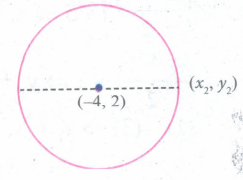
\(M(x,y)=\left( \frac { { x }_{ 1 }+{ x }_{ 2 } }{ 2 } ,\frac { { y }_{ 1 }+{ y }_{ 2 } }{ 2 } \right) \)
\((-4,2)=\left( \frac { -3+{ x }_{ 2 } }{ 2 } ,\frac { 7+{ y }_{ 2 } }{ 2 } \right) \left( { x }_{ 1 }{ y }_{ 1 } \right) \)
\(\frac { -3+{ x }_{ 2 } }{ 2 } =-4\quad \frac { 7+{ y }_{ 2 } }{ 2 } =2\)
-3 + x2 = -8
7 +y2 = 4
x2 = -8 +3
y2 = 4 -7 = -3
x2 = -5
The other end is (-5, -3)
24.
\(\left( 5\sqrt { 125 } \right) ^{ 7 }\) = \({ 125 }^{ \frac { 7 }{ 5 } }\)
25.
\(\sqrt { 27 } \) =\(\sqrt { 3 } \times \sqrt { 3 } \times \sqrt { 3 } =\left( { 3 }^{ \cfrac { 1 }{ 2 } } \right) ^{ 3 }=\left( 3 \right) ^{ \left( \cfrac { 3 }{ 2 } \right) }\)
26.
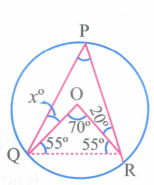
\(\angle \)QPR = \(\cfrac { 1 }{ 2 } \) \(\angle \)QPR =\(\cfrac { 1 }{ 2 } \) X 70o = 35o
In\(\triangle\)QPR
\(\angle \)R + \(\angle \)P + \(\angle \)Q = 180o
75o + 35o +\(\angle \)Q =180o
\(\angle \)Q =180o-110o = 70o
\(\angle \)Q = xo + 55o = 70o
xo = 70o - 55o = 15o
27.
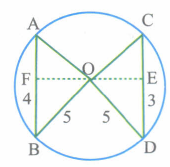
The distance between the two chord
FE = OF + OE
OE = \(\sqrt { { 5 }^{ 2 }-3^{ 2 } } =\sqrt { 25-9 } \)
= \(\sqrt { 16 } \) = 4 cm
OF = \(\sqrt { { 5 }^{ 2 }-{ 4 }^{ 2 } } =\sqrt { 25-16 } =\sqrt { 9 } \) = 3 cm
\(\therefore\) DE = 4 cm + 3 cm = 7 cm
Distance between the chord is 7 cm.
28.
We know that (a+b)3 ≡ a3+3a2b+3ab2+b3
(2a+3b)3 = (2a)3+3(2a)2(3b)+3(2a)(3b)2+(3b)3
= 8a3+36a2b+54ab2+27b3
29.
22
30.
{ }
31.
p(x) = x2 - \(2\sqrt { 2 } +1\)
\(p\left( 2\sqrt { 2 } \right) ={ \left( 2\sqrt { 2 } \right) }^{ 2 }-2\sqrt { 2 } \left( 2\sqrt { 2 } \right) +1\)
= 8 - 8 + 1
= 0 + 1 = 1
32.
It is a trapezium
33.
(b)
9cm
34.
(c)
\(x^{ 2 }-4x+6\)
35.
(a)
0
36.
(b)
trapezium
37.
(d)
A Δ B
38.
(b)
60
39.
(d)
- ve y-axis
40.
(c)
\(\sqrt{26}\)
41.
(b)
\(0.\overline { 714285 } \)
42.
(d)
\(\sqrt { 2 } \)
43.
(d)
\(0.\bar { 45 } \)
44.
(c)
\(-\frac{3}{2}\)
45.
(c)
32
46.
(b)
rectangle

9th Standard Syllabus & Materials
9th Standard
TN 9th Tamil உள்ளத்தின் சீர் - திருக்குறள் Important Questions And Answers Study Material - QB365 Set A
NEW9th Standard
TN 9th Tamil உள்ளத்தின் சீர் - மணிமேகலை Important Questions And Answers Study Material - QB365 Set A
NEW9th Standard
TN 9th Tamil உள்ளத்தின் சீர் - ஏறு தழுவுதல் Important Questions And Answers Study Material - QB365 Set A
NEW9th Standard
TN 9th Tamil உயிருக்கு வேர் - தண்ணீர் Important Questions And Answers Study Material - QB365 Set A



Tamilnadu Stateboard 9th Standard Subjects
Tamilnadu Stateboard Standards





