100% FREE ACCESS
9th Standard CBSE Syllabus & Materials
9th Standard CBSE
CBSE 9th Science Is matter around us pure? - New Model Questions Papers Study Material - QB365 Set A
NEW9th Standard CBSE
CBSE 9th Science Matter in our surroundings - New Model Questions Papers Study Material - QB365 Set A
NEW9th Standard CBSE
CBSE 9th Mathematics Heron's Formula Sample Question Papers Study Material - QB365 Set A
NEW9th Standard CBSE
CBSE 9th Mathematics Circles Sample Question Papers Study Material - QB365 Set A
NEW9th Standard CBSE
CBSE 9th Mathematics Quadrilaterals Sample Question Papers Study Material - QB365 Set A
NEW9th Standard CBSE
CBSE 9th Mathematics Triangles Sample Question Papers Study Material - QB365 Set A

Published on: 31/07/2018
Based on the current academic syllabus, some of the important questions are prepared from the chapter Areas of Parallelograms and Triangles.
Download CBSE Class 9th Standard CBSE Mathematics question papers, sample papers, important questions, and previous year solved papers in PDF format. Get free study materials, NCERT solutions, and exam preparation resources for Class 9th Standard CBSE Mathematics
Questions + Answers key
Take MCQ Mathematics Test
1.
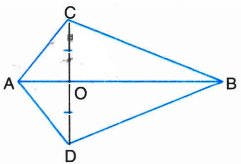
\(\Delta \)ABC and \(\Delta \) ABD are two triangles on the same base AB. If line segment CD is bisected by AB at O, show that ar (\(\Delta \) ABC) = ar (\(\Delta \)ABD)
2.
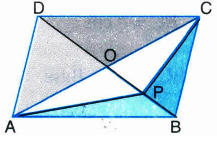
ABCD is a parallelogram whose diagonals intersect at o. If P is any point on BO, prove that
(i) ar(\(\Delta \)ADO) = ar(\(\Delta \) CDO)
(ii) ar(\(\Delta \)ABP) = ar(\(\Delta \) CBP)
3.
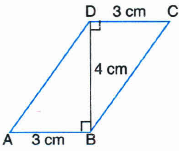
ABCD is a quadrilateral and BD is one of its diagonals as shown in figure. Show that ABCD is a parallelogram and find its area.
4.
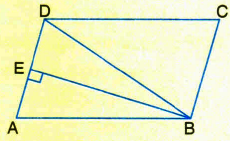
In the given figure, ABCD is a \(BE\bot AD\)parallelogram. If BE = 14 cm and AD = 8 cm, find the area of \(\Delta\)DBC.
5.
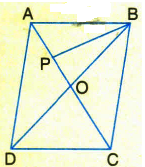
ABCD is a parallelogram with area 80 sq. cm. The diagonals AC and BD intersect at O. P is the midpoint of OA. Calculate ar(\(\Delta\) BOP)
6.
In the figure, ABCD is a parallelogram. AB = 12 cm, DM = 6 cm and BN = 9 cm. Find the length of AD.
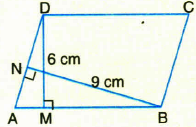
7.
In the figure, ar( \(\Delta\)ABE) = 50 cm2. Find the area of the parallelogram ABCD. Give reasons.
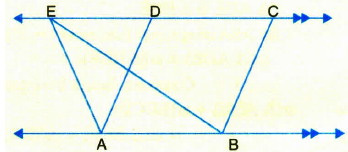
8.
In the figure, PQRS is a parallelogram with PQ = 12 cm, altitudes corresponding to PQ and SP are respectively 8 cm and 10 cm. Find SP.
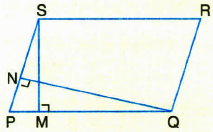
9.
Diagonals AC and BD of a quadrilateral ABCD intersect at O in such a way that ar(\(\Delta \) AOD) = ar(\(\Delta \) BOC). Prove that ABCD is a trapezium.
10.
In figure, AP || BQ || CR. Prove that ar(\(\Delta \)AQC) = ar(\(\Delta \)PBR).
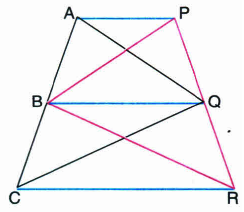
11.
In the figure, BC = 2BE and area (\(\Delta\)ABC) = 60 cm2, then ar (\(\Delta\)AEC) is:
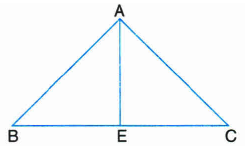
15 cm2
20 cm2
30 cm2
40 cm2
12.
In the figure, ABCD is a parallelogram. If area (AOD) = 12 cm2 then area (ABCD) is:
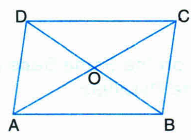
3 cm2
24 cm2
48 cm2
36 cm2
13.
If the medians of a triangle ABC intersect each other at G, then area of \(\Delta\)AGB equals:
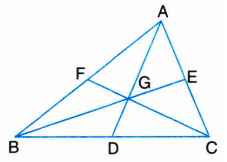
\(ar\ \Delta ABC\)
\(\frac { 1 }{ 2 } ar\ \Delta ABC\)
\(\frac { 1 }{ 3 } ar\ \Delta ABC\)
\(\frac { 1 }{ 4 } ar\ \Delta ABC\)
14.
If the area of \(\Delta\)ABC is 800 cm2 AD is a median, E is the midpoint of AD, F is the midpoint of AB, then the area of \(\Delta\)AEF (in cm2) is:
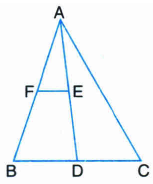
400
300
200
100
15.
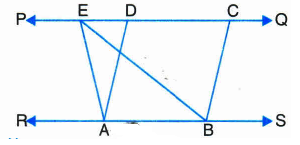
In the figure, PQ || RS, ABCD is a parallelogram and AEB is a triangle. Area of the parallelogram ABCD is:
half the area of triangle \(\Delta\)AEB
equal to ar(\(\Delta\) AEB)
thrice the area of \(\Delta\)AEB
twice the ar (\(\Delta\)AEB)
16.
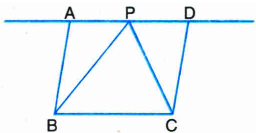
In the figure, parallelogram ABCD and \(\Delta\)BCP are on the same base BC and between the same parallels. If ar(BCP) = 15 cm2. Then ar(ABCD) equals:
7.5 cm2
30 cm2
15 cm2
60 cm2
17.
If a triangle and a parallelogram are on same base and between same parallels, then the ratio of the area of the triangle to the area of the parallelogram is
1:3
1:2
3:1
1:4
18.
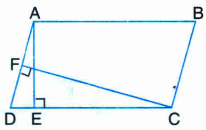
In the given figure, if ABCD is a parallelogram, \(CF\bot AD\) and \(AE\bot DC\) If AB = 16 cm, AE = 4 cm and CF = 10 cm, the length of BC is:
5.8 cm
6.4 cm
7.5 cm
12 cm
19.
In the figure, the area of parallelogram PQRS is:
\(PQ\times QB\)
\(QR\times QC\)
\(SR\times QC\)
\(PS\times SA\)
20.
Area of a triangle is equal to
\(\frac { 1 }{ 2 } \times Base\times Corresponding\quad altitude\)
\(\frac { 1 }{ 4 } \times Base\times Corresponding\quad altitude\)
\(\frac { 1 }{ 3 } \times Base\times Corresponding\quad altitude\)
\( Base\times Corresponding\quad altitude\)
1.
Given:\(\Delta \) ABC and \(\Delta \) ABD are two triangles on the same base AB. Line segment CD is bisected by AB at O.
To Prove: ar(ABC) = ar(ABD)
Proof: Line segment CD is bisected by AB at O
CO = DO
\(\Rightarrow \) O is the midpoint of CD.
\(\Rightarrow \) AO is a median of \(\Delta \)ACD and BO is a median of \(\Delta \)BCD
AO is a median of \(\Delta \)ACD
ar(\(\Delta \) AOC) = ar(\(\Delta \) AOD) ... (1)
| A median of a triangle divides it into two triangles of equal areas
BO is a median of \(\Delta \) BCD
ar(\(\Delta \) BOC) = ar(\(\Delta \) BOD) ... (2)
| A median of a triangle divides it into two triangles of equal areas
Adding (1) and (2), we get,
\(ar(\Delta AOC)+ar(\Delta BOC)\)
\(\\ =ar(\Delta AOD)+ar(\Delta BOD)\)
\(\\ \Rightarrow ar(\Delta ABC)=ar(\Delta ABD)\)
2.
Given: ABCD is a parallelogram whose diagonals intersect at O. P is any point on BO.
To prove:
(i) ar(\(\Delta \)ADO) = ar(\(\Delta \) CDO)
(ii) ar(\(\Delta \)ABP) = ar(\(\Delta \) CBP)
Proof:
i) Diagonals of a parallelogram bisect each other
AO = OC
O is the midpoint of AC
DO is a median of \(\Delta \)DAC
ar(\(\Delta \) ADO) = ar(\(\Delta \) CDO)
|A median of a triangle divides it into two triangles of equal areas
(ii) BO is a median of \(\Delta \)BAC
ar(\(\Delta \) BOA) = ar(\(\Delta \) BOC) ..........(1)
|A median of a triangle divides it into two triangles of equal areas
PO is a median of \(\Delta \)PAC
ar(\(\Delta \) POA) = ar(\(\Delta \) POC) .........(2)
|A median of a triangle divides it into two triangles of equal areas
Subtracting (2) from (1), we get
ar(\(\Delta \) BOA) - ar(\(\Delta \) POA) = ar(\(\Delta \) BOC) - ar(\(\Delta \) POC)
ar(\(\Delta \) ABP) = ar(\(\Delta \) CBP)
3.
Given: ABCD is a quadrilateral and BD is one of its diagonals.
To Prove: ABCD is a parallelogram and to determine its area.
Proof:\(\angle ABD=\angle BDC(=90°)\) |Given
But these angles form a pair of equal alternate.interior angles for lines AB, DC and a transversal BD
AB || DC
Also, AD = DC (= 3 cm) I Given
Hence, quadrilateral ABCD is a parallelogram.
I A quadrilateral is a parallelogram if its one pair of opposite sides are parallel and equal
Now,
\(ar(||gm\ ABCD)=base\times Corresponding\ altitude\)
\(\\ =3\times 4\)
\(\\ =12{ cm }^{ 2 }\)
4.
56 cm2
5.
10 cm2
6.
8 cm
7.
100 cm2
8.
9.6 cm
9.
Given: Diagonals AC and BD of a quadrilateral ABCD intersect at 0 in such a way that ar(\(\Delta \) AOD) = ar(\(\Delta \) BOC).
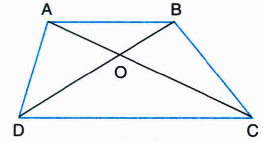
To Prove: \(\Box \) ABCD is a trapezium.
Proof: ar(\(\Delta \) AOD) = ar(\(\Delta \) BOC) IGiven
ar(\(\Delta \) AOD) + ar(\(\Delta \) AOB)
= ar(\(\Delta \) BOC) + ar(\(\Delta \) AOB)
I Adding ar(\(\Delta \)AOB) to both sides
= ar(\(\Delta \) ABD) = ar(\(\Delta \)ABC)
But \(\Delta \)ABD amd \(\Delta \) ABC are on the same base AB.
\(\Delta \) ABD and \(\Delta \) ABC will have equal corresponding altitudes.
\(\Delta \) ABD and \(\Delta \) ABC will lie between the same parallels.
AB || DC
ABCD is a trapezium.
A quadrilateral is a trapezium if exactly one pair of opposite sides are parallel
10.
Given: AP || BQ || CR.
To Prove: ar(\(\Delta \) AQC) = ar(\(\Delta \)PBR).
Proof: \(\Delta \) BAQ and \(\Delta \)BPQ are on the same base BQ and between the same parallels BQ and AP.
ar(\(\Delta \) BAQ) = ar(\(\Delta \) BPQ) ...(1)
|Two triangles on the same base (or equal bases) and between the same parallels are equal in area
\(\Delta \) BCQ and \(\Delta \)BQR are on the same base BQ and between the same parallels BQ and CR.
ar(\(\Delta \) BCQ) = ar(\(\Delta \) BQR) ...(1)
|Two triangles on the same base (or equal bases) and between the same parallels are equal in area
Adding the corresponding sides of (1) and (2), we get
ar(\(\Delta \) BAQ) + ar(\(\Delta \) BCQ)
= ar(\(\Delta \) BPQ) + ar(\(\Delta \) BQR)
= ar(\(\Delta \) AQC) = ar(\(\Delta \) PBR).
11.
(c)
30 cm2
12.
A diagonal of a parallelogram divides it into two congruent triangles. Two congruent triangles have equal areas. The diagonals of a parallelogram bisect each other.A median of a triangle divides it into two triangles of equal areas.
13.
14.
A median of a triangle divides it into two triangles of equal areas.
15.
If a parallelogram and a triangle are on the same base and between the same parallels, then area of the triangle is half the area of the parallelogram.
16.
If a parallelogram and a triangle are on the same base and between the same parallels Then area of the triangle is half the area of the parallelogram.
17.
If a parallelogram and a triangle are on the same base and between the same parallels, then area of the triangle is half the area of the parallelogram.
18.
Area of a parallelogram = Base x Corresponding altitude
19.
Area of parallelelogram=\(Base\times Corresponding\quad altitude\)
20.
Theorem

9th Standard CBSE Syllabus & Materials
9th Standard CBSE
CBSE 9th Mathematics Lines and Angles Sample Question Papers Study Material - QB365 Set A
NEW9th Standard CBSE
CBSE 9th Mathematics Introduction to Euclid's Geometry Sample Question Papers Study Material - QB365 Set A
NEW9th Standard CBSE
CBSE 9th Mathematics Linear Equations in Two Variables Sample Question Papers Study Material - QB365 Set A
NEW9th Standard CBSE
CBSE 9th Mathematics Coordinate Geometry Sample Question Papers Study Material - QB365 Set A



CBSE 9th Standard CBSE Subjects
CBSE Standards