100% FREE ACCESS
9th Standard CBSE Syllabus & Materials
9th Standard CBSE
CBSE 9th Science Is matter around us pure? - New Model Questions Papers Study Material - QB365 Set A
NEW9th Standard CBSE
CBSE 9th Science Matter in our surroundings - New Model Questions Papers Study Material - QB365 Set A
NEW9th Standard CBSE
CBSE 9th Mathematics Heron's Formula Sample Question Papers Study Material - QB365 Set A
NEW9th Standard CBSE
CBSE 9th Mathematics Circles Sample Question Papers Study Material - QB365 Set A
NEW9th Standard CBSE
CBSE 9th Mathematics Quadrilaterals Sample Question Papers Study Material - QB365 Set A
NEW9th Standard CBSE
CBSE 9th Mathematics Triangles Sample Question Papers Study Material - QB365 Set A

Published on: 22/09/2018
First Revision Test
Download CBSE Class 9th Standard CBSE Mathematics question papers, sample papers, important questions, and previous year solved papers in PDF format. Get free study materials, NCERT solutions, and exam preparation resources for Class 9th Standard CBSE Mathematics
Questions + Answers key
Take MCQ Mathematics Test
1.
Find k in each case, if x=2, y=1 is a solution of the equations:
(i) 3x+2y=k,
(ii) 2x-ky=6
(iii) \(\frac{x}{4}+\frac{y}{3}=5k\)
2.
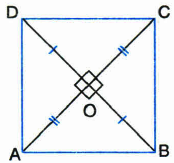
Show that if the diagonals of a quadrilateral are equal and bisect each other at right angles, then it is a square.
3.
Consider two 'postulates' given below:
(i) Given any two distinct points A and B, there exists a third point C which is in between A and B.
(ii) There exist at least three points that are not on the same line.
Do these postulates contain any undefined terms? Are these postulates consistent? Do they follow from Euclid's postulates? Explain.
4.
Write 3 different solutions of 2x +y =
5.
See figure and write the following:
(i) The coordinates of B.
(ii) The coordinates of C.
(iii) The point identified by the coordinates (-3,-5)
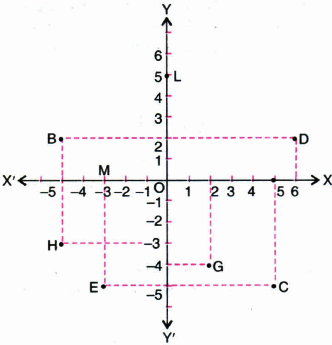
(iv) The point identified by the coordinates (2, - 4).
(v) The abscissa of the point D.
(vi) The ordinate of the point H.
(vii) The coordinates of the point L.
(viii) The coordinates of the point M.
6.
Write the following cubes in expanded from: \({ \left[ \frac { 3 }{ 2 } x+1 \right] }^{ 3 }\)
7.
Verify whether the following are zeroes of the polynomial, indicated against them.
\(p(x)=3x+1,x=-\frac { 1 }{ 3 } \)
8.
Rationalize the \(\frac { 1 }{ \sqrt { 7 } -\sqrt { 6 } } \)
9.
Express the following in the form p/q, where p and q are integers and \(q\neq 0\)
\(0.\overline { 6 } \)
10.
Is zero a rational number?can you write it in the form \(\frac { p }{ q } \),where p and q are integers and \(q\neq 0\)?
11.
A villager had a plot of land in the shape of a quadrilateral. The Gram Panchayat decided to take come portion of his plot from one of the corners to construct a Health Centre. He reluctantly agrees but with a condition that he will be given equal amount of land in lieu of his plot so as to form a triangular plot.
Answer the following questions:
(i) Explain how could this be implemented with figure?
(ii) what value of the villager is depicted hare?
(iiii) Do you thick constructing a Health Centre in the village is justified.If so, why?
12.
PQRS is a parallelogram and O is a point in the interior of the parallelogram. Show that ar(POS) + ar(QOR)=\(\frac { 1 }{ 2 } ar(PQRS)\).
13.
If ΔABC and ΔDEF are two triangles such that AB, BC are respectively equal and parallel to DE, EF then show that:
(i) quadrilateral ABED is a parallelogram
(ii) quadrilateral BCEF is a parallelogram.
(iii) AC = DF
(iv) ΔABC≡ΔDEF
14.
If \(x=\frac { \sqrt { 5 } +1 }{ \sqrt { 5 } -1 } \) and \(y=\frac { \sqrt { 5 } -1 }{ \sqrt { 5 } +1 } \) than find the value of x2 +y2
15.
If the polynomial 2x3+ax2+7x-6 is exactly divisible by 2x-1, then find the value of a. Hence factorize the polynomial.
16.
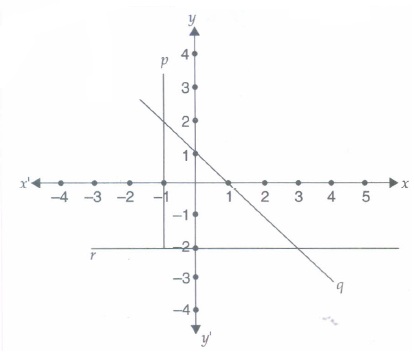
Write the equation of lines p and r in the given graph.
A student answered the equation of a line 'q' as x+y=1. Did he answered correctly? Also, find the area of lines enclosed between p,q and r.
17.
Show that each angle of a rectangle is a right angle.
18.
In figure, C is the mid-point of AB and Dis the mid-point of AC. Prove that AD = \(1\over2\) AB.

19.
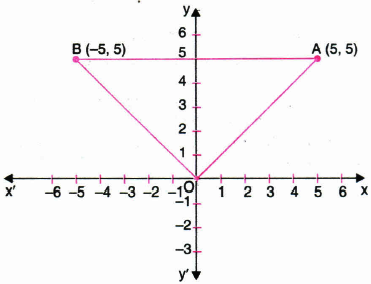
Plot the points A(5,5) and B(-5,5) in Cartesian plane.Join AB, OA and OB.Name the figure obtained.
20.
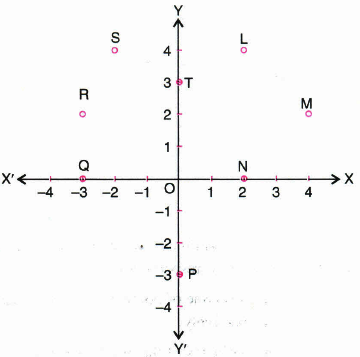
From the given figure, write the points whose
(a) ordinate = 0
(b) abscissa = 0
(c) abscissa = -3
(d) ordinate = 4
21.
Verify that \(xy[(x+y)(\frac{1}{x}+\frac{1}{y})-4]=(x-y)^2\)
22.
Multiply \(9x^2+25y^2+15xy+12x-20y+16\quad by\quad3x-5y-4\) Using suitable identity.
23.
Find the value of 'p' if \({ 5 }^{ p-3 }\times { 3 }^{ 2p-8 }=225\)
24.
How many irrational numbers lie between \(\sqrt { 2 } \) and \(\sqrt { 3 } \) ?Find any three irrational numbers lying between \(\sqrt { 2 } \) and \(\sqrt { 3 } \)
25.
Find four rational numbers between \(\frac { 3 }{ 7 } \)and \(\frac { 5 }{ 7 } \)
26.
Find the value of k, so that polynomial x3+3x2-kx-3 has one factor as x+3.
27.
If a = 2 and b = 3, then find the value of ab + ba
28.
Plot the points A(-3,-3), B(3,-3), C(3,3), D(-3,3) in the Cartesian plane.Also, find the length of the line segment AB.
29.
In which quadrant do the given point lie? (2,-1)
30.
Find the value of k so that (2x-1) be the factor of \(8x^4+4x^3-16x^2+10x+k.\)
31.
Find the value of \({ \left( \frac { 64 }{ 125 } \right) }^{ -\frac { 2 }{ 3 } }+\frac { 1 }{ { \left( \frac { 256 }{ 625 } \right) }^{ \frac { 1 }{ 4 } } } +\frac { \sqrt { 25 } }{ \sqrt [ 3 ]{ 64 } } \)
32.
Simplify the following by rationalizing the denominators: \(\frac { 3\sqrt { 3 } -2\sqrt { 5 } }{ 3\sqrt { 3 } +2\sqrt { 5 } } +\frac { \sqrt { 12 } }{ \sqrt { 5 } -\sqrt { 3 } } \)
33.
Simplify \(5\sqrt { 8 } +2\sqrt { 32 } -2\sqrt { 2 } \)
34.
Are the following statements true or false? Give reasons for your answers.
(i) Every whole number is a natural number.
(ii) Every integer is a rational number.
(iii) Every rational number is an integer.
35.
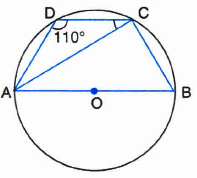
In the given figure, O is the centre of the circle. ABCD is a trapezium in which AB || DC and \(\angle ADC=110°\) The measure of \(\angle ADC\) is equal to:
35°
70°
20°
55°
36.
A cubic polynomial has number of zeroes:
2
1
3
At least three
37.
The simplified value of \({ \left( 81 \right) }^{ -1/4 }\times \sqrt [ 4 ]{ 81 } \) is:
9
3
1
0
38.
If \(x=\frac { \sqrt { 7 } }{ 5 } \) and \(\frac { 5 }{ x } =p\sqrt { 7 } \) , then the value of p is:
\(\frac { 5 }{ \sqrt { 7 } } \)
\(\frac { 25 }{ 7 } \)
\(\frac { 7 }{ 25 } \)
\(\frac { \sqrt { 7 } }{ 5 } \)
39.
The process of visualisation of representation of numbers on the number line through a magnifying glass is called
successive magnification
approximation
imagination
none of these
40.
Which of the following is a rational number?
\(1+\sqrt { 3 } \)
\(\pi \)
\(2\sqrt { 3 } \)
0
41.
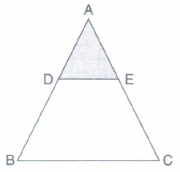
In an equilateral triangle ABC, D and E are the mid-points of sides AB and AC respectively, then length of DE is....
42.
Factorize: x2-3x.
43.
Write the equivalent of (a+√b)(a-√b).
44.
Identify an irrational number among the following numbers: 0.13, \(0.13\overline{15}\) , \(0.\overline{1315}\) , 0.3013001300013...
45.
The graph of the linear equation 3x + 5y = 15 cuts the x-axis at the point ___
46.
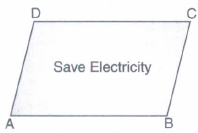
Ankush prepare a poster in the form of parallelogram, as in figure.
(i) If ㄥA=(5x + 7)° and LB = (3x- 3)°, find all the angles of a parallelogram ABCD.
(ii) Which mathemetical concept is used in this question?
(iii) By writing a slogan on poster which value is depicted by Ankush?
47.
Geetha told her classmate Radha that "\(\sqrt { \frac { \left( \sqrt { 2 } -1 \right) }{ \left( \sqrt { 2 } +1 \right) } } \) is an irrational number." Radha replied that "you are wrong" and further claimed that "If there is a number 'x' such that x3 is an irrational number, then x5 is also irrational". Geetha said, "No Radha, you are wrong". Radha took some time and after verification accepted her mistakes and thanked Geetha for pointing out these mistakes.
(i) Justify both the statements.
(ii) What value is depicted from this question?
48.
Two classmates Salma and Anil simplified two different expressions during the revision hour and explained during the revision hour and explained to each other their simplifications Salma explains simplification of \(\frac { \sqrt { 2 } }{ \sqrt { 5 } +\sqrt { 3 } } \) and Anil explains simplification of \(\sqrt { 28 } +\sqrt { 98 } +\sqrt { 147 } \) . Write both the simplification. What value does it depict?
1.
(i) Given 3x+2y=k
Put x=2, y=1 then
3(2)+2(1)=k \(\Rightarrow\) k=8
(ii) Given, 2x-ky=6
Put x=2, y=1, then
2(2)-k(1)=6
\(\Rightarrow\) 4-k=6\(\Rightarrow\) k=4-6=-2
(iii) Given, \(\frac{x}{4}+\frac{y}{3}=5k\)
Put x=2, y=1, then
\(\frac{2}{4}+\frac{1}{3}=5k\)
\(\Rightarrow 5k=\frac{10}{12}=\frac{5}{6}\)
\(\Rightarrow k=\frac{1}{6}\)
2.
Given: The diagonals AC and BD of a quadrilateral ABCD are equal and bisect each other at right angles.
To Prove: Quadrilateral ABCD is a square.
Proof: In \(\Delta\)OAD and \(\Delta\)OCB,
OA = OC I Given
OD = OB I Given
\(\therefore \Delta OAD\cong \Delta OCB\) I SAS Congruence Rule
\(\therefore \) AD = CB I C.P.C.T.
\(\angle ODA=\angle OBC\) |C.P.C.T
\(\angle BDA=\angle DBC\)
Now, \(\because\) AD = CB and AD II CB
\(\therefore \) Quadrilateral ABCD is a II gm. I A quadrilateral is a parallelogram if a pair of opposite sides are parallel and equal.
In \(\therefore \) \(\Delta\) AOB and \(\Delta\)AOD,
AO = AO I Common
OB = OD I Given
\(\angle \)AOB = \(\angle \)AOD |Each=\(90°\)
\(\therefore \) \(\Delta\)AOB \(\cong \) \(\Delta\) AOD I SAS Congruence Rule
AB = AD I C.P.C.T.
Now, \(\because\) ABCD is a parallelogram and
AB=AD
\(\because\) ABCD is a rhombus.
Again, in \(\Delta\) ABC and \(\Delta\) BAD,
AC = BD I Given
BC = AD I \(\because\) ABCD is a rhombus
AB = BA I Common
\(\therefore \) \(\Delta\) ABC \(\cong \) \(\Delta\) BAD I SSS Congruence Rule
\(\therefore \) \(\angle \) ABC = \(\angle\) BAD I C.P.C.T.
\(\because\) AD II BC I Opp. sides of IIgm ABCD and transversal AB intersects them.
\(\therefore \) \(\angle ABC+\angle BAD=180°\)
ABC = \(\angle\)BAD = \(90°\)
Similarly,\(\angle\)BCD =\(\angle\)ADC =\(90°\)
\(\therefore \) ABCD is a square.
3.
Yes! These postulates contain two undefined terms: Point and Line. Yes! These postulates are consistent because they deal with two different situations
(i) says that given two points A and B, there is a point C lying on the line in between them,
(ii) says that given A and B, we can take C not lying on the line through A and B. These 'postulates' do not follow from Euclid's postulates, however, they follow from Axiom 'Given two distinct lines, there is a unique line that passes through them.
4.
(0,0), (1,-2), (2, -4)
5.
(i) \(B\rightarrow (-5,2)\)
(ii) \(C\rightarrow \left( 5,-5 \right) \)
(iii) E
(iv) G
(v) 6
(vi) -3
(vii) \(L\rightarrow (0,5)\)
(viii) \(M\rightarrow (-3,0)\)
6.
\({ \left[ \frac { 3 }{ 2 } x+1 \right] }^{ 3 }\)
\(={ \left( \frac { 3 }{ 2 } x \right) }^{ 3 }+{ (1) }^{ 3 }+3\left( \frac { 3 }{ 2 } x \right) (1)\left( \frac { 3 }{ 2 } x+1 \right) \) | Using Identity VI
\(=\frac { 27 }{ 8 } { x }^{ 3 }+1+\frac { 9 }{ 2 } x\left( \frac { 3 }{ 2 } x+1 \right) \)
\(=\frac { 27 }{ 8 } { x }^{ 3 }+1+\frac { 27 }{ 4 } { x }^{ 2 }+\frac { 9 }{ 2 } x\)
\(=\frac { 27 }{ 8 } { x }^{ 3 }+\frac { 27 }{ 4 } { x }^{ 2 }+\frac { 9 }{ 2 } x+1\)
7.
\(p\left( -\frac { 1 }{ 3 } \right) =3\left( -\frac { 1 }{ 3 } \right) +1=-1+1=0\)
\(\therefore -\frac { 1 }{ 3 } \) is a zero of p(x)
8.
\(\frac { 1 }{ \sqrt { 7 } -\sqrt { 6 } } \)=\(\frac { 1 }{ \sqrt { 7 } -\sqrt { 6 } } \)\(\times \frac { \sqrt { 7 } +\sqrt { 6 } }{ \sqrt { 7 } +\sqrt { 6 } } \)
Multiplying and dividing by \(\sqrt { 7 } +\sqrt { 6 } \)
\(=\frac { \sqrt { 7 } +\sqrt { 6 } }{ \sqrt { 7 } -\sqrt { 6 } } =\sqrt { 7 } +\sqrt { 6 } \)
9.
Let x = \(0.\overline { 6 } \) = 0.6666...
Multiplying both sides by 10, we get
10 x = 6.6666...
10x = 6+0.6666...
10x = 6+x
10x - x = 6
9x = 6
x = 6/9
x = 2/3
Thus, \(0.\overline { 6 } \)= 2/3
Here p= 2
q = 3(\(\neq 0\))
10.
Yes! zero is a rational number.We can write zero in the form \(\frac { p }{ q } \),where p and q are integers and \(q\neq 0\)as follows:
\(0=\frac { 0 }{ 1 } =\frac { 0 }{ 2 } =\frac { 0 }{ 3 } \)etc.
11.
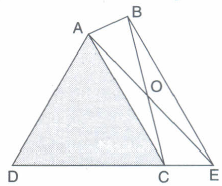
(i) Let the plot be ABCD.
Construction: Join AC. Draw BE||AC.
Proof: ar(\(\Delta\)ADE) = ar(Quad.ABCD)
Health centre can be constructed in triangular plot (\(\Delta\)AOB) and the farmer can have the triangular plot \(\Delta\)ADE.
Proof:
ar(\(\Delta\)ADE) = ar(\(\Delta\)ADC) + ar(\(\Delta\)ACE)
= ar(\(\Delta\)ADC) + ar(\(\Delta\)ABC)
= ar(Quad.ABCD)
(ii) Helpful, wise, and co-operating.
(iii) Yes, constructing a Health Centre is justified and essential also, because Health is Wealth.
12.
Through O, draw AB || PS
Also PA || BS
PABS is a parallelogram.
ar(POS) =\(\frac { 1 }{ 2 } ar(PABS)\)
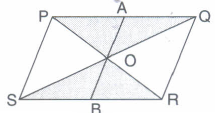
(Triangle and a parallelogram are on the same base and between the same parallels)
Similarly, ar(QOR )= \(\frac { 1 }{ 2 } \)ar(QABR)
\(\therefore \ ar(POS)+ar(QOR)=\frac { 1 }{ 2 } [ar(PABS)+ar(QABR)]\)
\(=\frac { 1 }{ 2 } ar(PQRS)\)
13.
Two triangles ABC and DEF, such that
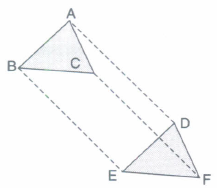
AB = DE and AB II DE
Also BC = EF and BC II EF
Proof: (i) In a quadrilateral ABED,
AB = DE and AB II DE
⇒ One pair of opposite sides are equal and parallel.
ABED is a parallelogram
⇒ AD = BE and AD II BE....(i)
(ii) In quadrilateral BCFE,
BC = EF and BC II EF
⇒ One pair of opposite sides are equal and parallel.
BCFE is a parallelogram
CF = BE and CF II BE ...(ii)
(iii) From equations (i) and (ii), we get
AD = CF and AD II CF
⇒ ACFD is a parallelogram
AC = DF andAC II DF
(iv) In ∆ABC and ∆DEF
AB = DE (Given)
BC = EF (Given)
and AC = DF (Proved above in part (c))
So by S.S.s.,ΔABC≅ΔDEF.
14.
\(x=\frac { \sqrt { 5 } +1 }{ \sqrt { 5 } -1 } \)
\({ x }^{ 2 }={ \left[ \frac { \sqrt { 5 } +1 }{ \sqrt { 5 } -1 } \right] }^{ 2 }=\frac { 6+2\sqrt { 5 } }{ 6-2\sqrt { 5 } } =\frac { 3+\sqrt { 5 } }{ 3-\sqrt { 5 } } \)
\(y=\frac { \sqrt { 5 } -1 }{ \sqrt { 5 } +1 } \)
\({ y }^{ 2 }={ \left[ \frac { \sqrt { 5 } -1 }{ \sqrt { 5 } +1 } \right] }^{ 2 }=\frac { 6-2\sqrt { 5 } }{ 6+2\sqrt { 5 } } =\frac { 3-\sqrt { 5 } }{ 3+\sqrt { 5 } } \)
\({ x }^{ 2 }+{ y }^{ 2 }=\frac { { \left( 3+\sqrt { 5 } \right) }^{ 2 }+{ \left( 3-\sqrt { 5 } \right) }^{ 2 } }{ \left( 3-\sqrt { 5 } \right) \left( 3+\sqrt { 5 } \right) } \)
\(=\frac { 9+5+6\sqrt { 5 } +9+5-6\sqrt { 5 } }{ 9-5 } \)
\(=\frac { 28 }{ 4 } \)
\({ x }^{ 2 }+{ y }^{ 2 }=7\)
15.
Let p(x)=2x3+ax2+7x-6
p(x) is divisble by 2x-1
\(\Rightarrow p\left( \frac { 1 }{ 2 } \right) =0\)
\(p\left( \frac { 1 }{ 2 } \right) ={ p\left( \frac { 1 }{ 2 } \right) }^{ 3 }+a{ \left( \frac { 1 }{ 2 } \right) }^{ 2 }+7\left( \frac { 1 }{ 2 } \right) -6=0\)
\(\Rightarrow 2\times \left( \frac { 1 }{ 8 } \right) +a\left( \frac { 1 }{ 4 } \right) +7\left( \frac { 1 }{ 2 } \right) -6=0\)
\(\Rightarrow \frac { 1 }{ 4 } +\frac { a }{ 4 } +\frac { 7 }{ 2 } -6=0\)
\(\Rightarrow \ \frac { a }{ 4 } -\frac { 9 }{ 4 } =0\)
\(\Rightarrow \ a=9\)
\(\therefore\) p(x)=2x3+ax2+7x-6
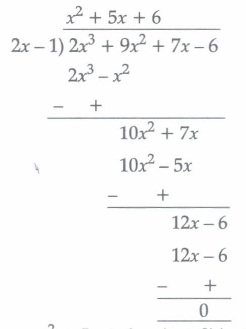
\(\therefore\) x2+5x+6=(x+2)(x+3)
Hence p(x)=(2x-1)(x+2)(x+3)
16.
Equation of p is x=-1
Equation of r is y=-2
Yes, the equation of q is
x+y=1
Area \(=\frac{1}{2}\times4\times 4=8\) sq.units
17.
Let us recall what a rectangle is.
A rectangle is a parallelogram in which one angle is a right angle.
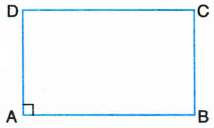
Let ABCD be a rectangle in which \(\angle\) A = 90°.
We have to show that \(\angle\) B = Ð C = \(\angle\) D = 90°
We have, AD || BC and AB is a transversal
(see Fig.).
So, \(\angle\) A + \(\angle\) B = 180° (Interior angles on the same
side of the transversal)
But, \(\angle\) A = 90°
So, \(\angle\) B = 180° – \(\angle\) A = 180° – 90° = 90°
Now, \(\angle\) C = Ð A and \(\angle\) D = \(\angle\) B
(Opposite angles of the parallellogram)
So, \(\angle\) C = 90° and \(\angle\) D = 90°.
Therefore, each of the angles of a rectangle is a right angle.
18.
\(\because\) C is the midpoint of AB
\(\therefore \) AC = CB
AC + AC = CB + AC
| If equals are added to equals, then the wholes are equal (Euclid's Axiom (ii))]
\(\Rightarrow \) 2AC = AB I CB + AC coincides with AB
\(\Rightarrow \) \(1\over2\)(2AC) = \(1\over2\) AB
| Things which are halves of the same thing are equal (Euclid's Axiom (vii»]
\(\Rightarrow \) AC =\(1\over2\)AB
\(\Rightarrow \) \(1\over2\)AC = \(1\over2\)(\(1\over2\)AB)
| Things which are halves of the same thing are equal to one another (Euclid's Axiom (vii))]
\(1\over2\)AC = \(1\over2\)AB
AD = \(1\over4\)AB
\(\because\) D is the mid-point of AC
\(\therefore \)AD = DC =\(1\over2\)AC (as above)
19.
The figure obtained is a right angled triangle.
20.
(a) The points whose ordinates are O and Q and N.
(b) The points whose abscissae are 0 are T and P.
(c) The points whose abscissae are -3 are Q and R.
(d) The points whose ordinates are 4 are S and L.
21.
L.H.S \(=xy[(x+y)\frac{1}{x}+\frac{1}{y}-4]\)
\(=xy[(x+y)(\frac{y+x}{xy})-4]\)
\(=xy[\frac{(x+y)^2}{xy}-4]\)
\(=(x+y)^2-4xy\)
\(=(x^2+y^2+2xy)-4xy\) | Using Identity I
\(=x^2+y^2-2xy=(x-y)^2\) | Using Identity II
22.
\((3x-5y-4)(9x^2+25y^2+15xy+12x-20y+16)\)
\(=\left\{ (3x)+(-5y)+(-4)(3x)^{ 2 }+(-5y)^{ 2 }+(-4)^{ 2 }-(3x)(-5y)-(-5y)(-4)-(-4)(3x) \right\} \)
\(=(3x)^2+(-5y)^3+(-4)^3-3(3x)(-5y)(-4)\)
\(=27x^3-125y^3-64-180xy\)
23.
\({ 5 }^{ p-3 }\times { 3 }^{ 2p-8 }=225\)
\(\\ { 5 }^{ p-3 }\times { 3 }^{ 2p-8 }={ 5 }^{ 2 }\times { 3 }^{ 2 }\)
\(\\ p-3=2\)
\(\\ 2p-8=2\)
\(\\ p=5\)
24.
Infinitely many irrational numbers lie between \(\sqrt { 2 } \) and \(\sqrt { 3 } \)
One irrational number between \(\sqrt { 2 } \) and \(\sqrt { 3 } \) is \(\sqrt { \sqrt { 2 } \sqrt { 3 } } =\sqrt { \sqrt { 6 } } ={ 6 }^{ \frac { 1 }{ 4 } }\)
Another irrational number between \(\sqrt { 2 } \)and \(\sqrt { 3 } \) is \(\sqrt { \sqrt { 2 } { 6 }^{ \frac { 1 }{ 4 } } } \)
\(={ 2 }^{ \frac { 1 }{ 4 } }.{ 6 }^{ \frac { 1 }{ 8 } }={ 2 }^{ \frac { 1 }{ 4 } }.{ 2 }^{ \frac { 1 }{ 8 } }.{ 3 }^{ \frac { 1 }{ 8 } }\)
\(\\ ={ 2 }^{ \frac { 1 }{ 4 } +\frac { 1 }{ 8 } }.{ 3 }^{ \frac { 1 }{ 8 } }={ 2 }^{ \frac { 3 }{ 8 } }.{ 3 }^{ \frac { 1 }{ 8 } }\)
Third irrational number between \(\sqrt { 2 } \) and \(\sqrt { 3 } \) is
\(\sqrt { \sqrt { 2 } .{ 2 }^{ \frac { 3 }{ 8 } }.{ 3 }^{ \frac { 1 }{ 8 } } } ={ 2 }^{ \frac { 1 }{ 4 } }.{ 2 }^{ \frac { 3 }{ 16 } }.{ 3 }^{ \frac { 1 }{ 16 } }={ 2 }^{ \frac { 7 }{ 16 } }.{ 3 }^{ \frac { 1 }{ 16 } }\)
25.
\(\frac { 3 }{ 7 } =\frac { 30 }{ 70 } \)
\(\\ \frac { 5 }{ 7 } =\frac { 50 }{ 70 } \)
30<31<32<33<34<35
\(\frac { 30 }{ 70 } <\frac { 31 }{ 70 } <\frac { 32 }{ 70 } <\frac { 33 }{ 70 } <\frac { 34 }{ 70 } <\frac { 50 }{ 70 } \)
So four rational numbers between \(\frac { 3 }{ 7 } \) and \(\frac { 5 }{ 7 } \)
\(\frac { 31 }{ 70 } ,\frac { 32 }{ 70 } ,\frac { 33 }{ 70 } \) and \(\frac { 34 }{ 70 } \)
\(\frac { 31 }{ 70 } ,\frac { 16 }{ 35 } ,\frac { 33 }{ 70 } \)and \(\frac { 17 }{ 35 } \)
26.
f(x) = x3+3x2-kx-3
(x+3) is a factor of f(x) = x3+3x2-kx-3
\(\Rightarrow\) f(-3) = 0
\(\Rightarrow\) (-3)3+3(-3)2-k(-3)-3=0
\(\Rightarrow\) -27 + 27 + 3k -3=0
\(\Rightarrow\) 3k-3 = 0
\(\Rightarrow\) k = 1
27.
a = 2 and b = 3
ab + ba=23 + 32
= 8 + 9
= 17
28.
6 Units.
29.
IV
30.
-2
31.
\(\frac { 65 }{ 16 } \)
32.
\(\frac { 68 }{ 7 } -\frac { 5 }{ 7 } \sqrt { 15 } \)
33.
0
34.
(i) False, because zero is a whole number but not a natural number.
(ii) True, because every integer m can be expressed in the form m/1, and so it is a rational number.
(iii) False because 3/5 is a rational number but not an integer.
35.
\(\angle ABC=180°-\angle ADC=180°-110°=70°\)
\(\angle ACB=90°\)
\(\therefore \angle BAC=20°\)
\(\angle ACD=\angle BAC\) | Alternate interior angles
36.
By definition
37.
(c)
1
38.
(b)
\(\frac { 25 }{ 7 } \)
39.
(a)
successive magnification
40.
(d)
0
41.
()
Since D and E are mid-points of sides AB and AC respectively, so, by mid-point theorem, DE=\(\frac{1}{2}\)BC.
42.
()
x2-3x=x(x-3)
43.
()
(a+√b)(a-√b)=(a)2-(√b)2=a2-b.
44.
()
0.13 is a terminating number. So, it is not an irrational number.
\(0.13\overline{15}\) = 0.131515...,15 is representing continuously, so it is not an irrational number.
\(0.\overline{1315}\) = 0.13151315..., is representing continuously, so it is not an irrational number.
0.3013001300013..., non-terminating and non-recurring decimal. Hence, it is an irrational number. So, 0.3013001300013 is an irrational number.
45.
()
x=5, y=0 i.e., (5,0)
46.
(i) Since sum of adjacent angles of a parallelogram is 180°
ஃ We have ㄥA+ㄥB=180
⇒ 5x + 7 + 3x - 3 = 180
⇒ 8x + 4 = 180
⇒ 8x = 176
⇒ x=\(\frac{176}{8}\)=22
ㄥA=(5x+7)°=(5x22+7)=117°
ㄥB=(3x-3)°=(3x22-3)=63°
ㄥC=ㄥA=117°
and ㄥD=ㄥA=63°
(ii) Properties of parallelogram.
(iii) Energy conservation is necessary for a happy and prosperous future.
47.
\(\sqrt { \frac { \left( \sqrt { 2 } -1 \right) }{ \left( \sqrt { 2 } +1 \right) } } \)is an irrational number.
\(\sqrt { \frac { \left( \sqrt { 2 } -1 \right) }{ \left( \sqrt { 2 } +1 \right) } } =\sqrt { \frac { \left( \sqrt { 2 } -1 \right) }{ \left( \sqrt { 2 } +1 \right) } \times \frac { \left( \sqrt { 2 } -1 \right) }{ \left( \sqrt { 2 } -1 \right) } } \)
\(=\sqrt { \frac { { \left( \sqrt { 2 } -1 \right) }^{ 2 } }{ 2-1 } } \)
\(=\sqrt { \frac { { \left( \sqrt { 2 } -1 \right) }^{ 2 } }{ 1 } } =\sqrt { 2 } -1\)
which is an irrational number.
Let, there is a number x such that x3 is an irrational number but x5 is a rational number.
Let, x =\(\sqrt[5]{7}\) be the number.
⇒ x3 = (5√7)3 = (7)3/5
is an irrational number.
But x5 = (\(\sqrt[5]{7}\))5=(7)5/5 = 7
=7 is a rational number.
(ii) Accepting own mistakes gracefully, co-operative learning among the classmates.
48.
Justify, \(\frac { \sqrt { 2 } }{ \sqrt { 5 } +\sqrt { 3 } } =\frac { \sqrt { 2 } }{ \sqrt { 5 } +\sqrt { 3 } } \times \frac { \left( \sqrt { 5 } -\sqrt { 3 } \right) }{ \left( \sqrt { 5 } -\sqrt { 3 } \right) } \)
\(=\frac { \sqrt { 10 } -\sqrt { 6 } }{ { \left( \sqrt { 5 } \right) }^{ 2 }-{ \left( \sqrt { 3 } \right) }^{ 2 } } =\frac { \sqrt { 10 } -\sqrt { 6 } }{ 5-3 } \)
\(=\frac { \sqrt { 10 } -\sqrt { 6 } }{ 2 } \)
Again, \(\sqrt { 28 } +\sqrt { 98 } +\sqrt { 147 } \)
\(=\sqrt { 2\times 2\times 7 } +\sqrt { 2\times 7\times 7 } +\sqrt { 3\times 7\times 7 } \)
\(=2\sqrt { 7 } +7\sqrt { 2 } +7\sqrt { 3 } \)

9th Standard CBSE Syllabus & Materials
9th Standard CBSE
CBSE 9th Mathematics Lines and Angles Sample Question Papers Study Material - QB365 Set A
NEW9th Standard CBSE
CBSE 9th Mathematics Introduction to Euclid's Geometry Sample Question Papers Study Material - QB365 Set A
NEW9th Standard CBSE
CBSE 9th Mathematics Linear Equations in Two Variables Sample Question Papers Study Material - QB365 Set A
NEW9th Standard CBSE
CBSE 9th Mathematics Coordinate Geometry Sample Question Papers Study Material - QB365 Set A



CBSE 9th Standard CBSE Subjects
CBSE Standards