
 100% FREE ACCESS
9th Standard Syllabus & Materials
9th Standard
TN 9th Tamil உள்ளத்தின் சீர் -கற்கண்டு (இலக்கணம்) - தொடர் இலக்கணம், ஆகுபெயர் Important Questions And Answers Study Material - QB365 Set A
NEW9th Standard
TN 9th Tamil உள்ளத்தின் சீர் -விரிவானம் (துணைப்பாடம்) - தாய்மைக்கு வறட்சி இல்லை! Important Questions And Answers Study Material - QB365 Set A
NEW9th Standard
TN 9th Tamil உள்ளத்தின் சீர் -கவிதை பேழை (செய்யுள்) - மார்கழி பெருவிழா Important Questions And Answers Study Material - QB365 Set A
NEW9th Standard
TN 9th Tamil உயிருக்கு வேர்-இலக்கணம் - பகுபத உறுப்பிலக்கணம் Important Questions And Answers Study Material - QB365 Set A
NEW9th Standard
TN 9th Tamil அமுதென்று பேர் - இலக்கணம்-எழுத்து -அளபெடை Important Questions And Answers Study Material - QB365 Set A
NEW9th Standard
TN 9th Tamil அமுதென்று பேர்-துணைப்பாடம் - ஆறாம்திணை Important Questions And Answers Study Material - QB365 Set A

Published on: 29/12/2018
SECOND SUMMATIVE EXAM 2018
Download Tamil Nadu 9th Standard Maths question papers, model tests, one-mark questions, important questions, and public exam papers in PDF format. Free study materials and answer keys for TN State Board students.
Questions + Answers key
Take MCQ Maths Test1.
In a rice mill, seven labours are receiving the daily wages of Rs. 500, Rs. 600, Rs. 600, Rs. 800, Rs. 800, Rs. 800 and Rs. 1000, find the modal wage
2.
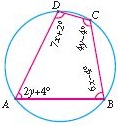
Find all the angles of the given cyclic quadrilateral ABCD in the figure.
3.
Factorise the following: 4x2+9y2+25z2+12xy+30yz+20xz
4.
By using identity evaluate the following: 73-103+33
5.
Find the expansion of the following: (x + 4) (x + 5) (x + 6)
6.
Write the following in scientific notation: (4000000)3 ÷ (0.00002)4
7.
Simplify: (1.598 \(\times\) 1017) - (4.58 \(\times\) 1016)
8.
Use a fractional index to write: \(\left( \sqrt [ 3 ]{ 49 } \right) ^{ 5 }\)
9.
If P = {1,2,5,7,9}, Q = {2, 3, 5, 9, 11}, R = {3, 4,5 7, 9} and S = {2, 3, 4, 5, 8}, then find
(i) \((P\cup Q)\cup R\)
(ii) \((P\cap Q)\cap S\)
(iii) \((Q\cap S)\cap R\)
10.
If A = {2, 3, 4, 5}, B = {2, 3, 5, 7} and C = {1, 3, 5}, then verify \(A\cup (B\cup C)=(A\cup B)\cup C\).
11.
If U = {x : x ∈ Z, -2 ≤ x ≤ 10}, A = {x : x = 2p +1, p ∈ Z, -1 ≤ p ≤ 4}, B = {x : x = 3q + 1, q ∈ Z, -1 ≤ q < 4} verify De Morgan’s laws for complementation.
12.
Verify \(\left( A\cup B \right) '\)=\(A'\cap B'\) using Venn diagrams
13.
A researcher studying the behavior of mice has recorded the time (in seconds) taken by each mouse to locate its food by considering 13 different mice as 31, 33, 63, 33, 28, 29, 33, 27, 27, 34, 35, 28, 32. Find the median time that mice spent in searching its food.
14.
The following table represents the marks obtained by a group of 12 students in a class test in Mathematics and Science
| Marks (Mathematics) |
52 | 55 | 32 | 30 | 60 | 44 | 28 | 25 | 50 | 75 | 33 | 62 |
|---|---|---|---|---|---|---|---|---|---|---|---|---|
| Marks (Science) |
54 | 42 | 48 | 49 | 27 | 25 | 24 | 19 | 28 | 58 | 42 | 69 |
Indicate in which subject, the level of achievement is higher?
15.
Factorise x3+13x2+ 32x + 20 into linear factors.
16.
If 2x − 3y − 4z = 0 , then find 8x3− 27y3− 64z3
17.
Find the value of m, if (x -2) is a factor of the polynomial 2x2- 6x2+ mx + 4.
18.
Find the value of a and b if \(\frac { \sqrt { 7 } -2 }{ \sqrt { 7 } +2 } \) = a\(\sqrt{7}\) + b
19.
Rationalise the denominator and simplify \(\frac { 5\sqrt { 3 } +\sqrt { 2 } }{ \sqrt { 3 } +\sqrt { 2 } } \)
20.
If K = {a,b,d e f } L = {b,c,d,g} and M = {a,b,c,d,h}, then find the following:
(i) K \(\cup \)(L \(\cap \) M)
(ii) K \(\cap \)(L \(\cup \) M)
(iii) (K\(\cup \)L)\(\cap \)(K\(\cup \)M)
(iv) (K\(\cap \)L)\(\cup \)(K\(\cap \)M)
21.
The mean of the first 10 prime numbers is ___________
12.6
12.7
12.8
12.9
22.
If the mean of five observations x, x+2, x+4, x+6, x+8, is 11, then the mean of first three observations is _______.
9
11
13
15
23.
For which set of numbers do the mean, median and mode all have the same values?
2, 2, 2, 4
1, 3, 3, 3, 5
1, 1, 2, 5, 6
1, 1, 2, 1, 5
24.
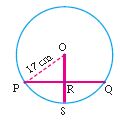
In the given figure, If OP = 17cm PQ = 30 cm and OS is perpendicular to PQ, then RS is ________.
10 cm
6 cm
7 cm
9 cm
25.
In a cyclic quadrilateral ABCD, ㄥA = 4x, ㄥC = 2x the value of x is ________.
30°
20°
15°
25°
26.
A chord is at a distance of 15 cm from the centre of the circle of radius 25 cm. The length of the chord is ________.
25 cm
20 cm
40 cm
18 cm
27.
GCD of any two prime numbers is _______.
-1
0
1
2
28.
Cubic polynomial may have maximum of ________ linear factors.
1
2
3
4
29.
(x+y)(x2−xy+y2) is equal to_______.
(x+y)3
(x-y)3
x3 + y3
x3 - y3
30.
Which is the best example of a number written in scientific notation?
0.5 \(\times\) 105
0.1254
5.367 \(\times\) 10-6
12.5 \(\times\) 102
31.
\(\frac { \sqrt [ 3 ]{ 18 } }{ \sqrt [ 3 ]{ 2 } } \) is same as _____________
3
\(\sqrt [ 3 ]{ 9 } \)
9
\(\sqrt [ 6 ]{ 3 } \)
32.
When (2\(\sqrt{5}\)-\(\sqrt{2}\))2 is simplified, we get ________.
4\(\sqrt{5}\)+2\(\sqrt{2}\)
22-4\(\sqrt{10}\)
8-4\(\sqrt{10}\)
2\(\sqrt{10}\)-2
33.
If A and B are two non-empty sets, then (A-B)U(A⋂B) is _____________
A
B
ф
U
34.
Which of the following is true?
A-B = A\(\cap \)B
A−B = B −A
(A\(\cup \)B)' = A'\(\cup \)B'
(A\(\cap \)B)' = A'\(\cup \)B'
35.
For any three sets P, Q and R, P-(Q\(\\ \cap \)R) is ________.
P-(Q\(\cup \)R)
(P\(\\ \cap \)Q)-R
(P-Q)\(\cup \)(P-R)
(P-Q)\(\\ \cap \)(P-R)
36.
In the concentric circles, chord AB of the outer circle cuts the inner circle at C and D as shown in the diagram. Prove that, AB−CD = 2AC
37.
Construct the ΔPQR such that PQ = 5cm, PR= 6cm and ㄥQPR = 60° and locate its centroid.
38.
Draw the \(\triangle \)ABC , where AB = 6 cm, B = 110° and AC = 9 cm and construct the centroid.
39.
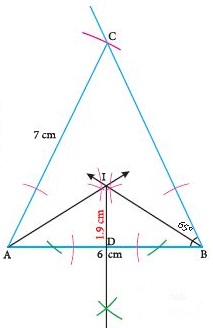
Construct the incentre of ΔABC with AB = 6 cm, ㄥB = 65° and AC = 7 cm. Also draw the incircle and measure its radius.
1.
In the given data Rs. 800 occurs thrice. Hence the mode is Rs. 800
2.
In the cyclic quadrilateral \(\angle\)A + \(\angle\)C = 1800

6y = 1800
\(y=\cfrac { { 180 }^{ 0 } }{ 6 } ={ 30 }^{ 0 }\)
\(\angle\)B+\(\angle\)D = 6\(\times\)-4+7\(\times\)+2
13\(\times\)-2 = 1800
13\(\times\) = 180 + 2 = 1820
x = \(\cfrac{182}{13}={14}^{0}\)
\(\therefore\) \(\angle\)A = 2(30) + 40 = 640
\(\angle\)B = 6(14) - 40 = 84 - 4 = 800
\(\angle\)C = 4(30) - 4 = 120 - 4 = 1160
\(\angle\)D = 7(14) + 2 = 98 + 2 = 1000
3.
(2x)2+(3y)2+(5z)2+2(2x)(3y)+2(3y)+(5z)+2x3yx5z
(2x+3y+5z)2
∵ (a+b+1)2 = a2+b2+c2+2ab+2bc+2ca
4.
(a+b+c) (a2+b2+c2-ab-bc-ca) = a3+b3+c3-3abc
If a+b+c = 0, then a3+b3+c3 = 3abc
ஃ 7-10+3 = 0
⇒ 73-103+33 = 3\(\times\)7\(\times\)-10\(\times\)3
= 9\(\times\)-70 = -630
5.
(x+4) (x+5) (x+6) = x3+(4 + 5 + 6)x2+(4\(\times\)5 + 5\(\times\)6 + 6\(\times\)4)x + 4\(\times\)5\(\times\)6
= x3+15x2+ (20 + 30 + 24)x + 120
(x+4) (x+5) (x+6) = x3+15x2+74x+120
6.
(4000000)3 ÷ (0.00002)4
\( =\left(4.0 \times 10^{6}\right)^{3} \div\left(2.0 \times 10^{-5}\right) 4 \)
\(=(4.0)^{3} \times\left(10^{6}\right)^{3} \div(2.0)^{4} \times\left(10^{-5}\right)^{4} \)
\(=\frac{64.0 \times 10^{18}}{16.0 \times 10^{-20}} \)
\(=4 \times 10^{18} \times 10^{+20} \)
\(=4.0 \times 10^{38} \)
7.
\( =1.598 \times 10^{17}-4.58 \times 10^{15} \\ =\left(1.598-4.58 \times 10^{-2}\right) 10^{17} \\ =(1.598-0.0458) \times 10^{17} \\ =1.5522 \times 10^{17} \)
8.
\((\sqrt[3]{49})^{5}=\left(\sqrt[3]{7^{2}}\right)^{5}=7^{\frac{2 \times 5}{3}}=7^{\frac{10}{3}}\)
9.
(i) (P∪Q)∪R
(P∪Q) = {1, 2, 5, 7, 9} U {2, 3, 5, 9, 11} = {1,2,3,5,7,9,11}
(P∪Q)∪R = {1,2,3,5,7,9,11} U {3,4,5,7,9} = {1,2,3,4,5,7,9,11}
(ii) (P⋂Q)⋂S
(P⋂Q) = {1,2,5,7,9} ⋂ {2,3,5,9,11} = {2,5,9}
(P⋂Q)⋂S = {2,5,9} ⋂ {2,3,4,5,8} = {2,5}
(iii) (Q⋂S)⋂R
(Q⋂S) = {2,3,5,9,11} ⋂ {2,3,4,5,8} = {2,3,5}
(Q⋂S)⋂R = {2,3,5} ⋂ {3,4,5,7,9} = {3,5}
10.
Given, A = {2, 3, 4, 5},B = {2, 3, 5,7} and C = {1, 3, 5}
Now, \(B\cup C\) = {1,2, 3,5,7}
\(A\cup (B\cup C)\) ={1, 2, 3, 4, 5, 7} .....(1)
Then, \(A\cup B\) = {2, 3, 4,5,7}
\((A\cup B)\cup C\) = {1,2, 3, 4, 5, 7} ...(2)
From (1) and (2), it is verified that \(A\cup (B\cup C)\) = \((A\cup B)\cup C\).
11.
Given U = {−2,−1,0,1,2,3,4,5,6,7,8,9,10},
A = {−1,1,3,5,7,9} and B = {−2,1,4,7,10}
Law (i) \(\left( A\cup B \right)' =A'\cap B'\)
Now, AUB = {-2,-1,1,3,4,5,7,9,10}
\(\left( A\cup B \right) '\)= {0,2,6,8} ............... (1)
Then, A'= {-2,0,2,4,6,8,10} and B' = {-1,0,2,3,5,6,8,9}
\(A'\cap B'\) = {0,2,6,8} ........... (2)
From (1) and (2), it is verified that \(\left( A\cup B \right) =A'\cap B'\)
Law (ii) \(\left( A\cap B \right) '=A'\cup B'\)
Now, \(A\cap B\) = {1,7}
\((A\cap B)'\) = {-2,-1,0,2,3,4,5,6,8,9,10} ........ (3)
Then \(A'\cup B'\) = { -2, -1,0,2,3,4,5,6,8,9,10} ......... (4)
From (3) and (4), it is verified that \(\left( A\cap B \right) '=A'\cup B'\)
12.
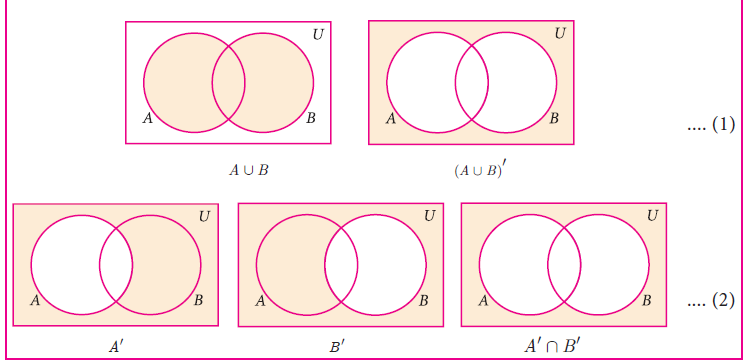
From (1) and (2), it is verified that \(\left( A\cup B \right) '\)=\(A'\cap B'\)
13.
Data in ascending order 27, 27, 28, 28, 29, 31, 32, 33, 33, 33, 34, 35, 63
Number of terms = 13
If n is odd then Median = \(\left[\frac{\mathrm{N}+1}{2}\right]^{t h}\) observation
\(=\left(\frac{13+1}{2}\right)^{t h}\)observation
= 7th observation
7th observation = 32
14.
Let us arrange the marks in the two subjects in ascending order.
| Marks (Mathematics) |
52 | 55 | 32 | 30 | 60 | 44 | 28 | 25 | 50 | 75 | 33 | 62 |
|---|---|---|---|---|---|---|---|---|---|---|---|---|
| Marks (Science) |
54 | 42 | 48 | 49 | 27 | 25 | 24 | 19 | 28 | 58 | 42 | 69 |
Since the number of students is 12, the marks of the middle-most student would be the mean mark of 6th and 7th students.
Therefore, Median mark in Mathematics \(={44+50\over2}=47\)
Median mark in Science \(={42+42\over2}=42\)
Here the median mark in Mathematics is greater than the median mark in Science. Therefore, the level of achievement of the students is higher in Mathematics than Science.
15.
Let, p(x) = x3+13x2+ 32x + 20
Sum of all the coefficients = 1 + 13 + 32 + 20 = 66 ≠ 0
Hence, (x -1) is not a factor.
Sum of coefficients of even powers and constant term = 13 + 20 = 33
Sum of coefficients of odd powers = 1 + 32 = 33
Hence, (x +1) is a factor of p (x)
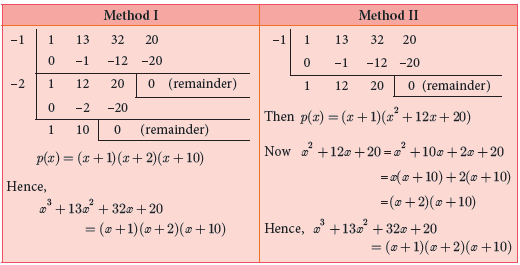
Now we use synthetic division to find the other factors
16.
If 2x-3y−4z = 0 then 8x3− 27y3− 64z3=?
If x+y+z = 0 then x3+y3+z3 = 3xyz
8x3− 27y3− 64z3 = (2x)3+(−3y)3+(−4z)3
= 3\(\times\)2\(\times\)−3y\(\times\)−4z = 72xyz
17.
Let p(x) = 2x3- 6x2+ mx + 4
By factor theorem, (x - 2) is a factor of p(x) , if p(2) = 0
[To find the zero of x-2;
put x-2 = 0
we get x = 2
p(2) = 0
2(2)3- 6(2)2+ m(2)+ 4 = 0
2(8)- 6(4)+2m + 4 = 0
- 4+2m = 0
m = 2
18.
\(\frac { \sqrt { 7 } -2 }{ \sqrt { 7 } +2 } =a\sqrt{7}+b\)
L.H.S = \(\frac{\sqrt{7}-2\times\sqrt{7}-2}{\sqrt{7}+2\times\sqrt{7}-2}=\frac{(\sqrt{7}-2)^2}{\sqrt{7}^2-2^2}=\frac{\sqrt{7}^2-2\sqrt{7}\times2+2^2}{7-4}\)
=\(\frac{7-4\sqrt{7}+4}{3}=\frac{11-4\sqrt{7}}{3}=\frac{11}{3}-\frac{4\sqrt{7}}{3}\)
\(\frac{-4\sqrt{7}}{3}+\frac{11}{3}=a\sqrt{7}+b\)
a √7=\(\frac{-4\sqrt{7}}{3}\)
a = \(\frac{-4}{3}\)
b = \(\frac{11}{3}\)
19.
\(\frac { 5\sqrt { 3 } +\sqrt { 2 } }{ \sqrt { 3 } +\sqrt { 2 } } =\frac{(5\sqrt{3}+\sqrt{2})\times(\sqrt{3}-\sqrt{2})}{(\sqrt{3}+\sqrt{2})\times(\sqrt{3}-\sqrt{2})}\)
=\(\frac{5\sqrt{3}\times\sqrt{3}+\sqrt{2}\times\sqrt{3}-5\sqrt{3}\times\sqrt{2}-\sqrt{2}^2}{\sqrt{3}^2-\sqrt{2}^2}\)
=\(\frac{5\times3+\sqrt{6}-5\sqrt{6}-2}{3-2}=\frac{13-4\sqrt{6}}{1}=13-4\sqrt{6}\)
20.
K = {a,b,d,e,f}, L = {b,c,d,g} and M = {a,b,c,d,h}
(i) K\(\cup\)(L\(\cap \)M)
L\(\cap \) M = {b,c,d,g} \(\cap \) {a,b,c,d,h} = {b,c,d}
K\(\cup\)(L\(\cap \)M) = {a,b,d,e,f} \(\cup\) {b,c,d} = {a,b,c,d,e,f}
(ii) K∩(L\(\cup\)M)
L\(\cup\)M = {a,b,c,d,g,h}
K⋂(L \(\cup\) M) = {a,b,d,e,f) \(\cap \) {a,b,c,d,g,h} = {a,b,d}
(iii) (K \(\cup\) L) \(\cap \) (K\(\cup\)M)
K \(\cup\) L = {a,b,c,d,e,f,g}
K \(\cup\) M = {a,b,c,d,e,f,h}
(K \(\cup\) L) \(\cap \) (K \(\cup\) M) = {a,b,c,d,e,f}
(iv) (K \(\cap \) L) \(\cup\) (K \(\cap \) M)
(K \(\cap \) L) = {b,d}
(K \(\cap \) M) = {a,b,d}
(K \(\cap \) L) \(\cup\) (K \(\cap \) M) = {b,d} \(\cup\) {a,b,d} = {a,b,d}
21.
(d)
12.9
22.
(a)
9
23.
(b)
1, 3, 3, 3, 5
24.
(d)
9 cm
25.
(a)
30°
26.
(c)
40 cm
27.
(c)
1
28.
(c)
3
29.
(c)
x3 + y3
30.
(c)
5.367 \(\times\) 10-6
31.
(b)
\(\sqrt [ 3 ]{ 9 } \)
32.
(b)
22-4\(\sqrt{10}\)
33.
(a)
A
34.
(d)
(A\(\cap \)B)' = A'\(\cup \)B'
35.
(c)
(P-Q)\(\cup \)(P-R)
36.
Given: Chord AB of the outer circle cuts the inner circle at C and D.
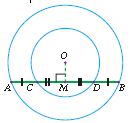
To prove: AB − CD = 2AC
Construction: Draw OM ⊥ AB
Proof: Since, OM ⊥ AB (By construction)
Also, OM ⊥ CD
Therefore, AM = MB ... (1) (Perpendicular drawn from centre to chord bisect it)
CM = MD ... (2)
Now, AB – CD = 2AM–2CM
= 2(AM–CM) from (1) and (2)
AB – CD = 2AC
37.
In PQR,
PQ = 5 cm,
PR = 6 cm
\(\angle \)QPR = 60°
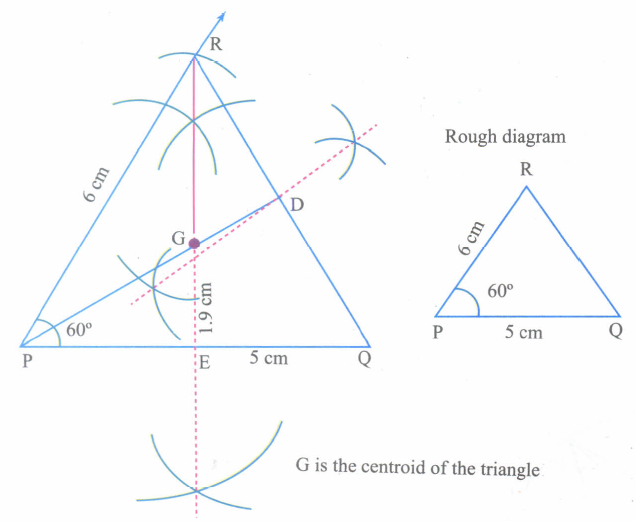
Construction :
Step 1: Draw △ PQR with the given measurement
Step 2: Draw perpendicular bisectors of any two sides (PQ and QR) to find the midpoints of PQ and QR.
Step 3: Draw medians PD and RE. Let them meet at G.
Step 4: G is the centroid of the given △PQR.
38.
In \(\triangle \)ABC, AB = 6 cm, ∠B= 110°, AC = 9 cm
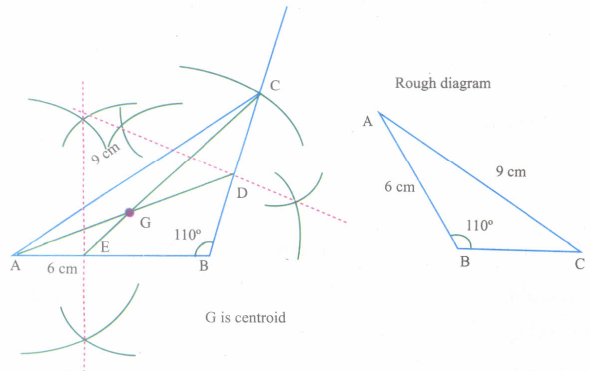
Construction :
Step 1: Draw \(\triangle \)ABC with AB = 6 cm, ∠B =110°, AC = 9 cm
Step 2: Draw perpendicular bisectors of any two sides (BC and AB) to find the midpoints of BC and AB.
Step 3: Construct medians AD and CE. Let them meet at G.
Step 4: G is the centroid of the given \(\triangle \)ABC.
39.
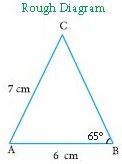
Step 1 : Draw the ΔABC with AB = 6 cm, ㄥB = 65° and AC = 7cm
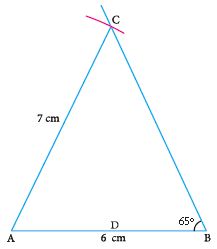
Step 2 : Construct the angle bisectors of any two angles (A and B) and let them meet at I.
Then I is the incentre of ΔABC. Draw perpendicular from I to any one of the side (AB) to meet AB at D
Step 3: With I as centre and ID as radius draw the circle. This circle touches all the sides of the triangle internally
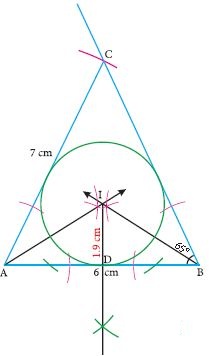
Step 4: Measure inradius
Inradius = 1.9 cm

9th Standard Syllabus & Materials
9th Standard
TN 9th Tamil உள்ளத்தின் சீர் - திருக்குறள் Important Questions And Answers Study Material - QB365 Set A
NEW9th Standard
TN 9th Tamil உள்ளத்தின் சீர் - மணிமேகலை Important Questions And Answers Study Material - QB365 Set A
NEW9th Standard
TN 9th Tamil உள்ளத்தின் சீர் - ஏறு தழுவுதல் Important Questions And Answers Study Material - QB365 Set A
NEW9th Standard
TN 9th Tamil உயிருக்கு வேர் - தண்ணீர் Important Questions And Answers Study Material - QB365 Set A



Tamilnadu Stateboard 9th Standard Subjects
Tamilnadu Stateboard Standards





