
 100% FREE ACCESS
9th Standard Syllabus & Materials
9th Standard
TN 9th Tamil உள்ளத்தின் சீர் -கற்கண்டு (இலக்கணம்) - தொடர் இலக்கணம், ஆகுபெயர் Important Questions And Answers Study Material - QB365 Set A
NEW9th Standard
TN 9th Tamil உள்ளத்தின் சீர் -விரிவானம் (துணைப்பாடம்) - தாய்மைக்கு வறட்சி இல்லை! Important Questions And Answers Study Material - QB365 Set A
NEW9th Standard
TN 9th Tamil உள்ளத்தின் சீர் -கவிதை பேழை (செய்யுள்) - மார்கழி பெருவிழா Important Questions And Answers Study Material - QB365 Set A
NEW9th Standard
TN 9th Tamil உயிருக்கு வேர்-இலக்கணம் - பகுபத உறுப்பிலக்கணம் Important Questions And Answers Study Material - QB365 Set A
NEW9th Standard
TN 9th Tamil அமுதென்று பேர் - இலக்கணம்-எழுத்து -அளபெடை Important Questions And Answers Study Material - QB365 Set A
NEW9th Standard
TN 9th Tamil அமுதென்று பேர்-துணைப்பாடம் - ஆறாம்திணை Important Questions And Answers Study Material - QB365 Set A

Published on: 04/10/2019
Term 1 Geometry
Download Tamil Nadu 9th Standard Maths question papers, model tests, one-mark questions, important questions, and public exam papers in PDF format. Free study materials and answer keys for TN State Board students.
Questions + Answers key
Take MCQ Maths Test1.
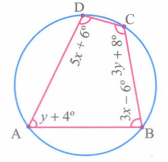
Find the angle of the given cyclic quadrilateral ABCD in the figure.
2.
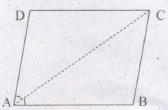
Diagonal AC of a parallelogram ABCD bisects ㄥA. Show that
(i) it bisects ㄥC also
(ii) ABCD is a rhombus.
3.
Show that the bisectors of angles of a parallelogram form a rectangle.
4.
In a quadrilateral ABCD, ∠A = 72° and ∠C is the supplementary of ∠A. The other two angles are 2x–10 and x + 4. Find the value of x and the measure of all the angles.
5.
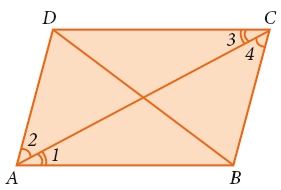
ABCD is a parallelogram Fig such that ∠BAD = 120o and AC bisects ∠BAD show that ABCD is a rhombus.
6.
ΔABC and ΔDEF are two triangles in which AB = DF, ∠ACB = 70°, ∠ABC = 60°, ∠DEF = 70° and ∠EDF = 60°. Prove that the triangles are congruent.
7.
Draw and locate the centroid of the triangle ABC where right angle at A, AB = 8 cm and AC = 6 cm.
8.
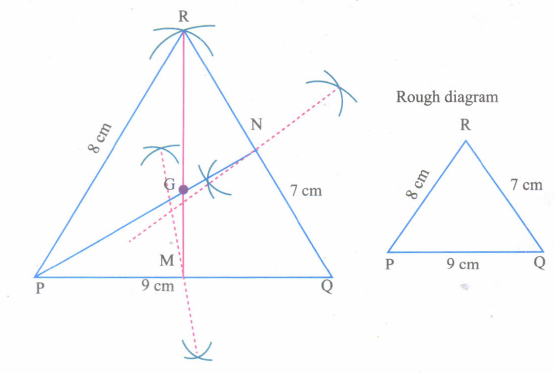
Construct the centroid of \(\triangle\)PQR such that PQ = 9 cm, PQ = 7cm, RP = 8 cm.
9.
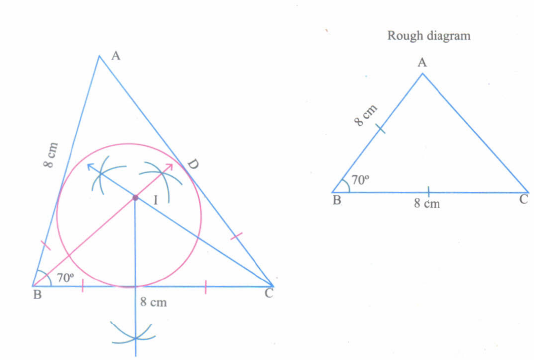
Construct \(\triangle\)ABC in which AB = BC = 8cm and \(\angle \)B =70o. Locate its in centre and draw the incircle
10.
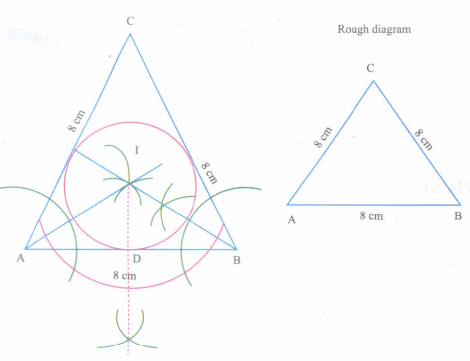
Draw an equilateral triangle of side 8 cm and locate its incentre. Also draw the incircle.
1.
\(\angle\)In the cyclic quadrilateral \(\angle\) A+\(\angle\)C = 180o
y + 4o + 3yo + 8o = 180o
4yo + 12o = 80o
4yo = 180o -12o = 168
y =\(\cfrac { 168 }{ 4 } \) = 42
\(\angle\)B + \(\angle\)D = 180o
8x + 12 = 180o
8x = 180o - 12o = 168
x = \(\cfrac { 168 }{ 8 } \) = 21o
\(\therefore\) \(\angle\)A = y + 4o = 42o + 4o = 46o
\(\angle\)C = 3y + 8 = 3 \(\times\) 42 + 8 = 126 + 8 = 134o
\(\angle\)B = 3x + 6 = 3 \(\times\) 21 + 6 = 63 + 6 = 69o
\(\angle\)D = 5x + 6 = 5 \(\times\) 21 + 6
= 105 + 6 = 111o
2.
We have a parallelogram ABCD in which diagonals AC bisect ㄥA.
ㄥDAC = ㄥBAC
(i) To prove that AC bisects LC
∵ ABCD is a parallelogram
∴ AB II DC and AC is a transversal
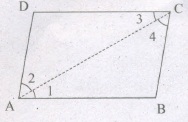
∴ ㄥ1 = ㄥ3 (Alternate interior angle) .........(1)
.Also BC II AD and AC is a transversal.
∴ ㄥ2 = ㄥ4 (Alternate interior angle) ...........(2)
But AC bisects ㄥA
∴ ㄥ1 = ㄥ2
From (1), (2) and (3) we get
ㄥ3 = ㄥ4
∴ AC bisects ㄥC.
(ii) To prove that ABCD is a rhombus.
In ΔABC, we have ㄥ1 = ㄥ4 [ ∵ ㄥ1 = ㄥ2 = ㄥ4]
∴ BC = AB (side opposite to equal angles are equal) (4)
Similarly AD = DC ....... (5)
But ABCD is a parallelogram AB = DC (Opposite sides of a parallelogram) .......(6)
From (4), (5) and (6) we have AB = BC = CD = DA.
Thus ABCD is a rhombus.
3.
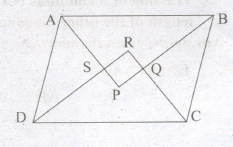
A parallelogram in which bisector of angle A, B, C, D intersect at P, Q, R, S to form a quadrilateral PQRS.
To prove: Quadrilateral PQRS is a rectangle.
Proof: Since ABCD is a parallelogram. Therefore, AB II DC.
Now, AB II DC, and transversal AD cuts them, so we have
\(\angle A+\angle D=180^0\)
\(\frac{1}{2}\angle A+\frac{1}{2}\angle D=\frac{180^0}{2}\)
\(\angle DAS+\angle ADS=90^0\)
But in \(\triangle ASD\) , we have
\(\angle ADS+\angle DAS+\angle ASD=180^0\)
\(90^0+\angle ASD=180^0\)
\(\angle ASD=90^0\)
\(\angle RSP=\angle ASD\) (vertically opposite angle)
\(\angle RSP=90^0\)
Similarly, we can prove that
\(\angle SRQ=90^0,\angle RQP=90^0\ and \angle QPS=90^0\)
Thus, PQRSis a quadrilateral each of whose angle is 90°.
Hence, PQRS is a rectangle.
4.
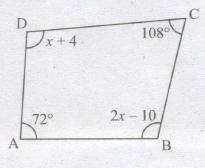
\(\angle A=72^0\)
\(\angle C=180^0-72^0\) (\(\angle A\) and \(\angle C\) are supplementary)
= 1080
\(\angle A+\angle B+\angle C+\angle D=360^0\) (Total angles of a quadrilateral)
72o+ 2x -10 +108o+ x + 4 = 360o
3x + 174o = 360o
3x = 360o-174o = 1860
\(x=\frac{186^0}{3}\)
x = 62o
The value of x = 62°
\(\angle B=2x-10\)
= 2(62o) -10
= 124o-10o = 114o
\(\angle D=x+4\)
= 62o+ 4 = 66o
The other angles are 72°, 114°, 108° and 66°.
5.
Given ∠BAD = 120° and AC bisects ∠BAD
\(\angle{BAC}=\frac{1}{2}\times 120^{0}=60^{0}\)
∠1 = ∠2 = 60°
AD || BC and AC is the traversal
∠2 = ∠4 = 60°
Δ ABC is isosceles triangle [∴ ∠1 = ∠4 = 60 °]
⇒ AB = BC
Parallelogram ABCD is a rhombus.
6.
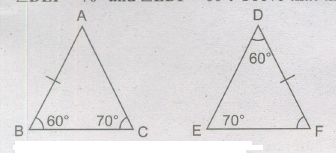
In \(\triangle ABC\angle B=60^0\ and\ \angle C=70^0\)
\(\therefore\angle A=180^0-(60^0+70^0)\)
\(=180^0-130^0\) = 500
In \(\triangle E=70^0\ and \angle D=60^0\)
\(\therefore \angle F=180^0-(70^0+60^0)\)
= 180° - 130° = 50°
\(\angle A=\angle F=50^0\)
\(\angle B=\angle D=60^0\)
\(\angle C=\angle E=70^0\)
By AAA congruency
\(\therefore\triangle ABC\cong\triangle FDE\)
7.
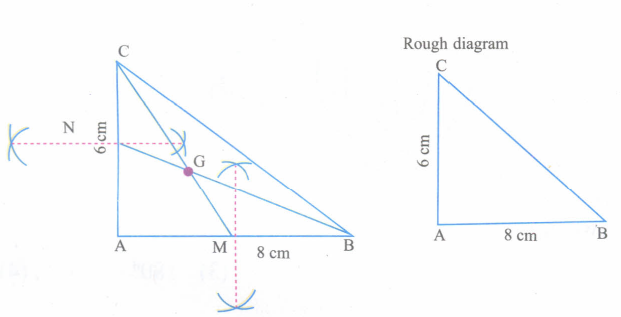
Construction:
Step 1: Draw ΔABC with the given measurements AB = 8 cm, \(\angle\)A = 90o and AC = 6 cm and construct the perpendicular bisector of any two sides (AB and AC) to find the mid points M and N of AB and BC respectively.
Step 2: Draw the medians (C and BN and let them meet at G. The point G is the centroid of the given ΔABC.
8.
In \(\triangle\)PQR, PQ = 5 cm, PR = 6 cm, \(\angle\)QPR = 60°
Construction:
Step 1: Draw \(\triangle\) PQR using the given measurements PQ = 9 cm, QR = 7 cm and RP = 8 cm and construct the perpendicular bisector of any two sides (PQ and QR) to find the mid-points M and N of PQ and QR respectively.
Step 2: Draw the medians PN and RM and let them meet at G. The point G is the centroid of the given \(\triangle\)PQR.
9.
In \(\triangle\)ABC, AB = BC = 8 cm, \(\angle\)B = 70°.
Construction :
Step 1: Draw \(\triangle\)ABC with BC = 8 cm, \(\angle\)B = 70°. AB = 8.
Step 2: Construct the angle bisectors of any two angles (B and C) and let them meet at I. Then I is the incentre of \(\triangle\)ADC. Draw perpendicular from I to anyone of the side (BC) to meet BC at D.
Step 3: With I as centre and ID as radius draw a circle. This circle touches all the sides of the triangle internally.
10.
Construction :
Step 1: Draw \(\triangle\)ABC with AB = BC = CA = 8 cm
Step 2: Construct angle bisectors of any two angles (A and B) and let them meet at I. I is the incentre of \(\triangle\)ABC.
Step 3: Draw perpendicular from I to any one of the side (AB) to meet AB at D.
Step 4: With I as centre, ID as radius draw the circle. This circle touches all the sides of triangle internally.

9th Standard Syllabus & Materials
9th Standard
TN 9th Tamil உள்ளத்தின் சீர் - திருக்குறள் Important Questions And Answers Study Material - QB365 Set A
NEW9th Standard
TN 9th Tamil உள்ளத்தின் சீர் - மணிமேகலை Important Questions And Answers Study Material - QB365 Set A
NEW9th Standard
TN 9th Tamil உள்ளத்தின் சீர் - ஏறு தழுவுதல் Important Questions And Answers Study Material - QB365 Set A
NEW9th Standard
TN 9th Tamil உயிருக்கு வேர் - தண்ணீர் Important Questions And Answers Study Material - QB365 Set A



Tamilnadu Stateboard 9th Standard Subjects
Tamilnadu Stateboard Standards





