 100% FREE ACCESS100% FREE ACCESS
9th Standard Syllabus & Materials
9th Standard
TN 9th Tamil உள்ளத்தின் சீர் -கற்கண்டு (இலக்கணம்) - தொடர் இலக்கணம், ஆகுபெயர் Important Questions And Answers Study Material - QB365 Set A
NEW9th Standard
TN 9th Tamil உள்ளத்தின் சீர் -விரிவானம் (துணைப்பாடம்) - தாய்மைக்கு வறட்சி இல்லை! Important Questions And Answers Study Material - QB365 Set A
NEW9th Standard
TN 9th Tamil உள்ளத்தின் சீர் -கவிதை பேழை (செய்யுள்) - மார்கழி பெருவிழா Important Questions And Answers Study Material - QB365 Set A
NEW9th Standard
TN 9th Tamil உயிருக்கு வேர்-இலக்கணம் - பகுபத உறுப்பிலக்கணம் Important Questions And Answers Study Material - QB365 Set A
NEW9th Standard
TN 9th Tamil அமுதென்று பேர் - இலக்கணம்-எழுத்து -அளபெடை Important Questions And Answers Study Material - QB365 Set A
NEW9th Standard
TN 9th Tamil அமுதென்று பேர்-துணைப்பாடம் - ஆறாம்திணை Important Questions And Answers Study Material - QB365 Set A

Published on: 24/07/2018
Some of the important questions are covers from the Term I syllabus. The questions are prepared from the book back and PTA questions.
Download Tamil Nadu 9th Standard Maths question papers, model tests, one-mark questions, important questions, and public exam papers in PDF format. Free study materials and answer keys for TN State Board students.
Questions + Answers key
Take MCQ Maths Test1.
The degree of the polynomial \( \sqrt { 2 } { x }^{ 2 }-\frac { 7 }{ 2 } { x }^{ 4 }+x-5x^{ 3 }\) is _______________
2
3
4
5
2.
The coefficient of \({ x }^{ 2 }\ and\ x\ in\ 2{ x }^{ 3 }-5{ x }^{ 2 }+6x-3\) are respectively ____________
2, -5
2, 6
-5, 6
-5, -3
3.
The sum of \({ 5x }^{ 2 };-7x^{ 2 };8x^{ 2 };11x^{ 2 }\ and\ -9x^{ 2 }\) is ___________
\(2{ x }^{ 2 }\)
\(4{ x }^{ 2 }\)
\(6{ x }^{ 2 }\)
\(8{ x }^{ 2 }\)
4.
Which of the following is a formula to find the sum of interior angles of a quadrilateral of n-sides?
\(\frac { n }{ 2 } \) \(\times\) 180
\(\left( \frac { n+1 }{ 2 } \right) \)1800
\(\left( \frac { n-1 }{ 2 } \right) \)180o
(n-2)180o
5.
If all the four sides of a parallelogram are equal and the adjacent angles are of 120° and 60°, then the name of the quadrilateral is ______
rectangle
square
rhombus
kite
6.
One angle of a parallelogram is a right angle. The name of the quadrilateral is ______
square
rectangle
rhombus
kite
7.
What is the name of a regular polygon of six sides?
Square
Equilateral triangle
Regular hexagon
Regular octagon
8.
The set (A - B) U(B - A) is ___________
AΔB
AUB
A∩B
A'UB'
9.
Sets having the same number of elements are called ___________
overlapping sets
disjoint sets
equivalent sets
equal sets
10.
A = {set of odd natural numbers}, B = {set of even natural numbers}, then A and B are ___________
equal set
equivalent sets
overlapping sets
disjoint sets
11.
If \(\frac { 1 }{ 7 } \)= 0.142857, then the value of is______________.
0.285741
0.428571
0.285714
0.574128
12.
Irrational number has a________________ .
terminating decimal
no decimal part
non-terminating and recurring decimal
non-terminating and non-recurring decimal
13.
Which one of the following has terminating decimal expansion?
\(\frac { 7 }{ 9 } \)
\(\frac { 8 }{ 15 } \)
\(\frac { 1 }{ 2 } \)
\(\frac { 5 }{ 32 } \)
14.
The diagonal of a square formed by the points (1, 0), (0, 1), (-1, 0) and (0, - 1) is_______________
2
4
\(\sqrt{2}\)
8
15.
The distance between the points (a, 0) and (0, b) is____________
a unit
b unit
\(\sqrt{a^2+{b^2}}\ unit\)
\(\sqrt{a^2-{b^2}}\ unit\)
16.
The point whose abscissa is 5 and lies on the x-axis is__________
(-5, 0)
(5,5)
(0,5)
(5,0)
17.
Find the odd one out of the following.
\(\sqrt { 32 } \times \sqrt { 2 } \)
\(\frac { \sqrt { 27 } }{ \sqrt { 3 } } \)
\(\sqrt { 72 } \times \sqrt { 8 } \)
\(\frac { \sqrt { 54 } }{ \sqrt { 18 } } \)
18.
if \(\frac { 1 }{ 7 } \) = \(0.\overline { 142857 } \) then the value of \(\frac { 5 }{ 7 } \) ________.
\(0.\overline { 142857 } \)
\(0.\overline { 714285 } \)
\(0.\overline { 571428 } \)
0.714285
19.
The distance between the two points ( 2, 3 ) and ( 1, 4 ) is ______.
2
\(\sqrt { 56 } \)
\(\sqrt { 10 } \)
\(\sqrt { 2 } \)
20.
The point whose ordinate is 4 and which lies on the y-axis is ______.
( 4, 0 )
(0, 4)
(1, 4)
(4, 2)
21.
The smallest rational number by which \(\frac { 1 }{ 3 } \) should be multiplied so that its decimal expansion terminates after one place of decimal is ________.
\(\frac { 1 }{ 10 } \)
\(\frac { 3 }{ 10 } \)
3
30
22.
Which one of the following has a terminating decimal expansion?
\(\frac { 5 }{ 64 } \)
\(\frac { 8 }{ 9 } \)
\(\frac { 14 }{ 15 } \)
\(\frac { 1 }{ 12 } \)
23.
The Auto fare is found as minimum Rs. 25 for 3 kilometer and thereafter Rs. 12 for per kilometer. Which of the following equations represents the relationship between the total cost ‘c’ in rupees and the number of kilometers n?
c = 25 + n
c = 25 + 12n
c = 25 + (n–3)12
c = (n–3)12
24.
The sum of the polynomials p(x) = x3 – x2 – 2, q(x) = x2–3x+ 1 _______.
x3 – 3x – 1
x3 + 2x2 – 1
x3 – 2x2 – 3x
x3 – 2x2 + 3x –1
25.
If n is a natural number then \(\sqrt { n } \) is ________.
always a natural number
always an irrational number
always a rational number
may be rational or irrational
26.
The type of the polynomial 4–3x3 is ________.
constant polynomial
linear polynomial
quadratic polynomial
cubic polynomial.
27.
If x3 + 6x2 + kx + 6 is exactly divisible by (x + 2), then k= ?
-6
-7
-8
11
28.
The point M lies in the IV quadrant. The coordinates of M is _______
(a,b)
(–a, b)
(a, –b)
(–a, –b)
29.
The shaded region in the adjacent diagram represents ______________
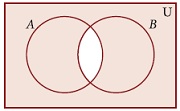
(A∪B)′
(A∩B)′
A′∩B′
A∩B
30.
If A∪B = A∩B, then ________.
A ≠ B
A = B
A ⊂ B
B ⊂ A
31.
If A = {x, y, z} then the number of non-empty subsets of A is ________.
8
5
6
7
32.
Which of the following statement is correct?
Opposite angles of a parallelogram are not equal.
Adjacent angles of a parallelogram are complementary.
Diagonals of a parallelogram are always equal.
Both pairs of opposite sides of a parallelogram are always equal.
33.
If bisectors of ∠A and ∠B of a quadrilateral ABCD meet at O, then ∠AOB is ________.
∠C + ∠D
\(\frac { 1 }{ 2 } (\angle C+\angle D)\)
\(\frac { 1 }{ 2 } \angle C+\frac { 1 }{ 3 } \angle D\)
\(\frac { 1 }{ 3 } \angle C+\frac { 1 }{ 2 } \angle D\).
34.
If the diagonal of a rhombus are equal, then the rhombus is a ________.
Parallelogram but not a rectangle
Rectangle but not a square
Square
Parallelogram but not a square
35.
The correct statement out of the following is ________.
ΔABC ≅ ΔDEF
ΔABC ≅ ΔDEF
ΔABC ≅ ΔFDE
ΔABC ≅ ΔFED
36.
ABCD is a square, diagonals AC and BD meet at O. The number of pairs of congruent triangles with vertex O are ________.

6
8
4
12
37.
If \(\sqrt { 10 } \)= 3.1622, then the value of is \(\frac { 1 }{ \sqrt { 10 } } \) is_________.
38.
The value of \(3\sqrt { 3 } +\sqrt { 3 } \) is ______________.
39.
A square has sides of equal length and angles of equal measures, so it is not a ______ polygon.
40.
All sides of a ______ are equal and all angles are right angles.
41.
All angles of a rectangle are equal and are _______
42.
The diagonals of a rhombus bisect each other at ________
43.
If A and B are two finite sets such that n(A - B) = 30, n(A U B) = 180, then n(B) is ___________
44.
If n(A) = 50, n(B) = 35, n(A ⋂ B) = 5, then n(A U B) is equal to __________
45.
If A ⊆ B, then A - B is __________
46.
The abscissa of every point on y-axis is______________
47.
The ordinate of every point on the x-axis is________________
48.
The abscissa of the origin is ____________
49.
Consider the following sets A = {0, 3, 5, 8}, B = {2, 4, 6, 10} and C = {12, 14,18, 20}.
4 _____ B.
50.
Consider the following sets A = {0, 3, 5, 8}, B = {2, 4, 6, 10} and C = {12, 14,18, 20}.
18 _______ B.
1.
(a)
2
(b)
3
(c)
4
(d)
5
2.
(a)
2, -5
(b)
2, 6
(c)
-5, 6
(d)
-5, -3
3.
(a)
\(2{ x }^{ 2 }\)
(b)
\(4{ x }^{ 2 }\)
(c)
\(6{ x }^{ 2 }\)
(d)
\(8{ x }^{ 2 }\)
4.
(a)
\(\frac { n }{ 2 } \) \(\times\) 180
(b)
\(\left( \frac { n+1 }{ 2 } \right) \)1800
(c)
\(\left( \frac { n-1 }{ 2 } \right) \)180o
(d)
(n-2)180o
5.
(a)
rectangle
(b)
square
(c)
rhombus
(d)
kite
6.
(a)
square
(b)
rectangle
(c)
rhombus
(d)
kite
7.
(a)
Square
(b)
Equilateral triangle
(c)
Regular hexagon
(d)
Regular octagon
8.
(a)
AΔB
(b)
AUB
(c)
A∩B
(d)
A'UB'
9.
(a)
overlapping sets
(b)
disjoint sets
(c)
equivalent sets
(d)
equal sets
10.
(a)
equal set
(b)
equivalent sets
(c)
overlapping sets
(d)
disjoint sets
11.
(a)
0.285741
(b)
0.428571
(c)
0.285714
(d)
0.574128
12.
(a)
terminating decimal
(b)
no decimal part
(c)
non-terminating and recurring decimal
(d)
non-terminating and non-recurring decimal
13.
(a)
\(\frac { 7 }{ 9 } \)
(b)
\(\frac { 8 }{ 15 } \)
(c)
\(\frac { 1 }{ 2 } \)
(d)
\(\frac { 5 }{ 32 } \)
14.
(a)
2
(b)
4
(c)
\(\sqrt{2}\)
(d)
8
15.
(a)
a unit
(b)
b unit
(c)
\(\sqrt{a^2+{b^2}}\ unit\)
(d)
\(\sqrt{a^2-{b^2}}\ unit\)
16.
(a)
(-5, 0)
(b)
(5,5)
(c)
(0,5)
(d)
(5,0)
17.
(a)
\(\sqrt { 32 } \times \sqrt { 2 } \)
(b)
\(\frac { \sqrt { 27 } }{ \sqrt { 3 } } \)
(c)
\(\sqrt { 72 } \times \sqrt { 8 } \)
(d)
\(\frac { \sqrt { 54 } }{ \sqrt { 18 } } \)
18.
(a)
\(0.\overline { 142857 } \)
(b)
\(0.\overline { 714285 } \)
(c)
\(0.\overline { 571428 } \)
(d)
0.714285
19.
(a)
2
(b)
\(\sqrt { 56 } \)
(c)
\(\sqrt { 10 } \)
(d)
\(\sqrt { 2 } \)
20.
(a)
( 4, 0 )
(b)
(0, 4)
(c)
(1, 4)
(d)
(4, 2)
21.
(a)
\(\frac { 1 }{ 10 } \)
(b)
\(\frac { 3 }{ 10 } \)
(c)
3
(d)
30
22.
(a)
\(\frac { 5 }{ 64 } \)
(b)
\(\frac { 8 }{ 9 } \)
(c)
\(\frac { 14 }{ 15 } \)
(d)
\(\frac { 1 }{ 12 } \)
23.
(a)
c = 25 + n
(b)
c = 25 + 12n
(c)
c = 25 + (n–3)12
(d)
c = (n–3)12
24.
(a)
x3 – 3x – 1
(b)
x3 + 2x2 – 1
(c)
x3 – 2x2 – 3x
(d)
x3 – 2x2 + 3x –1
25.
(a)
always a natural number
(b)
always an irrational number
(c)
always a rational number
(d)
may be rational or irrational
26.
(a)
constant polynomial
(b)
linear polynomial
(c)
quadratic polynomial
(d)
cubic polynomial.
27.
(a)
-6
(b)
-7
(c)
-8
(d)
11
28.
(a)
(a,b)
(b)
(–a, b)
(c)
(a, –b)
(d)
(–a, –b)
29.
(a)
(A∪B)′
(b)
(A∩B)′
(c)
A′∩B′
(d)
A∩B
30.
(a)
A ≠ B
(b)
A = B
(c)
A ⊂ B
(d)
B ⊂ A
31.
(a)
8
(b)
5
(c)
6
(d)
7
32.
(a)
Opposite angles of a parallelogram are not equal.
(b)
Adjacent angles of a parallelogram are complementary.
(c)
Diagonals of a parallelogram are always equal.
(d)
Both pairs of opposite sides of a parallelogram are always equal.
33.
(a)
∠C + ∠D
(b)
\(\frac { 1 }{ 2 } (\angle C+\angle D)\)
(c)
\(\frac { 1 }{ 2 } \angle C+\frac { 1 }{ 3 } \angle D\)
(d)
\(\frac { 1 }{ 3 } \angle C+\frac { 1 }{ 2 } \angle D\).
34.
(a)
Parallelogram but not a rectangle
(b)
Rectangle but not a square
(c)
Square
(d)
Parallelogram but not a square
35.
(a)
ΔABC ≅ ΔDEF
(b)
ΔABC ≅ ΔDEF
(c)
ΔABC ≅ ΔFDE
(d)
ΔABC ≅ ΔFED
36.
(a)
6
(b)
8
(c)
4
(d)
12
37.
()
0.31623
38.
()
\(4\sqrt { 3 } \)
39.
()
regular
40.
()
square
41.
()
right angles
42.
()
right angles
43.
()
150
44.
()
80
45.
()
Ø
46.
()
0
47.
()
0
48.
()
0
49.
()
\(\in \)
50.
()
\(\notin \)

9th Standard Syllabus & Materials
9th Standard
TN 9th Tamil உள்ளத்தின் சீர் - திருக்குறள் Important Questions And Answers Study Material - QB365 Set A
NEW9th Standard
TN 9th Tamil உள்ளத்தின் சீர் - மணிமேகலை Important Questions And Answers Study Material - QB365 Set A
NEW9th Standard
TN 9th Tamil உள்ளத்தின் சீர் - ஏறு தழுவுதல் Important Questions And Answers Study Material - QB365 Set A
NEW9th Standard
TN 9th Tamil உயிருக்கு வேர் - தண்ணீர் Important Questions And Answers Study Material - QB365 Set A


Tamilnadu Stateboard 9th Standard Subjects
Tamilnadu Stateboard Standards