
 100% FREE ACCESS
9th Standard Syllabus & Materials
9th Standard
TN 9th Tamil உள்ளத்தின் சீர் -கற்கண்டு (இலக்கணம்) - தொடர் இலக்கணம், ஆகுபெயர் Important Questions And Answers Study Material - QB365 Set A
NEW9th Standard
TN 9th Tamil உள்ளத்தின் சீர் -விரிவானம் (துணைப்பாடம்) - தாய்மைக்கு வறட்சி இல்லை! Important Questions And Answers Study Material - QB365 Set A
NEW9th Standard
TN 9th Tamil உள்ளத்தின் சீர் -கவிதை பேழை (செய்யுள்) - மார்கழி பெருவிழா Important Questions And Answers Study Material - QB365 Set A
NEW9th Standard
TN 9th Tamil உயிருக்கு வேர்-இலக்கணம் - பகுபத உறுப்பிலக்கணம் Important Questions And Answers Study Material - QB365 Set A
NEW9th Standard
TN 9th Tamil அமுதென்று பேர் - இலக்கணம்-எழுத்து -அளபெடை Important Questions And Answers Study Material - QB365 Set A
NEW9th Standard
TN 9th Tamil அமுதென்று பேர்-துணைப்பாடம் - ஆறாம்திணை Important Questions And Answers Study Material - QB365 Set A

Published on: 04/01/2019
Class 9 Term 3 SA Model Question
Download Tamil Nadu 9th Standard Maths question papers, model tests, one-mark questions, important questions, and public exam papers in PDF format. Free study materials and answer keys for TN State Board students.
Questions + Answers key
Take MCQ Maths Test1.
Find the points of trisection of the line segment joining (−2, −1) and (4, 8)
2.
Use graphical method to solve the following system of equations y = 2x + 1; −4x + 2y = 2
3.
The probability of guessing the correct answer to a certain question is \(\frac { x }{ 3 } \). If the probability of not guessing the correct answer is \(\frac { x }{ 5 } \), then find the value of x.
4.
What is the probability of throwing an even number with a single standard dice of six faces?
5.
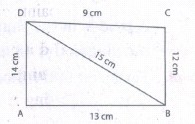
Find the area of a quadrilateral ABCD whose sides are AB = 13cm, BC = 12cm, CD = 9cm, AD = 14cm and diagonal BD = 15cm.
6.
The sides of the triangular ground are 22 m, 120 m and 122 m. Find the area and cost of levelling the ground at the rate of Rs. 20 per m2.
7.
Find the value of 8 sin 2x cos 4x sin 6x , when x =150
8.
Five years ago, a man was seven times as old as his son, while five years hence, the man will be four times as old as his son. Find their present age.
9.
The monthly income of A and B are in the ratio 3 : 4 and their monthly expenditures are in the ratio 5 : 7. If each saves Rs. 5,000 per month, find the monthly income of each.
10.
Evaluate:
(i) sin 300 +cos 300
(ii) tan 600 cot 600
(iii) \(\frac { tan45° }{ tan30°+tan60° } \)
(iv) sin2 450 +cos2 450
11.
Find the centroid of the triangle whose vertices are
(i) (2, −4), (−3, −7) and (7, 2)
(ii) (−5, −5), (1, −4) and (−4, −2)
12.
Using section formula, show that the points A(7, −5), B(9, −3) and C(13, 1) are collinear.
13.
The total surface area of a cube is 864 cm2. Find its volume
14.
The probability that it will rain tomorrow is \(\\ \frac { 91 }{ 100 } \). What is the probability that it will not rain tomorrow?
15.
In an office, where 42 staff members work, 7 staff members use cars, 20 staff members use two-wheelers and the remaining 15 staff members use cycles. Find the relative frequencies.
16.
A cube has the Total Surface Area of 486 cm2. Find its lateral surface area.
17.
Find the value of
(i) sin 38036' + tan 12012'
(ii) tan 60025' - cos 49020'
18.
Find the value of sin 64034'.
19.
Find the value of k, for the following system of equation has infinitely many solutions. 2x − 3y = 7;(k + 2)x − (2k +1)y = 3(2k −1)
20.
Express
(i) sin 74° in terms of cosine
(ii) tan 12° in terms of cotangent
(iii) cosec 39° in terms of secant
21.
The lengths of sides of a triangular field are 28 m, 15 m and 41 m. Calculate the area of the field. Find the cost of levelling the field at the rate of Rs. 20 per m2
22.
Solve by cross-multiplication method
(i) 8x − 3y = 12 ; 5x = 2y + 7
(ii) 6x + 7y −11 = 0 ; 5x + 2y = 13
(iii) \(\frac { 2 }{ x } +\frac { 3 }{ y } =5;\frac { 3 }{ x } -\frac { 1 }{ y } +9=0\)
23.
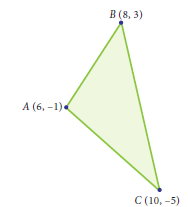
Find the centroid of the triangle whose vertices are A(6, −1), B(8, 3) and C(10, −5).
24.
The total surface area of a cuboid with dimension 10 cm × 6 cm × 5 cm is _______.
280 cm2
300 cm2
360 cm2
600 cm2
25.
The lateral surface area of a cube of side 12 cm is _______.
144 cm2
196 cm2
576 cm2
664 cm2
26.
If A is any event in S and its complement is A' then, P(A′) is equal to _______.
1
0
1-A
1-P(A)
27.
Probability lies between _______.
−1 and +1
0 and 1
0 and n
0 and \(\infty \)
28.
The value of 2tan30° tan60° is
1
2
\(2\sqrt { 3 } \)
6
29.
The value of \(\frac { 2tan\ 30° }{ 1-{ tan }^{ 2 }30° } \) is equal to ________.
cos 600
sin 600
tan 600
sin 300
30.
The value of k for which the pair of linear equations 4x + 6y −1 = 0 and 2x + ky − 7 = 0 represents parallel lines is _______.
k = 3
k = 2
k = 4
k = -3
31.
The linear equation in one variable is __________
2x + 2 = y
5x − 7 = 6 − 2x
2t(5 − t) = 0
7p − q = 0
32.
The ratio in which the x-axis divides the line segment joining the points (6, 4) and (1, −7) is ______.
2:3
3:4
4:7
4:3
33.
If \(P(\frac{a}{3},\frac{b}{2})\)is the mid-point of the line segment joining A(−4, 3) and B(−2, 4) then (a, b) is ______.
(-9, 7)
\((-3, \frac{7}{2})\)
(9, -7)
\((3, -\frac{7}{2})\)
1.
Let A(−2, −1) and B(4, 8) are the given points.
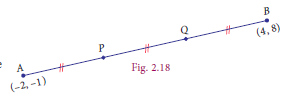
Let P(a,b) and Q(c,d) be the points of trisection of AB, so that AP = PQ = QB .
By the formula proved above,
P is the point.
\(\left( \frac { { x }_{ 2 }+{ 2x }_{ 1 } }{ 3 } ,\frac { { y }_{ 2 }+{ 2y }_{ 1 } }{ 3 } \right) =\left( \frac { 4+2(-2) }{ 3 } ,\frac { 8+2(-1) }{ 3 } \right) \) = (0, 2)
Q is the point
\(\left( \frac { { 2x }_{ 2 }+{ x }_{ 1 } }{ 3 } ,\frac { {2 y }_{ 2 }+{ y }_{ 1 } }{ 3 } \right) =\left( \frac { 2(4)-2 }{ 3 } ,\frac { 2(8)-1 }{ 3 } \right) \) = (2, 5)
2.
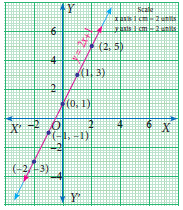
Let us form table of values for each line and then fix the ordered pairs to be plotted.
Graph of y = 2x + 1
Graph of -4x + 2y = 2
2y = 4x + 2
y = 2x + 1
| x | -2 | -1 | 0 | 1 | 2 |
| 2x | -4 | -2 | 0 | 2 | 4 |
| 1 | 1 | 1 | 1 | 1 | 1 |
| y = 2x + 1 | -3 | -1 | 1 | 3 | 5 |
Points to be plotted : (−2, −3), (−1, −1), (0, 1), (1, 3), (2, 5)
| x | -2 | -1 | 0 | 1 | 2 |
| 2x | -4 | -2 | 0 | 2 | 4 |
| 1 | 1 | 1 | 1 | 1 | 1 |
| y = 2x + 1 | -3 | -1 | 1 | 3 | 5 |
Points to be plotted : (−2, −3), (−1, −1), (0, 1), (1, 3), (2, 5)
Here both the equations are identical; they were only represented in different forms. Since they are identical, their solutions are same. All the points on one line are also on the other!
This means we have an infinite number of solutions which are the ordered pairs of all the points on the line.
3.
\(\frac { x }{ 3 } +\frac { x }{ 5 } \) = 1
\(\frac { 5x+3x }{ 15 } \) = 1
\(\frac { 8x }{ 15 } \) = 1
8x = 15
x = \(\frac { 15 }{ 8 } \)
4.
Faces of a dice (S) = {1, 2, 3, 4,5, 6}
n(S) = 6
Event of throwing an even number
A = {2, 4, 6}, n(A) = 3
∴ Probability of throwing an even number
P(A) = \(\frac { n(A) }{ n(S) } =\frac { 3 }{ 6 } =\frac { 1 }{ 2 } \).
5.
Area of the quadrilateral ABCD
= Area of the Δ ABD + Area of the Δ BCD
Sides of the triangle ABD are 13 cm, 14 cm, 15 cm.
s = \(\frac { 13+14+15 }{ 2 } \)cm
= \(\frac { 42 }{ 2 } \) = 21 cm
Area =\(\sqrt { s(s-a)(s-b)(s-c) } \)
=\(\sqrt { 21(21-13)(21-14)(21-15) } \)
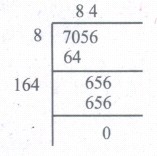
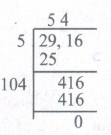
=\(\sqrt { 21\times 8\times 7\times 6 } =\sqrt { 7056 } \)=84 cm2
sides of the triangle
BCD are 12 cm, 9 cm, 15 cm
∴ s = \(\frac { 12+9+15 }{ 2 } =\frac { 36 }{ 2 } \) = 18 cm
Area =\(\sqrt { 18(18-2)(18-9)(18-15) } \)
=\(\sqrt { 18\times 6\times 9\times 3 } =\sqrt { 2916 } \) = 54 cm2
∴ Area of the quadrilateral
= 84 cm2 + 54 cm2 =138 cm2
6.
side: 22 m, 120 m, 122 m
Using Heron's formula
s = \(\frac { 22+120+122 }{ 2 } =\frac { 264 }{ 2 } \) = 12 m
Area = \(\sqrt { s(s-a)(s-b)(s-c) } \)
= \(\sqrt { 132(132-22)(132-120)(132-122) } \)
= \(\sqrt { 132\times 110\times 12\times 10 } \)
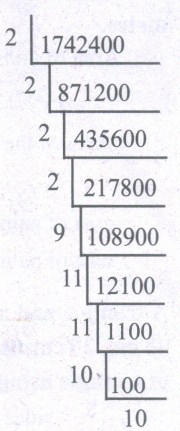
= \(\sqrt { 1742400 } =\sqrt { 11\times 11\times 3\times 3\times 2\times 2\times 2\times 2\times 10\times 10 } \)
= 11 \(\times\) 3 \(\times\) 2 \(\times\) 10 = 1320 m2
cost of levelling 1 m2 = Rs. 20
∴ cost of levelling 1320 m2= 1320 \(\times\) 20 = Rs. 26400
7.
8 sin 2(15°). cos 4 (15°). sin 6(15°)
= 8 sin 30° cos 60° sin 90°
= \(8\times \cfrac { 1 }{ 2 } \times \cfrac { 1 }{ 2 } \times 1=2\)
8.
Let the man's present age = x
Five years ago his age is = x - 5
Let his son's age be = y
5 years ago his son's age = y - 5
\(\therefore\) x - 5 = 7(y- 5)
x - 5 = 7y-35
x - 7y = -35 + 5
x - 7y = -30 ....(1)
After 5 years, man's age will be = x + 5
His son's age will be = y + 5
\(\therefore\) x + 5 = 4(y + 5)
x+ 5 = 4y+ 20
x-4y = 20-5
\(\Rightarrow\) x-4y = 15
(1) \(\Rightarrow\) x-7y = -30
(2) \(\Rightarrow\) \(\cfrac { x-4y=15 }{ 3y\quad =\quad 45 } \)
y= 15
Substitute y = 15 in (1)
x -7 (15) = -30
x-105 =- 30
x = -30 + 105
x = 75
\(\therefore\) Man's Age = 75, His son's Age = 15
9.
Let the monthly income of A and B be 3x and 4x respectively.
Let the monthly expenditure of A and B be 5y and 7y respectively.
\(\therefore\) 3x - 5y = 5000 --------- (1)
4x - 7y = 5000 --------- (2)
(1) \(\times\)4 \(\Rightarrow\) 12x - 20y = 20000
(2) \(\times\) 37 \(\Rightarrow\) \(\cfrac { 12-21y=15000 }{ 1y\quad =\quad 5000 } \)
Substitute y = 5000 in (1)
3x - 5 (5000) = 5000
3x - 25000 = 5000
3x = 5000 + 25000
3x = 30000
x = 10000
\(\therefore\) Monthly income of A is 3x = 3\(\times\)1 0000 = Rs. 30000
Monthly income of B is 4x = 4 \(\times\) 10000 = Rs. 40000
10.
(i)sin 300 + cos 300 = \(\frac { 1 }{ 2 } +\frac { \sqrt { 3 } }{ 2 } =\frac { 1+\sqrt { 3 } }{ 2 } \)
(ii) tan 600 cot 600 = \(\sqrt { 3 } \times \frac { 1 }{ \sqrt { 3 } } =1\)
(iii) \(\frac { tan45° }{ tan30°+tan60° } \) = \(\frac { 1 }{ \frac { 1 }{ \sqrt { 3 } } +\frac { \sqrt { 3 } }{ 1 } } =\frac { 1 }{ \frac { 1+\left( \sqrt { 3 } \right) ^{ 2 } }{ \sqrt { 3 } } } =\frac { 1 }{ \frac { 1+3 }{ \sqrt { 3 } } } = \frac { \sqrt { 3 } }{ 4 } \)
(iv) sin2450 + cos2450 = \(\left( \frac { 1 }{ \sqrt { 2 } } \right) ^{ 2 }+\left( \frac { 1 }{ \sqrt { 2 } } \right) ^{ 2 }=\frac { 1^{ 2 } }{ \left( \sqrt { 2 } \right) ^{ 2 } } +\frac { 1^{ 2 } }{ \left( \sqrt { 2 } \right) ^{ 2 } } =\frac { 1 }{ 2 } +\frac { 1 }{ 2 } =1\)
11.
x1 y1 x2 y2 x3y3
(2, -4) (-3, -7) (7, 2)
(i) Centroid G (x, y) \(=\left( \frac { { x }_{ 1 }+{ x }_{ 2 }+{ x }_{ 3 } }{ 3 } ,\frac { { y }_{ 1 }+{ y }_{ 2 }+{ y }_{ 3 } }{ 3 } \right) \)
\(=\left( \frac { (2)+(-3)+7 }{ 3 } ,\frac { \left( -4 \right) +\left( -7 \right) +\left( 2 \right) }{ 3 } \right) \)
\(=\left( \frac { 6 }{ 3 } ,\frac { -9 }{ 3 } \right) =(2,-3)\)
(ii) x1 y1 x2 y2 x3y3
(2, -4) (1, -4) (-4, -2)
Centroid G (x, y) \(=\left( \frac { (-5)+1+(-4) }{ 3 } ,\frac { \left( -5 \right) +\left( -4 \right) +\left( -2 \right) }{ 3 } \right) \)
\(=\left( \frac { -8 }{ 3 } ,\frac { -11 }{ 3 } \right) \)
12.
x1 y1 x2 y2
A(7, -5) B(9, -3)
\(\bar { AB } =\sqrt { { ({ x }_{ 2 }-{ x }_{ 1 }) }^{ 2 }+{ ({ y }_{ 2 }-{ y }_{ 1 }) }^{ 2 } } \)
\(=\sqrt { { (9-7) }^{ 2 }+{ (-3-(-5)) }^{ 2 } } =\sqrt { { 2 }^{ 2 }+{ (-3+5) }^{ 2 } } =\sqrt { 4+4 } \)
\(=\sqrt { 8 } =\sqrt { 4\times 2 } =2\sqrt { 2 } \)
\(\bar { BC } =\sqrt { { (13-7 })^{ 2 }+{ (1-(-5)) }^{ 2 } } =\sqrt { { 4 }^{ 2 }+{ 4 }^{ 2 } } =\sqrt { 16+16 } \)
\(=\sqrt { 32 } =\sqrt { 16\times 2 } =4\sqrt { 2 } \)
\(\bar { AC } =\sqrt { { (13-7) }^{ 2 }+{ (1-(-5)) }^{ 2 } } \)
\(=\sqrt { { 6 }^{ 2 }+{ 6 }^{ 2 } } =\sqrt { 36+36 } \)
\(=\sqrt { { 6 }^{ 2 }+{ 6 }^{ 2 } } =\sqrt { 36+36 } \)
\(2\sqrt { 2 } +4\sqrt { 2 } =6\sqrt { 2 } \)
∴ AB + BC = AC, Here B is the common Point
∴ A, B, C are collinear
13.
Let ‘a’ be the side of the cube.
Given that, total surface area = 864 cm2
6a2= 864
a2 = \(\frac{864}{6}\)
a2 = 144
Therefore, side (a) = 12 cm
Now, volume of the cube = a3
= 123 = 12 ×12 ×12 = 1728 cm3
14.
Let E be the event that it will rain tomorrow. Then E′ is the event that it will not rain tomorrow.
Since P(E) = 0.91, we have P(E′) = 1−0.91 (how?)
= 0.09
Therefore, the probability that it will not rain tomorrow
= 0.09
15.
Total number of staff members = 42
The relative frequencies:
Car users \(=\frac { 7 }{ 42 } =\frac { 1 }{ 6 } \)
Two-wheeler users \(=\frac { 20 }{ 42 } =\frac { 10 }{ 21 } \)
Cycle users \(=\frac { 15 }{ 42 } =\frac { 5 }{ 14 } \)
16.
Here, Total Surface Area of the cube = 486 cm2
6a2 = 486 \(\Rightarrow\) a2 = \(\frac{486}{6}\) and so, a2 = 81 . This gives a = 9.
The side of the cube = 9 cm
Lateral Surface Area = 4a2 = 4 × 92 = 4 × 81 = 324 cm2
17.
(i) sin 38036' + tan 12012'
sin 38036' = 0.6239
tan12012' = 0.2162
sin 38036' + tan 12012' = 0.8401
(ii) tan 60025' - cos 49020'
tan 60025' = 1.7603 + 0.0012 = 1.7615
cos 49020' = 0.6521 - 0.0004 = 0.6517
tan 60025' - cos 49020' = 1.1098
18.
| 0' | 6' | 12' | 18' | 24' | 30' | 36' | 42' | 48' | 54' | Mean Difference | |||||
| 0.00 | 0.10 | 0.20 | 0.30 | 0.40 | 0.50 | 0.60 | 0.70 | 0.80 | 0.90 | 1 | 2 | 3 | 4 | 5 | |
| 640 | 0.9026 | 5 | |||||||||||||
write 64034' = 64030' + 4'
From the table we have, sin64030' = 0.9026

19.
Given two linear equations are
2x - 3y = 7;
(k + 2)x - (2k + 1)y = 3(2k - 1)
\(\left[ \begin{matrix} { a }_{ 1 }x+{ b }_{ 1 }y+{ c }_{ 1 }=0 \\ { a }_{ 2 }x+{ b }_{ 2 }y+{ c }_{ 2 }=0 \end{matrix} \right] \)
Here a1 = 2, b1 = −3, a2 = (k + 2), b2 = −(2k +1), c1 = 7, c2 = 3(2k −1)
For infinite number of solution we consider \(\frac { { a }_{ 1 } }{ { a }_{ 2 } } =\frac { { b }_{ 1 } }{ { b }_{ 2 } } =\frac { { c }_{ 1 } }{ { c }_{ 2 } } \)
\(\frac { 2 }{ k+2 } =\frac { -3 }{ -(2k+1) } =\frac { 7 }{ 3(2k-1) } \)
\(\frac { 2 }{ k+2 } =\frac { -3 }{ -(2k+1) } \)
2(2k +1) = 3(k + 2)
4k + 2 = 3k + 6
k = 4
\(\frac { -3 }{ -(2k+1) } =\frac { 7 }{ 392k-1) } \)
9(2k −1) = 7(2k +1)
18k − 9 = 14k + 7
4k = 16
k = 4
20.
(i) sin74° = sin(900 -160) (since, 900 -160 = 740 )
RHS is of the form sin(900 - \(\theta\)) = cos\(\theta\)
Therefore sin74° = cos160
(ii) tan12° = tan(900 - 780) (since, 120= 900 = 780 )
RHS is of the form tan(900- \(\theta\)) = cot \(\theta\)
Therefore tan12° = cot 780
(iii) cosec 39° = cosec(900 - 510) (since, 390 = 900 - 510 )
RHS is of the form cosec(900 - \(\theta\)) = sec\(\theta\)
Therefore cosec39° = sec510
21.
Let a = 28 m, b = 15 m and c = 41 m
Then, s \(\frac{a+b+c}{2}=\frac{28+15+41}{2}=\frac{84}{2}\) = 42 m
Area of triangular field =\(\sqrt { s(s-a)(s-b)(s-c) } \)
=\(\sqrt { 42(42-28)(42-15)(42-41) } \)
=\(\sqrt { 42\times 14\times 17\times 1 } \)
=\(\sqrt { 2\times 3\times 7\times 7\times 2\times 3\times 3\times 3\times 1 } \)
\(=2 \times 3 \times 7 \times 3\)
= 126 m2
Given the cost of levelling is Rs. 20 per m2.
The total cost of levelling the field = 20 \(\times\)126 = Rs. 2520.
22.
(i) 8x- 3y = 12 ...(1)
5x-2y = 7 ..(2)
8x- 3y-12 = 0
5x-2y- 7 = 0
For cross multiplication method, we write the co-efficients as

\(\cfrac { x }{ (-3)(-7)(-2)(-12) } =\cfrac { y }{ (-12)(5)-(-7)(8) } =\cfrac { 1 }{ (8)(-2)-(5)(-3) } \)
\(\cfrac { x }{ 21-24 } =\cfrac { y }{ -60+56 } =\cfrac { 1 }{ -16+15 } \)
\(\cfrac { x }{ -3 } =\cfrac { y }{ -60+56 } =\cfrac { 1 }{ -16+15 } \)
\(\therefore \ \cfrac { x }{ 3 } =\cfrac { 1 }{ -1 } \ \cfrac { y }{ -4 } =\cfrac { 1 }{ -1 } \)
x = 3 , y = 4
\(\therefore\) Solutions: x = 3; y = 4
(ii) 6x+ 7y-11 = 0
5x+ 2y-13 = 0
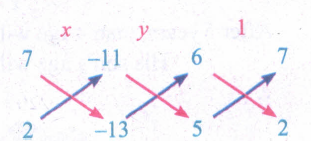
For cross multiplication method, we write the co-efficients as
\(\cfrac { x }{ -91-(-22) } =\cfrac { y }{ -55-(-68) } =\cfrac { 1 }{ 12-35 } \)
\(\cfrac { x }{ -91+22 } =\cfrac { y }{ -55+78 } =\cfrac { 1 }{ -23 } \)
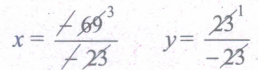
\(\cfrac { x }{ -69 } =\cfrac { y }{ 23 } =\cfrac { 1 }{ -23 } \)
\(\cfrac { x }{ -69 } =\cfrac { 1 }{ -23 } \quad \cfrac { y }{ 23 } =\cfrac { 1 }{ -23 } \)
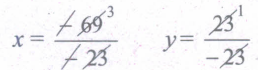
x = 3, y= -1
\(\therefore\) x = 3; y= -1
(iii)
\(\cfrac { 2 }{ x } +\cfrac { 3 }{ y } -5=0\)
\(\cfrac { 3 }{ x } -\cfrac { 1 }{ y } +9=0\)
In (1), (2) Put \(\cfrac { 1 }{ x } =a,\cfrac { 1 }{ y } =b\)
(1) \(\Rightarrow\) 2a + 3b - 5 = 0
(2) \(\Rightarrow\) 3a - b + 9 = 0
For cross multiplication method, we write the co-efficients as
\(\cfrac { a }{ (3)(9)-(-1)(-5) } =\cfrac { b }{ (-5)(3)-(9)(2) } =\cfrac { 1 }{ (2)(-1)-(3)(3) } \)
\(\cfrac { a }{ 27-5 } =\cfrac { b }{ -15-18 } =\cfrac { 1 }{ -2-9 } \)
\(\cfrac { a }{ 22 } =\cfrac { b }{ -33 } =\cfrac { 1 }{ -11 } \)
\(\therefore \ \cfrac { a }{ 22 } =\cfrac { 1 }{ -11 } \cfrac { b }{ -33 } =\cfrac { 1 }{ -11 } \)
a = -2 b = 3
\(a=\cfrac { 1 }{ x } =-2\quad b=\cfrac { 1 }{ y } =3\)
\(\therefore \ x=\cfrac { -1 }{ 2 } \ \ y=\cfrac { 1 }{ 3 } \)
solution \(\ x=\cfrac { -1 }{ 2 } \ \ y=\cfrac { 1 }{ 3 } \)
23.
The centroid G(x, y) of a triangle whose vertices are (x1, y1), (x2 , y2 ) and (x3 , y3) is given by
G(x,y)\(\left( \frac { { x }_{ 1 }+{ x }_{ 2 }+{ x }_{ 3 } }{ 3 } ,\frac { { y }_{ 1 }+{ y }_{ 2 }+{ y }_{ 3 }3 }{ } \right) \)
We have (x1, y1) = (6, −1); (x2 , y2 ) = (8, 3); (x3 , y3) = (10, −5)
The centroid of the triangle
G(x, y) =G\(\left( \frac { 6+8+10 }{ 3 } ,\frac { -1+3-5 }{ 3 } \right) \)
= G \((\frac{24}{3},\frac{-3}{3})\)= G(8, -1)
24.
(a)
280 cm2
25.
(c)
576 cm2
26.
(d)
1-P(A)
27.
(b)
0 and 1
28.
(b)
2
29.
(c)
tan 600
30.
(a)
k = 3
31.
(b)
5x − 7 = 6 − 2x
32.
(c)
4:7
33.
(a)
(-9, 7)

9th Standard Syllabus & Materials
9th Standard
TN 9th Tamil உள்ளத்தின் சீர் - திருக்குறள் Important Questions And Answers Study Material - QB365 Set A
NEW9th Standard
TN 9th Tamil உள்ளத்தின் சீர் - மணிமேகலை Important Questions And Answers Study Material - QB365 Set A
NEW9th Standard
TN 9th Tamil உள்ளத்தின் சீர் - ஏறு தழுவுதல் Important Questions And Answers Study Material - QB365 Set A
NEW9th Standard
TN 9th Tamil உயிருக்கு வேர் - தண்ணீர் Important Questions And Answers Study Material - QB365 Set A



Tamilnadu Stateboard 9th Standard Subjects
Tamilnadu Stateboard Standards





