
 100% FREE ACCESS
9th Standard Syllabus & Materials
9th Standard
TN 9th Tamil உள்ளத்தின் சீர் -கற்கண்டு (இலக்கணம்) - தொடர் இலக்கணம், ஆகுபெயர் Important Questions And Answers Study Material - QB365 Set A
NEW9th Standard
TN 9th Tamil உள்ளத்தின் சீர் -விரிவானம் (துணைப்பாடம்) - தாய்மைக்கு வறட்சி இல்லை! Important Questions And Answers Study Material - QB365 Set A
NEW9th Standard
TN 9th Tamil உள்ளத்தின் சீர் -கவிதை பேழை (செய்யுள்) - மார்கழி பெருவிழா Important Questions And Answers Study Material - QB365 Set A
NEW9th Standard
TN 9th Tamil உயிருக்கு வேர்-இலக்கணம் - பகுபத உறுப்பிலக்கணம் Important Questions And Answers Study Material - QB365 Set A
NEW9th Standard
TN 9th Tamil அமுதென்று பேர் - இலக்கணம்-எழுத்து -அளபெடை Important Questions And Answers Study Material - QB365 Set A
NEW9th Standard
TN 9th Tamil அமுதென்று பேர்-துணைப்பாடம் - ஆறாம்திணை Important Questions And Answers Study Material - QB365 Set A

Published on: 08/01/2019
Term 3 Important Questions
Download Tamil Nadu 9th Standard Maths question papers, model tests, one-mark questions, important questions, and public exam papers in PDF format. Free study materials and answer keys for TN State Board students.
Questions + Answers key
Take MCQ Maths Test1.
The dimensions of a brick are 24 cm × 12 cm × 8 cm. How many such bricks will be required to build a wall of 20 m length, 48 cm breadth and 6 m height?
2.
1500 families were surveyed and following data was recorded about their maids at homes
| Type of maids | Only part time | Only full time | Both |
| Number of families | 860 | 370 | 250 |
A family is selected at random. Find the probability that the family selected has
(i) Both types of maids
(ii) Part time maids
(iii) No maids
3.
Find the TSA and LSA of the cube whose side is
(i) 8 m
(ii) 21 cm
(iii) 7.5 cm
4.
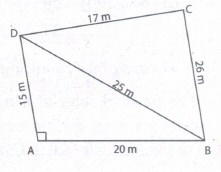
A park is in the shape of a quadrilateral. The sides of the park are 15 m, 20 m, 26 m and 17 m and the angle between the first two sides is a right angle. Find the area of the park.
5.
The age of Arjun is twice the sum of the ages of his two children. After 20 years, his age will be equal to the sum of the ages of his children. Find the age of the father
6.
Find the area of an equilateral triangle whose perimeter is 180 cm.
7.
It takes 24 hours to fill a swimming pool using two pipes. If the pipe of larger diameter is used for 8 hours and the pipe of the smaller diameter is used for 18 hours. Only half of the pool is filled. How long would each pipe take to fill the swimming pool.
8.
If \(\left( \frac { 3 }{ 2 } ,5 \right) ,\left( 7,\frac { -9 }{ 2 } \right) \)and\((\frac{13}{2},\frac{-13}{2})\) are mid-points of the sides of a triangle, then find the centroid of the triangle.
9.
If the centroid of a triangle is at (4, −2) and two of its vertices are (3, −2) and (5, 2) then find the third vertex of the triangle.
10.
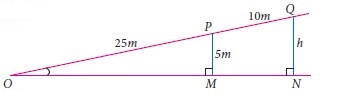
A boy standing at a point O finds his kite flying at a point P with distance OP = 25 m. It is at a height of 5m from the ground. When the thread is extended by 10 m from P, it reaches a point Q. What will be the height QN of the kite from the ground? (use trigonometric ratios)
11.
If cos A = \(\frac { 3 }{ 5 } \), then find the value of \(\frac { sinA-cosA }{ 2tanA } \)
12.
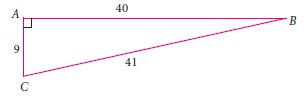
From the given figure, find all the trigonometric ratios of angle B.
13.
If the mid-point (x, y) of the line joining (3, 4) and (p, 7) lies on 2x + 2y +1 = 0 , then what will be the value of p?
14.
Solve the following linear equations
(i) \(\frac { 2(x+1) }{ 3 } =\frac { 3(x-2) }{ 5 } \)
(ii) \(\frac { 2 }{ x+1 } =4-\frac { x }{ x+1 } ,(x\neq -)\)
15.
Check whether \(\frac { 1 }{ 4 } \) is a solution of the equation 3(x + 1) = 3( 5–x) – 2( 5 + x).
16.
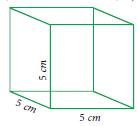
Find the Total Surface Area and Lateral Surface Area of the cube, whose side is 5 cm.
17.
Solve by cross multiplication method : 3x + 5y = 21; −7x − 6y = −49
18.
Draw the graph for the following
(i) y = 2x
(ii) y = 4x - 1
(iii) \(y=\left( \frac { 3 }{ 2 } \right) x+3\)
(iv) 3x + 2y = 14
19.
If (x, 3), (6, y), (8, 2) and (9, 4) are the vertices of a parallelogram taken in order, then find the value of x and y.
20.
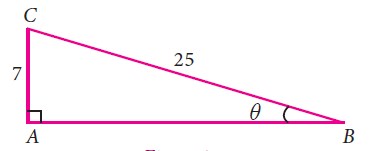
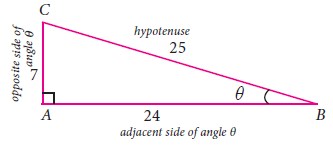
Find the six trigonometric ratios of the angle \(\theta\) using the given diagram.
21.
Find the area of a quadrilateral ABCD whose sides are AB = 8cm, BC = 15 cm, CD = 12 cm, AD = 25 cm and  = 90°.
22.
Solve 2x = −7y + 5; −3x = −8y −11 by cross multiplication method.
23.
Solve for x and y: 8x − 3y = 5xy, 6x − 5y = −2xy by the method of elimination.
24.
Find the values of the following:
(i) (cos 00 + sin 450 + sin 300)(sin 900 - cos 450 + cos 600)
(ii) tan2600 - 2tan2450 - cot2300 +2sin2300 + \(\frac { 3 }{ 4 } \) cosec2 450
25.
The sum of the digits of a given two digit number is 5. If the digits are reversed, the new number is reduced by 27. Find the given number.
26.
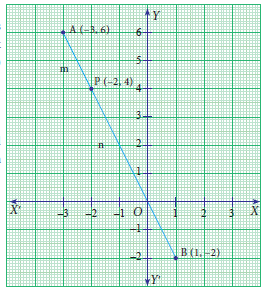
In what ratio does the point P(–2, 4) divide the line segment joining the points A(–3, 6) and B(1, –2) internally?
27.
Find the points of trisection of the line segment joining (−2, −1) and (4, 8)
28.
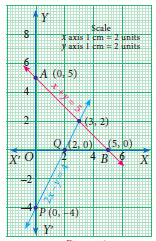
Use graphical method to solve the following system of equations x + y = 5; 2x – y = 4.
29.
(Graphing made easier!) Draw the graph of the line given by the equation y = 4x – 3.
30.
The six faces of the dice are called equally likely if the dice is _______.
Small
Fair
Six-faced
Round
31.
The perimeter of an equilateral triangle is 30 cm. The area is _______.
\(10\sqrt { 3 } \) cm2
\(12\sqrt { 3 } \) cm2
\(15\sqrt { 3 } \) cm2
\(25\sqrt { 3 } \) cm 2
32.
The probability based on the concept of relative frequency theory is called _______.
Empirical probability
Classical probability
Both (1) and (2)
Neither (1) nor (2)
33.
The value of \(\frac { 1-{ tan }^{ 2 }{ 45 }^{ 0 } }{ 1+{ tan }^{ 2 }{ 45 }^{ 0 } } \) is ________.
2
1
0
\(\frac { 1 }{ 2 } \)
34.
The value of \(\frac { tan15° }{ cot75° } \) is
cos 900
sin 300
tan 450
cos 300
35.
A pair of linear equations has no solution then the graphical representation is _______.


36.
Which of the following is a solution of the equation 2x − y = 6.
(2,4)
(4,2)
(3, −1)
(0,6)
37.
Find the value of m from the equation 2x + 3y = m. If its one solution is x = 2 and y = −2 .
2
-2
10
0
38.
The ratio in which the x-axis divides the line segment joining the points A(a1, b1) and B(a2, b2) is ______.
b1 : b2
−b1 : b2
a1 : a2
−a1 : a2
39.
If \(P(\frac{a}{3},\frac{b}{2})\)is the mid-point of the line segment joining A(−4, 3) and B(−2, 4) then (a, b) is ______.
(-9, 7)
\((-3, \frac{7}{2})\)
(9, -7)
\((3, -\frac{7}{2})\)
1.
l = 24 cm b = 12 cm h = 8 cm
Volume of the brick = l × b × h = (24 \(\times\) 12 \(\times\) 8) cm3= 2304 cm3
Wall dimensions are:
L = 20 m = 2000 cm
B = 48 cm
H = 6 m = 600 cm
No. of bricks required to build the wall = \(\frac { Volume\ of\ the\ wall }{ Volume\ of\ a\ bricks } \)
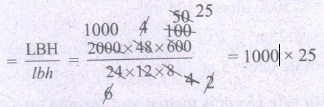
No. of bricks required = 25000
2.
Total number of families S = 1500
n(S) = 1569
Let P be the event of selecting a family having part time maids and F be the event of selecting a family having full time maids.
(i) Both types of maids Let P \(\cap\) F be the event of selecting a family having both types of maids.
Let (P \(\cap\) F) = 259
\(\mathrm{P}(\mathrm{P} \cap \mathrm{F})=\frac{\mathrm{n}(\mathrm{P} \cap \mathrm{F})}{\mathrm{n}(\mathrm{S})}=\frac{250}{1500}=\frac{1}{6}\)
(ii) Part time maids Part time maids = only part time maid + both
= 860 + 250 = 1110 '
n(P) = 1110
\(\mathrm{p}(\mathrm{P})=\frac{\mathrm{n}(\mathrm{P})}{\mathrm{n}(\mathrm{S})}=\frac{1110}{1500}=\frac{111}{150}\)
(iii) No maids Let (P \(\cup\) P)'be the event of choosing a family not having maids and (P u F) be the event of choosing a family having part time or full time or both maids.
n(P \(\cup\) F ) = only n(P) + only n(F) + n(p \(\cap\) p) = 850 + 370 + 250
n(P\(\cup\)F) = 1480
n(P\(\cup\)F)' = n(S)-n(P\(\cup\)F)
= 1500 - 1480
n(P \(\cup\) F)' = 20
\(\mathrm{P}(\mathrm{P} \cup \mathrm{F})^{\prime}=\frac{\mathrm{n}(\mathrm{P} \cup \mathrm{F})^{\prime}}{\mathrm{n}(\mathrm{S})}=\frac{20}{1500}=\frac{1}{75}\)
3.
(i) side of a cube = 8 m
TSA of the cube = 6a2 = 6 \(\times\) 64 = 384 m2
LSA of the cube = 4a2 = 4 \(\times\) 64 = 256 m2
(ii) side a = 21 cm
TSA= 6a2 = 6 \(\times\) 21 \(\times\) 21 = 2646 cm2.
LSA = 4a2 = 4 \(\times\) 21 \(\times\) 21 = 1764 cm2.
(iii) side a = 7.5 cm
TSA = 6a2 = 6 \(\times\) 7.5 \(\times\) 7.5 cm2 = 337.5 cm2
LSA = 4a2 = 4 \(\times\) 7.5 \(\times\) 7.5 cm2 = 225 cm2.
4.
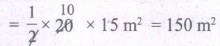
Area of the quadrilateral
= Area of Δ ABD + Area of Δ BCD
Δ ABD is right angled triangle
∴ Area = \(\frac{1}{2}\)b h
=
In Δ ABD, BD2= AD2 + AB2
= 152+ 202= 225 + 400 = 625 m2
BD =\(\sqrt { 625 } \) = 25 m
∴ In ΔBCD, s = \(\frac { 25+25+17 }{ 2 } \)
= \(\frac { 68 }{ 2 } \) = 4
Area of Δ BCD = \(\sqrt { s(s-a)(s-b)(s-c) } \)
= \(\sqrt { 34(34-25)(34-26)(34-17) } \)
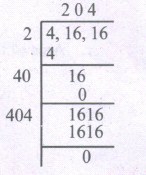
= \(\\ \sqrt { 34\times 9\times 8\times 17 } =\sqrt { 41616 } \)
∴ Area of the quadrilateral
= (150 + 204) m2 = 354 m2.
5.
Let the age of the father be x .
Let the sum of the age of his sons be y
At present x = 2y \(\Rightarrow\) x - 2y = 0
After 20 years x + 20 = y + 40
x-y = 40 -20
x-y = 20 ...(1)
(1) \(\Rightarrow\) x-2y = 0
(2) \(\Rightarrow\) \(\cfrac { x-y=20 }{ -y=-20 } \)
y = 20
Substitute y = 20 in (1)
x-2(20) = 0
x-40 = 0
x = 40
\(\therefore\) The age of the father is 40 years
6.
Perimeter of an equilateral triangle = 180 cm
∴ one side (a) = \(\\ \frac { 180 }{ 3 } \) = 60 cm.
Area of an equilateral triangle =\(\frac { \sqrt { 3 } }{ 4 } \) a2 sq.units
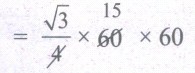
= 900\(\sqrt { 3 } \) m2
= 900 \(\times\) 1.732 = 1558.8 m2
7.
Let the time taken by the larger pipe be x hours
and Set the time taken by the smaller pipe be y hours.
\(\cfrac { 1 }{ x } +\cfrac { 1 }{ y } =\cfrac { 1 }{ 24 } \)
In 1 hour the larger pipe can fill it = \(\cfrac { 1 }{ x } \)
In 1 hour the smaller pipe can fill it = \(\cfrac { 1 }{ y } \)
\(\cfrac { 8 }{ x } +\cfrac { 18 }{ y } =\cfrac { 1 }{ 2 } \)
Put \(\cfrac { 1 }{ x } =a,\cfrac { 1 }{ y } =b\)
\(a+b\ =\cfrac { 1 }{ 24 } \)
24a + 24b = 1
24a + 24b - 1 = 0 ...(1)
8a + 18b = \(\cfrac { 1 }{ 2 } \)
16a+36b = 1
16a + 36b - 1 = 0 ..(2)
For cross multiplication method, we write the co-efficients as
\(\cfrac { a }{ -24+36 } =\cfrac { b }{ -16+24 } =\cfrac { 1 }{ 864-384 } \)
\(\cfrac { a }{ 12 } =\cfrac { b }{ 8 } =\cfrac { 1 }{ 480 } \)
\(\cfrac { a }{ 12 } =\cfrac { 1 }{ 480 } \ \) \( \cfrac { b }{ 8 } =\cfrac { 1 }{ 480 } \\ \)

\(\therefore\) x = 40, y = 60
8.
"The centroid of the triangle obtained by joining the mid points of the sides of a triangle is the same as the centroid of the original triangle."
\(\therefore\) The mid points of the sides of the triangle are given as
x1y1 , x2y, x3y3
\(\left( \frac { 3 }{ 2 } ,5 \right) \left( 7,\frac { -9 }{ 2 } \right) \left( \frac { 13 }{ 2 } ,\frac { -13 }{ 2 } \right) \)
\(\therefore\)Centroid \(=\left( \frac { { x }_{ 1 }+{ x }_{ 2 }+{ x }_{ 3 } }{ 3 } ,\frac { { y }_{ 1 }+{ y }_{ 2 }+{ y }_{ 3 } }{ 3 } \right) \)
\(=\left( \frac { \frac { 3 }{ 2 } +\frac { 7 }{ 1 } +\frac { 13 }{ 2 } }{ 3 } ,\frac { 5+\left( \frac { -9 }{ 2 } \right) +\frac { (-13) }{ 2 } }{ 3 } \right) =\left( \frac { \frac { 3+14+13 }{ 2 } }{ 3 } ,\frac { \frac { 10-9-13 }{ 2 } }{ 3 } \right) \)
\(=\left( \frac { \frac { 30 }{ 2 } }{ 3 } ,\frac { \frac { -12 }{ 2 } }{ 3 } \right) =\left( \frac { 15 }{ 3 } ,\frac { -6 }{ 3 } \right) =(5,-2)\)
9.
Centroid G (x,y) = (4, -2)
two vertices (x1, y1) = (3, -2)
(x2, y2) = (5, 2), (x3, y3) =?
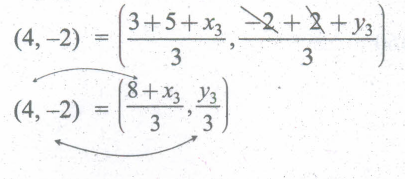
\(\frac { 8+{ x }_{ 3 } }{ 3 } =4\ \ \frac { { y }_{ 3 } }{ 3 } =-2\)
8 + x3 = 12 y3 = -6
x3 = 4
∴ The third vertex (x3, y3) = (4, -6)
10.
In the figure,
\(\triangle\)OPM, \(\triangle\)OQN are similar triangles. In similar triangles the sides are in the same proportion.
\(\cfrac { QN }{ PM } =\cfrac { QO }{ PO } \)
\(\cfrac { h }{ 5 } =\cfrac { 35 }{ 25 } \)
\(h=\cfrac { 5\times 35 }{ 25 } \)
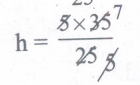
h = 7m
11.
\(sinA=\cfrac { 4 }{ 5 } \)
\(tanA=\cfrac { 4 }{ 3 } \)
\(\therefore \cfrac { sinA-cosA }{ 2tanA } =\cfrac { \frac { 4 }{ 5 } -\frac { 3 }{ 5 } }{ 2\times \frac { 4 }{ 3 } } =\cfrac { \frac { 1 }{ 5 } }{ 2\times \frac { 4 }{ 3 } } =\cfrac { 1 }{ 4 } \times \cfrac { 1 }{ 5 } \times \cfrac { 3 }{ 4 } =\cfrac { 3 }{ 40 } \)
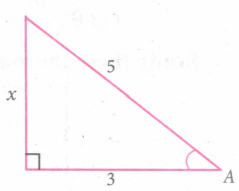
By the Pythagoras theorem
x=\(\sqrt { { 5 }^{ 2 }-{ 3 }^{ 2 } } \)
= \(\sqrt { 25-9 } \)
= \(\sqrt { 16 } =4\)
12.
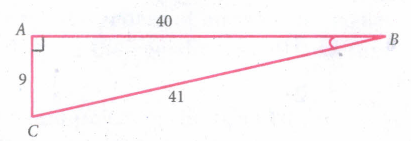
sin B = \(\frac { 9 }{ 41 } \);
cos B = \(\frac { 40 }{ 41 } \);
tan B =\(\frac { 9 }{ 40 } \) ;
cosec B = \(\frac { 1 }{ sinB } \) = \(\frac { 41 }{ 9 } \);
sec B =\(\frac { 1 }{ cotB } \) = \(\frac { 41 }{ 40 } \);
cot B =\(\frac { 1 }{ tanB } \) = \(\frac { 40 }{ 9 } \)
13.
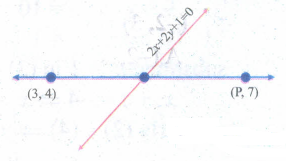
\(M(x,y)=\left( \frac { 3+p }{ 2 } ,\frac { 4+7 }{ 2 } \right) \)
\(\frac { 3+p }{ 2 } =x\quad \frac { 4+7 }{ 2 } =y\)
\(y=\frac { 11 }{ 2 } \)
substitute the values of (x, y) in 2x + 2y +1 = 0
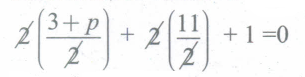
3 + p + 11 + 1 = 0
P + 15 = 0
p = -15
14.
(i) \(\cfrac { 2x+2 }{ 3 } =\cfrac { 3x-6 }{ 5 } \)
5(2x+2) = 3(3x - 6) [By cross multiplication]
10x + 10 = 9x - 18
10x = 9x - 18 - 10
10x = 9x-28
10x- 9x = -28
x = -28
(ii)
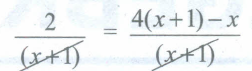
2 = 4 (x + 1)-x
2 = 4x+4-x
3x + 4 = 2'
3x+4-4 = 2-4
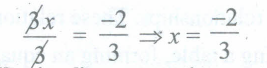
3x =-2
15.
\(3\left( \cfrac { 1 }{ 4 } +1 \right) =3\left( 5-\cfrac { 1 }{ 4 } \right) -2\left( 5+\cfrac { 1 }{ 4 } \right) \)
\(3\left( \cfrac { 5 }{ 4 } \right) =3\left( \cfrac { 20-1 }{ 4 } \right) -2\left( \cfrac { 20+1 }{ 4 } \right) \)
\(\cfrac { 15 }{ 4 } =\cfrac { 57 }{ 4 } -\cfrac { 42 }{ 4 } \)
\(\cfrac { 15 }{ 4 } =\cfrac { 15 }{ 4 } \)
Yes \(\cfrac { 1 }{ 4 } \) is a solution of the given equation
16.
The side of the cube (a) = 5 cm
Total Surface Area = 6a2 = 6(52) = 150 sq. cm
Lateral Surface Area = 4a2 = 4(52) = 100 sq. cm
17.
The given system of equations are 3x + 5y − 21 = 0; −7x − 6y + 49 = 0
Now using the coefficients for cross multiplication, we get,
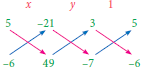
\(\Rightarrow \frac { x }{ (5)(49)-(-6)(-21) } =\frac { y }{ (-21)(-7)-(49)(3) } =\frac { 1 }{ (3)(-6)-(-7)(5) } \)
\(\frac { x }{ 119 } =\frac { y }{ 0 } =\frac { 1 }{ 17 } \)
\(\Rightarrow \frac { x }{ 119 } =\frac { 1 }{ 17 } ,\frac { y }{ 0 } =\frac { 1 }{ 17 } \)
\(\Rightarrow x=\frac { 119 }{ 17 } ,y=\frac { 0 }{ 17 } \)
\(\Rightarrow\) x = 7, y = 0
Verification :
3x + 5y = 21 ...(1)
3(7) + 5(0) = 21
21 + 0 = 21
21 = 21 True
-7x - 6y = -49 ...(2)
-7(7) - 6(0) = - 49
-49 = -49
-49 = -49 True
18.
(i) y = 2x
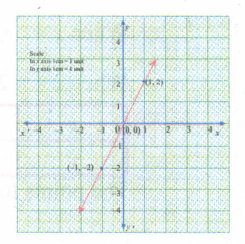
Put x = -1, y = 2 \(\times\) - 1 = -2
When x = 0, y = 2 \(\times\) 0 = 0
When x = 1, y = 2 \(\times\)- 1 = 2
| x | -1 | 0 | 1 |
| y | -2 | 0 | 2 |
The points (x,y) to be plotted.
(ii) y = 4x - 1
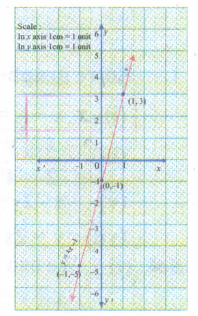
When x = -1\(\Rightarrow\) y = 4(-1)-1
y = -4 - 1 = -5
x = 0 \(\Rightarrow\) y = 4 \(\times\)0 -1 = -1
x = 1 \(\Rightarrow\) y = 4\(\times\)1 -1 = 3
| x | -1 | 0 | 1 |
| y | -5 | -1 | 3 |
The points (x, y) to be plotted:
(-1, -5), (0, -1), (1, 3)
(iii) \(y=\left( \frac { 3 }{ 2 } \right) x+3\)
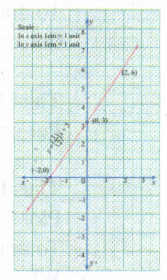
\(x=-2\Rightarrow y=\left( \cfrac { 3 }{ 2 } \right) \left( 2 \right) +3\)
= -3 + 3 = 0
\(x=0\Rightarrow y=\left( \cfrac { 3 }{ 2 } \right) \left( 0 \right) +3\)
y = 0 + 3 = 3
\(x=2\Rightarrow y=\left( \cfrac { 3 }{ 2 } \right) \left( 2 \right) +3\)
= 3 + 3
y = 6
| x | -2 | 0 | 2 |
| y | 0 | 3 | 6 |
The points to be plotted
(-2, 0), (0, 3),(2, 6)
(iv) 3x + 2y = 14
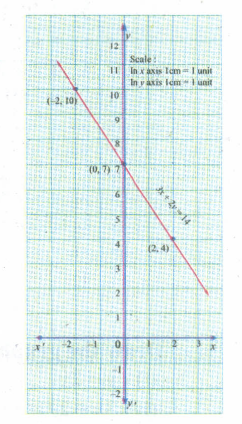
2y = -3x + 14
\(y=\cfrac { -3x+14 }{ 2 } \)
\(\Rightarrow y=\left( \cfrac { -3 }{ 2 } \right) \left( 0 \right) +7=7\)
When x = -2, \(y=\left( \cfrac { -3 }{ 2 } \right) \left( -2 \right) +7=3+7=10\)
When x = 0 , \(y=\left( \cfrac { -3 }{ 2 } \right) \left( 0 \right) +7=7\)
When x = 2, y = -3 +7 = 4
| x | -2 | 0 | 2 |
| y | 10 | 7 | 4 |
The points to be plotted (-2, 10), (0, 7), (2, 4)
19.
Let A(x, 3), B(6, y), C(8, 2) and D(9, 4) be the vertices of the parallelogram ABCD. By definition, diagonals AC and BD bisect each other.
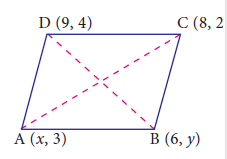
Mid-point of AC = Mid-point of BD
\(\left( \frac { x+8 }{ 2 } ,\frac { 3+2 }{ 2 } \right) =\left( \frac { 6+9 }{ 2 } ,\frac { y+4 }{ 2 } \right) \)
equating the coordinates on both sides, we get
\(\frac { x+8 }{ 2 } =\frac { 15 }{ 2 } \)
x + 8 = 15
x = 7
\(\frac { 5 }{ 2 } =\frac { y+4 }{ 2 } \)
5 = y + 4
y = 1
Hence, x = 7 and y = 1.
20.
By Pythagoras theorem,
\(AB=\sqrt { { BC }^{ 2 }{ AC }^{ 2 } } \)
= \(\sqrt { { \left( 25 \right) }^{ 2 }-{ 7 }^{ 2 } } \)
= \(\sqrt { 625-49 } =\sqrt { 576 } \) = 24
The six trigonometric ratios are
\(sin\theta =\frac { opposite\ side }{ hypotenuse } =\frac { 7 }{ 25 } \)
\(tan\theta =\frac { oppositeside }{ adjacent\ side } =\frac { 7 }{ 24 } \)
\(sec\theta =\frac { hypotenuse }{ adjacent\ side } =\frac { 25 }{ 24 } \)
\(cos\theta =\frac { adjacentside }{ hypotenuse } =\frac { 24 }{ 25 } \)
\(cosec\theta =\frac { hypotenuse }{ oppositeside } =\frac { 25 }{ 7 } \)
\(cot \theta\ \frac { adjacentside }{ oppositeside } =\frac { 24 }{ 7 } \)
21.
In the quadrilateral ABCD, join one of the diagonals, say AC.
Area of \(\triangle\)ABC = \(\frac{1}{2}\)\(\times\) base \(\times\) height
=\(\frac{1}{2}\)\(\times\)8\(\times\)15\(\times\) 60 cm2
By Pythagoras theorem, in right angled triangle ABC,
AC2 = AB2 + BC2
= 82 +152 = 64 + 225 = 289 cm
Therefore, AC =\(\sqrt{289}\) =17cm
Now, for\(\triangle\)ACD, let us consider a = 17 cm, b =12 cm, c =25 cm
then, s = \(\frac{a+b+c}{2}=\frac{17+12+25}{2}=\frac{54}{2}\) = 27cm
.PNG)
Area of \(\triangle\)ACD =\(\sqrt { s(s-a)(s-b)(s-c) } \)
=\(\sqrt{27(27-17)(27-12)(27-25)}\)
=\(\sqrt{27\times10\times15\times2}\)
=\(\sqrt{3\times3\times3\times2\times5\times5\times3\times2}\)
= 3 × 3 × 2 × 5 = 90cm2
Therefore, Area of quadrilateral ABCD
=Area of \(\triangle\)ABC + Area of \(\triangle\)ACD
= 60 + 90 = 150 cm2
22.
The given system of equations can be written as
2x + 7y − 5 = 0
−3x + 8y +11 = 0
For the cross multiplication method, we write the coefficients as
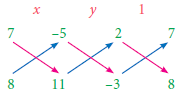
\(\frac { x }{ (7)(11)-(8)(-5) } =\frac { y }{ (-5)(-3)-(11)(2) } =\frac { 1 }{ (2)(8)-(-3)(7) } \)
\(\frac { x }{ 77+40 } =\frac { y }{ 15-22 } =\frac { 1 }{ 16+21 } \)
\(\frac { x }{ 117 } =\frac { y }{ -7 } =\frac { 1 }{ 37 } \)
\(\frac { x }{ 117 } =\frac { 1 }{ 37 } ,\frac { y }{ -7 } =\frac { 1 }{ 37 } \)
Hence the solution is \(\left( \frac { 117 }{ 37 } ,\frac { -7 }{ 37 } \right) \)
Verification:
2x + 7y -5 = 0 .....(1)
\(2\left( \frac { 117 }{ 37 } \right) +7\left( \frac { -7 }{ 37 } \right) -5=0\)
\(\frac { 234 }{ 57 } -\frac { 49 }{ 37 } -5=0\)
\(\frac { 185 }{ 37 } -5=0\)
5 - 5 =0 True
3x+8y+11 = 0 ...(2)
\(3\left( \frac { 117 }{ 37 } \right) +8\left( \frac { -7 }{ 37 } \right) +11=0\)
\(\frac { -351 }{ 37 } -\frac { 56 }{ 37 } +11=0\)
\(\frac { -407 }{ 37 } +11=0\)
-11 + 11 = 0 True
23.
The given system of equations are 8x − 3y = 5xy ...(1)
6x − 5y = −2xy ...(2)
Observe that the given system is not linear because of the occurrence of xy term. Also note that if x =0, then y =0 and vice versa. So, (0,0) is a solution for the system and any other solution would have both x \(\neq \) 0 and y \(\neq \) 0
Let us take up the case where x \(\neq \) 0 and y \(\neq \) 0
Dividing both sides of each equation by xy,
\(\frac { 8x }{ xy } -\frac { 3y }{ xy } =\frac { 5xy }{ xy } \)
\(\frac { 6x }{ xy } -\frac { 5y }{ xy } =\frac { -2xy }{ xy } \)
Let \(a=\frac { 1 }{ x } ,b=\frac { 1 }{ y } \)
We get, \(\frac { 8 }{ y } -\frac { 3 }{ x } =5\) .....(3)
\(\frac { 6 }{ y } -\frac { 5 }{ x } =-2\) .......(4)
(3)&(4) respectively become, 8b − 3a = 5 ...(5)
b − 5a = −2 ...(6)
which are linear equations in a and b.
To eliminate a, we have, (5) \(\times\) 5\(\Rightarrow\) 40b −15a = 25 .....(7)
(6) × 3\(\Rightarrow\) 18b −15a = −6 .....(8)
Now proceed as in the previous example to get the solution\(\left( \frac { 11 }{ 23 } ,\frac { 22 }{ 31 } \right) \).
Thus, the system have two solutions \(\left( \frac { 11 }{ 23 } ,\frac { 22 }{ 31 } \right) \) and (0,0).
24.
(i) (cos00 + sin 450 + sin 300) (sin 900 - cos 450 + cos 600)
= \(\left[ 1+\frac { 1 }{ \sqrt { 2 } } +\frac { 1 }{ 2 } \right] \left[ 1-\frac { 1 }{ \sqrt { 2 } } +\frac { 1 }{ 2 } \right] \)
= \(\left[ \frac { 2\sqrt { 2 } +2+\sqrt { 2 } }{ 2\sqrt { 2 } } \right] \left[ \frac { 2\sqrt { 2 } -2+\sqrt { 2 } }{ 2\sqrt { 2 } } \right] =\left[ \frac { 3\sqrt { 2 } +2 }{ 2\sqrt { 2 } } \right] \left[ \frac { 3\sqrt { 2 } -2 }{ 2\sqrt { 2 } } \right] \)
= \(\frac { 18-4 }{ 4\left( \sqrt { 2 } \right) ^{ 2 } } =\frac { 14 }{ 4\times 2 } =\frac { 7 }{ 4 } \)
(ii) tan2600 - 2tan2450 - cot2300 +2sin2300 + \(\frac { 3 }{ 4 } \) cosec2450
= \(\left( \sqrt { 3 } \right) ^{ 2 }-2(1)^{ 2 }-\left( \sqrt { 3 } \right) ^{ 2 }+2\left( \frac { 1 }{ 2 } \right) ^{ 2 }+\frac { 3 }{ 4 } \left( \sqrt { 2 } \right) ^{ 2 }\)
= \(3-2-3+\frac { 1 }{ 2 } +\frac { 3 }{ 2 } \)
= -2 + \(\frac { 4 }{ 2 } \) = -2 + 2 = 0
25.
Let x be the digit at ten’s place and y be the digit at unit place.
Given that x + y = 5 …… (1)
| Tens | Ones | Value | |
| Given Number | x | y | 10x + y |
| New Number (after reversal) |
y | x | 10y + x |
Given, Original number − reversing number = 27
(10x + y) − (10y + x) = 27
10x − x + y −10y = 27
9x − 9y = 27
\(\Rightarrow\) x − y = 3 ... (2)
Also from (1), y = 5 – x ... (3)
Substitute (3) in (2) to get x − (5 − x) = 3
x − 5 + x = 3
2x = 8
x = 4
Substituting x = 4 in (3), we get y = 5 − x = 5 − 4
y = 1
Thus, 10x + y = 10 × 4 +1 = 40 +1 = 41.
Therefore, the given two-digit number is 41.
Verification :
sum of the digits = 5
x + y = 5
4 + 1 = 5
5 = 5 true
Original number – reversed number = 27
41 - 14 = 27
27 = 27 true
26.
Given points are A(–3, 6) and B(1, –2), P(–2, 4) divide AB internally in the ratio m : n.
By section formula,
\(P(x, y)=P\left(\frac{m x_{2}+n x_{1}}{m+n}, \frac{m y_{2}+n y_{1}}{m+n}\right)\)
= P(−2, 4) .......(1)
Here x1 = −3, y1 = 6, x2 = 1, y2 = −2
\((1)\Rightarrow \left( \frac { m(1)+n(-3) }{ m+n } ,\frac { m(-2)+n(6) }{ m+n } \right) \)
Equating x-coordinates, we get
\(\frac{m-3 n}{m+n}=-2\) or m− 3n = −2m− 2n
3m = n
\(\frac{m}{n}=\frac{1}{3}\)
m : n = 1: 3
Hence P divides AB internally in the ratio 1 : 3.
27.
Let A(−2, −1) and B(4, 8) are the given points.
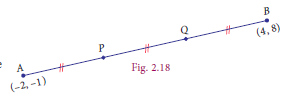
Let P(a,b) and Q(c,d) be the points of trisection of AB, so that AP = PQ = QB .
By the formula proved above,
P is the point.
\(\left( \frac { { x }_{ 2 }+{ 2x }_{ 1 } }{ 3 } ,\frac { { y }_{ 2 }+{ 2y }_{ 1 } }{ 3 } \right) =\left( \frac { 4+2(-2) }{ 3 } ,\frac { 8+2(-1) }{ 3 } \right) \) = (0, 2)
Q is the point
\(\left( \frac { { 2x }_{ 2 }+{ x }_{ 1 } }{ 3 } ,\frac { {2 y }_{ 2 }+{ y }_{ 1 } }{ 3 } \right) =\left( \frac { 2(4)-2 }{ 3 } ,\frac { 2(8)-1 }{ 3 } \right) \) = (2, 5)
28.
Given x + y = 5 ...(1)
2x – y = 4 ...(2)
To draw the graph (1) is very easy. We can find the x and y intercepts and thus two of the points on the line (1).
When x = 0, (1) gives y = 5.
Thus A(0,5) is a point on the line.
When y = 0, (1) gives x = 5.
Thus B(5,0) is another point on the line.
Plot A and B; join them to produce the line (1).
To draw the graph of (2), we can adopt the same procedure.
When x = 0, (2) gives y = −4.
Thus P(0,−4) is a point on the line.
When y = 0, (2) gives x = 2.
Thus Q(2,0) is another point on the line.
Plot P and Q; join them to produce the line (2).
The point of intersection (3, 2) of lines (1) and (2) is a solution.
The solution is the point that is common to both the lines. Here we find it to be (3,2). We can give the solution as x = 3 and y = 2.
29.
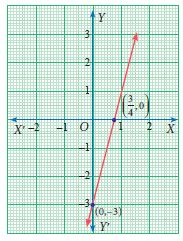
We have already come across one method: forming a table of values, listing and plotting ordered pairs and joining the points.
But, to fix a line, after all, how many points do we need? Just two! These can easily be obtained when a line is given in the form y = mx + c.
The given line y = 4x – 3
put x = 0 to get y-intercept
y = 4(0)–3
y = –3
point is (0, –3) and y-intercept = – 3
put y = 0 to get x-intercept
0 = 4x – 3
3 = 4x
\(\frac { 3 }{ 4 } =x\)
point is \(\left( \frac { 3 }{ 4 } ,0 \right) \) and x-intercept = \(\frac { 3 }{ 4 } \)
The graph may be drawn through two points (0,−3) and \(\left( \frac { 3 }{ 4 } ,0 \right) \)
30.
(b)
Fair
31.
(d)
\(25\sqrt { 3 } \) cm 2
32.
(a)
Empirical probability
33.
(c)
0
34.
(c)
tan 450
35.
(b)
36.
(b)
(4,2)
37.
(b)
-2
38.
(b)
−b1 : b2
39.
(a)
(-9, 7)

9th Standard Syllabus & Materials
9th Standard
TN 9th Tamil உள்ளத்தின் சீர் - திருக்குறள் Important Questions And Answers Study Material - QB365 Set A
NEW9th Standard
TN 9th Tamil உள்ளத்தின் சீர் - மணிமேகலை Important Questions And Answers Study Material - QB365 Set A
NEW9th Standard
TN 9th Tamil உள்ளத்தின் சீர் - ஏறு தழுவுதல் Important Questions And Answers Study Material - QB365 Set A
NEW9th Standard
TN 9th Tamil உயிருக்கு வேர் - தண்ணீர் Important Questions And Answers Study Material - QB365 Set A



Tamilnadu Stateboard 9th Standard Subjects
Tamilnadu Stateboard Standards





