
 100% FREE ACCESS
9th Standard Syllabus & Materials
9th Standard
TN 9th Tamil உள்ளத்தின் சீர் -கற்கண்டு (இலக்கணம்) - தொடர் இலக்கணம், ஆகுபெயர் Important Questions And Answers Study Material - QB365 Set A
NEW9th Standard
TN 9th Tamil உள்ளத்தின் சீர் -விரிவானம் (துணைப்பாடம்) - தாய்மைக்கு வறட்சி இல்லை! Important Questions And Answers Study Material - QB365 Set A
NEW9th Standard
TN 9th Tamil உள்ளத்தின் சீர் -கவிதை பேழை (செய்யுள்) - மார்கழி பெருவிழா Important Questions And Answers Study Material - QB365 Set A
NEW9th Standard
TN 9th Tamil உயிருக்கு வேர்-இலக்கணம் - பகுபத உறுப்பிலக்கணம் Important Questions And Answers Study Material - QB365 Set A
NEW9th Standard
TN 9th Tamil அமுதென்று பேர் - இலக்கணம்-எழுத்து -அளபெடை Important Questions And Answers Study Material - QB365 Set A
NEW9th Standard
TN 9th Tamil அமுதென்று பேர்-துணைப்பாடம் - ஆறாம்திணை Important Questions And Answers Study Material - QB365 Set A

Published on: 07/12/2019
Atomic Structure
Download Tamil Nadu 9th Standard Science question papers, model tests, one-mark questions, important questions, and public exam papers in PDF format. Free study materials and answer keys for TN State Board students.
Questions + Answers key
Take MCQ Science Test1.
Gay-Lussac law always dealing with________
Solids
Liquids
Gases
Semi-solids
2.
Our bodies contain radioisotopes such as ___________which continuously emit radiation.
Potassium 40
Iodine 131
Cobalt 60
Carbon 14
3.
The electronic configuration of Neon is 2, 8. So the valency is _________
2
8
0
10
4.
Atoms of the same element having same atomic number but different Mass number are called _________
Isotopes
Isobars
Isotones
Isotherm
5.
Protons and neutrons are collectively called as ________
mesons
neutrino
Nucleons
Positrons
6.
Calculate the number of electrons present in the third (M) and fourth (N) orbits
7.
An atom is electrically neutral. Why?
8.
Name the other particles present in the Nucleus of an atom.
9.
What are nucleons?
10.
Define an orbit.
11.
Define quantum numbers
12.
Assign the valency of magnesium and sulphur
13.
Define Isotones with examples.
14.
Why do some isotopes show radioactivity? Give example.
15.
Calculate the atomic number of an element whose mass number is 40 and number of neutron is 20. Also find the name of the element.
16.
Write the characteristics of fundamental particles
17.
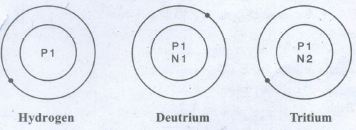
What are isotopes? Write the isotopes of Hydrogen
18.
Write about quantum numbers.
19.
What is electronic configuration? Write the Bohr-Bury Rule of electronic configuration.
1.
(c)
Gases
2.
(a)
Potassium 40
3.
(c)
0
4.
(a)
Isotopes
5.
(c)
Nucleons
6.
(M) (n = 3) 2 x 32 = 18 electrons
(N) (n = 4) 2 x 42 = 32 electrons
7.
An atom is electrically neutral because the number of protons is equal to the number of electrons.
8.
Mesons, neutrino, antineutrino, positrons are present in the nucleus of an atom.
9.
The proton and neutrons are collectively called as nucleons.
10.
Orbit is defined as the path by which electrons revolve around the nucleus.
11.
The number which designate and distinguish various atomic orbitals and electrons present in an atom are called quantum numbers.
12.
Electronic configuration of Magnesium is 2, 8, 2. So the valency is 2.
Electronic configuration of Sulphur is 2, 8, 6. So the valency is 2(8 - 6).
13.
Atoms of different elements with different atomic numbers, which have the same mass number are known as isobars. Atomic number of calcium is 20 and Argon is 18, but the mass number of both these elements is 40.
14.
When the number of neutrons exceeds the number of protons in the nucleus of an atom, some nuclei become unstable. These nuclei emit certain type of radiations. They are known as radioactive isotopes. Example: H3 and C14.
15.
Mass number = Atomic number + Number of neutrons
Atomic number = Mass number - Number of neutrons = 40 - 20
Atomic number = 20
Element having Atomic number 20 is calcium.
16.
| Particle | Mass | Charge | Location | Mass relative to Hydrogen atom | |
|---|---|---|---|---|---|
| Unit | Coulomb | ||||
| Electron | 9.108 x10⁻²⁸ g | -1 | -1.602 x10⁻¹⁹ | orbit | 1/1837 |
| Proton | 1.672 x 10⁻²⁴ g | +1 | 1.602 x 10⁻¹⁹ | Nucleus | 1 |
| Neutron | 1.674 x 10⁻²⁴ g | 0 | -- | Nucleus | 1 |
17.
| Atomic mass | Mass number | Number of proton | Number of electron | Number of neutron | |
|---|---|---|---|---|---|
| Hydrogen (H) | 1.008 amu | 1 | 1 | 1 | - |
| Deuterium (D) | 2.016 amu | 2 | 1 | 1 | 1 |
| Tritium (T) | 2.016 amu | 3 | 1 | 1 | 2 |
18.
A quantum number describes a specific aspect of an electron.
1. Principal quantum number (n) - Tells how far is the electron from the nucleus.
2. Azimuthal quantum number (l) - Tells which orbital does it occupy and what is its shape.
3. Magnetic quantum number (m) - how this orbital is oriented in space.
4. Spin quantum number (s) : What kind of spin the electron has.
19.
The systematic arrangement of electrons in various shells or orbit in an atom is called the electronic configuration.
Bohr-Bury Rule of electronic configuration:
Rule 1: The maximum number of electrons that can be accommodated in a shell is equal to 2n2 where 'n' is the quantum number of the shell.
Rule 2: Shells are filled in a stepwise manner in the increasing order of energy.
Rule 3: The outermost shell cannot have more than 8 electrons and the next inner, i.e., the penultimate shell cannot have more than 18 electrons

9th Standard Syllabus & Materials
9th Standard
TN 9th Tamil உள்ளத்தின் சீர் - திருக்குறள் Important Questions And Answers Study Material - QB365 Set A
NEW9th Standard
TN 9th Tamil உள்ளத்தின் சீர் - மணிமேகலை Important Questions And Answers Study Material - QB365 Set A
NEW9th Standard
TN 9th Tamil உள்ளத்தின் சீர் - ஏறு தழுவுதல் Important Questions And Answers Study Material - QB365 Set A
NEW9th Standard
TN 9th Tamil உயிருக்கு வேர் - தண்ணீர் Important Questions And Answers Study Material - QB365 Set A



Tamilnadu Stateboard 9th Standard Subjects
Tamilnadu Stateboard Standards





