
 100% FREE ACCESS
9th Standard Syllabus & Materials
9th Standard
TN 9th Tamil உள்ளத்தின் சீர் -கற்கண்டு (இலக்கணம்) - தொடர் இலக்கணம், ஆகுபெயர் Important Questions And Answers Study Material - QB365 Set A
NEW9th Standard
TN 9th Tamil உள்ளத்தின் சீர் -விரிவானம் (துணைப்பாடம்) - தாய்மைக்கு வறட்சி இல்லை! Important Questions And Answers Study Material - QB365 Set A
NEW9th Standard
TN 9th Tamil உள்ளத்தின் சீர் -கவிதை பேழை (செய்யுள்) - மார்கழி பெருவிழா Important Questions And Answers Study Material - QB365 Set A
NEW9th Standard
TN 9th Tamil உயிருக்கு வேர்-இலக்கணம் - பகுபத உறுப்பிலக்கணம் Important Questions And Answers Study Material - QB365 Set A
NEW9th Standard
TN 9th Tamil அமுதென்று பேர் - இலக்கணம்-எழுத்து -அளபெடை Important Questions And Answers Study Material - QB365 Set A
NEW9th Standard
TN 9th Tamil அமுதென்று பேர்-துணைப்பாடம் - ஆறாம்திணை Important Questions And Answers Study Material - QB365 Set A

Published on: 29/12/2018
Term 2 FA(B) Model Exam
Download Tamil Nadu 9th Standard Science question papers, model tests, one-mark questions, important questions, and public exam papers in PDF format. Free study materials and answer keys for TN State Board students.
Questions + Answers key
Take MCQ Science Test1.
Statement: Elements in a group generally possess similar properties but elements along a period have different properties.
Reason: The difference in electronic configuration makes the element differ in their chemical properties along a period.
a) Statement is true and reason explains the statement.
b) Statement is false but the reason is correct.
2.
Mark the correct choice as:
(a) If both assertion and reason are true and reason is the correct explanation of assertion.
(b) If both assertion and reason are true but reason is not the correct explanation of assertion.
(c) If assertion is true but reason is false.
(d) If assertion is false but reason is true.
Assertion: Maximum sunlight reaches earth’s surface during the afternoon time.
Reason: Heat from the sun reaches earth’s surface by radiation.
3.
Explain the structure of kidney and the steps involved in the formation of urine
4.
Write about the elements of Xylem.
5.
Plaster of Paris should be stored in a moisture proof container. why?
6.
List down the differences between Ionic and Covalent compounds.
7.
State any five features of modern periodic table.
8.
Explain the principle, construction and working of a dc motor.
9.
Draw a circuit with a 2\(\Omega\) and 5\(\Omega\) resistors in series. Connect another 3\(\Omega\) resistor parallel to the above connection.
10.
What are the changes of state in water? Explain.
11.
Complete the following table referring the modern periodic table:
| Period number | Total no of elements | Elements | Total no of elements in | ||||
| From | To | s-block | p-block | d-block | f-block | ||
| 1 | |||||||
| 2 | |||||||
| 3 | |||||||
| 4 | |||||||
| 5 | |||||||
| 6 | |||||||
| 7 | |||||||
12.
Complete the missing terms in the following table:
| Process | Phase I | Phase II |
| Sublimation | Vapour | |
| Solidification | Solid | |
| Solid | Liquid | |
| Freezing | Liquid | |
| Condensation | Liquid |
13.
Name the connective tissue with a fluid matrix.
14.
State modern periodic law.
15.
Draw and label the diagram of an AC generator.
16.
Define magnetic flux density.
17.
What is the effective resistance across the terminals a and b of the arrangement of resistors?

18.
How much heat energy is required to change 2 kg of ice at 0ºC into water at 20ºC? (Specific latent heat of fusion of water = 3,34,000 J/kg, Specific heat capacity of water = 4200JKg-1K-1).
19.
Name the parts of a computer
20.
Why is meiosis called reductional division and mitosis as equational division?
21.
Two acids ‘A’ and ‘B’ are given. Acid A gives one hydrogen ion per molecule of the acid in solution. Acid B gives two hydrogen ions per molecule of the acid in solution.
(i) Find out the acid A and acid B.
(ii) Which acid is called the King of Chemicals?
22.
Find the odd one out.
(i) H2, Cl2, NaCl, O2, N2
(ii) H2O2, MnO4–, LiAlH4, Cr2O72–
23.
What are the limitations of Mendeleev's periodic table?
24.
State Faraday’s laws of electromagnetic induction.
25.
Name any two appliances which work under the principle of heating effect of current.
26.
Identify the following parts:
1. It conducts food from pharynx to stomach by peristalsis-
2. Finger-like projections which enhances the absorbing capacity of small intestine-
3. The bunch of capillaries inside the Bowman’s capsule-
4. Thin muscular tubes which carry urine from kidney to urinary bladder-
5. Small sac-like muscular structures that encloses testes-
27.
Match the parts of the given figure with the correct option.
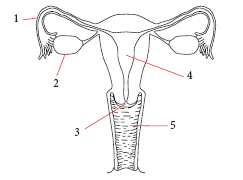
| 1 | 2 | 3 | 4 | 5 |
| a.Fallopian tube | Oviduct | Uterus | Cervix | Vagina |
| b.Oviduct | Cervix | Vagina | Ovary | Vas deferens |
| c.Ovary | Oviduct | Uterus | Vagina | Cervix |
| d.Fallopian tube | Ovary | Cervix | Uterus | Vagina |
28.
Electric field lines________ from positive charge and__________ in negative charge.
start; start
end; start
start; end
end; end
29.
Unstriated muscles are found in
blood vessels
gastrointestinal tract
urinary bladder
all of these
30.
The hydrated salt of copper sulphate has______colour
Red
White
Blue
Pink
31.
Number of valence electrons in carbon is
2
3
4
5
32.
The specific heat capacity of water is
4200 Jkg-1K-1
420 Jg-1K-1
0.42 Jg-1K-1
4.2 Jkg-1K-1
33.
Electrons move from__________ potential to __________ potential
34.
During pairing of chromosomes in meiosis, the _______ chromosomes come to lie side by side.
35.
A device for producing electric current is_________.
36.
Parenchyma is a simple tissue
37.
The speed of rotation of an electric motor can be increased by decreasing the area of the coil
1.
a) Statement is true and reason explains the statement.
2.
b. If both assertion and reason are true but reason is not the correct explanation of assertion.
Correct explanation: When the sun is at its highest point, the earth's surface absorbs more heat and retains. This heat is slowly radiated out causing increase in temperature.
3.
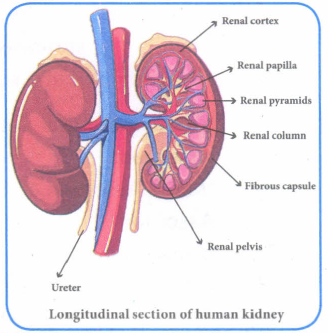
Kidneys:
(i) Kidneys are bean-shaped organs reddish brown in colour.
(ii) The kidneys lie on either side of the vertebral column in the abdominal cavity attached to the dorsal body wall.
(iii) The right kidney is placed lower than the left kidney as the liver takes up much space on the right side.
(iv) Each kidney is about 11 cm long, 5 cm wide and 3 cm thick.
(v) Internally the kidney consists of an outer dark region, the cortex and an inner lighter region, the medulla.
(vi) The medulla consists of multitubular conical masses called the medullary pyramids or renal pyramids whose base are adjacent to cortex.
(vii) On the inner concave side of each kidney, a notch called hilum is present through which blood vessels and nerves enter in and the urine leaves through the ureter.
Process of Urine formation:
The process of urine formation includes the following three stages.
(i) Glomerular filtration
(ii) Tubular reabsorption and
(iii) Tubular secretion
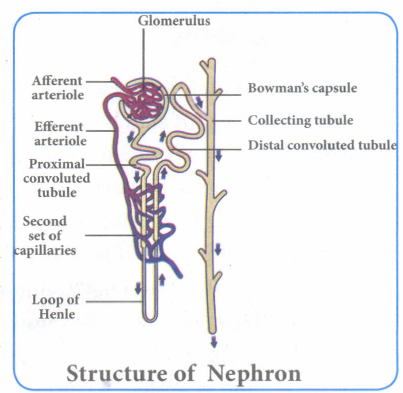
Glomerular filtration: Urine formation begins with the filtration of blood through epithelial walls of the glomerulus and Bowman's capsule. The filtrate is called as the glomerular filtrate. Both essential and non-essential substances present in the blood are filtered.
Tubular reabsorption: The filtrate in the proximal tubule consists of essential substances such as glucose, amino acids, vitamins, sodium, potassium, bicarbonates and water that are reabsorbed into the blood by a process of selective reabsorption.
Tubular secretion: Substances such as H+ or K+ ions are secreted into the tubule. Certain substances like potassium and a large number of drugs like penicillin and aspirin are passed into the filtrate in the distal convoluted tubule. This tubular filtrate is finally known as urine, which is hypertonic in man. Finally the urine passes into collecting ducts to the pelvis and through the ureter into the urinary bladder by urethral peristalsis (waves of constriction in the ureters). When the urinary bladder is full the urine is expelled out through the urethra. This process is called micturition
4.
Xylem:
(i) Xylem is a conducting tissue which conducts water, mineral nutrients upward from root to leaves.
(ii) Xylem is composed of different kinds of elements. They are (1) xylem tracheids (2) xylem fibres (3) xylem vessels and (4) xylem parenchyma
(1) Xylem tracheids
(i) They are elongated or tube-like dead cells with hard, thick and lignified walls.
(ii) Their ends are tapering, blunt or chisel-like and devoid of protoplast. They have large lumen without any content.
(iii) Their function is conduction of water and providing mechanical support to the plant.
(2) Xylem fibres
(i) These cells are elongated, lignified and pointed at both the ends.
(ii) Xylem fibres help in conduction of water and nutrients from root to the leaf and also provide mechanical support to the plant.
(3) Xylem vessels
(i) They are long cylindrical, tube like structures with lignified walls and wide central lumen.
(ii) These cells are dead as these do not have protoplast.
(iii) They are arranged in longitudinal series in which the partitioned walls (transverse walls) are perforated, and so the entire structure looks-like a water pipe.
(iv) Their main function is transport of water and minerals from root to leaf, and also to provide mechanical strength.
(4) Xylem parenchyma
Its cells are living and thin walled. The main function of xylem parenchyma is to store starch and fatty substances.
5.
Plaster of paris should be stored in a moisture-proof container as it absorbs water from moisture present in air and turn into hard substance (Gypsum).
6.
| S.No | Ionic Compounds | Covalent Compounds |
| 1. | Formed by the transfer of electrons from a metal to a non-metal atom. | Formed by sharing of electrons between non-metal atoms. |
| 2. | Strong electrostatic force of attraction between cations and anions | Mutual sharing of electrons and so weak force of attraction between atoms. |
| 3. | Solids at room temperature. | Gases, liquids and soft solids |
| 4. | Conducts electricity in molten state or in solutions | Non-conductors of electricity |
| 5. | Have high melting and boiling points | Have low melting and boiling points. |
| 6. | Soluble in polar solvents. | Soluble in non-polar solvents |
| 7. | Hard and brittle | Soft and waxy. |
| 8. | Undergo ionic reaction which are fast and instantaneous. | Undergo molecular reactions which are slow. |
7.
Features of modern periodic table:
(i) All the elements are arranged in the increasing order of their atomic number.
(ii) The horizontal rows are called periods. There are seven periods in the periodic table.
(iii) The elements are placed in periods based on the number of shells in their atoms.
(iv) Vertical columns in the periodic table starting from top to bottom are called groups. There are 18 groups in the periodic table.
(v) Based on the physical and chemical properties of elements, they are grouped into various families.
8.
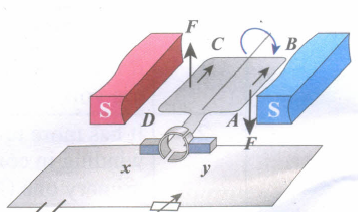
Principle: An electric motor works on the principle that a current carrying conductor placed in a magnetic field experiences a force. The direction of force is given by Fleming's left hand rule.
Construction: An electric motor consists of the following main parts.
Armature: It is a rectangular coil ABCD having a large number of turns of this insulated copper wire wound over a soft iron core. The armature is placed between the poles of the field magnet and it can be rotated about an axis perpendicular to the magnetic field lines.
Split rings (commutators): It consists of a cylindrical metal ring split into two halves S1 & S2. As the coil rotates, the split rings also rotate about the same axis of rotation. The function of the split ring is to reverse the direction of current in the coil after every half rotation. Carbon brushes: Two graphite or flexible metal rods maintain a sliding contact with split rings S1 and S2 alternately.
Battery: A battery of few cells is connected to the brushes. The current from the battery flows to the armature coil through the brushes and the split rings with split rings S1 and S2 alternately battery flows to the armature coil through the brushes and the split rings.
Working: A simple coil is placed inside two poles of a magnet. Now look at the current carrying conductor segment AB. The direction of the current is towards B, whereas in the conductor segment CD the direction is opposite. As the current is flowing in opposite directions in the segments AB and CD, the direction of the motion of the segments would be in opposite directions according to Fleming's left hand rule. When two ends of the coil experience force in opposite direction, they rotate. If the current flow is along the line ABCD, then the coil will rotate in clockwise direction first and then in anticlockwise direction. If we want to make the coil rotate in anyone direction, say clockwise, then the direction of the current should be along ABCD in the first half of the rotation and along DCBA in the second half of the rotation. When the gap in the split ring commutator is aligned with terminals X and Y there is no flow of current in the coil. But, as the coil is moving, it continues to move forward bringing one of the split ring commutator in contact with the carbon brushes X and Y. The reversing of the current is repeated at each half rotation, giving rise to a continuous rotation of the coil.
9.
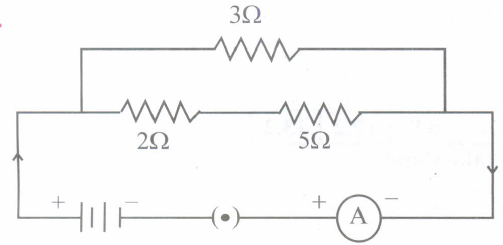
10.
The process of changing of a substance from one physical state to another at a definite temperature is defined as change of state.
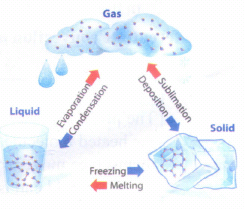
For example, water molecules are in liquid state at normal temperature. When water is heated to 100oC, it becomes steam which is a gaseous state of matter. On reducing the temperature of the steam it becomes water again. If we reduce the temperature further to 0oC, it becomes ice which is a solid state of water. Ice on heating, becomes water again. Thus, water changes its state when there is a change in temperature. There are different such processes in the change of state in matter. The figure shows various processes of change state.
11.
| Period number | Total no of elements | Elements | Total no of elements in | ||||
| From | To | s-block | p-block | d-block | f-block | ||
| 1 | 2 | H | He | 2 | - | - | - |
| 2 | 8 | Li | Ne | 2 | 6 | - | - |
| 3 | 8 | Na | Ar | 2 | 6 | - | - |
| 4 | 18 | K | Kr | 2 | 6 | 10 | - |
| 5 | 18 | Rb | Xe | 2 | 6 | 10 | - |
| 6 | 32 | Cs | Rn | 2 | 6 | 9 | 15 |
| 7 | 32 | Fr | Og | 2 | 6 | 9 | 15 |
12.
| Process | Phase I | Phase II |
| Sublimation | SOLID | Vapour |
| Solidification | GAS | Solid |
| MELTING | Solid | Liquid |
| Freezing | Liquid | SOLID |
| Condensation | GAS | Liquid |
13.
Blood and lymph
14.
Modern periodic law states that "The Chemical and Physical properties of elements are the periodic functions of their atomic number".
15.
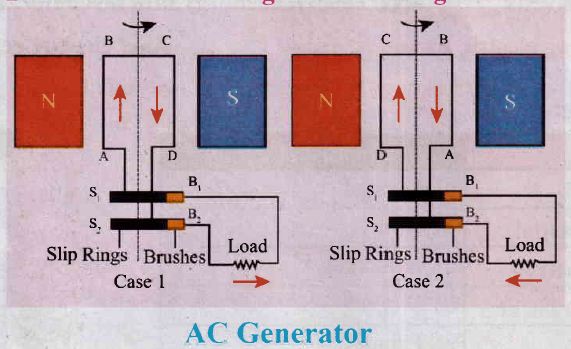
16.
The number of magnetic field lines crossing unit area kept normal to the direction of field lines is called magnetic flux density. Its unit is Wb/m2.
17.
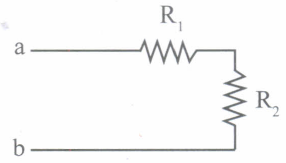
Effective resistance of the
series combination of R1 & R2
Effective resistance of the parallel combination of
R1 = R1 + R2 = R + R = R\(\Omega \)
Effective resistance of the entire circuit,
R3 & R4
\(\cfrac { 1 }{ { R }^{ 11 } } =\cfrac { 1 }{ { R }_{ 3 } } +\cfrac { 1 }{ { R }_{ 4 } } \)
\(\cfrac { 1 }{ { R }^{ 11 } } =\cfrac { 1 }{ R } +\cfrac { 1 }{ R } =\cfrac { 2 }{ R } \)
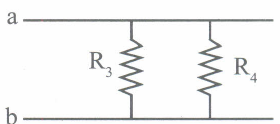
Effective resistance of the entire circuit,
\(\cfrac { 1 }{ { R }_{ P } } =\cfrac { 1 }{ { R }^{ 1 } } +\cfrac { 1 }{ { { R }^{ 11 } } } \)
\(=\cfrac { 1 }{ 2R } +\cfrac { 2 }{ R } =\cfrac { 1+4 }{ 2R } =\cfrac { 5 }{ 2R } \)
\({ R }_{ P }=\cfrac { 2 }{ 5 } R\Omega \)
18.
Mass (m) = 2 kg
Specific heat capacity (c) = 4200 Jkg-1 K-1
Temperature variation (\(\triangle \)t) = 20oC -0oC = 20oC
Specific latent heat (L) = 3,34,000 J/kg
Heat energy required = mc\(\triangle \)t + ml
= (2 x 4200 x 20) + (2 x 3, 34,000)
= 168000 + 668000
= 836000 J
19.
Three parts of the computer are:
(i) Input Unit
(ii) Central Processing Unit (CPU)
(iii) Output Unit.
20.
(i) In mitosis one parent cell divides into two identical daughter cells, each with a nucleus having the same amount of DNA, same number of chromosomes and genes as the parent cells. It is therefore called as equational division.
(ii) Meiosis is called reduction division because the chromosome number is reduced to haploid (n) from diploid (2n) in the daughter cells.
21.
(i) Acid A - HCl - Hydrochloric acid. Acid B - H2SO4 - Sulphuric acid.
(ii) Sulphuric acid - H2SO4
22.
(i) NaCl It is an ionic compound whereas others are covalent compounds.
(ii) LiAlH4 It is a reducing agent other three are oxidising agents.
23.
(i) Elements with large difference in properties were included in the same group.
Eg: Hard metals like copper (Cu) and silver (Ag) were included along with soft metals like sodium (Na) and potassium (K).
(ii) No proper position could be given to the element hydrogen. Non-metallic hydrogen was placed along with metals like lithium (Li), sodium (Na) and potassium (K).
(iii) The increasing order of atomic mass was not strictly followed throughout.
Eg: Co & Ni, Te & I.
(iv) No place for isotopes in the periodic table.
24.
First law: Whenever there is a change in magnetic flux linked with a coil, an electric current is induced. The induced potential difference lasts so long as there is a change in the magnetic flux linked with the coil.
Second law: The magnitude of the induced current is directly proportional to the rate of change of magnetic flux linked with the coil
25.
The appliances which work under the principle of to after, heating effects are iron box, water heater, toaster etc.
26.
1.Oesophagus
2.Villi
3.Glomerulus
4.Ureter
5.Scrotal sacs
27.
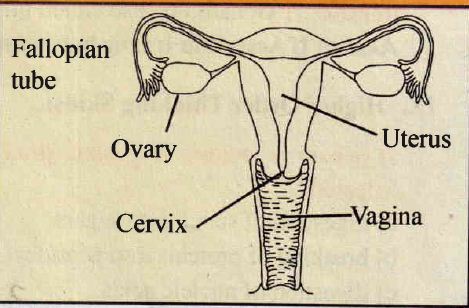
| d.Fallopian tube | Ovary | Cervix | Uterus | Vagina |
28.
(b)
end; start
29.
(d)
all of these
30.
(c)
Blue
31.
(c)
4
32.
(a)
4200 Jkg-1K-1
33.
()
higher, lower
34.
()
homologous
35.
()
electric generator
36.
(a)
37.
(b)

9th Standard Syllabus & Materials
9th Standard
TN 9th Tamil உள்ளத்தின் சீர் - திருக்குறள் Important Questions And Answers Study Material - QB365 Set A
NEW9th Standard
TN 9th Tamil உள்ளத்தின் சீர் - மணிமேகலை Important Questions And Answers Study Material - QB365 Set A
NEW9th Standard
TN 9th Tamil உள்ளத்தின் சீர் - ஏறு தழுவுதல் Important Questions And Answers Study Material - QB365 Set A
NEW9th Standard
TN 9th Tamil உயிருக்கு வேர் - தண்ணீர் Important Questions And Answers Study Material - QB365 Set A



Tamilnadu Stateboard 9th Standard Subjects
Tamilnadu Stateboard Standards





