
 100% FREE ACCESS
9th Standard Syllabus & Materials
9th Standard
TN 9th Tamil உள்ளத்தின் சீர் -கற்கண்டு (இலக்கணம்) - தொடர் இலக்கணம், ஆகுபெயர் Important Questions And Answers Study Material - QB365 Set A
NEW9th Standard
TN 9th Tamil உள்ளத்தின் சீர் -விரிவானம் (துணைப்பாடம்) - தாய்மைக்கு வறட்சி இல்லை! Important Questions And Answers Study Material - QB365 Set A
NEW9th Standard
TN 9th Tamil உள்ளத்தின் சீர் -கவிதை பேழை (செய்யுள்) - மார்கழி பெருவிழா Important Questions And Answers Study Material - QB365 Set A
NEW9th Standard
TN 9th Tamil உயிருக்கு வேர்-இலக்கணம் - பகுபத உறுப்பிலக்கணம் Important Questions And Answers Study Material - QB365 Set A
NEW9th Standard
TN 9th Tamil அமுதென்று பேர் - இலக்கணம்-எழுத்து -அளபெடை Important Questions And Answers Study Material - QB365 Set A
NEW9th Standard
TN 9th Tamil அமுதென்று பேர்-துணைப்பாடம் - ஆறாம்திணை Important Questions And Answers Study Material - QB365 Set A

Published on: 03/12/2019
Light
Download Tamil Nadu 9th Standard Science question papers, model tests, one-mark questions, important questions, and public exam papers in PDF format. Free study materials and answer keys for TN State Board students.
Questions + Answers key
Take MCQ Science Test1.
The velocity of light in air is______________
\(1.8\times { 10 }^{ 8 }\)m/s
\(3\times { 10 }^{ 8 }\)m/s
\(2.25\times { 10 }^{ 8 }\)m/s
\(3\times { 10 }^{ 6 }\)m/s
2.
The second law of refraction is stated by ____________________
C.V. Raman
Galileo
Newton
Snell
3.
The angle between the normal and the refracted ray is called angle of ________________________
reflection
refraction
incidence
deviation
4.
Which of the following statements about total internal reflection is true?
angle of incidence should be greater than critical angle
light must travel from a medium of higher refractive index to a medium of lower refractive index
both (a) and (b)
5.
A real and enlarged image can be obtained by using a
convex mirror
plane mirror
concave mirror
6.
What happened when a ray of light travels from denser medium to rarer medium?
7.
What happens when a ray of light travels from rarer medium to the denser medium?
8.
Copy this figure in your answer book and show the direction of the light ray after reflection
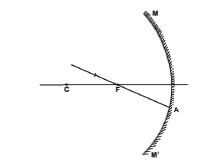
9.
A coin in a glass beaker appears to rise as the beaker is slowly filled with water, why?
10.
According to Cartesian sign convention, which mirror and which lens has negative focal length?
11.
Write the uses of convex and concave mirrors.
12.
What is the reason for the brilliance of diamond?
13.
Why do stars twinkle?
14.
Write the spherical mirror formula and explain the meaning of each symbol used in it.
15.
What is meant by magnification? Write its expression. What is its sign for the image and virtual image?
16.
The radius of curvature of a convex mirror is 30 cm. Find its focal length.
17.
State and verify laws of refraction using a glass slab.
1.
(b)
\(3\times { 10 }^{ 8 }\)m/s
2.
(d)
Snell
3.
(b)
refraction
4.
(c)
both (a) and (b)
5.
(c)
concave mirror
6.
When a light ray travels from denser medium to rarer medium it bends away from the normal.
7.
When a ray of light travels from rarer medium to the denser medium it bent towards the normal.
8.
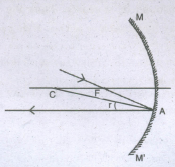
A ray passing through the principal focus of a concave mirror after reflection will emerge parallel to the principal axis.
9.
Due to refraction.
10.
Concave mirror and concave lens.
11.
Uses of concave mirror:
(1) As a dentist's head mirror: A circular mirror attached to a band tied to the forehead of the dentist / ENT specialist. A parallel beam of light is made to fall on the concave mirror; this mirror focuses the light beam on a small area of the body.
(2) As a make-up mirror: When a concave mirror is held near the face, an upright and magnified image is seen. Here, our face will be seen magnified.
(3) Concave mirrors are also used as reflectors in torches, head lights in vehicles and search lights to get powerful beams of light.
(4) Concave reflectors are also used in room heaters.
(5) Large concave mirrors are used in solar heaters.
Uses of convex mirror:
(1) Convex mirrors are used as rear-view mirrors in vehicles.
(2) A convex mirror provides a much wider field of view compared to plane mirror.
(3) Convex mirrors are installed on public roads as traffic safety device.
12.
The critical angle for diamond - air interface ( \(\theta _{ c }\) = 24.4°) is very small; therefore once light enters a diamond, it is very likely to undergo total internal reflection inside it: Diamonds faces in nature rarely exhibit the brilliance for which they are known. It is the technical skill of a diamond cutter which makes diamonds to sparkle so brilliantly. By cutting the diamond suitably, multiple total internal reflections can be made to occur.
13.
Light from the star passes through our atmosphere before it reaches our eyes. This light bends (refracts) due to the varying densities and temperature of atmosphere.
Therefore, the light which reaches us appears to come from different points. This gives the impression that stars are twinkling.
14.
The spherical mirror equation is \(\frac { 1 }{ f } =\frac { 1 }{ { u } } +\frac { 1 }{ v } \)
u = distance of object.
v = distance of image.
f = focal length of spherical mirror.
15.
Magnification is defined as the ratio of the height of the image \(\left( { h }_{ i } \right) \) to the height of object \(\left( { h }_{ 0 } \right) \)
Magnification \(=\frac { { h }_{ i } }{ { h }_{ 0 } }\)
1. Real image is negative sign.
2. Virtual image is positive sign
16.
R = 2f, F = \(\frac { r }{ 2 } \)
r = 30 cm (or) 0.3 m
\(F=\frac { 0.3 }{ 2 } \) = 0.15 m or 15 cm
The focal length of convex mirror is = 15 cm
17.
The laws of refraction of light : The incident ray, the refracted ray and the normal to the interface of two transparent media at the point of incidence, all lie in the same plane. The ratio of the sine of the angle of incidence to the sine of the angle of refraction is a constant for a light of given colour and for the given pair of media. This law is also known as Snell's law of refraction.
If i is the angle of incidence and r is the angle of refraction, then
\(\frac { \sin { i } }{ \sin { r } } =constant\)
Verification of laws of refraction :
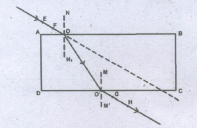
(1) Fix a sheet of white paper on a drawing board using drawing pins.
(2) Place a rectangular glass slab over the sheet in the middle. Draw the outline of the slab with a pencil. Let us name the outline as ABCD. Take four identical pins.
(3) Fix two pins. Say E and F, vertically such that the line joining the pins is inclined to the edge AB.
(4) Look for the images of the pins E and F through the opposite edge. Fix two other pins, say G and H, such that these pins and the images of E and F lie on a straight line.
(5) Remove the pins and the slab.
(6) Join the prints of the pins E and F and let it meet AB at O. Let EF meet AB at O. Similarly, join the prints of the pins G and H and Let it meet HG at O'. Join o and O'. Also produce EF as shown by a dotted line in Figure.
(7) Draw a perpendicular NN' to AB at O and another perpendicular MM' to CD at O'. In this activity, you will note that, the light ray has changed its direction at points O and O'. Note that both the points O and O' lie on surfaces separating two transparent media. The light ray has entered from air to glass and has bent towards the normal that is from a rarer to denser medium.
(8) The light ray has emerged from glass to air that is from a denser medium to a rarer medium. The light here has bent away from the normal. Compare the angle of incidence with the angle of refraction at both refracting surfaces AB and CD.
(9) In Figure, EO is the incident ray OO' the refracted ray and O'H the emergent ray. You may observe that the emergent ray is parallel to the direction of the incident ray.
(10) The extent of bending of the ray of light at the opposite parallel faces AB (air-glass interface) and CD (glass-air-interface) of the rectangular glass slab is equal and opposite. This is why the ray emerges parallel to the incident ray.

9th Standard Syllabus & Materials
9th Standard
TN 9th Tamil உள்ளத்தின் சீர் - திருக்குறள் Important Questions And Answers Study Material - QB365 Set A
NEW9th Standard
TN 9th Tamil உள்ளத்தின் சீர் - மணிமேகலை Important Questions And Answers Study Material - QB365 Set A
NEW9th Standard
TN 9th Tamil உள்ளத்தின் சீர் - ஏறு தழுவுதல் Important Questions And Answers Study Material - QB365 Set A
NEW9th Standard
TN 9th Tamil உயிருக்கு வேர் - தண்ணீர் Important Questions And Answers Study Material - QB365 Set A



Tamilnadu Stateboard 9th Standard Subjects
Tamilnadu Stateboard Standards





