
 100% FREE ACCESS
9th Standard Syllabus & Materials
9th Standard
TN 9th Tamil உள்ளத்தின் சீர் -கற்கண்டு (இலக்கணம்) - தொடர் இலக்கணம், ஆகுபெயர் Important Questions And Answers Study Material - QB365 Set A
NEW9th Standard
TN 9th Tamil உள்ளத்தின் சீர் -விரிவானம் (துணைப்பாடம்) - தாய்மைக்கு வறட்சி இல்லை! Important Questions And Answers Study Material - QB365 Set A
NEW9th Standard
TN 9th Tamil உள்ளத்தின் சீர் -கவிதை பேழை (செய்யுள்) - மார்கழி பெருவிழா Important Questions And Answers Study Material - QB365 Set A
NEW9th Standard
TN 9th Tamil உயிருக்கு வேர்-இலக்கணம் - பகுபத உறுப்பிலக்கணம் Important Questions And Answers Study Material - QB365 Set A
NEW9th Standard
TN 9th Tamil அமுதென்று பேர் - இலக்கணம்-எழுத்து -அளபெடை Important Questions And Answers Study Material - QB365 Set A
NEW9th Standard
TN 9th Tamil அமுதென்று பேர்-துணைப்பாடம் - ஆறாம்திணை Important Questions And Answers Study Material - QB365 Set A

Published on: 09/09/2019
Magnetism and Electromagnetism
Download Tamil Nadu 9th Standard Science question papers, model tests, one-mark questions, important questions, and public exam papers in PDF format. Free study materials and answer keys for TN State Board students.
Questions + Answers key
Take MCQ Science Test1.
Differentiate step up and step down transformer.
2.
List the main parts of an electric motor.
3.
State Fleming’s Left Hand Rule.
4.
State Faraday’s laws of electromagnetic induction.
5.
Draw a neat diagram of an AC generator.
6.
Explain the principle, construction and working of a dc motor.
7.
The unit of magnetic flux density is
weber
weber/metre
weber/metre2
weber. metre2
8.
An electric generator converts
electrical energy into mechanical energy
mechanical energy into heat energy
electrical energy into electrical energy
mechanical energy into electrical energy
9.
Which of the following converts electrical energy into mechanical energy?
motor
battery
generator
switch
10.
Devices which is used to convert high alternating current to low alternating current __________.
11.
No force acts in a current carrying conductor when it is __________ the magnetic field.
1.
| S.No. | Step up transformer | Step down transformer |
| 1. | It is used to change low alternative voltage to high alternating voltage. |
It is used to change high alternative voltage to low alternating voltage. |
| 2. | The number of turns in the secondary coil is more than the number of turns in the primary coil. |
The number of turns in the secondary coils are less than the number of turns in the primary coil. |
2.
NS - permanent magnet
ABCD - coil wire
B1 B2 - carbon brushes
S1 S2 - split ring
3.
Fleming's left hand rule:
Fleming's left hand rule states that while stretching the three fingers of left hand in perpendicular manner with each other, if the direction of the current is denoted by the middle finger of the left hand and the second finger is for direction of the magnetic field, then the thumb of the left hand denotes the direction of the force or movement of the conductor.
4.
First law: Whenever there is a change in magnetic flux linked with a coil, an electric current is induced. The induced potential difference lasts so long as there is a change in the magnetic flux linked with the coil.
Second law: The magnitude of the induced current is directly proportional to the rate of change of magnetic flux linked with the coil
5.
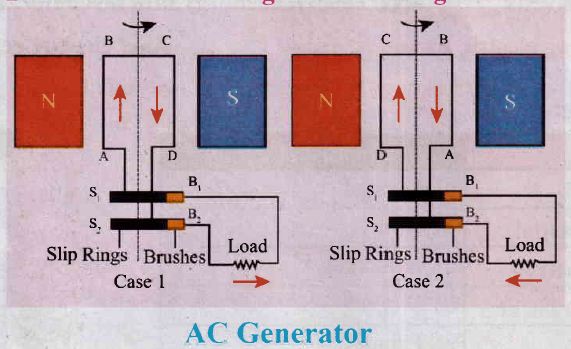
Explanation:
When the coil is rotated, the magnetic flux linked with the coil changes. This change in magnetic flux will lead to generation of induced current. The direction of the induced current, as given by Fleming's Right Hand Rule, is along ABCD in the coil and in the outer circuit it flows from B2 to B1. During the second half of rotation, the direction of current is along DCBA in the coil and in the outer circuit it flows from B1 to B2. As the rotation of the coil continues, the induced current in the external circuit is changing its direction for every half a rotation of the coil.
6.
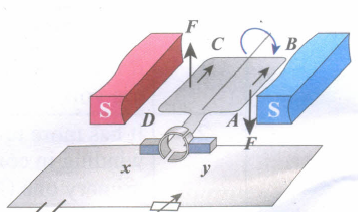
Principle: An electric motor works on the principle that a current carrying conductor placed in a magnetic field experiences a force. The direction of force is given by Fleming's left hand rule.
Construction: An electric motor consists of the following main parts.
Armature: It is a rectangular coil ABCD having a large number of turns of this insulated copper wire wound over a soft iron core. The armature is placed between the poles of the field magnet and it can be rotated about an axis perpendicular to the magnetic field lines.
Split rings (commutators): It consists of a cylindrical metal ring split into two halves S1 & S2. As the coil rotates, the split rings also rotate about the same axis of rotation. The function of the split ring is to reverse the direction of current in the coil after every half rotation. Carbon brushes: Two graphite or flexible metal rods maintain a sliding contact with split rings S1 and S2 alternately.
Battery: A battery of few cells is connected to the brushes. The current from the battery flows to the armature coil through the brushes and the split rings with split rings S1 and S2 alternately battery flows to the armature coil through the brushes and the split rings.
Working: A simple coil is placed inside two poles of a magnet. Now look at the current carrying conductor segment AB. The direction of the current is towards B, whereas in the conductor segment CD the direction is opposite. As the current is flowing in opposite directions in the segments AB and CD, the direction of the motion of the segments would be in opposite directions according to Fleming's left hand rule. When two ends of the coil experience force in opposite direction, they rotate. If the current flow is along the line ABCD, then the coil will rotate in clockwise direction first and then in anticlockwise direction. If we want to make the coil rotate in anyone direction, say clockwise, then the direction of the current should be along ABCD in the first half of the rotation and along DCBA in the second half of the rotation. When the gap in the split ring commutator is aligned with terminals X and Y there is no flow of current in the coil. But, as the coil is moving, it continues to move forward bringing one of the split ring commutator in contact with the carbon brushes X and Y. The reversing of the current is repeated at each half rotation, giving rise to a continuous rotation of the coil.
7.
(c)
weber/metre2
8.
(d)
mechanical energy into electrical energy
9.
(a)
motor
10.
()
step down transformer
11.
()
parallel

9th Standard Syllabus & Materials
9th Standard
TN 9th Tamil உள்ளத்தின் சீர் - திருக்குறள் Important Questions And Answers Study Material - QB365 Set A
NEW9th Standard
TN 9th Tamil உள்ளத்தின் சீர் - மணிமேகலை Important Questions And Answers Study Material - QB365 Set A
NEW9th Standard
TN 9th Tamil உள்ளத்தின் சீர் - ஏறு தழுவுதல் Important Questions And Answers Study Material - QB365 Set A
NEW9th Standard
TN 9th Tamil உயிருக்கு வேர் - தண்ணீர் Important Questions And Answers Study Material - QB365 Set A



Tamilnadu Stateboard 9th Standard Subjects
Tamilnadu Stateboard Standards





