
 100% FREE ACCESS
9th Standard Syllabus & Materials
9th Standard
TN 9th Tamil உள்ளத்தின் சீர் -கற்கண்டு (இலக்கணம்) - தொடர் இலக்கணம், ஆகுபெயர் Important Questions And Answers Study Material - QB365 Set A
NEW9th Standard
TN 9th Tamil உள்ளத்தின் சீர் -விரிவானம் (துணைப்பாடம்) - தாய்மைக்கு வறட்சி இல்லை! Important Questions And Answers Study Material - QB365 Set A
NEW9th Standard
TN 9th Tamil உள்ளத்தின் சீர் -கவிதை பேழை (செய்யுள்) - மார்கழி பெருவிழா Important Questions And Answers Study Material - QB365 Set A
NEW9th Standard
TN 9th Tamil உயிருக்கு வேர்-இலக்கணம் - பகுபத உறுப்பிலக்கணம் Important Questions And Answers Study Material - QB365 Set A
NEW9th Standard
TN 9th Tamil அமுதென்று பேர் - இலக்கணம்-எழுத்து -அளபெடை Important Questions And Answers Study Material - QB365 Set A
NEW9th Standard
TN 9th Tamil அமுதென்று பேர்-துணைப்பாடம் - ஆறாம்திணை Important Questions And Answers Study Material - QB365 Set A

Published on: 07/12/2019
Organization of Tissues
Download Tamil Nadu 9th Standard Science question papers, model tests, one-mark questions, important questions, and public exam papers in PDF format. Free study materials and answer keys for TN State Board students.
Questions + Answers key
Take MCQ Science Test1.
Bouquet stage refers to__________
diakinesis
leptotene
zygotene
pachytene
2.
The ________is a long fibre-like process
dendron
axon
dendrite
neurilemma
3.
_________is seen in unicellular animals.
Mitosis
meiosis
Amitosis
none of the above
4.
Elastic structures which connect bone to bone are called___________
muscles
tendons
ligaments
areolar tissue
5.
The____________ epithelium forms a selective permeable membrane surface.
Ciliated
Squamous
Cuboidal
Glandular
6.
__________is derived from ground meristem
Cortex
Epidermis
Xylem
Cambium
7.
Write the salient features of compound epithelium.
8.
What is crossing over?
9.
What is a tetrad?
10.
What are cartilage cells also known as?
11.
Name the supportive connective tissues.
12.
Write a note on blood and its components.
13.
Explain the components of phloem tissue
14.
Mitosis and Meiosis occurs in reproductive cells. Justify.
15.
How do WBC help in defence?
16.
Umbilical cord is collected at the time of child birth and stored in stem cell banks? Reason out
1.
(b)
leptotene
2.
(b)
axon
3.
(c)
Amitosis
4.
(c)
ligaments
5.
(b)
Squamous
6.
(a)
Cortex
7.
(i) It consists of more than one layer of cells and gives a stratified appearance. Hence, they are also known as stratified epithelial cells.
(ii) Being multilayered, they have limited role in secretion and absorption.
(iii) The main function of this epithelium is to give protection to the underlying tissues against mechanical and chemical stress.
(iv) They also cover the dry surface of the skin, the moist surface of the buccal cavity and pharynx.
8.
During pachytene of Meiotic prophase I, the chromatids break and the broken segments are interchanged between homologous chromosomes. The points of exchange are the chiasmata. This is called crossing over
9.
The chromosomes are visible as long paired twisted threads. The pairs so formed are called bivalents. Each bivalent now contains four chromatids (tetrad stage) in pachytene of Meiotic Prophase I.
10.
Chondrocytes.
11.
Cartilage and bone.
12.
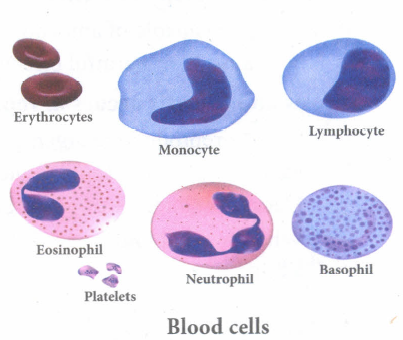
Blood is a fluid connective tissue. Blood contains corpuscles which are red blood cells (erythrocytes), white blood cells (leucocytes) and platelets. In this fluid connective tissue, the blood cells move in a fluid matrix called plasma. The plasma contains inorganic salts and organic substances. It is a main circulating fluid that helps in the transport of substances.
Red blood corpuscles (Erythrocytes)
(i) The red blood corpuscles are oval shaped, circular, biconcave disc-like and lack nucleus when mature (mammalian RBC).
(ii) They contain a respiratory pigment called haemoglobin which is involved in the transport of oxygen to tissues
White blood corpuscles (Leucocytes) They are larger in size, contain distinct nucleus and are colourless. They are capable of amoeboid movement and play an important role in body's defense mechanism. WBC's are of two types
i. Granulocytes (with granules in the cytoplasm)
ii. Agranulocytes (without granules in the cytoplasm).
Granulocytes have irregular shaped nuclei and cytoplasmic granules. They include the neutrophils, basophils and eosinophils. Agranulocytes lack cytoplasmic granules and include the lymphocytes which have a spherical nucleus and the monocytes which have a large nucleus indented on one side. They engulf or destroy foreign bodies and neutralise their harmful effects.
Blood platelets
They are minute, anucleated, fragile fragments of giant bone marrow called megakaryocytes. They play an important role in blood clotting mechanism
13.
Phloem like xylem is a complex tissue and consists of the following elements.
(i) Sieve elements
(ii) Companion cells.
(iii) Phloem fibres
(iv) Phloem parenchyma
(i) Sieve elements
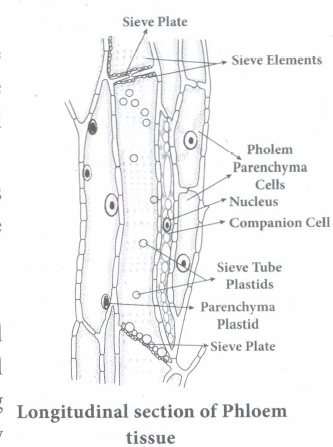
1. The conducting elements of phloem are collectively called as Sieve elements.
2. They may be segregated into less specialised Sieve cells and more specialised sieve tube elements.
3. Sieve tubes are elongated, tube-like slender cells placed end to end. The transverse walls at the ends are perforated and are known as sieve plates.
4. The main function of sieve tubes is translocation of food, from leaves to the storage organs of the plants.
ii. Companion cells
These are elongated cells attached to the lateral wall of the sieve tubes. A companion cell may be equal in length to the accompanying sieve tube element or the mother cell may be divided transversely, forming a series of companion cells
iii. Phloem parenchyma
The phloem parenchyma are living cells which have cytoplasm and nucleus. Their function is to store food materials.
iv. Phloem
fibers Sclerenchymatous cells associated with primary and secondary phloem are commonly called phloem fibers. These cells are elongated, lignified and provide mechanical strength to the plant body.
14.
When a reproductive organ grows in size from young age till the organism attains maturity, Mitosis occurs to increase the number of cells and grow in size. During production of gametes, meiosis occurs because the gametes are haploid. When two haploid gametes fuse a diploid zygote is formed which grows into an adult.
15.
They are capable of amoeboid movement and engulf the invading microbes or can neutralise their harmful effects. Thus they help in defence of the body.
16.
1. Umbilical cord consists of stem cells. They are undifferentiated cells which undergo unlimited divisions and give rise to one or more different types of cells. Embryonic stem cells differentiate into different tissues and organs.
2. Stem cells can be used in the treatment of certain degenerative diseases in future

9th Standard Syllabus & Materials
9th Standard
TN 9th Tamil உள்ளத்தின் சீர் - திருக்குறள் Important Questions And Answers Study Material - QB365 Set A
NEW9th Standard
TN 9th Tamil உள்ளத்தின் சீர் - மணிமேகலை Important Questions And Answers Study Material - QB365 Set A
NEW9th Standard
TN 9th Tamil உள்ளத்தின் சீர் - ஏறு தழுவுதல் Important Questions And Answers Study Material - QB365 Set A
NEW9th Standard
TN 9th Tamil உயிருக்கு வேர் - தண்ணீர் Important Questions And Answers Study Material - QB365 Set A



Tamilnadu Stateboard 9th Standard Subjects
Tamilnadu Stateboard Standards





