
 100% FREE ACCESS
9th Standard Syllabus & Materials
9th Standard
TN 9th Tamil உள்ளத்தின் சீர் -கற்கண்டு (இலக்கணம்) - தொடர் இலக்கணம், ஆகுபெயர் Important Questions And Answers Study Material - QB365 Set A
NEW9th Standard
TN 9th Tamil உள்ளத்தின் சீர் -விரிவானம் (துணைப்பாடம்) - தாய்மைக்கு வறட்சி இல்லை! Important Questions And Answers Study Material - QB365 Set A
NEW9th Standard
TN 9th Tamil உள்ளத்தின் சீர் -கவிதை பேழை (செய்யுள்) - மார்கழி பெருவிழா Important Questions And Answers Study Material - QB365 Set A
NEW9th Standard
TN 9th Tamil உயிருக்கு வேர்-இலக்கணம் - பகுபத உறுப்பிலக்கணம் Important Questions And Answers Study Material - QB365 Set A
NEW9th Standard
TN 9th Tamil அமுதென்று பேர் - இலக்கணம்-எழுத்து -அளபெடை Important Questions And Answers Study Material - QB365 Set A
NEW9th Standard
TN 9th Tamil அமுதென்று பேர்-துணைப்பாடம் - ஆறாம்திணை Important Questions And Answers Study Material - QB365 Set A

Published on: 16/09/2019
Download Tamil Nadu 9th Standard Science question papers, model tests, one-mark questions, important questions, and public exam papers in PDF format. Free study materials and answer keys for TN State Board students.
Questions + Answers key
Take MCQ Science Test1.
Give an account on phylum Arthropoda.
2.
State and verify laws of refraction using a glass slab.
3.
How are vitamins useful to us? Tabulate the sources, deficiency diseases and symptoms of fat soluble vitamins
4.
List out the generations of computer
5.
Explain the postulates of Bohr’s atomic model.
6.
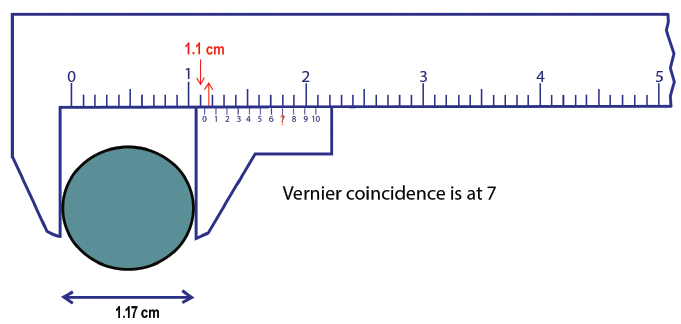
Calculate the diameter of the sphere which is shown in the Figure. Assume the scale has no zero error.
7.
Explain a method to find the thickness of a hollow tea cup.
8.
Write the differences between elements and compounds and give an example for each.
9.
Find the size, nature and position of image formed when an object of size 1 cm is placed at a distance of 15 cm from a concave mirror of focal length 10 cm.
1.
1. Arthropoda is an ancient and the largest phylum with number of species.
2. Insects, spiders, crabs, shrimps, butterflies, millipedes, centipedes and scorpions are arthropods.
3. Body is divisible into head, thorax and abdomen.
4. The coelomic cavity is filled with haemolymph
5. They have open circulatory system
6. Excretion occurs through Malpighian tubules in insects and through green glands in crabs and prawns.
2.
The laws of refraction of light : The incident ray, the refracted ray and the normal to the interface of two transparent media at the point of incidence, all lie in the same plane. The ratio of the sine of the angle of incidence to the sine of the angle of refraction is a constant for a light of given colour and for the given pair of media. This law is also known as Snell's law of refraction.
If i is the angle of incidence and r is the angle of refraction, then
\(\frac { \sin { i } }{ \sin { r } } =constant\)
Verification of laws of refraction :
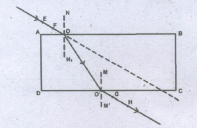
(1) Fix a sheet of white paper on a drawing board using drawing pins.
(2) Place a rectangular glass slab over the sheet in the middle. Draw the outline of the slab with a pencil. Let us name the outline as ABCD. Take four identical pins.
(3) Fix two pins. Say E and F, vertically such that the line joining the pins is inclined to the edge AB.
(4) Look for the images of the pins E and F through the opposite edge. Fix two other pins, say G and H, such that these pins and the images of E and F lie on a straight line.
(5) Remove the pins and the slab.
(6) Join the prints of the pins E and F and let it meet AB at O. Let EF meet AB at O. Similarly, join the prints of the pins G and H and Let it meet HG at O'. Join o and O'. Also produce EF as shown by a dotted line in Figure.
(7) Draw a perpendicular NN' to AB at O and another perpendicular MM' to CD at O'. In this activity, you will note that, the light ray has changed its direction at points O and O'. Note that both the points O and O' lie on surfaces separating two transparent media. The light ray has entered from air to glass and has bent towards the normal that is from a rarer to denser medium.
(8) The light ray has emerged from glass to air that is from a denser medium to a rarer medium. The light here has bent away from the normal. Compare the angle of incidence with the angle of refraction at both refracting surfaces AB and CD.
(9) In Figure, EO is the incident ray OO' the refracted ray and O'H the emergent ray. You may observe that the emergent ray is parallel to the direction of the incident ray.
(10) The extent of bending of the ray of light at the opposite parallel faces AB (air-glass interface) and CD (glass-air-interface) of the rectangular glass slab is equal and opposite. This is why the ray emerges parallel to the incident ray.
3.
Vitamins are vital nutrients, required in minute amounts to perform special functions to maintain a healthy body. It is deficiency in the food it cause many diseases.
| Vitamins | Sources | Deficiency disorders | Symptoms |
|
Vitamin A |
Carrot, papaya leaf vegetable, egg yolk, liver |
Xerophthalmia Nyctalopia (night blindness) |
Dryness of cornea unable to see in the night (dim light) scaly skin |
| Vitamin D |
Egg, liver, diary products, fish, synthesized by the sunlight |
Rickets (in children) |
Bow legs, defective ribs development of pigeon chest. |
| Vitamin E | Wheat, vegetable oil, meat, milk | Sterility in rats, Reproductive abnormalities |
Sterility |
| Vitamin K |
Leafy vegetables, soyabeans, milk | Blood clotting is prevented | Excessive bleeding due to delayed blood clotting. |
4.
Generations of Computer:
| Generation | Digital devices |
|---|---|
| 1940-1956 - I Generation | Vacuum tubes |
| 1956-1963 - II Generation | Transistor |
| 1964-1971 - III Generation | Integrated circuits |
| 1972-2010 - IV Generation | Microprocessors |
| After 2010 - V Generation | Artificial Intelligence |
5.
(i) In atoms, electrons revolve around the nucleus in certain special or permissible orbits known as discrete orbits or shells or energy levels.
(ii) While revolving in these discrete orbits the electrons do not radiate energy.
(iii) The circular orbits are numbered as 1, 2, 3, 4, ... or designated as K, L, M, N, shells. These numbers are referred to as principal quantum numbers (n)
(iv) K shell (n = 1) is closest to the nucleus and is associated with lowest energy. L, M, N, .... etc are the next higher energy levels. As the distance from the nucleus increases the energy of the shells also increases.
(v) The energy of each orbit or shell is a fixed quantity and the energy is quantized.
(vi) As the distance from the nucleus increases, the size of the orbits also increases.
(vii) Maximum number of electrons that can be accommodated in an energy level is given by 2n2 where n is the principal quantum number of the orbit.
(viii) When an electron absorbs energy, it jumps from lower energy level to higher energy level.
(ix) When an electron returns from higher energy level to lower energy level, it gives off energy.
6.
The diameter (D) of the sphere = Main scale reading (MSR) + (Vernier scale coincidence (VC) × least count (LC)) ± ZE. In this case the zero of the vernier scale is right after the main scale reading 1.1. So the main scale reading is 1.1 cm. The vernier scale coincidence is 7. The least count is 0.01 cm. The diameter of the sphere = 1.1 cm + (7 × 0.01 cm)‒0 = 1.1 + 0.07 = 1.17 cm.
7.
Finding the outer diameter of the tea cup:
1. Place the tea cup between the outside jaws.
2. Note the reading of main scale and vernier coincidence. Tabulate the readings.
3. The outer diameter of the tea cup is calculated by MSR + (VC x LC).
4. Repeat the experiment and find the average diameter.
Finding the inner diameter of the tea cup:
1. Place the tea cup between the inside jaws.
2. Note the reading of main scale and vernier coincidence.
3. Tabulate the readings.
4. The inner diameter of the tea cup is calculated by MSR + (VC x LC).
5. Repeat the experiment and find the average diameter.
| S.No | MSR | VSC | MSR + (VC x LC) ± ZC | |
| 1. 2. 3. |
Outer diameter | |||
| 1. 2. 3. |
Inner diameter |
The thickness of tea cup = outer reading - inner reading = __________ mm
8.
| ELEMENTS | COMPOUNDS |
| 1. Contains only one kind of atoms. | Contains more than one kind of atoms |
| 2. It is a pure substance. | It is not a pure substance |
| 3. Cannot be broken down further into simpler substances by chemical methods |
Can be broken down further into simpler substances by chemical methods |
| 4. Has definite physical and chemical properties. | Has definite physical and chemical properties. |
| 5. Example: Hydrogen, Oxygen | Example : Water, Cane sugar. |
9.
Position of image
Object distance u = − 15 cm (to the left of mirror )
Image distance v = ?
Focal length f = − 10 cm (concave mirror) Using mirror formula.
\(\frac { 1 }{ v } +\frac { 1 }{ u } =\frac { 1 }{ f } \)
\(\frac { 1 }{ v } +\frac { 1 }{ -15 } =\frac { 1 }{ -10 } \)
\(\frac { 1 }{ v } -\frac { 1 }{ 15 } =\frac { -1 }{ 10 } \)
\(\frac { 1 }{ v } =\frac { -1 }{ 10 } +\frac { 1 }{ 15 } \)
\(\frac { 1 }{ v } =\frac { -1 }{ 30 } \)
∴ Image distance v = -30cm (negative sign indicates that the image is on the left side of the mirror)
∴ Position of image is 30 cm in front of the mirror
2.Nature of image: Since the image is in front of the mirror it is real and inverted.
3.Size of image: To find the size of the image, we have to calculate the magnification
\(m=\frac { -v }{ u } \)
Object distance u = − 15cm
Image distance v = − 30 cm
\(m=\frac { -(-30) }{ (-15) } \)
m = − 2
We know that,\(m=\frac { { h }_{ 2 } }{ { h }_{ 1 } } \)
Here, height of the object h1 = 1 cm
-2 =\(\frac { { h }_{ 2 } }{ 1 } \)
h2 = -2\(\times\) 1
= -2 cm
The height of image is 2 cm (negative sign shows that the image is formed below the principal axis).

9th Standard Syllabus & Materials
9th Standard
TN 9th Tamil உள்ளத்தின் சீர் - திருக்குறள் Important Questions And Answers Study Material - QB365 Set A
NEW9th Standard
TN 9th Tamil உள்ளத்தின் சீர் - மணிமேகலை Important Questions And Answers Study Material - QB365 Set A
NEW9th Standard
TN 9th Tamil உள்ளத்தின் சீர் - ஏறு தழுவுதல் Important Questions And Answers Study Material - QB365 Set A
NEW9th Standard
TN 9th Tamil உயிருக்கு வேர் - தண்ணீர் Important Questions And Answers Study Material - QB365 Set A



Tamilnadu Stateboard 9th Standard Subjects
Tamilnadu Stateboard Standards





