
 100% FREE ACCESS
9th Standard Syllabus & Materials
9th Standard
TN 9th Tamil உள்ளத்தின் சீர் -கற்கண்டு (இலக்கணம்) - தொடர் இலக்கணம், ஆகுபெயர் Important Questions And Answers Study Material - QB365 Set A
NEW9th Standard
TN 9th Tamil உள்ளத்தின் சீர் -விரிவானம் (துணைப்பாடம்) - தாய்மைக்கு வறட்சி இல்லை! Important Questions And Answers Study Material - QB365 Set A
NEW9th Standard
TN 9th Tamil உள்ளத்தின் சீர் -கவிதை பேழை (செய்யுள்) - மார்கழி பெருவிழா Important Questions And Answers Study Material - QB365 Set A
NEW9th Standard
TN 9th Tamil உயிருக்கு வேர்-இலக்கணம் - பகுபத உறுப்பிலக்கணம் Important Questions And Answers Study Material - QB365 Set A
NEW9th Standard
TN 9th Tamil அமுதென்று பேர் - இலக்கணம்-எழுத்து -அளபெடை Important Questions And Answers Study Material - QB365 Set A
NEW9th Standard
TN 9th Tamil அமுதென்று பேர்-துணைப்பாடம் - ஆறாம்திணை Important Questions And Answers Study Material - QB365 Set A

Published on: 22/09/2018
Half Portion Test
Download Tamil Nadu 9th Standard Social Science question papers, model tests, one-mark questions, important questions, and public exam papers in PDF format. Free study materials and answer keys for TN State Board students.
Questions + Answers key
Take MCQ Social Science Test
1.
Pacific Ring of Fire - Most seismically and volcanically active. Why?
2.
Why do we say that investment in education and health of people can result in a high rate of returns?
3.
Define the terms (a) Absolute humidity (b) Relative humidity.
4.
What are mountain barriers?
5.
Write a short note on "State Parties".
6.
What is Democracy?
7.
Write a short note on "split in Jainism".
8.
What are fossils?
9.
What do you know about Muvendbar?
10.
The term civilization is used to distinguish the Urban society from early forms of societies. Why?
11.
How are clouds formed?
12.
What are isotherms?
13.
Define atmosphere.
14.
How important are coins as a source of evidence for the study of Sangam Age?
15.
State the salient features of the Ziggurats.
16.
List out the features of Megalithic Burial types.
17.
"Elections are considered essential for any representative democracy". Why?
18.
Write in detail what kind of environmental problems you face in your locality.
19.
The river channels in the lower course are wider than the upper course
20.
Give an account of Mobilisation and Democratic Participation.
21.
Give an account of 'Tsunami'
22.
Compare the employment conditions prevailing in the organised and unorganised sectors.
23.
Describe in detail about environmental policies in India
24.
What are the functions of political parties?
25.
Define the terms Hieroglyphics and Cuneiform with their main features.
26.
Explain the effects of Volcanoes
27.
What is a pressure group?
28.
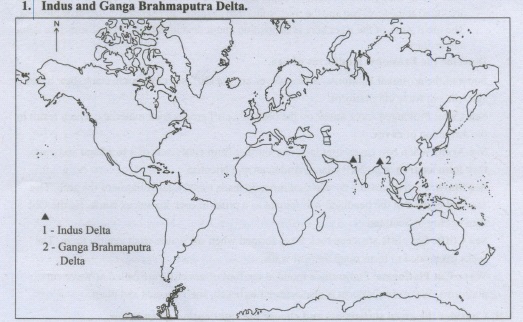
Indus and Ganga Brahmaputra Delta
1.
The Ring of Fire is a ring of volcanoes around the Pacific Ocean. These volcanoes result from subduction of oceanic plates beneath lighter continental plates, A subduction zone is a place where one plate of oceanic lithosphere is shoved under another plate. As it is shoved into the hotter mantle the plate heats up. The addition of volatiles such as water to the hot overlying mantle causes partial melting and the production of magma. This magma rises up through the over-lying plate to erupt at the surface. Hence, the Pacific Ring of Fire is most seismically and volcanically active.
2.
If a child is invested with good education and health, he or she may turn to be very productive in future in the form of higher earnings and greater contribution to the society. Therefore that. investment in education and health of people can result in a high rate of returns.
3.
Absolute humidity: The amount of water vapour in the atmosphere is called Absolute Humidity.
Relative Humidity: The ratio between the amount of water vapour in the atmosphere and the amount of water vapour it can hold is Relative humidity.
4.
(i) The location of the mountains influence the climate of a place.
(ii) The mountain chains act as natural barrier for the wind.
(iii) Sometimes they prevent the entry of cold winds into the country (or) the escape of monsoon winds, thus having a great influence over the climate.
5.
Other than the seven national parties, most of the major parties of the country are classified by the Election Commission as 'state parties'. These are commonly referred to as regional parties. A party is recognised as a state party by the Election Commission of India based on certain percentage of votes secured or a certain number of seats won in the Assembly or Lok Sabha elections.
6.
(i) Democracy is a form of government that allows people to choose their rulers.
(ii) Only leaders elected by people should rule the country.
(iii) People have freedom to express views, freedom to organise and freedom to protest.
7.
(i) In course of time, Jainism split into two branches namely the Digambaras (Sky-clad) and the Svetambaras (White-clad)
(ii) The Digambaras were the Orthodox followers of Mahavira. They rejected clothes altogether. The Svetambaras wore a white dress from head to toe.
8.
The bodies of plants and animals that fall on the sedimentary rock deposits get embedded in the layers and form fossils.
9.
Among the political powers of the Sangam Age, the Cheras, the Cholas and the Pandyas occupied pre-eminent positions. They were known as Muvendhar (the three kings). The muvendhar controlled the major towns and ports of the Sangam period.
10.
(i) The Urban society practised crafts, engaged in trade and exchange, adopted science and technology and formed political organisation.
(ii) Hence the term civilisation is used to distinguish them from the early forms of societies.
11.
(i) A visible mass of condensed water vapour floating in the air above the ground level is called is cloud.
(ii) Cool moisture laden air gets collected around particles like dust, salt content from the sea, smoke, etc, and forms clouds.
(iii) Sometimes mixing warmer and cooler air also produces clouds.
12.
(i) Isotherms are imaginary lines drawn on maps, connecting points that have equal temperatures.
(ii) Temperature varies from place to place, season to season and continent to continent.
13.
(i) The blanket of air that surrounds the Earth is called the atmosphere.
(ii) It is held close to the earth by gravitational attraction.
(iii) Atmosphere plays on important role in predicting weather phenomenon.
(iv) It is a mixture of gases, water vapour and dust particles in different proportion.
14.
(i) Coins as a medium of exchange were introduced for the first time in the Sangam Age.
(ii) The coins of the Cheras, the Cholas and the Pandyas, punch-marked coins, and Roman coins form another important source of evidence from the Sangam Age.
(iii) Sometimes coins were protected as a precious wealth.
15.
1. The Ziggurats were at the city centre on a platform and appeared like steep pyramids, with staircases leading to the top.
2. Around this temple were complexes of ceremonial courtyards, shrines, burial chambers for the priests and priestesses, ceremonial banquet halls, along with workshops, granaries storehouses and administrative buildings.
16.
1. In Megalithic period people buried the dead bodies with grave goods in the cists.
2. Urns or pottery jars were used for burning the dead and also they used sarcophagi made of terracotta.
3. Dolmens, table like stone structures were erected as funerary monuments. Menhirs pillar are like stones erected as part of the burials or memorials.
4. Port holes are holes found in the cists and dolmens on one side.
17.
(i) Democracy is a government of the people by the people and for the people.
(ii) To select a leader of people's choice we should have elections.
(iii) The representatives elected by the people can elect a suitable leader to rule the country.
18.
In my locality i found the following environmental problems:
1. Air pollution: As there are a number of vehicles in my area the air pollution in very high Whenever I walk on the road, I could smell the carbon dust emitted from the vehicle.
2. Water pollution: Previously we could get clear water from our taps. Now the water is muddy and polluted.
3. Soil Pollution: Because of the incrase of air pollution we could find the soil polluted in our area.
19.
(i) The river channels of the upper course has more energy gradiant then the channels of lower course.
(ii) As the river flows in the lower course it corrodes sideways and makes it wider.
20.
Mobilising people towards socially productive activities that lead to the overall betterment of people's lives is essential. Sometimes earthquakes, tsunamis, floods and other such natural disasters on a massive scale occur and people's immediate mobilisation for evacuation and emergency relief becomes most essential.
Democratic Participation: Democracy can succeed only when smaller local groups and, in fact, every citizen can take action that supports the tax and revenue collection systems, observance of national norms in environmental protection, cleanliness, health and hygiene, sanitary drives and immunisation programmes like pulse polio. However, we must keep in mind that there is no better form of government than Democratic government. To create a better society and nation, the people of India along with the union and state governments should come together to fight against the miseries of human life.
21.
The word 'Tsunami' is a Japanese term, meaning harbour waves. It is adapted to describe large seismically generated sea waves caused by Earthquakes, submarine explosions and landslides. These waves travel at a great speed (more than 500 km per hour) and the length of the waves exceeds 600 km. These waves reach to a height of more than 15 m near the sea shore and are capable of causing destruction along the coastal area.
The 2004 Indian Ocean Earthquake that caused tsunami is.the sixth-deadliest natural disaster which travelled at a speed of 6.00km per hour with an estimated death toll of 2,80,000. The Earthquake which occurred near Indonesia at 00.58 hours took nearly 7 hours to reach Chennai.
22.
| S.No | Organised Sector | Unorganised Sector |
| 1 | The organised sector is one that is incorporated with the appropriate authority or government and follows its rules and regulations |
In the unorganised sector the employment terms are not fixed and regular. |
| 2 | Banks, railways insurance, industry and so on are called as organised sector. |
House hold manufacturing activity, and small scale industry small jobs such as selling on the street, doing rePair work. |
| 3 | The employees in this sector are provided with job security. |
Employment is not secure. |
| 4 | It gives good salary fixed working hours, paid holidays medical allowances and insurance. |
They do not have paid leave, holiday due to sickness, jobs here are low paid and often not regular. |
23.
(i) Environmental policies in India have been evolved considerably over the past three decades.
(ii) These policies have covered a wide range of issues such as air, water pollution, waste management and biodiversity conservation.
(iii) India faces challenges in economic development, which has to be achieved with limited resources, minimum externalities and in the presence of an uncertain climate.
(iv) One of the approaches to overcome this challenge is through the path of sustainable development.
(v) The Supreme Court of India has interpreted and introduced new changes in environmental protection through a series of directions and judgments.
24.
(i) Parties contest elections. In most democracies, elections are fought mainly among the candidates put up by political parties.
(ii) Parties put forward their policies and programmes before the electorate to consider and choose.
(iii) Parties playa decisive role in making laws for a country. Formally, laws are debated and passed in the legislature.
(iv) Parties form and run the governments.
(v) Those parties that lose in the elections play the role of the Opposition to the party or a group of coalition parties in power, by voicing different views and criticising the government for its failures or wrong policies.
(vi) Parties shape public opinion. They raise and highlight issues of importance.
(vii) Parties function as the useful link between people and the government machinery.
25.
1. The writing of Egyptians were called hieroglyphic.
2. This form of writing used a pictogram based system.
3. Hieroglyphic was used in inscriptions on seals and other objects.
4. Many texts and books were written using this script.
5. The Egyptian writing system was deciphered by the French scholar Franco is Champollion cuneiform.
6. Cuneiform is the Sumerian writing system.
7. The shape of the letter is in the form of wedge and hence it is called cuneiform
8. It is one of the earliest scripts of the world.
9. The epic of Gilgamesh was written in this script.
10 The Sumerians used this script for commercial transactions and writing letters and stories.
11. The clay tablets contain loads of information on the Sumerian civilisation.
26.
Constructive Effects: Volcanic materials enrich the soil fertility that promotes agricultural activities. The hot volcanic region helps in generating geothermal energy. Many dormant and active volcanoes are the most attractive tourist spots of the world. Most of the volcanic materials are used as building materials.
Destructive Effects: Volcanic eruption causes Earthquakes, fast floods, mudslide and rock fall. Lava can travel very far and bum, bury or damage anything in its path: The large amount of dust and ash makes breathing hard and irritable. Volcanic eruptions can alter the weather conditions and disrupt transport (Iceland volcanic eruption) in and around the volcanic region.
27.
(i) There term 'pressure group' originated in the USA
(ii) A pressure group is a group of people who are organised actively for promoting and defending their common interest.
(iii) It is so catted as it attempts to bring a change in the public policy by exerting pressure on the government.
(iv) They are different from the political parties i.e they neither: contest elections nor try to capture political power.
28.
a)
b)
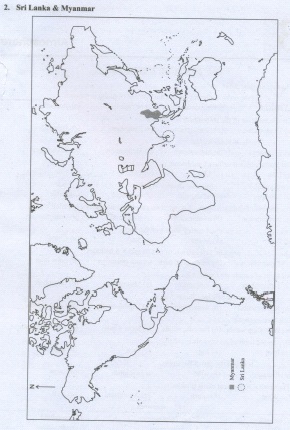

9th Standard Syllabus & Materials
9th Standard
TN 9th Tamil உள்ளத்தின் சீர் - திருக்குறள் Important Questions And Answers Study Material - QB365 Set A
NEW9th Standard
TN 9th Tamil உள்ளத்தின் சீர் - மணிமேகலை Important Questions And Answers Study Material - QB365 Set A
NEW9th Standard
TN 9th Tamil உள்ளத்தின் சீர் - ஏறு தழுவுதல் Important Questions And Answers Study Material - QB365 Set A
NEW9th Standard
TN 9th Tamil உயிருக்கு வேர் - தண்ணீர் Important Questions And Answers Study Material - QB365 Set A



Tamilnadu Stateboard 9th Standard Subjects
Tamilnadu Stateboard Standards




