
 100% FREE ACCESS
9th Standard CBSE Syllabus & Materials
9th Standard CBSE
CBSE 9th Science Is matter around us pure? - New Model Questions Papers Study Material - QB365 Set A
NEW9th Standard CBSE
CBSE 9th Science Matter in our surroundings - New Model Questions Papers Study Material - QB365 Set A
NEW9th Standard CBSE
CBSE 9th Mathematics Heron's Formula Sample Question Papers Study Material - QB365 Set A
NEW9th Standard CBSE
CBSE 9th Mathematics Circles Sample Question Papers Study Material - QB365 Set A
NEW9th Standard CBSE
CBSE 9th Mathematics Quadrilaterals Sample Question Papers Study Material - QB365 Set A
NEW9th Standard CBSE
CBSE 9th Mathematics Triangles Sample Question Papers Study Material - QB365 Set A
Published on: 21/10/2025
Download CBSE Class 9th Standard CBSE Social Science question papers, sample papers, important questions, and previous year solved papers in PDF format. Get free study materials, NCERT solutions, and exam preparation resources for Class 9th Standard CBSE Social Science
Questions + Answers key
Take MCQ Social Science Test
1.
who were 'jadidists'?
Muslim revolutionaries
Non-Russian nationality
Muslim reformers within the Russian Empire
Muslim reformers within the Russian Empire
2.
The Military Revolutionary Committee was headed by:
Leon Trotskii
Vladimir Lenin
Pro Tsarists
Stalin
3.
What was the Marseillaise?
A slogan
A type of hat
A patriotic song
A romantic song
4.
Who advocated government based on 'Social Contract'?
Darwin
Spencer
Rousseau
Montesquieu
5.
Petrograd had led the February Revolution that brought down the monarchy in February 1917. Explain.
6.
Explain the Directory Rules in France. Write any two draw-backs of the New Constitution.
7.
Why did Kerenskii's Government become unpopular in Russia?
8.
Analyse the given table. Which values you think were disturbing the balance of a country like France
| Active Citizens | Entitled to vote. About 4 million of a population of 28 million |
| Passive Citizens | No voting rights. About 3 million men, women ,children and youth below 25 |
9.
What consequences did Louis XVIand his queen face after France became a republic in 1792?
10.
In the context of Russia which group was the supporter of women Suffrage?
11.
On the given outline map of the world, four features are marked. These are the countries that were Allied Powers in the First WorldWar. Identify them.
12.
Read the following extract and answer the questions that follow
Rabindranath Tagore wrote from Russia in 1930
‘Moscow appears much less clean than the other European capitals. None of those hurrying along the streets look smart. The whole place belongs to the workers … Here the masses have not in the least been put in the shade by the gentlemen … those who lived in the background for ages have come forward in the open today … I thought of the peasants and workers in my own country. It all seemed like the work of the Genii in the Arabian Nights. [here] only a decade ago they were as illiterate, helpless and hungry as our own masses … Who could be more astonished than an unfortunate Indian like myself to see how they had removed the mountain of ignorance and helplessness in these few years’.
(i) How does the author of the above passage portray Moscow?
(ii) What is the condition of the mass there?
(iii) Why does the author call himself unfortunate?
13.
Read the following extract and answer the questions that follow:
Some of the basic rights set forth in Olympe de Gouges’ Declaration.
1. Woman is born free and remains equal to man in rights.
2. The goal of all political associations is the preservation of the natural rights of woman and man: These rights are liberty, property, security, and above all resistance to oppression.
3. The source of all sovereignty resides in the nation, which is nothing but the union of woman and man.
4. The law should be the expression of the general will; all female and male citizens should have a say either personally or by their representatives in its formulation; it should be the same for all. All female and male citizens are equally entitled to all honours and public employment according to their abilities and without any other distinction than that of their talents.
5. No woman is an exception; she is accused, arrested, and detained in cases determined by law. Women, like men, obey this rigorous law.
(a) How did Olympe de Gouges, view women?
(b) What should be the goal of all political associations according to her?
(c) What was her opinion about law?
14.
Observe the picture given below and answer the following questions.
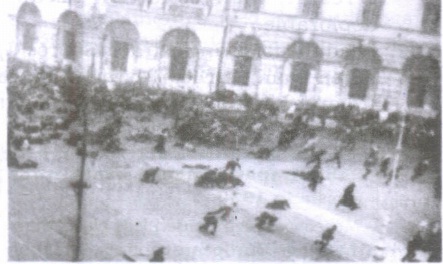
The above picture is of pro-Bolshevik demonstration on 17th July which get fired upon by the army.
(i) Who were Bolsheviks and who was their leader?
(ii) Why and by whom was the popular demonstration by the Bolsheviks in July 1917 harshly repressed?
1.
(c)
Muslim reformers within the Russian Empire
2.
(a)
Leon Trotskii
3.
(c)
A patriotic song
4.
(c)
Rousseau
5.
(i) In the winter of 1917, conditions in Petrograd were grim. The layout of the city emphasised divisions among the people. While workers quarters and factories i.e the poor were located to the right of River Neva, the official building including the Palace and-fashionable areas were on the left bank.
(ii) In February 1917, food shortage's were deeply felt in the workers quarters (right bank). The winter that year was exceptionally cold, marked with frost and heavy snow.
(iii) On 22nd February a lockout took place at a factory on the right bank. Next day, workers of fifty factories called a strike, led by women. The fashionable quarters and official buildings were surrounded by workers. The Government imposed a curfew. When the workers came back on the 24th and 25th, the government called out the police and cavalry provoking the workers.
(iv) On Sunday, 25th February the government suspended the Duma. Demonstrators ransacked the Police Headquarters. Streets were full of people raising slogans about bread, wages, better hours and democracy.
(v) The government tried to control the situation but the cavalry refused to fire on the demonstrators. An officer was shot, three regiments mutinied voting to join the strikers.
(vi) By the evening (Feb 25th) soldiers and striking workers gathered to form a 'Soviet' or 'Council' called the 'Petrograd Soviet' in the same building as the Duma met.
(vii) Under the advice of the Military commanders, the Tsar abdicated on 2nd March Soviet leaders and Duma leaders formed a Provisional Government to run the country.
(viii) Russia's future was hence to be decided by a constituent assembly, elected on the basis of universal adult suffrage.
6.
(i) The Directory was an executive made up of ive members
(ii) This was meant as a safeguard against concentration of power in a one man executive as under the Jacobins.
(iii) It was appointed by the two elected legislative councils that came into being under the new constitution after the fall of the Jacobins.
Drawbacks:
(i) The Directors often clashed with the legislative councils, who sought to dismiss them.
(ii) The political instability of the Directory paved the way for the rise of a military dictator, Napoleon Bonaparte
7.
(i) Non fulfillment of demands: Kerenskii's government was overthrown because it was unpopular with the people. It failed to meet the demands of the people for peace, land to the tiller, control of industries to workers' and equal status to non-Russian nationalities.
(ii) Lenin: In April 1917 the Bolshevik leader Lenin returned to Russia from exile. He put forward the April Thesis due to which he got full support. Kerenskii's government sought to establish political democracy through constitutional means but the Bolsheviks under Lenin wanted to establish a socialist state immediately, even if it meant taking recourse to violent means.
(iii) Bolsheviks: The Bolshevik party played a leading role. They campaigned against the war, and for peace on the basis of no annexations and no indemnities. Moreover German advances threatened Petrograd. This increased support for the Bolsheviks.
(iv) War: The Russians were war weary. Bolshevik ranks swelled with numbers and they controlled the Petrograd Soviet.
(v) Coup: Bolsheviks successfully staged a coup in October 1917 and overthrew the Provisional Government of Kerenskii.
8.
Values which were disturbing the balance of a country like France were:
(i) Not all citizens had the right to vote. Out of a population of 28 million, only 4 million i.e. 14% of the population had the right to vote.
(ii) The 'passive' citizens had no right to vote.
(iii) Nearly 3 million men, women and youth were below 25 years of age. They were categorized as 'passive' citizens, because in France only men 25 years of age who paid taxes were given status of 'active' citizens.
(iv) Despite being active participants in the events which brought important changes in French society, women whatever their age and economic status were denied voting rights.
9.
Louis XVI was sentenced to death by a court on the charge of treason. On 21 January 1793 he was executed publicly at the Place de la Concorde. The queen Marie Antoinette met with the same fate shortly after it.
10.
The Radicals
11.
The countries marked on the above map are
(i) France
(ii) England
(iii) Russia
(iv) America
12.
(i) Moscow, as the author describes, is much less clean than other European capitals. The whole place belongs to the workers.
(ii) The mass now look smart and enlightened.
(iii) The author calls so for being a citizen of the country which had long been under the influence of illiteracy and poverty and it took a long time to remove them.
13.
(a) Olympe de Gouges opined that woman was born free and, therefore, she should remain equal to man in rights. There should not be any disparity between both the sexes.
(b) According to Olympe de Gouges, the goal of all political associations should be the preservation of all the natural rights (liberty, property, security and resistance to oppression) of woman and man.
(c) She was of the opinion that the law should be the expression of the general will. All female and male citraens should have a say either personally or by their representatives in its formulation, it should be the same for all.
14.
(i) Bolsheviks were the majority group of the workers of Russia and their leader was Lenin.
(ii) The popular demonstration by the Bolsheviks was harshly repressed by the Provisional Government because Bolshevik influence was growing fast and the government was afraid that it might give rise to another revolution.

9th Standard CBSE Syllabus & Materials
9th Standard CBSE
CBSE 9th Mathematics Lines and Angles Sample Question Papers Study Material - QB365 Set A
NEW9th Standard CBSE
CBSE 9th Mathematics Introduction to Euclid's Geometry Sample Question Papers Study Material - QB365 Set A
NEW9th Standard CBSE
CBSE 9th Mathematics Linear Equations in Two Variables Sample Question Papers Study Material - QB365 Set A
NEW9th Standard CBSE
CBSE 9th Mathematics Coordinate Geometry Sample Question Papers Study Material - QB365 Set A



NCERT Books

Syllabus

Exam Pattern

Sample Question Papers

Previous year Question Papers

Important Notes

MCQ Practice test

NCERT Exemplers

Case study Questions

Image Based Questions

Passage based Questions

HOT Questions

Value Based Questions

Model Questions Papers
NCERT ( Book Back ) Questions

Assertion and Reason
Important Questions And Answers

CBSE 9th Standard CBSE Subjects
CBSE Standards


