
 100% FREE ACCESS
9th Standard Syllabus & Materials
9th Standard
TN 9th Tamil உள்ளத்தின் சீர் -கற்கண்டு (இலக்கணம்) - தொடர் இலக்கணம், ஆகுபெயர் Important Questions And Answers Study Material - QB365 Set A
NEW9th Standard
TN 9th Tamil உள்ளத்தின் சீர் -விரிவானம் (துணைப்பாடம்) - தாய்மைக்கு வறட்சி இல்லை! Important Questions And Answers Study Material - QB365 Set A
NEW9th Standard
TN 9th Tamil உள்ளத்தின் சீர் -கவிதை பேழை (செய்யுள்) - மார்கழி பெருவிழா Important Questions And Answers Study Material - QB365 Set A
NEW9th Standard
TN 9th Tamil உயிருக்கு வேர்-இலக்கணம் - பகுபத உறுப்பிலக்கணம் Important Questions And Answers Study Material - QB365 Set A
NEW9th Standard
TN 9th Tamil அமுதென்று பேர் - இலக்கணம்-எழுத்து -அளபெடை Important Questions And Answers Study Material - QB365 Set A
NEW9th Standard
TN 9th Tamil அமுதென்று பேர்-துணைப்பாடம் - ஆறாம்திணை Important Questions And Answers Study Material - QB365 Set A

Published on: 21/01/2020
Download Tamil Nadu 9th Standard Social Science question papers, model tests, one-mark questions, important questions, and public exam papers in PDF format. Free study materials and answer keys for TN State Board students.
Questions + Answers key
Take MCQ Social Science Test
1.
Explain the concept of migration.
2.
Write about the Gandhi's Concept of Gram Swaraj.
3.
Explain the term Virtual water.
4.
Explain the Global Navigation Satellite System (GNSS).
5.
Explain the term sustainable development. Why should we balance the economic, social and environmental factors of sustainability in equal harmony?
6.
Mention the development in textiles due to industrial revolution in Great Britain.
7.
Write a note on the following:
Persian wheel
8.
Explain the relationship between Money and Price.
9.
What was the impact of the Ming empire on China?
10.
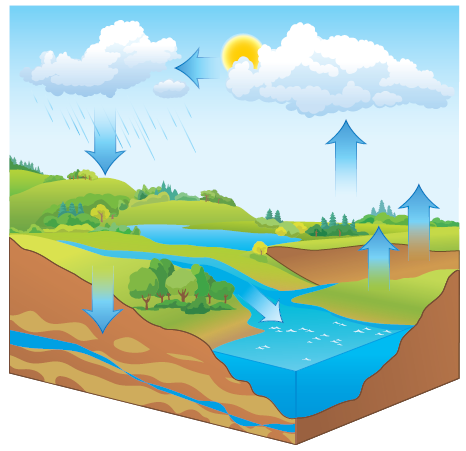
What does this picture depict? Write a note on the processes involved in it.
11.
Give an account of Mobilisation and Democratic Participation.
12.
Explain the teachings of Lao-Tse (Taoism).
13.
Distinguish between the Public sector and the Private sector.
14.
What are the function of Pressure groups in India?
15.
How are cyclones formed? How are they classified?
16.
What is your opinion about democracy in India?
17.
Compare and contrast the principles of Jainism and Buddhism.
18.
Describe the depositional work of winds.
19.
How are volcanoes classified based on the periodicity of their eruptions
20.
The developments in the fields of agriculture, pottery and metal tools are considered a landmark in the life of Megalithic period-Substantiate.
1.
(i) In any settlement-village or town change in population occurs due to birth, death and migration.
(ii) Of these three components of population change, birth and death is clearly identifiable events while migration poses the maximum amount of problem with regards to its definition and measurement.
(iii) As almost everyone keeps moving most of the time, it is not easy to define which of these moves have to be classified as migratory moves.
(iv) In the Census of lndia, migration is enumerated on two bases - Place of birth and Place of residence.
2.
(i) Gandhi really wanted 'Swaraj', The self rule by the people of India who represent the rural mass.
(ii) He observed "India's soul lives in the village".
(iii) He dreamt of village republics in term of Panchayat in the free India.
(iv) Mahatma Gandhi advocated Panchayat Raj, a decentralized form of government where each village is responsible for its own affairs.
(v) Gandhi's ideal village should be basically self-reliant, making provision for all necessities of life, food clothing, clean water, sanitation, housing, education and other requirements, including government and self-defense.
(vi) According to Gandhi Gram Swaraj should be a complete republic, independent of its neighbor.
(vii) Every village should be a democracy in which they will not depend even on neighbor for major needs.
3.
(i) The term virtual water was introduced by Tony Allen in 1990.
(ii) The water consumed in the production process of an agriculture or industrial product has been called the virtual water.
(iii) It is a hidden flow of water when food or other commodities are traded from one place to another.
(iv) For instance it takes 1340 cubic meters of water to produce one metric ton of wheat.
(v) That is, if one metric ton of wheat is exported to another country, then, it means that 1340 cubic metre of water used to cultivate this amount of wheat is also being exported.
(vi) India is the largest global freshwater user .
(vii) India has been the fifth largest exporter of virtual water in the world.
4.
(i) In the 21st century, GNSS has become a part of our lives to promote the safety and convenience of transport.
(ii) Global Navigation Satellite System (GNSS) is a satellite system connected with a small electronic receiver or tracker to locate, monitor and track a user's vehicle wherever in the world.
(iii) It can also set up instant alerts when a driver of a vehicle speeds or deviates from a particular area.
(iv) GNSS applications are used in tracking or mapping vehicles, ships and aircraft.
(v) A group of satellites (Space Segment) working with a network of ground stations (Control Segment) provide location data.
(vi) The receiver (User Segment) converts satellite signals into location, speed and time data.
(vii) Examples of GNSS:
(a) Europe's Galileo
(b) USA's NAVSTAR Global Positioning System (GPS)
(c) Russia's Global'naya Navigatsionnaya Sputnikovaya Sistema (GLONASS)
(d) China's BeiDou Navigation Satellite System
(e) India's NAVIC satellite system
5.
(i) "Sustainable development is development that meets the needs of the present without compromising the ability of future generation to meet their own needs".
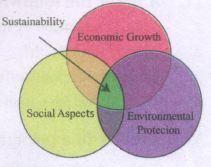
(ii) For sustainable development to be achieved, it is crucial to harmonize three core elements: economic growth, social aspects and environmental protection.
(iii) These elements are interconnected and are crucial for the well-being of individuals and societies
(iv) To achieve true sustainability, we need to balance the economic, social and environmental factors of sustainability in equal harmony.
Social Sustainability:
(i) The ability of a social system such as a country, family or organization to function at a defined level of social well being and harmony is called social sustainability.
(ii) The balancing capacity of a government in maintaining peaceful existence towards other countries and at the same time providing the requirements of its citizens without affecting the environment creates social sustainability.
Economic Sustainability:
(i) The economic sustainability is successfully implemented through strong Public Distribution System.
(ii) Economic sustainability ensures that our economic growth maintains a healthy balance with our ecosystem.
Environment Sustainability:
(i) It is the ability of the environment to support a defined level of environmental quality and natural resource extraction rates forever to mankind.
(ii) Unnecessary disturbances to the environment should be avoided whenever.
6.
(i) In 1733 John Kay invented the 'Flying Shuttle' increasing the speed of the weaving of cloth. In 1767 James Hargreaves invented 'the spinning jenny' which spun eight threads at one and the same time.
(ii) Richard Arkwright invented the 'waterframe' which used water power in the place of manpower.
(iii) In 1779 Samuel Crompton invented his 'spinning mule' which included a combination of both the 'spinning jenny' and the 'water frame'. It spun hundreds of threads simultaneously.
(iv) Eli Whitney invented the cotton gin in 1793. Removing the seed from the cotton increased the productivity manifold.
(v) Textile manufacture was at the heart of the Industrial Revolution. Over a span of fifty years, the textile manufacturing industry in Britain witnessed a transformation in the method of production from handmade to machine-made goods.
(vi) The newly invented machines enabled factories to produce textile goods in large quantities.
(vii) Derbyshire, Lancashire, Cheshire, Staffordshire, Nottinghamshire, and Yorkshire became the major factory centres.
(viii) The most notable was Manchester which had more than 50 mills in 1802.
7.
Persian wheel:
(i) The Persian wheel is a mechanical water lifting device.
(ii) It is usually operated by draught animals like bullocks, buffaloes or camels.
(iii) It is used to lift water from water sources typically open wells.
(iv) Since it was used in Persia, it got the name Persian wheel.
8.
(i) The relationship between money and price is connected with the Monetary policy.
(ii) There is a close relationship between the growth of money supply and inflation.
(iii) Price controls play a very important role in a country's economic stability.
(iv) This role is played by RBI.
(v) Currency is the medium of exchange in a country.
(vi) The Indian currency is called the Indian Rupee (INR).
(vii) In a country the foreign currency is called foreign exchange.
(viii) Purchasing capacity of all currencies in the world are compared using the US dollar as the standard currency.
(ix) This value differs from country to country.
(x) Most of the international trade transactions are carried out in US dollar
9.
(i) The Ming Empire, which replaced the Mongol empire, consciously discouraged industry and foreign trade in order to concentrate on agriculture.
(ii) This resulted in China lagging behind in the 16th century. Other parts of Eurasia, building on the techniques of the Chinese, began to march ahead.
10.
This picture depicts Water Cycle.
The three major processes involved in the water cycle are a)
Evaporation,
b) Condensation,
c) Precipitation.
Evaporation is the process by which water is converted from its liquid state to the gaseous state, usually as a result of the sun's warming rays.
Condensation occurs as the vapour rises into the atmosphere, creating clouds and fog. Once clouds are formed, advection (the movement of water in its various states) occurs through the atmosphere. Without advection, the water would evaporate and precipitate at the same place only.
Precipitation occurs when the vapour that condensed comes back out of the sky as rain, snow, sleet, hail. Most of it comes back to the ground or body of water. Thus water moves across land and is stored in lakes or reservoirs for human uses.
11.
Mobilising people towards socially productive activities that lead to the overall betterment of people's lives is essential. Sometimes earthquakes, tsunamis, floods and other such natural disasters on a massive scale occur and people's immediate mobilisation for evacuation and emergency relief becomes most essential.
Democratic Participation: Democracy can succeed only when smaller local groups and, in fact, every citizen can take action that supports the tax and revenue collection systems, observance of national norms in environmental protection, cleanliness, health and hygiene, sanitary drives and immunisation programmes like pulse polio. However, we must keep in mind that there is no better form of government than Democratic government. To create a better society and nation, the people of India along with the union and state governments should come together to fight against the miseries of human life.
12.
(i) The cause of human unhappiness in the world is human selfishness. Selfishness creates unlimited human desires, which can never be satisfied.
(ii) In nature, all the things act in a natural way. The law of human conduct must correspond with nature.
(iii) Humans live a life under the regulation of someone. This is because they have acquired knowledge and have not remained innocent. On the basis of their acquired knowledge, they have built up an urban civilisation and have made themselves unhappy.
13.
| S.No | Public Sector | Private Sector |
| 1 | Service motive | Profit motive |
| 2 | Government owns the assets | Private individuals own the assets |
| 3 | Wages are paid by the government | Wages are paid by the owner of private enterprises. |
| 4. | NIC, SAIL, BSNL. | TVS motors, Ashok Leyland, TATA Steel. |
14.
(i) Pressure groups are the interest groups that work to secure certain interest by influencing the public policy
(ii) They are non-aligned with any other party.
(iii) They work as an indirect yet powerful group to influence the policy decisions.
(iv) They support through activities such as petitions, marches, demonstrations and other forms of political protest.
(v) It comments on government policy and using high profile academics, scientists and even celebrities to get their views across with an emphasis to cultivate expert authority.
(vi) Many pressure groups are vital sources of information and render advice to the government.
(vii) They are regularly consulted in the process of policy formulation.
15.
The term cyclone is a Greek word meaning "coil of a snake". Cyclones are centres of low pressure where, winds from the surrounding high pressure area converge towards the centre in a spiral form. Due to the rotation of the earth, the cyclonic winds in the northern hemisphere move in anti-clockwise direction, whereas they move in clockwise direction in the southern hemisphere.
Cyclones can be classified into Tropical cyclones, Temperate cyclones and Extratropical cyclones.
Tropical cyclones: Tropical cyclones develop in the Intertropical convergence zone [ITCZ]. They are formed due to the differential heating of land and sea. Tropical cyclones are known as 'cyclones' in Indian ocean, 'typhoons' in the western pacific ocean, 'hurricanes' in the Atlantic and eastern Pacific ocean, 'baguios' in Philippines and 'willy willy' in Australia. Tropical cyclones often cause heavy loss of life and property on the coasts and become weak after reaching the landmasses.
Temperate cyclones: Temperate cyclones are formed along a front where hot and cold air masses meet in mid-latitudes between 35° and 65°N and S. Temperate cyclones do not become weak like the tropical cyclones on reaching the land. Temperate cyclone commonly occurs over the North Atlantic Ocean, North West Europe, Mediterranean basin. Mediterranean basin's temperate cyclones extend up to Russia and India in winter. In India it is as called western disturbances.
Extratropical cyclones: Extratropical cyclones occur in the latitudes between 30° and 60° in both the hemispheres. They are also called as mid-latitude cyclones. They collect energy from temperature differences which are found in higher latitudes. Extratropical cyclones produce mild showers to heavy gales, thunderstorms, blizzards, and tornadoes.
16.
(i) India has a Parliamentary form of democracy.
(ii) The Indian Parliament comprises the elected representatives of people.
(iii) It makes the laws for the country.
(iv) The participation of people in the decision making and the consent of citizens are the two important elements of Parliamentary form of government in India.
(v) India is the largest democratic country in the world.
(vi) Democracy in India works on five basic principles.
(vii) These are sovereign, socialist, secular, democratic and republic.
(viii) Every citizen of India who is not less than 18 years of age can exercise their right to vote in India.
(ix) There is no discrimination based on a person's caste, creed, religion, gender and education when it comes to providing the right to vote.
17.
UNITY:
(i) Mahavira and Gautama Buddha were princes in their early life.
(ii) Both of them left the house at the age of 30 and wandered from place to place subjecting themselves to severe penance and got wisdom and enlightenment.
(iii) Both religion preached their teachings in the people's language.
(iv) These two religions denied blood sacrifice and animal sacrifice.
(v) Ahimsa is the basic faith followed by these two religions.
(vi) The two religions insist disciplined life, Right faith, and Right knowledge.
(vii) Later on these two religion split into two.
DIVERSITIES:
(i) Jainism believed that all the things had soul. But Buddhism did not accept it.
(ii) Mahavira's teachings are known as Triratnas and Buddha's teachings are known as eight fold path.
(iii) Jain texts are written in Sanskrit and Prakrit language But Buddhist text are written in Pali language.
(iv) Buddhism was patronised by the kings Ashoka and Kanishka. Jainism was not patronised by any king.
(v) Buddhism spread all over the world but Jainism did not spread to other countries.
18.
Deposition occurs when the speed of wind is reduced by the presence of obstacles like bushes, forests and rock structures. The sediments carried by wind get deposited on both the wind ward and leeward sides of these obstacles Some of the depositional landforms are sand dunes, barchans and loess.
Sand Dune: In deserts, during sandstorms, wind carries loads of sand. When the speed of ·wind decreases, huge amount of sand gets deposited. These mounds or hills of sand are called sand dunes. There are different types of sand dunes
Barchan: Barchans are isolated, crescent shaped sand dunes. They have gentle slopes on the ·windward side and steep slopes on the leeward side
Transverse Dunes: Transverse dunes are asymmetrical in shape. They are formed by alternate slow and fast winds that blow from the same direction.
Longitudinal Dunes: Longitudinal dunes are long narrow ridges of sand, which extend in a direction parallel to the prevailing winds. These dunes are called Seifs in Sahara.
Loess: The term loess refers to the deposits of fine silt and porous sand over a vast region.
Extensive loess deposits 'are found in Northern and Western China, the Pampas of Argentina, in Ukraine and in the Mississippi Valley of the United States.
19.
Based on the periodicity of eruptions, volcanoes are classified into
(i) Active volcano,
(ii) Dormant volcano,
(iii) Extinct volcano.
(i) Active Volcano: Active volcanoes are those which constantly eject volcanic lava, gases and fragmented materials. (e.g.) Mount St. Helens in the United States.
(ii) Dormant Volcano: Volcanoes that do not show any sign of volcanic activity for a long period of time are known as dormant volcanoes. Sometimes there may be a sudden explosion which may cause unimaginable loss to life and property (e.g.) Mt. Fuji, Japan.
(iii) Extinct or Dead Volcano: When a volcano permanently stops its volcanic activity, then it is called as extinct or dead volcano (e.g.) Mt. Kilimanjaro, Tanzania.
Volcanoes can also be classified based on their structure and composition as composite volcano, shield volcano and dome volcano.
20.
AGRICULTURE:
1. The people in megalithic practiced agriculture, domesticated cattle and sheep.
2. Megalithic sites are found nearby rivers and tanks. In the deltaic regions.
3. Irrigation as a technology had developed.
4. Irrigation management developed in this period.
5. Millets and rice were cultivated.
POTTERY:
1. Pottery was made with hand or wheels.
2. people used the black and red colour to make black ware and red ware pottery.
3. The black and red ware pottery has a black inside and a red outside, with lustrous surfaces.
4. Potteries were used for cooking, storage and dining purposes.
METAL TOOLS:
1. The Megalithic burials have abundant iron objects placed in the burials as grave goods.
2. Weapons such as swords and daggers, axes, chisels, lamps and tripod stands are also found.
3. The Iron tools were used for agriculture, hunting, gathering and in battles.
4. Bronze bowls, bronze mirrors and bell have been found.

9th Standard Syllabus & Materials
9th Standard
TN 9th Tamil உள்ளத்தின் சீர் - திருக்குறள் Important Questions And Answers Study Material - QB365 Set A
NEW9th Standard
TN 9th Tamil உள்ளத்தின் சீர் - மணிமேகலை Important Questions And Answers Study Material - QB365 Set A
NEW9th Standard
TN 9th Tamil உள்ளத்தின் சீர் - ஏறு தழுவுதல் Important Questions And Answers Study Material - QB365 Set A
NEW9th Standard
TN 9th Tamil உயிருக்கு வேர் - தண்ணீர் Important Questions And Answers Study Material - QB365 Set A



Tamilnadu Stateboard 9th Standard Subjects
Tamilnadu Stateboard Standards




