
 100% FREE ACCESS
9th Standard Syllabus & Materials
9th Standard
TN 9th Tamil உள்ளத்தின் சீர் -கற்கண்டு (இலக்கணம்) - தொடர் இலக்கணம், ஆகுபெயர் Important Questions And Answers Study Material - QB365 Set A
NEW9th Standard
TN 9th Tamil உள்ளத்தின் சீர் -விரிவானம் (துணைப்பாடம்) - தாய்மைக்கு வறட்சி இல்லை! Important Questions And Answers Study Material - QB365 Set A
NEW9th Standard
TN 9th Tamil உள்ளத்தின் சீர் -கவிதை பேழை (செய்யுள்) - மார்கழி பெருவிழா Important Questions And Answers Study Material - QB365 Set A
NEW9th Standard
TN 9th Tamil உயிருக்கு வேர்-இலக்கணம் - பகுபத உறுப்பிலக்கணம் Important Questions And Answers Study Material - QB365 Set A
NEW9th Standard
TN 9th Tamil அமுதென்று பேர் - இலக்கணம்-எழுத்து -அளபெடை Important Questions And Answers Study Material - QB365 Set A
NEW9th Standard
TN 9th Tamil அமுதென்று பேர்-துணைப்பாடம் - ஆறாம்திணை Important Questions And Answers Study Material - QB365 Set A

Published on: 21/01/2020
Download Tamil Nadu 9th Standard Social Science question papers, model tests, one-mark questions, important questions, and public exam papers in PDF format. Free study materials and answer keys for TN State Board students.
Questions + Answers key
Take MCQ Social Science Test
1.
Write about the reign of Alexander, the Great
2.
Who were Jesuit missionaries?
3.
Write about Zwingli and Calvin
4.
Mention the various relief features of ocean floor.
5.
Outline the differences of Martin Luther with the Catholic Church.
6.
What is sericulture?
7.
Write about the military expeditions of Malik Kafur.
8.
Scientists use GPS to measure the rate of Tectonic Plate movements. Discuss.
9.
What do you know of Ajathasatru?
10.
Agriculture was one of the main sources of subsistence in Sangam Age. Give reasons
11.
How important are coins as a source of evidence for the study of Sangam Age?
12.
Define :
a) Moraine
b) Drumlin
c) Esker
13.
List out any four karst topographical areas found in India.
14.
How does a cave differ from a sea arch?
15.
What are the Federal features of Indian Constitution?
16.
Why are children and old age (above 60 years) are not considered for computation of workforce?
17.
What is ‘Solar Power’?
18.
Why human resources is considered as the foremost resource of any country?
19.
Mention the forms of democracy.
20.
Study your area and write down about its settlement pattern.
1.
(i) Under Alexander the Great, the Greeks were able to establish a kingdom in Macedonia.
(ii) This kingdom succeeded in annexing two historic empires of Egypt and the Middle East.
(iii) But the entire period of Alexander's reign was spent on wars.
(iv) The Greek school of Science, Mathematics and Philosophy reached its peak in the Greek-Egyptian city of Alexandria.
2.
(i) Jesuit missionaries were active especially among the fishing communities on the Pandyan coast.
(ii) The best known among the Jesuit missionaries was St Francis Xavier who was instrumental in making the fishing community to take to Christianity in the Tuticorin region.
(iii) Another notable Jesuit was Roberto de Nobili, a scholar, who was based in Madurai.
3.
(i) Zwingli of Switzerland and John Calvin of Geneva followed Martin Luther.
(ii) Zwingli worked from Zurich and was against all forms of rituals.
(iii) John Calvin also opposed all forms of display of wealth.
(iv) Calvin codified his views in his book Institutes of Christian Religion.
(v) He believed that Church should be independent of political control on religious matters.
(vi) Calvinism became more popular
4.
The ocean basins are characterised by the following major relief features:
(i) Continental shelf
(ii) Continental slope
(iii) Continental rise
(iv) Deep sea plain or Abyssal plain
(v) Oceanic deep
(vi) Oceanic ridge
5.
(i) Martin Luther rejected the belief that ceremonies and penances would lead to salvation.
(ii) He argued that it was by faith alone that one could attain salvation.
(iii) The grace of God would be bestowed by the divine will alone and not by the deeds of the people.
(iv) Further, the Bible could be read and interpreted by all and not by the Church alone.
(v) Thus, he rejected the role of the Church as an intermediary between the individual and God.
6.
(i) Sericulture the silk production by breeding the mulberry silkworm was introduced in the fourteenth and fifteenth centuries.
(ii) By the seventeenth century, Bengal had become one of the largest silk-producing regions in the world.
(iii) In addition, other varieties of silk (like tassar) were also produced.
7.
The first ten years of the 1300 AD(CE) Alauddin Khalji's slave and commander Malik Kafur was sent on military expedition to south India.
8.
GPS works by sending radio signals from satellites to ground stations. The distance between the satellites and station is recorded. Over time, these distances change slightly. Scientists can measure the rate of Tectonic Plate movements by recording the time it takes for ground stations to move a given distance.
9.
1. Ajathasatru, the son of Bimbisara is said to have murdered his father and ascended the throne in 493 BCE.
2. He expanded his territory through military conquests.
3. He strengthened the Rajagriha fort and also built another fort at Pataligrama on the Ganges.
10.
1. Agriculture was one of the main sources of subsistence.
2. Both wet and dry land farming were practiced.
3. In the riverine and tank-irrigated areas, paddy was cultivated.
4. Millets were cultivated in dry lands.
11.
(i) Coins as a medium of exchange were introduced for the first time in the Sangam Age.
(ii) The coins of the Cheras, the Cholas and the Pandyas, punch-marked coins, and Roman coins form another important source of evidence from the Sangam Age.
(iii) Sometimes coins were protected as a precious wealth.
12.
Moraine:
(i) Landforms formed by the glacial deposits of valley (or) continental glaciers are termed as moraines.
(ii) They are of various shapes and sizes, like ground, terminal and lateral moraines, etc.
Drumlin: Drumlins are deposits of glacial moraines that resemble giant inverted teaspoons (or) half cut eggs.
Esker: Long narrow ridges composed of boulders gravel and sand deposited by streams of melting water which run parallel to a glacier are called eskers.
13.
(i) Guptadham caves - Western Bihar
(ii) Pandav caves Pachmarhi Madhya Pradesh
(iii) Kutumsar - Bastar district in Chhattisgarh
(iv) Borra caves of Visakhapatnam - Andhra Pradesh
14.
| Sea cave | Sea Arch |
| Prolonged wave attack on the base of a cliff erodes rock materials which result in the formation of caves. | When two caves approach one another from either side of a headland and unite, they form an arch. e.g., Neil Island, Andaman & Nicobar |
15.
Federal features of Indian Constitution are,
(1) Dual Government
(2) Written constitution
(3) Division of Powers
(4) Supremacy of the Constitution
(5) The constitution is the supreme law of the land. The laws enacted by the Centre and the states must conform to its provisions.
(6) Rigid Constitution
(7) Independent Judiciary
(8) Bicameralism
16.
(i) Persons who are less than 15 years are considered as children and person who have crossed 60 years are old people.
(ii) They are excluded as they are not physically fit to undertake productive occupation.
17.
(i) Solar power is the conversion of energy from sunlight into electricity either directly using photovoltaic cells or indirectly using concentrated solar power.
(ii) Solar panels absorb the sunlight as a source of energy to generate electricity.
(iii) A solar electric system can reliably produce electricity for our home and offices.
18.
(i) Human resource is necessary for the progress of any country.
(ii) It refers to the collective abilities of people which can be utilised in the production sector.
(iii) It is invested with good education and health.
(iv) Therefore investment in education and health can result in a high rate of returns in the future.
19.
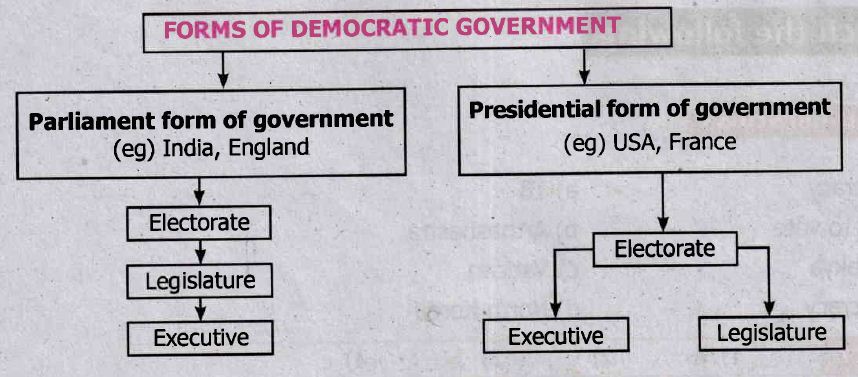
20.
(i) A settlement pattern refers to the way that buildings and houses are distributed in a rural settlement.
(ii) Settlement patterns are of interest to geographers, historians and anthropologists for the insight they offer in how a community has developed over time.
Linear : In a linear settlement pattern, the buildings are arranged in lines. These lines often follow the route of a road or body of water.
Dispersed : In a dispersed settlement pattern, the buildings are scattered over a wide area. Dispersed settlement patterns are often associated with agricultural activity and are frequently surrounded by farmland.
Nucleated: In a nucleated settlement pattern, the buildings are grouped around a central core. Nucleated settlement patterns are usually associated with patterns of agriculture in which the settlement is surrounded by two or three fields, and each field divided into strips that were formed by individual farmers.

9th Standard Syllabus & Materials
9th Standard
TN 9th Tamil உள்ளத்தின் சீர் - திருக்குறள் Important Questions And Answers Study Material - QB365 Set A
NEW9th Standard
TN 9th Tamil உள்ளத்தின் சீர் - மணிமேகலை Important Questions And Answers Study Material - QB365 Set A
NEW9th Standard
TN 9th Tamil உள்ளத்தின் சீர் - ஏறு தழுவுதல் Important Questions And Answers Study Material - QB365 Set A
NEW9th Standard
TN 9th Tamil உயிருக்கு வேர் - தண்ணீர் Important Questions And Answers Study Material - QB365 Set A



Tamilnadu Stateboard 9th Standard Subjects
Tamilnadu Stateboard Standards




