
 100% FREE ACCESS
9th Standard Syllabus & Materials
9th Standard
TN 9th Tamil உள்ளத்தின் சீர் -கற்கண்டு (இலக்கணம்) - தொடர் இலக்கணம், ஆகுபெயர் Important Questions And Answers Study Material - QB365 Set A
NEW9th Standard
TN 9th Tamil உள்ளத்தின் சீர் -விரிவானம் (துணைப்பாடம்) - தாய்மைக்கு வறட்சி இல்லை! Important Questions And Answers Study Material - QB365 Set A
NEW9th Standard
TN 9th Tamil உள்ளத்தின் சீர் -கவிதை பேழை (செய்யுள்) - மார்கழி பெருவிழா Important Questions And Answers Study Material - QB365 Set A
NEW9th Standard
TN 9th Tamil உயிருக்கு வேர்-இலக்கணம் - பகுபத உறுப்பிலக்கணம் Important Questions And Answers Study Material - QB365 Set A
NEW9th Standard
TN 9th Tamil அமுதென்று பேர் - இலக்கணம்-எழுத்து -அளபெடை Important Questions And Answers Study Material - QB365 Set A
NEW9th Standard
TN 9th Tamil அமுதென்று பேர்-துணைப்பாடம் - ஆறாம்திணை Important Questions And Answers Study Material - QB365 Set A

Published on: 13/11/2019
Download Tamil Nadu 9th Standard Social Science question papers, model tests, one-mark questions, important questions, and public exam papers in PDF format. Free study materials and answer keys for TN State Board students.
Questions + Answers key
Take MCQ Social Science Test
1.
Consider the following statements
Assertion (A): Child marriages should be avoided.
Reason (R): When girls get married early, they lose many privileges thereby affecting the society as a whole.
a) Both A and R are correct and R explains A
b) Both A and R are correct but R does not explain A
c) A is correct but R is false
d) A is false but R is correct
Both (A) and (R) are correct and (R) explains (A)
Both (A) and (R) are correct but (R) does not explain (A)
(A) is correct and (R) is false
(A) is false and (R) is correct.
2.
Assertion (A): Many of the Mesolithic sites are found nearby rivers and tanks.
Reason (R): Irrigation management developed during Mesolithic period.
(a) A and R are correct and R explains A
(b) A and R are correct but R doesn’t explain A
(c) A is correct but R is incorrect
(d) A and R both are incorrect
A and R are correct and R explains A
A and R are correct but R doesn’t explain A
A is correct but R is incorrect
A and R both are incorrect
3.
Mention any three ways to conserve Water.
4.
Who monitors the quantity and quality of ground water?
5.
Narrate the given food web of Arctic Tundra in your own words.
6.
Who were Patricians and Plebeians?
7.
Fall of Constantinople
What was promoted by them?
8.
Write a note on a) Lopo Gonçalves b) Bartholomew Diaz
9.
What role is played by NIO (National Institute of Oceanography)
10.
Why do children need special attention?
11.
Why were coins of low value printed in large quantities?
12.
Who founded the Vijayanagar Kingdom? Mention the dynasties that ruled over the kingdom.
13.
Impact of Crusades.
14.
Pacific Ring of Fire - Most seismically and volcanically active. Why?
15.
What are wave cut Platforms?
16.
What leads to development?
17.
Cuddalore and Nagapattinam are always affected by cyclones. Why?
18.
What is the nature of employment in India?
19.
Snowline of Alps is 2700 metre whereas the snowline of Greenland is just 600 mts. Find out the reason.
20.
What do you know about Voters Verified Paper Audit Trail?
21.
What is an Urban centre?
22.
Highlight the steps taken by Ashoka to spread Buddhism.
23.
State the salient features of the Ziggurats.
24.
Explain the term Virtual water.
25.
Study your area and write down about its settlement pattern.
26.
How is currency printed in India?
27.
How was Ottoman supremacy established?
28.
Write a note on weathering classify and explain.
29.
Mention about the Unitary feature of Indian constitution.
30.
Why are children and old age (above 60 years) are not considered for computation of workforce?
31.
Expand the following:
1. NNP
2. PCI
32.
Give the meaning of a political party
33.
Give Abraham Lincoln’s definition for democracy.
34.
In Greece the land was controlled by __________.
Slaves
Writers
Philosophers
Ruling class
35.
A mathematical model of revolution of the earth was presented by
Galileo
Copernicus
Ptolemy
Euclid
36.
Why is the usage of rainforest biomes for large scale agriculture unsustainable?
because it is too wet
because the temperature is too warm.
because the soil is too thin
because the soil is poor
37.
Krishnadeva Raya was a contemporary of _________.
Babur
Humayun
Akbar
Shershah
38.
_____means great name - lord.
Daimyo
Shogun
Fujiwara
Tokugawa
39.
The uppermost layer of the atmosphere is ___________
Stratosphere
Mesosphere
Exosphere
Thermosphere
40.
The discovery of _______ marked the beginning of the second phase in the history of civilisations.
Iron
Gold
Copper
Bronze
41.
The earliest Tamil Grammar book
Valayapathi
Tholkappiyam
Thirukkural
Silappathikaram
42.
__________ continues to be the largest employer in Tamil Nadu
Agriculture
Manufacturing
Banking
Small Scale Industry
43.
Inter-generational equality is ensured under the process of
Industrial progress
Economic development
Sustainable development
Economic growth
44.
Who accords recognition to various political parties as national or regional parties?
The President
The Election Commission
The Parliament
The President in consultation with the Election Commission
1.
a) Both A and R are correct and R explains A
2.
A and R both are incorrect
3.
(i) To conserve water do not dump in or around rivers. Clean up rivers that have a lot of trash in and around them.
(ii) Never dispose of cooking fats and oils by pouring them down the sink.
(iii) Turn off water while brushing teeth, washing, gardening and showering.
4.
(i) The Union Water Board is constantly monitoring the level and nature of ground water.
(ii) This continuous monitoring has categorized the Panchayat Union in terms of the amount of groundwater used.
5.
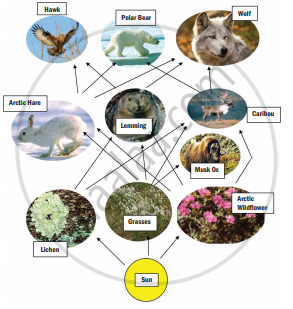
It is a well-balanced food web. This region gets slanting sunrays means very little sunlight in which lichens, grasses, and wildflowers grow and form the first trophic level as a producer. In the second trophic level herbivores who depend on the producers for survival like Arctic Hare, Musk ox, Lemming is the primary consumers. Carnivores who eat the herbivore are-Hawk, Polar Bear and Wolf. They are above the herbivores in a food pyramid. They are secondary consumers.
6.
(i) Patricians were Aristocrats in the Roman Society. Senators and Consuls protected the interests of Patricians.
(ii) Plebeians were chronically in debt and had to eventually lose their land to the Patricians.
7.
Their presence and encouragement promoted the study of classical literature and art of Greeks and Romans.
8.
(a) Lopo Gonçalves:
(i) Lopo Gonçalves was the first sailor to cross the equator. Till then sailors did not dare to venture beyond, as they harboured fears about boiling waters and sea monsters.
(b) Bartholomew Diaz:
(i) ventured further down the African coast reaching Cape point or the southern tip of Africa in 1487 A.D. He named it the Cape of Storms as he encountered fierce storms there. King John II of Portugal renamed it as Cape of Good Hope as it provided hope to reach India by sea.
9.
(i) National Institute of Oceanography (NIO) was established on 1st January 1966.
(ii) The headquarters of NIO is located at Dona Paula, Goa.
(iii) It conducts research and observations to understand Oceanic features, Ocean engineering, Marine Archaeology etc.,
10.
(i) Children should be treated as individuals with fundamental human rights. Children are vulnerable.
(ii) There are root causes such as poverty, gender discrimination, broken families, behind the sale or trafficking of children.
(iii) Children are subjected to sale or trafficking for various reasons - economic exploitation, sexual exploitation, sexual abuse, drug trafficking and child labour. So children need special attention.
11.
(i) As days went by, issues arose while trade prospered, there were insufficient reserves of gold and silver.
(ii) Mines also had a limited reserve of these metals.
(iii) An alternative was found and coins were made using metals with lesser value.
(iv) These were used to buy and sell goods of lesser value.
12.
(i) Vijayanagar kingdom was established by - Harihara and Bukka (the two brothers).
(ii) This empire was ruled by Sangama dynasty, Saluva dynasty and the Tuluva dynasty.
13.
(i) Crusades ended the feudal relations.
(ii) Many of the nobles who went to East to take part in the Crusades either stayed too long a period or did not return.
(iii) The serfs took advantage of their absence to break away from their bondage to the soil.
(iv) Increasing demand for products of the east led to expansion of trade.
(v) Venice, Genoa, and Pisa emerged as important commercial centres in the mediterranean region.
(vi) Constantinople ceased to be the middleman in the trade between the East and the West.
(vii) The elimination of powerful nobles had its influence in strengthening the monarchy in France and England. One notable outcome of Crusades was the loss of prestige suffered by Pope and Papacy.
14.
The Ring of Fire is a ring of volcanoes around the Pacific Ocean. These volcanoes result from subduction of oceanic plates beneath lighter continental plates, A subduction zone is a place where one plate of oceanic lithosphere is shoved under another plate. As it is shoved into the hotter mantle the plate heats up. The addition of volatiles such as water to the hot overlying mantle causes partial melting and the production of magma. This magma rises up through the over-lying plate to erupt at the surface. Hence, the Pacific Ring of Fire is most seismically and volcanically active.
15.
Flat surface found at the foot of the sea cliffs are called as wave cut platform. It is also referred as Beach, shelf, terrace. and plain.
16.
If our thinking turns towards progress and about the ways to achieve the many goals for progress, it leads to development.
17.
(i) Coastal zone is exposed to natural forces including cyclones and Tsunamis.
(ii) Cuddalore and Nagapattinam are situated on the Sea-Shore.
(iii) Cuddalore and Nagapattinam are vulnerable to storms.
(iv) During Summer Bay of Bengal subject to intense heat cause to raise the humid and unstable air masses that produce cyclone.
18.
The nature of employment in India is multi-dimensional. Some get employment throughout the year. Some others get employed for only a few months in a year.
19.
On tropical mountains, the snowline may be as high as 500 mts, but when traced poleward it descends to 2700 mts in the European Alps to 600 meters in Greenland and just to sea level near the poles.
20.
(i) Voters Verified Paper Audit Trail (VVPAT) is the way forward to enhance credibility and transparency of the election process.
(ii) This system was first introduced in 2014 General election.
21.
A planned town with brick architecture and, a proper layout. Urban centres have a larger population involved in non-agrarian, commercial and political occupations. Various industrial activities are seen in these towns.
22.
1. Ashoka became an ardent Buddhist after meeting the Buddhist monk Upagupta and propounded his Dharma.
2. The only true conquest he proclaimed is the conquest of self and the conquest of men's hearts by the dhamma or dharma.
3. He sent his son Mahendra and his daughter Sanghamitra to Ceylon to spread his message of Dharma there.
23.
1. The Ziggurats were at the city centre on a platform and appeared like steep pyramids, with staircases leading to the top.
2. Around this temple were complexes of ceremonial courtyards, shrines, burial chambers for the priests and priestesses, ceremonial banquet halls, along with workshops, granaries storehouses and administrative buildings.
24.
(i) The term virtual water was introduced by Tony Allen in 1990.
(ii) The water consumed in the production process of an agriculture or industrial product has been called the virtual water.
(iii) It is a hidden flow of water when food or other commodities are traded from one place to another.
(iv) For instance it takes 1340 cubic meters of water to produce one metric ton of wheat.
(v) That is, if one metric ton of wheat is exported to another country, then, it means that 1340 cubic metre of water used to cultivate this amount of wheat is also being exported.
(vi) India is the largest global freshwater user .
(vii) India has been the fifth largest exporter of virtual water in the world.
25.
(i) A settlement pattern refers to the way that buildings and houses are distributed in a rural settlement.
(ii) Settlement patterns are of interest to geographers, historians and anthropologists for the insight they offer in how a community has developed over time.
Linear : In a linear settlement pattern, the buildings are arranged in lines. These lines often follow the route of a road or body of water.
Dispersed : In a dispersed settlement pattern, the buildings are scattered over a wide area. Dispersed settlement patterns are often associated with agricultural activity and are frequently surrounded by farmland.
Nucleated: In a nucleated settlement pattern, the buildings are grouped around a central core. Nucleated settlement patterns are usually associated with patterns of agriculture in which the settlement is surrounded by two or three fields, and each field divided into strips that were formed by individual farmers.
26.
(i) In 1925, the British government established a government press at Nasik in Maharashtra.
(ii) Currencies were printed three years later.
(iii) In 1974, a press was started in Dewas, Madhya Pradesh.
(iv) In the 1990s two more presses were started in Mysuru, Karnataka and Salboni in West Bengal to print banknotes.
(v) The Reserve Bank of India has the authority to decide the value of currency to be printed and how the amount should reach its destination safely.
(vi) Though the RBI has the power to print up to ten-thousand-rupee notes, at present a maximum of up to rupees two thousand is printed.
27.
(i) When the Seljuq Turks weakened, the Ottomans extended their power.
(ii) They captured Bulgaria and Serbia, and made Adrianople their capital.
(iii) The conquest of Constantinople in 1453 A.D. by Mohammad II, helped establish Ottoman supremacy in the Balkans, Black Sea and the Middle East.
(iv) After conquering Egypt, they assumed the title of Caliph. They became a major player in the international power politics of the day.
28.
Weathering is the disintegration and decomposition of materials of the earth's crust by their exposure to atmosphere.
There are three types of weathering,
(a) Physical weathering,
(b) Chemical weathering
(c) Biological weathering
Physical weathering: It is the breakdown of rocks without changing their chemical composition, through the action of physical forces. The constant freezing and thawing of rocks during the night and day leads to the expansion and contraction of rocks. Cracks are formed and disintegration occurs eventually. Exfoliation, block disintegration, granular disintegration etc., are the different types of weathering.
Chemical weathering: Disintegration and decomposition of rocks due to chemical reactions is called Chemical Weathering. This is predominantly high in the hot and humid regions such as the equatorial, tropical and subtropical zones. Chemical weathering takes place through the processes of oxidation, carbonation, solution, and hydration. The agents of Chemical weathering are Oxygen, Carbon dioxide and Hydrogen.
Biological weathering: Biological weathering occurs due to the penetration and expansion of plant roots, earthworms, burrowing animals (rabbits, rats) and some human activities
29.
Unitary features of Indian constitution are
(1) Strong Centre
(2) Central Government's control over state territory
(3) Single Constitution.
(4) Flexibility of the Constitution
(5) Unequal representation of states
(6) Emergency Provisions
(7) Single citizenship
(8) Single Integrated Judiciary
(9) All India Services
(10) Appointment of Governor by the central government.
30.
(i) Persons who are less than 15 years are considered as children and person who have crossed 60 years are old people.
(ii) They are excluded as they are not physically fit to undertake productive occupation.
31.
(i) NNP - Net National Product
(ii) PCI - Per Capita Income
32.
(i) A political party is an organisation formed by a group of people with a certain ideology and agenda to contest elections and hold power in the government.
(ii) A political party has three components: a leader, active members and the followers.
33.
Abraham Lincoln defines democracy as a government of the people, by the people and for the people
34.
(d)
Ruling class
35.
(b)
Copernicus
36.
(a)
because it is too wet
37.
(d)
Shershah
38.
(a)
Daimyo
39.
(c)
Exosphere
40.
(a)
Iron
41.
(b)
Tholkappiyam
42.
(a)
Agriculture
43.
(d)
Economic growth
44.
(b)
The Election Commission

9th Standard Syllabus & Materials
9th Standard
TN 9th Tamil உள்ளத்தின் சீர் - திருக்குறள் Important Questions And Answers Study Material - QB365 Set A
NEW9th Standard
TN 9th Tamil உள்ளத்தின் சீர் - மணிமேகலை Important Questions And Answers Study Material - QB365 Set A
NEW9th Standard
TN 9th Tamil உள்ளத்தின் சீர் - ஏறு தழுவுதல் Important Questions And Answers Study Material - QB365 Set A
NEW9th Standard
TN 9th Tamil உயிருக்கு வேர் - தண்ணீர் Important Questions And Answers Study Material - QB365 Set A



Tamilnadu Stateboard 9th Standard Subjects
Tamilnadu Stateboard Standards




