100% FREE ACCESS
9th Standard CBSE Syllabus & Materials
9th Standard CBSE
CBSE 9th Science Is matter around us pure? - New Model Questions Papers Study Material - QB365 Set A
NEW9th Standard CBSE
CBSE 9th Science Matter in our surroundings - New Model Questions Papers Study Material - QB365 Set A
NEW9th Standard CBSE
CBSE 9th Mathematics Heron's Formula Sample Question Papers Study Material - QB365 Set A
NEW9th Standard CBSE
CBSE 9th Mathematics Circles Sample Question Papers Study Material - QB365 Set A
NEW9th Standard CBSE
CBSE 9th Mathematics Quadrilaterals Sample Question Papers Study Material - QB365 Set A
NEW9th Standard CBSE
CBSE 9th Mathematics Triangles Sample Question Papers Study Material - QB365 Set A

Published on: 29/02/2020
9th Standard CBSE Mathematics Annual Exam Model Question 2020
Download CBSE Class 9th Standard CBSE Mathematics question papers, sample papers, important questions, and previous year solved papers in PDF format. Get free study materials, NCERT solutions, and exam preparation resources for Class 9th Standard CBSE Mathematics
Questions + Answers key
Take MCQ Mathematics Test
1.
A die is thrown 1000 times with the frequencies of outcomes 1,2,3,4,5, and 6 as given below:
| Outcome | 1 | 2 | 3 | 4 | 5 | 6 |
| Frequency | 179 | 150 | 157 | 149 | 175 | 190 |
Find the probability of getting each outcome
2.
ABCD is a parallelogram with area 80 sq. cm. The diagonals AC and BD intersect at O. P is the mid-point of OA. Calculator ar (\(\Delta\)BOP).
3.
Consider a small unit of a factory where there are 5 employees: a supervisor laborers. The laborers draw a salary Rs 5,000 per month each while the supervisor gets Rs 15,000 per month. Calculate the mean, median, mode of the salaries of this unit of the factory.
4.
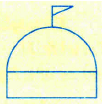
A hemispherical dome of a building needs to be painted. If the circumference of the base of the dome is 17.6 cm, find the cost of painting it, given the cost of painting is Rs 5 per 100 cm2. \(\left( Take\ \pi =\frac { 22 }{ 7 } \right) \)
5.
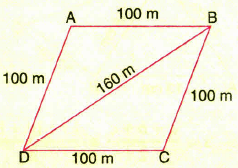
Sanya has a piece of land which is in the shape of a rhombus. She wants her one daughter and one son to work on the land and produce different crops to suffice the needs of their family. She divided the land in two equal parts. If the perimeter of the land is 400 m and one of the diagonals is 160 m, how much area each of them will get?
6.
In a parallelogram PQRS, if \(\angle \)QRS=2x, \(\angle \)PQS=4x, and \(\angle \)PSQ=4x, find the angles of the parallelogram.
7.
If (3x-\(58^{ 0 }\)) and (x+\(38^{ 0 }\)) are supplementary angles,find x and the angles.
8.
Consider the following statement: There exists a pair of straight lines that are everywhere equidistant from one another. Is this statement a
9.
Write the following as an equation in two variables:
5y=2
10.
Plot the points (0,-5) and (-2,5) in the coordinate plane.
11.
Using identity find the following product \((2x-y+3z)(4x^2+y^2+9z^2+2xy+3yz-6zx)\)
12.
Evaluate: \(\frac { \sqrt { 5 } +\sqrt { 3 } }{ \sqrt { 5 } -\sqrt { 3 } } \) , given that \(\sqrt { 15 } =3.87\)
13.
Rationalize the denominator of \(\frac { 1 }{ 2+\sqrt { 3 } } \)
14.
The following table shows the birthday of 30 students of class X:
| Day | Number of students |
| Sunday | 3 |
| Monday | 6 |
| Tuesday | 2 |
| Wednesday | 1 |
| Thursday | 9 |
| Friday | 5 |
| Saturday | 4 |
Find the probability that student was born either on Tuesday or on Wednesday
\(\frac { 1 }{ 10 } \)
\(\frac { 9 }{ 10 } \)
\(\frac { 1 }{ 5 } \)
\(\frac { 1 }{ 3 } \)
15.
If the mode of 4,9,5,4,9,5,4,9, and x - 10 is 9, then value of is:
4
19
1
5
16.
If the edges of a cuboid are l, b and h respectively, then the total surface area of the cuboid is
2(lb + bh + hl)
lbh
2(l + b)h
none of these.
17.
The sides of a triangle 40 cm, 70 cm, and 90 cm.The area of the triangle is
\(600\sqrt { 5 } \)cm2
\(500\sqrt { 6 } \) cm2
\(482\sqrt {5 } \) cm2
\(60\sqrt {5 } \) cm2
18.
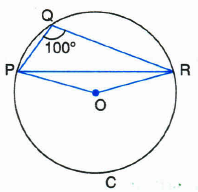
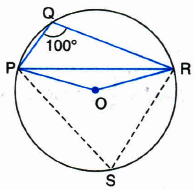
In the adjoining figure, O is the centre of the circle and P, Q and R are points on the circle such that \(\angle PQR=100°\), then \(\angle OPR\) equals:
80°
10°
100°
60°
19.
If a rectangle and a square stand on the same base and between the same parallels, then the ratio of their areas is
1:2
1:4
1:1
2:1
20.
If only one pair of opposite sides of a quadrilateral are parallel, then the quadrilateral is a
Paralleogram
trapezium
rhombus
rectangle
21.
In two triangles ABC and DEF, ㄥA = ㄥD, ㄥB = ㄥE and AB = EF, then are the two triangles congruent? If yes, by which congruency rule?
yes, by AA
NO
yes, by ASA
Yes, by RHS
22.
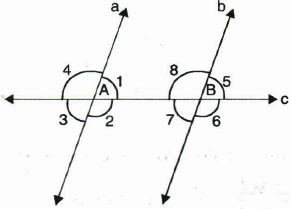
In the following figure a transversal c intersects two parallel lines a and b The angles formed at A and B have been marked.Tell which pair of angles need not be equal?
\(\angle 1,\angle 2\)
\(\angle 1,\angle 3\)
\(\angle 1,\angle 5\)
\(\angle 2,\angle 8\)
23.
'Lines are parallel if they do not intersect' is stated in the form of:
an axiom
a definition
a postulate
a proof
24.
Graph of linear equation 2x+by+c=0, a≠0, b≠0 cuts x-axis and y-axis respectively at the points:
\(\left(-{c\over a},0\right)\left(0,-{c\over b}\right)\)
\(\left(0,-{c\over b}\right),\left(-{c\over a},0\right)\)
(-c, 0),(0, -c)
(x,0), (y,0)
25.
The points (-5,2) and (2,-5) lie in the:
Same quadrant
II and III quadrants respectively
II and IV quadrants respectively
IV and III quadrants respectively
26.
In the polynomial \(1-\sqrt{11} x,\) the coefficient of x is:
1
11
\(-\sqrt{11}\)
\(\sqrt{11}\)
27.
If \(\sqrt { x } \) is an irrational number, then x is:
rational
irrational
0
real
28.
company manufactures car tyres of a particular type. The lives (in year) of 40 such tyres are as follows:
2.6,3.0,3.7,3.2,2.2,4.1,3.5,4.5,3.5,2.3,32, 3.4,3.8,3.2, 4.6,3.7,2.5,4.4,3.4, 3.3,2.9,3.0,4.3,2.8,3.5,3.2,3.9,3.2, 32,3.1,3.7,3.4,4.6,3.8,32,2.6,2.5,42,2.9,3.6
Construct a continuous grouped frequency distribution for the above data of equal class size and with first class interval as 2 - 2.5, (2.5 is not included)
29.
Construct a right triangle whose base is 4 cm and sum of its hypotenuse and other side is 8 cm.
30.
In the figure, ar (\(\Delta\)DRC) = ar(\(\Delta\) DPC) and ar(\(\Delta\)BDP) = ar(\(\Delta\)ARC). Show that both the quarilaterals ABCD and DCPR are trapeziums.
31.
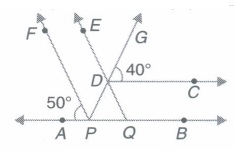
In the figure AB||CD and DE||PF. If \(\angle APF=50^o\) and \(\angle CDG=40^o.\) Find
\((i)\angle AQD\)
\((ii)\angle EDG\)
\((iii) \angle DPF\)
32.
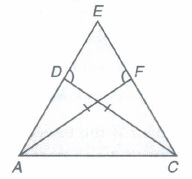
In the figure, if AF = CD are \(\angle\)AFE = \(\angle\)CDE, prove that EF = ED.
33.
Factorize: 9x2+y2+z2-6xy+2yz-6xz. Hence, find its value when x=1, y=2 and z=-1.
34.
Cards with numbers 1,2,3, ..., 100 are placed in a box and mixed thoroughly. One card is drawn, what is the probability that the card drawn is:
(i) a prime number less than 30
(ii) a multiple of 5 and 7
(Iii) a multiple of 5 or 7
35.
A hemispherical bowl made of brass has inner diameter 10.5 cm. Find the cost of tin-plating it on the inside at the rate of Rs 16 per 100 cm2.
36.
Find the cost of leveling a ground in the form of a triangle with sides 40 m, 70 m and 90 m at Rs.4 per square metre. (Use\(\sqrt { 5 } \) = 2.24).
37.
If the non-parallel sides of a trapezium are equal, prove that it is cyclic.
38.
Does Euclid 's fifth postulate simply the existence of parallel lines? Explain.
39.
Draw the graph of the following linear equations in two variables:
y=3x
40.
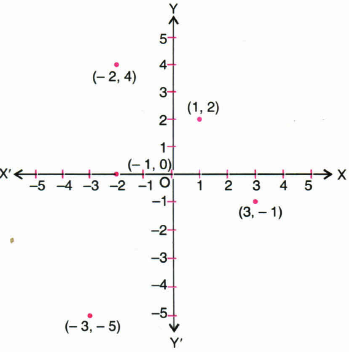
In which quadrant or on which axis do each of the points (-2,4), (3,-1), (-1,0), (1,2) and (-3,-5) lie?Verify your answer by locating them on the Cartesian plane.
41.
Find \({ 125 }^{ 1/3 }\)
42.
PQ and RS are two parallel chords of a circle whose centre is O and the radius is 10 cm. If PQ = 16 cm and RS = 12 cm, find the distance b/w PQ and RS when they lie,
(i)On the same side of centre O.
(ii)On the opposite sides of centre O.
43.
A solid cube of side 12 cm is cut into eight cubes of equal volume. What will be the side of the new cube? Also, find the ratio between their surface area [surface area of 8 new cubes and the original cube]
44.
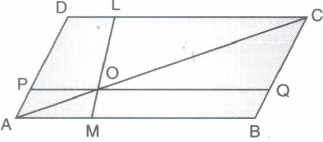
ABCD is parallelogram as shown is figure. O is any point on AC. PQ||AB and LM||AD. show that ar(DLOP)=ar(BMOQ).
45.
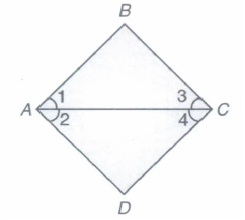
In the fig, we have \(\angle1=\angle3 \ and\ \angle2=\angle4.\) Show that \(\angle A= \angle C.\) State which axiom you use here. Also give two more axioms other than the axioms used in the above situation.
46.
The polynomials bx3+3x2-3 and 2x3 - 5x+b when divided by x-4, leave the remainders R1 and R2 respectively. Find the value of b, if 2R1-R2=0.
47.
On a particular day, the number of vehicles through a crossing is given below:
| Vehicle | Frequency |
| Two-wheeler | 57 |
| Three-wheeler | 33 |
| Four-wheeler | 30 |
A particular vehicle is chosen at random. What is the probability that it is not a four-wheeler?
48.
Find the median of the following data:
95,65,75,70,75,100,50,40.
49.
An isosceles triangle has perimeter 30 m and each of the equal sides is 12 cm.Find area of the triangle.
50.
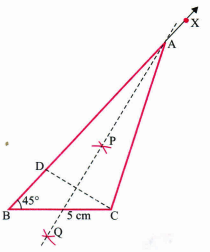
(i) Construct a triangle ABC in which BC = 5 cm, ㄥB = 45°and AB - AC= 2.8cm.
(ii) Measure AB.
(iii) Measure AC
(iv) Verify that AB - AC = 2.8 cm.
(v)Hari comments that ㄥACB = 112°. Is he true? Which value is depicted by comment of Hari?
51.
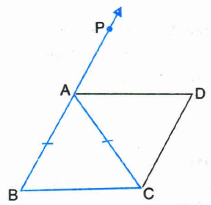
ABC is an isosceles triangle in which AB = AC AD bisects \(\angle \) PAC and CD II AB. Show that
(i) \(\angle \) DAC =\(\angle \) BCA
(ii) ABCD is a parallelogram
52.
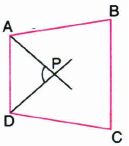
In figure AP and DP are bisectors of two adjacent angles A and D of a quadrilateral ABCD Prove that 2 \(\angle APD=\angle B+\angle C\)
53.
Express x=3y in the form ax+by+c=0 and indicate the values of a, b and c.Write two solutions of the equation.
54.
Plot the following points on the graph sheet: A(-3,-4), B(-2,0), C(-1,4), D(1,0).These points lie in which quadrant or axes?
55.
Two solid spheres made of the same metal have masses 5920 g of and 740 g respectively. Determine the radius of the larger sphere, if the diameter of the smaller sphere is 5 cm.
56.
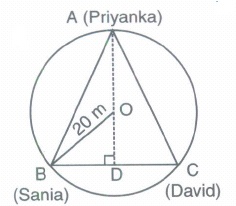
Three students Priyanka, Sania and David are protesting against killing innocent animals for commercial purposes in a circular park of radius 20 m. They are standing at equal distance on its boundary by holding banners in their hands.
(i) Find the distance between each of them?
(ii) Which mathematical concept is used in it?
(iii) How does an act like this reflects their attitude towards society?
57.
For spreading the message "Save Girl Child Save Future" a rally was organized by some students of a school. They were given triangular cardboard piece PQR which they divided in to two parts by drawing the angle bisectors QO and RO of base angles Q and R and wrote a slogan. Prove that \(\angle\)QOR = 90° + \(\frac{1}{2}\)\(\angle\)P. What is the benefit of these types of rallies?
58.
The % of marks obtained by students in the annual examination of a class in mathematics are given below:
| Percentage of marks | No. of students |
|---|---|
| 0-10 | 8 |
| 10-30 | 32 |
| 30-45 | 18 |
| 45-50 | 10 |
(i) How many students get less than 30% of marks?
(ii) Represent the data by histogram.
(iii) Which value is depicted by a student Ram obtaining the highest marks in the interval 45-50?
59.
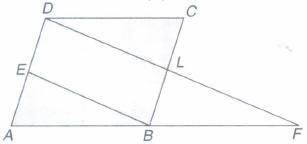
In the given figure ABCD is a parallelogram and E is the mid-point of AD. A line through D, drawn parallel to EB, meets AB produced at F and BC at L Prove that
(i) AF = 2DC
(ii) DF = 2DL
60.
Geetha told her classmate Radha that "\(\sqrt { \frac { \left( \sqrt { 2 } -1 \right) }{ \left( \sqrt { 2 } +1 \right) } } \) is an irrational number." Radha replied that "you are wrong" and further claimed that "If there is a number 'x' such that x3 is an irrational number, then x5 is also irrational". Geetha said, "No Radha, you are wrong". Radha took some time and after verification accepted her mistakes and thanked Geetha for pointing out these mistakes.
(i) Justify both the statements.
(ii) What value is depicted from this question?
1.
Let Ei denote the event of getting the outcome i, where i = 1, 2, 3, 4, 5, 6.
Then
Probability of the outcome 1 = \(\mathrm{P}\left(\mathrm{E}_{1}\right)=\frac{\text { Frequency of } 1}{\text { Total number of times the die is thrown }}\)
\(=\frac{179}{1000}=0.179\)
Similarly, \(\mathrm{P}\left(\mathrm{E}_{2}\right)=\frac{150}{1000}=0.15, \quad \mathrm{P}\left(\mathrm{E}_{3}\right)=\frac{157}{1000}=0.157,\)
\(\mathrm{P}\left(\mathrm{E}_{4}\right)=\frac{149}{1000}=0.149, \quad \mathrm{P}\left(\mathrm{E}_{5}\right)=\frac{175}{1000}=0.175\)
\(\mathrm{P}\left(\mathrm{E}_{6}\right)=\frac{190}{1000}=0.19\)
2.
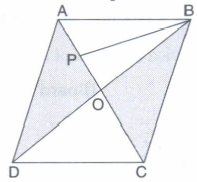
Area of a parallelogram is divided into four equal parts by the diagonals.
\(\Rightarrow \ ar(AOB)=\frac { 1 }{ 4 } ar(ABCD)\)
\(ar(\Delta BOP)=\frac { 1 }{ 2 } ar(AOB)=\frac { 1 }{ 8 } ar\ (ABCD)\)
\(=\frac { 1 }{ 8 } \times 80=10\quad { cm }^{ 2 }\)
3.
\(\text { Mean }=\frac{5000+5000+5000+5000+15000}{5}=\frac{35000}{5}=7000\)
So, the mean salary is Rs. 7000 per month.
To obtain the median, we arrange the salaries in ascending order:
5000, 5000, 5000, 5000, 15000
Since the number of employees in the factory is 5, the median is given by the \(\left(\frac{5+1}{2}\right) \mathrm{th}=\frac{6}{2} \mathrm{th}=3 \mathrm{rd}\) 3rd observation. Therefore, the median is Rs. 5000 per month.
To find the mode of the salaries, i.e., the modal salary, we see that 5000 occurs the maximum number of times in the data 5000, 5000, 5000, 5000, 15000. So, the modal salary is Rs. 5000 per month.
4.
Since only the rounded surface of the dome is to be painted, we would need to find the curved surface area of the hemisphere to know the extent of painting that needs to be done. Now, circumference of the dome = 17.6 m. Therefore, 17.6 = 2\(\pi\)r.
So, the radius of the dome \(=17.6 \times \frac{7}{2 \times 22} \mathrm{~m}=2.8 \mathrm{~m}\)
The curved surface area of the dome = 2\(\pi\)r2
\(=2 \times \frac{22}{7} \times 2.8 \times 2.8 \mathrm{~m}^{2}\)
= 49.28 m2
Now, cost of painting 100 cm2 is RS. 5.
So, cost of painting 1 m2 = RS. 500
Therefore, cost of painting the whole dome
= RS. 500 x 49.28
= RS. 24640
5.
Let ABCD be the field.
Perimeter = 400 m
So, each side = 400 m ÷ 4 = 100 m.
i.e. AB = AD = 100 m.
Let diagonal BD = 160 m.
Then semi-perimeter s of D ABD is given by
\(s=\frac{100+100+160}{2} \mathrm{~m}=180 \mathrm{~m}\)
Therefore, area of \(\Delta \mathrm{ABD}=\sqrt{180(180-100)(180-100)(180-160)}\)
\(=\sqrt{180 \times 80 \times 80 \times 20} \mathrm{~m}^{2}=4800 \mathrm{~m}^{2}\)
Therefore, each of them will get an area of 4800 m2.
6.
\(36°\),\(144°\),\(36°\), \(144°\)
7.
x=50, \(92^{ 0 }\) and \(88^{ 0 }\)
8.
Take any line l and a point P not on l. Then, by Playfair’s axiom, which is equivalent to the fifth postulate, we know that there is a unique line m through P which is parallel to l.
9.
0x+5y-2=0
10.
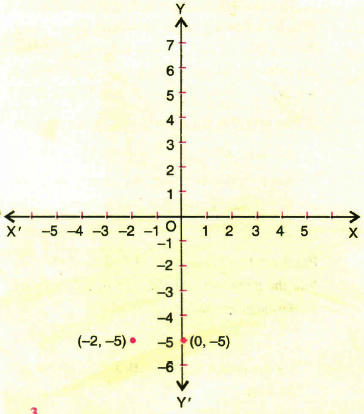
11.
\(8x^3-y^3+27z^3+18xyz\)
12.
7.87
13.
\(2-\sqrt { 3 } \)
14.
Required probability=\(\frac { 2+1 }{ 30 } =\frac { 1 }{ 10 } \)
15.
Frequency of 4 = 3
Frequency of 9 = 3
For mode to be 9, x -10 = 9 \(\Rightarrow\) x =19
so that the observation 9 has the maximum frequency.
16.
Length of the rod \(=\sqrt { { \left( 10 \right) }^{ 2 }+{ \left( 10 \right) }^{ 2 }+{ \left( 5 \right) }^{ 2 } } \)
17.
(a)
\(600\sqrt { 5 } \)cm2
18.
\(\angle POR=2\angle PSR=2(180°-\angle PQR)\)
\( =2(180°-100°)=160°\)
OP=OR
∴ \(\angle OPR=\angle ORP\)
19.
A rectangle is essentially a parallelogram. A square is essentially a parallelogram. Parallelograms on the same base and between the same parallels are equal in area
20.
(b)
trapezium
21.
(c)
yes, by ASA
22.
\(\angle 1\) and \(\angle 2\) are simply adjacent angles
23.
(a)
an axiom
24.
\(ax+b(0)+c=0 \ \ \ \Rightarrow\ \ \ x=-{c\over a}\)
\(a(0)+by+c=0\ \ \ \Rightarrow\ \ \ y=-{c\over b}\)
25.
(c)
II and IV quadrants respectively
26.
Evident
27.
(d)
real
28.
| Class Intervals | Tally Marks | No. of Tyres |
|---|---|---|
| 2.0-2.5 | II | 2 |
| 2.5-3.0 | .png) |
7 |
| 3.0-3.5 | .png) |
14 |
| 3.5-4.0 | .png) |
10 |
| 4.0-4.5 | IIII | 4 |
| 4.5-5.0 | III | 3 |
| 40 |
29.
Steps of construction:
i) Draw a ray BX and cut off line segment BC = 4cm
ii) Construct ㄥXBY = 90o
iii) From BY cut off line segment BD = 8 cm,
iv) Join CD.
v) Draw the ⊥ bisector of CD, intersecting BD at A
vi) Join AC, ABC is the required triangle
30.
ar(\(\Delta\)DRC) = ar(\(\Delta\)DPC), (Given)
But they are on the same base DC.
Therefore, \(\Delta\)DRC and \(\Delta\)DPC must lie between the same parallels.
So, DC || RP
i.e., one pair of opposite sides of quadrilateral DCPR is parallel.
therefore, DCPR is a trapezium.
Also, ar(\(\Delta\)BDP) = ar(\(\Delta\)ARC) (Given) ........(i)
and ar (\(\Delta\)DPC) = ar(\(\Delta\)DRC) (Given) .........(ii)
Subtracting (ii) from (i), we get
ar(\(\Delta\) BDP) - ar(\(\Delta\)DPC) = ar(\(\Delta\)ARC) - ar(\(\Delta\)DRC) ar(\(\Delta\)BDC) = ar(\(\Delta\)ADC)
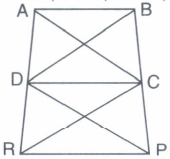
But they are on the same base DC.
Therefore, \(\Delta\)BDC and \(\Delta\)ADC must lie between the same parallels.
So, AB || DC
i.e., One pair of opposite sides of quadrilateral ABCD is parallels.
So, AB || DC
i.e., One pair of opposite sides of quadrilateral ABCD is parallel.
Therefor, ABCD is a trapezium.
31.
EQ||FP and transversal cut them
\(\therefore \angle AQD=\angle APF\) (Conresponding angles)
\(\angle AQD=50^o\)
\(\therefore \angle DQB=180^o-50^o=130^o\)
AB||CD and transversal EQ cuts them
\(\therefore \angle EDG=\angle DQB=130^o\)
\(\therefore \angle EDG=130^o-40^o=90^o\)
FP||EQ and transversal PG cut them
\(\therefore \angle FPD=\angle EDG=90^o\)
32.
In \(\triangle\)AFE and \(\triangle\)CDE,
\(\therefore\) AF = CD
\(\therefore\) \(\angle\)AFE = \(\angle\)CDE
\(\therefore\) \(\angle\)E = \(\angle\)E
\(\therefore\) \(\angle\)FAE = \(\angle\)DCE
\(\therefore\) \(\triangle AFE\cong \triangle CDE\)
\(\therefore\) EF =ED
33.
9x2+y2+z2-6xy+2yz-6xz
=(-3x)2+(y)2+(z)2+2\(\times\)(-3x)(y)+2\(\times\)(y)(z)+2(-3x)(z)
=(-3x+y+z)2
If x=1, y=2, z=-1, then
(-3x+y+z)2=(-3\(\times\)2-1)2
=4.
34.
\((i)\frac { 1 }{ 10 }\)
\((ii)\frac { 1 }{ 50 }\)
\((iii)\frac { 8 }{ 25 } \)
35.
Inner diameter = 10.5 cm
\(\therefore\) Inner radius (r) = \(\frac { 10.5 }{ 2 } cm=5.25cm\)
\(\therefore\) Inner surface area = \(2\pi { r }^{ 2 }\)
\(=2\times \frac { 22 }{ 7 } \times { \left( 5.25 \right) }^{ 2 }=173.25{ cm }^{ 2 }\)
\(\therefore\) Cost of tin-plating at the rate of Rs 16 per 100 cm2
= Rs \(\frac { 16 }{ 100 } \times 173.25\)= Rs 27.72.
36.
Rs.5376
37.
Given: ABCD is a trapezium whose nonparallel sides AD and BC are equal.
To Prove: Trapezium ABCD is cyclic.
Construction: Draw BE 11 AD.
Proof: ∵ AB || DE I Given
and AD || BE I By construction
∴ Quadrilateral ABCD is a parallelogram.
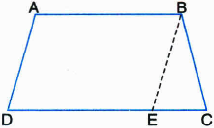
∴ \(\angle BAD=\angle BED\) ....(1)
| Opp.\(\angle \) s of a || gm are equal
and AD = BE ...(2)
Opp. sides of a || gm are equal
But AD = BC ...(3) I Given
From (2) and (3),
BE = BC
∴ \(\angle BEC=\angle BCE\) ....(4)
| Angles opposite to equal sides of a triangle are equal
\(\angle BEC+\angle BED=180°\) | Linear Pair Axiom
⇒ \(\angle BCE+\angle BAD=180°\) I From (4) and (1)
⇒ Trapezium ABCD is cyclic.
I ∵ If the sum of a pair of opposite angles of a quadrilateral is 180°, then the quadrilateral is cyclic
38.
If a straight line I falls on two straight lines m and n such that sum of the interior angles on one side of I is two right angles, then by Euclid's fifth postulate the lines m and n will not meet on this side of I. Next, we know that the sum of the interior angles on the other side of line I will also be two right angles. Therefore, they will not meet on the other side also. So, the lines m and n never meet and are, therefore arallel.
39.
y = 3x
y =3x
Table of solution
| X | 0 | 1 |
|---|---|---|
| Y | 0 | 3 |
We plot the points (0, 0) and (1, 3) on the graph paper and join the same by a ruler to get the line which is the graph of the equation y = 3x.
.png)
40.
(i) The point (-2,4) lies in the II quadrant.
(ii) The point (3, -1) lies in the IV quadrant.
(iii) The point (- 1,0) lies on the negative x-axis.
(iv) The point (1, 2) lies in the I quadrant.
(v) The point (- 3, - 5) lies in the Ill quadrant.
41.
\({ 125 }^{ 1/3 }={ \left( 5^{ 3 } \right) }^{ 1/3 }\)
\(\\ ={ 5^{ 3\times 1/3 } }={ 5 }^{ 1 }=5\)
42.
OP=OR
= 10 cm (radii)
PQ = 16 cm,
RS = 12 cm
Let OL \(\bot\) PQ and OM\(\bot\)RS
Since perpendicular from the centre bisects the chord
\(\therefore\) PL = LQ = \(\frac { 1 }{ 2 } \)PQ = 8 cm
RM =MS=\(\frac { 1 }{ 2 } \)RS= 6cm
In right triangle OLP
OP2 = OL2 + PL2
(ByPythagoras theorem)
100 = OL2 + 64
OL=\(\sqrt { 100-64 } =\sqrt { 36 } \)
OL =6cm
In right triangle OMR (By Pythagoras theorem)
OR2 = OM2 + RM2
100 = OM2 + 36
OM=8cm
(i) If PQ and RS lie on the same side of centre O
.JPG)
The distance between PQ and RS
=LM= OM-OL
=8-6 = 2 cm
(ii) PQ and RS lie on opposite sides of centre O
.jpg)
The distance between PQ and RS
=LM
=OL+OM
=6+8 cm
= 14 cm
43.
Let, Side of new cube = x
\(\therefore\) (12)3 = 8x3
or, \(\frac { { (12) }^{ 3 } }{ 8 } ={ x }^{ 3 }\)
\(\Rightarrow \ { \left( \frac { 12 }{ 2 } \right) }^{ 3 }={ x }^{ 3 }\)
or 6 = x
\(\therefore\) Side of new cube = 6 cm.
Ratio of surface areas of 8 new cubes to original cube
\(=\frac { 8\times { 6x }^{ 2 } }{ { 6(12 })^{ 2 } } \)
\(=\frac { 8\times 6(6)^{ 2 } }{ 6\times 12\times 12 } \)
\(=\frac { 8\times 6\times 6\times 6 }{ 6\times 12\times 12 } =\frac { 2 }{ 1 } \)
\(\therefore\) Ratio = 2:1.
44.
To prove that: Ar(||gm DLOP) = Ar(||gm BMOQ)
Proof: Give ABCD is a ||gm and AC is one if its digonal
\(\therefore\) ar(\(\Delta\)ABC) = ar(\(\Delta\)ADC) .......(i)
[\(\because\) The diagonal of a ||gm divides it into two equal triangles]
Now, LM is parallel to AD
(\(\because\) AD=BC and AD||BC as ABCD is a ||gm)
\(\therefore\) LM||BC \(\Rightarrow\) LO||CQ
Similarly PQ||DC \(\Rightarrow\) OQ||LC
\(\therefore\) CLOQ is also a ||gm, as its opposite sides on parallel to each other.
In ||gm CLOG, CO is the diagonal
\(\therefore\) ar(\(\Delta\)COQ) = ar(\(\Delta\)CLO) ..........(ii)
[\(\because\) The diagonal of a ||gm divides it into two equal triangles]
Again, AD || LM \(\Rightarrow\) AP||OM
and AB || PQ \(\Rightarrow\) AM||PO
\(\therefore\) APOM is also a ||gm, as its opposite sides one parallel to each other.
In ||gm AOPM, AO is the diagonal
\(\therefore\) ar(\(\Delta\) AOP) = ar(\(\Delta\)AOM) .........(iii)
[\(\because\) The diagonal of a ||gm divides it into two equal triangles]
Now using (i) ar(\(\Delta\)ABC) = ar(\(\Delta\)ADC)
\(\Rightarrow\) ar(\(\Delta\)COQ) + ar(\(\Delta\)AOM) + ar(BMOQ) = ar(\(\Delta\)CLO) + ar(AOP)+ar(DLOP)
using (ii) and (iii), we get
ar(BMOQ) = ar(DLOP)
Now, BMOQ is a ||gm as
PQ||AB \(\Rightarrow\) OQ||BM
and BC || AD \(\Rightarrow\) OM||BQ
Similarly, DLOP is also || gm as
AD||LM \(\Rightarrow\) DP||LO
and PQ||DC \(\Rightarrow\) PO||DL
\(\therefore\) ar(||gm BMOQ) = ar(||gm DLOP)
Hence Proved.
45.
Since \(\angle1=\angle3 \ and \ \angle2=\angle4,\) therefore adding both equation
\(\angle1+\angle2=\angle3+\angle4\)
\(\Rightarrow \angle BAD=\angle BCD\)
\(\Rightarrow \angle A=\angle C\)
If equals are added to equal, the wholes are equal
Two more axioms:
Things which are equal to the same thing are equal to one another
e.g., if \(\overline {AB}=\overline{ PQ} \ and\ \overline {PQ}=\overline {XY}, then\ \angle{AB}=\angle{XY}\)
If equals are subtracted from equals, the remainders are equal.
e.g., if \(m\angle1=m\angle2\) then
\(m\angle3=m\angle3\)
\(=m\angle2-m\angle3\)
46.
Let p(x)=bx3+3x2-3
Put x-4 = 0 or x = 4 in p(x),
We get p(4) = b(4)3+3(4)2- 3
=R1
64b + 48-3 = R1
64b+45=R1
Let q(x) = 2x3-5x+b
Again put x-4=0 or x=4 in q(x),
We get q(4) = 2(4)3-5(4)+b = R2
= 128 - 20 + b = R2
108+b = R2
Given that 2R1-R2=0
\(\Rightarrow\) 2(64b+45)-(108+b) = 0
\(\Rightarrow\) 128b + 90 - 108 -b = 0
\(\Rightarrow\) 127b-18 = 0
\(\Rightarrow\) \(b=\frac { 18 }{ 127 } \)
47.
Number of two wheelers = 57
Number of three wheelers = 33
Number of four wheelers = 30
Total number of vehicles = 57 + 33 + 30 = 120
Number of vehicles that is not a four-wheeler = 57 + 33 = 90
Probability that the vehicle chosen at random is not a four-wheeler
\(\frac { 90 }{ 120 } =\frac { 3 }{ 4 } \)
48.
Arranging the given data in the ascending order, we have
40,50,65,70,75,75,95,100
Number of observations (n) = 8 which is even, \(\therefore\) Median
\(=\frac { { \left( \frac { n }{ 2 } \right) }^{ th }observation+{ \left( \frac { n }{ 2 } +1 \right) }^{ th }observation }{ 2 } \)
\(=\frac { { \left( \frac { 8 }{ 2 } \right) }^{ th }observation+{ \left( \frac { 8 }{ 2 } +1 \right) }^{ th }observation }{ 2 } \)
\(=\frac { { 4 }^{ th }observation+{ 5 }^{ th }observation }{ 2 } \)
\(=\frac { 70+75 }{ 2 } \)
= 72.5
49.
Let the third side be x cm. Then, 12 + 12 + x = 30
24 + x = 30
x = 6 cm
So, a = 12 cm, b = 12 cms, c = 6 cm
\(\therefore s=\frac { a+b+c }{ 2 } =\frac { 12+12+6 }{ 2 } \)
= 15 cm
\(\therefore \) Area \(=\sqrt { s(s-a)(s-b)(s-c) } \)
\(=\sqrt { 15(15-12)(15-12)(15-6) } \)
\(=9\sqrt { 15 } \) cm2
50.
(i) Steps of Construction
1. Draw the base BC = 5 em.
2. At point B make an angle XBC = 45°.
3. CutthelinesegmentBD=AB-AC(=2.8 cm) from the ray BX.
4. Join DC.
5. Draw the perpendicular bisector, say PQ of DC.
6. Let it intersect BX at a point A.
7. Join AC.
Then, ABC is the required triangle.
(ii) By measurement, AB = 13cm
(iii) By measurement, AC = 10.2cm
(iv) AB - AC = 13 - 10 .2 = 2.8cm
(v) Yes! Hari is true as by measurement ㄥACB = 112°.
The value 'wise' is depicted by comment of Hari.
51.
Given: ABC is an isosceles triangle in which AB = AC. AD bisects L PAC and CD IIAB.
To Prove:
(i) \(\angle \)DAC =\(\angle \)BCA
Proof:
(i) In \(\Delta \) ABC,
\(\because\) AB = AC
\(\therefore\) \(\angle \)B =\(\angle \)C .......(1) I Angles opposite to equal sides of a triangle are equal
Also, Ext. \(\angle \)PAC =\(\angle \)B +\(\angle \)C
⇒
⇒ 2\(\angle \)CAD = 2\(\angle \)C
⇒ \(\angle \)CAD =\(\angle \)C
\(\therefore\) AD II BC
Also, CD II AB I Given
\(\therefore\) ABCD is a parallelogram IA quadrilateral is a parallelogram if its both the pairs of opposite sides are parallel.
52.
Given AP and DP are bisectors of two adjacent angles A and D of a quadrilateral ABCD
To prove \(2\angle APD=\angle B+\angle C\)
We know that the sum of all the angles of a quadrilateral is \(360^{ 0 }\)
\(\Rightarrow \angle A+\angle D=360^{ 0 }-(\angle B+\angle C)\)
Now in \(\triangle \)PAD
\(\angle APD+\angle PAD+\angle PDA=180^{ 0 }\)
|Angle sum property of a triangle
\(\Rightarrow \angle APD+\frac { 1 }{ 2 } \angle A+\frac { 1 }{ 2 } \angle D=180^{ 0 }\)
|AP and DP are the bisectors of two adjacent angles And D of quadrilateral ABCD
\(\Rightarrow 2\angle APD=360^{ 0 }-(\angle A+\angle D)\)
\(\\ \Rightarrow 2\angle APD=\angle B+\angle C\)
53.
x=3y
x-3y=0
(1)x+(-3)y+(0)=0
Comparing with ax+by+c=0, we get
a=1
b=-3
c=0
Now x=3y
\(\Rightarrow\ \ \ y={x\over 3}\)
Put x=0, then \(y={0\over3}=0\)
Put x=3, then \(y={3\over 3}=1\)
Hence, (0, 0) and (3, 1) are the two solutions of the equation x=3y.
54.
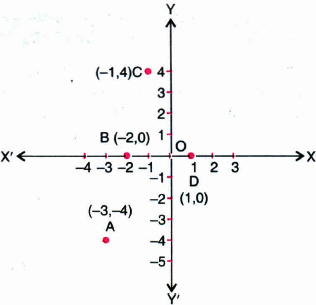
(i) The point A(-3, -4) lies in III quadrant.
(ii) The point B(-2, 0) lies on x-axis.
(iii) The point C(-1, 4) lies in II quadrant.
(iv) The point D(1, 0) lies on x-axis.
55.
Let r and R be the radii of the smaller and larger spheres respectively, we have
\(r=\frac { 5 }{ 2 } cm\)
Volume of the smaller sphere \(=\frac { 4 }{ 3 } \pi { r }^{ 3 }=\frac { 4 }{ 3 } \pi { \left( \frac { 5 }{ 2 } \right) }^{ 3 }\)
\(=\frac { 4 }{ 3 } \times \pi \times \frac { 125 }{ 8 } { cm }^{ 3 }\)
Density of metal\(=\frac { mass }{ Valume } \)
\(=\frac { 740 }{ \frac { 4 }{ 3 } \pi \times \frac { 125 }{ 8 } } g\quad { cm }^{ 3 }\) ...........(i)
Volume of larger sphere = \(\frac { 4 }{ 3 } \pi { R }^{ 3 }\)
Density of metal=\(\frac { mass }{ Volume } =\frac { 5920 }{ \frac { 4 }{ 3 } \pi { R }^{ 3 } } \) ......(ii)
From (i) and (ii), we have
\(\frac { 740 }{ \frac { 4 }{ 3 } \pi \times \frac { 125 }{ 8 } } =\frac { 5920 }{ \frac { 4 }{ 3 } \pi { R }^{ 3 } } \)
\(\Rightarrow \quad { R }^{ 3 }=\frac { 5920\times 125 }{ 740\times 8 } \)
= 125
\(\Rightarrow\) R = 5 cm.
56.
(i) Let us assume that A, Band C are the position of Priyanka, Sania and David respectively on the boundary of circular park with centre O.
Draw AD\(\bot\) BC
Since the centre of the circle coincides with the centroid of the equilateral \(\triangle\) ABC
\(\therefore\) Radius of circumscribed circle = \(\frac{2}{3}\) AD
\(\Rightarrow 20=\frac { 2 }{ 3 } AD\)
\(\Rightarrow AD=20\times \frac { 2 }{ 3 } \)
\(\Rightarrow AD=30m\)
Now, AD\(\bot\)BC, and let AB=BC=CA=x
\(\Rightarrow BD=CD=\frac { 1 }{ 2 } BC=\frac { x }{ 2 } \)
In rt. \(\triangle\)BDA, D=900
By Pythagoras Theorem, we have
AB2=BD2+AD2
\(\Rightarrow { x }^{ 2 }={ \left( \frac { x }{ 2 } \right) }^{ 2 }+{ (30) }^{ 2 }\)
\(\Rightarrow{ x }^{ 2 }-{ \frac { { x }^{ 2 } }{ 4 } }=90\)
\(\Rightarrow \frac { 3 }{ 4 } { x }^{ 2 }=90\)
\(\Rightarrow { x }^{ 2 }=900\times \frac { 4 }{ 3 } \)
\(\Rightarrow { x }^{ 2 }=1200\)
\(\therefore x=\sqrt { 1200 } =20\sqrt { 3 } \)
Hence, the distance between each of them is \(20\sqrt { 3 } .\)
(ii) Properties of the circle, equilateral triangle and Pythagoras theorem.
(iii) Live and let live.
57.
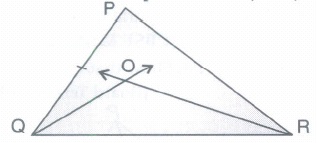
Proof: QO is bisector of \(\angle\)PQR
\(\angle\)OQR = \(\frac{1}{2}\)\(\angle\)PQR = \(\frac{1}{2}\) =\(\angle\)Q
RO is bisector \(\angle\)ORQ
\(\therefore\) \(\angle\)ORQ =\(\frac{1}{2}\) \(\angle\)PRQ = \(\frac{1}{2}\) \(\angle\)R
In \(\angle\)OQR
\(\angle\)QOR + \(\angle\)OQR + \(\angle\)ORQ = 180°
(Angle sum property)
\(\angle\)QOR + \(\frac{1}{2}\) \(\angle\)Q + \(\frac{1}{2}\) \(\angle\)R = 180°
\(\angle\)QOR = 180°- \(\frac{1}{2}\)(\(\angle\)Q + \(\angle\)R)
But in \(\angle\)PQR
\(\angle\)P + \(\angle\)Q + \(\angle\)R = 180°
\(\angle\)Q + \(\angle\)R = 180°- \(\angle\)P
\(\angle\)QOR = 180°- \(\frac{1}{2}\) (180°- \(\angle\)P)
= 180°-90° + \(\frac{1}{2}\)\(\angle\)P
= 90° + \(\angle\)P Hence Proved.
These type of rallies spread awareness among people for not to kill girl child and helping in equalising sex ratio.
58.
(i) Required number of students = 8 + 32 = 40
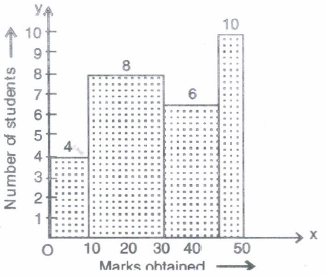
(ii) Here, We notice that classes are continuous but class-size is not the same for all the classes. We notice minimum class-size is of class 45-50, i.e., 5. We will first find proportionate length of rectangle (adjusted frequency) for each class.
Length of rectangle (adjusted frequency) =\(\frac { Frequency\ of\ Class }{ Width\ of\ class } \times Minimum\ class-size\)
| Marks (C.I.) |
Number of students(f) | Width of class (Clss-size) |
Length of rectangle |
|---|---|---|---|
| 0-10 | 8 | 10 | \(\frac{8}{10}\)x 5 = 4 |
| 10-30 | 32 | 20 | \(\frac{32}{20}\) x 5 = 8 |
| 30-45 | 18 | 15 | \(\frac{18}{15}\) x 5 = 6 |
| 45-50 | 10 | 5 | \(\frac{10}{5}\) x 5 = 10 |
Now, we construct rectangles with respective class-intervals as widths and adjusted frequencies as heights.
Histogram representing marks obtained by students in unit test of Mathematics.
(iii) Hardwork and Dilligence.
59.
(i) As EB II DL and ED II BL.
Therefore EBLD is a parallelogram.
ஃ BL = ED
=\(\frac{1}{2}\)BC=CL ...(i)
Now in triangles DCL and FBL, we have
CL=BL from (i)
ㄥDLC= ㄥFLB
ㄥCDL=ㄥBFL
ΔCDL≡ΔBFL
CD= BF
and DL= FL
Now, BF = DC = AB
⇒ 2AB = 2DC
⇒ AF = 2DC
(ii) ∵ DL=FL
⇒ DF = 2DL
60.
\(\sqrt { \frac { \left( \sqrt { 2 } -1 \right) }{ \left( \sqrt { 2 } +1 \right) } } \)is an irrational number.
\(\sqrt { \frac { \left( \sqrt { 2 } -1 \right) }{ \left( \sqrt { 2 } +1 \right) } } =\sqrt { \frac { \left( \sqrt { 2 } -1 \right) }{ \left( \sqrt { 2 } +1 \right) } \times \frac { \left( \sqrt { 2 } -1 \right) }{ \left( \sqrt { 2 } -1 \right) } } \)
\(=\sqrt { \frac { { \left( \sqrt { 2 } -1 \right) }^{ 2 } }{ 2-1 } } \)
\(=\sqrt { \frac { { \left( \sqrt { 2 } -1 \right) }^{ 2 } }{ 1 } } =\sqrt { 2 } -1\)
which is an irrational number.
Let, there is a number x such that x3 is an irrational number but x5 is a rational number.
Let, x =\(\sqrt[5]{7}\) be the number.
⇒ x3 = (5√7)3 = (7)3/5
is an irrational number.
But x5 = (\(\sqrt[5]{7}\))5=(7)5/5 = 7
=7 is a rational number.
(ii) Accepting own mistakes gracefully, co-operative learning among the classmates.

9th Standard CBSE Syllabus & Materials
9th Standard CBSE
CBSE 9th Mathematics Lines and Angles Sample Question Papers Study Material - QB365 Set A
NEW9th Standard CBSE
CBSE 9th Mathematics Introduction to Euclid's Geometry Sample Question Papers Study Material - QB365 Set A
NEW9th Standard CBSE
CBSE 9th Mathematics Linear Equations in Two Variables Sample Question Papers Study Material - QB365 Set A
NEW9th Standard CBSE
CBSE 9th Mathematics Coordinate Geometry Sample Question Papers Study Material - QB365 Set A



CBSE 9th Standard CBSE Subjects
CBSE Standards