100% FREE ACCESS
9th Standard CBSE Syllabus & Materials
9th Standard CBSE
CBSE 9th Science Is matter around us pure? - New Model Questions Papers Study Material - QB365 Set A
NEW9th Standard CBSE
CBSE 9th Science Matter in our surroundings - New Model Questions Papers Study Material - QB365 Set A
NEW9th Standard CBSE
CBSE 9th Mathematics Heron's Formula Sample Question Papers Study Material - QB365 Set A
NEW9th Standard CBSE
CBSE 9th Mathematics Circles Sample Question Papers Study Material - QB365 Set A
NEW9th Standard CBSE
CBSE 9th Mathematics Quadrilaterals Sample Question Papers Study Material - QB365 Set A
NEW9th Standard CBSE
CBSE 9th Mathematics Triangles Sample Question Papers Study Material - QB365 Set A

Published on: 24/09/2019
Areas of Parallelograms and Triangles
Download CBSE Class 9th Standard CBSE Mathematics question papers, sample papers, important questions, and previous year solved papers in PDF format. Get free study materials, NCERT solutions, and exam preparation resources for Class 9th Standard CBSE Mathematics
Questions + Answers key
Take MCQ Mathematics Test
1.
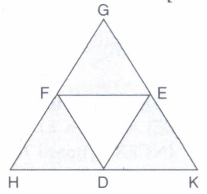
In \(\Delta\)GHK; D, E and F are the mid-point of sides HK, KG and GH respectively. show that EFHK is trapezium and ar(EFHK) = \(\frac { 3 }{ 4 } ar(\Delta GHK)\)
2.
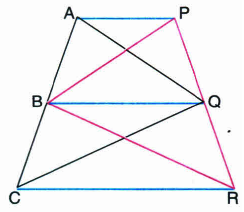
In the figure, AP || BQ || CR. Prove that ar(AQC) = ar(PBR).
3.
In the figure, ar (\(\Delta\)DRC) = ar(\(\Delta\) DPC) and ar(\(\Delta\)BDP) = ar(\(\Delta\)ARC). Show that both the quarilaterals ABCD and DCPR are trapeziums.
4.
If a parallelogram and a triangle are on the same base and between the same parallels, then prove that area of a triangle is equal to half the area of a parallelogram.
5.
MNOP is a parallelogram and PN is one of its diagonals show that ar(\(\Delta\)PMN) = ar(\(\Delta\)PON).
6.
Diagonals AC and BD of a quadrilateral ABCD intersect at O in such a way that ar(\(\Delta \) AOD) = ar(\(\Delta \) BOC). Prove that ABCD is a trapezium.
7.
In figure, AP || BQ || CR. Prove that ar(\(\Delta \)AQC) = ar(\(\Delta \)PBR).
8.
ABCD is a' trapezium with AB || DC A line parallel to AC intersects AB at X and BC at Y. Prove that ar(\(\Delta \) ADX) = ar(\(\Delta \) ACY)
9.
A villager Itwaari has a plot of land of the shape of a quadrilateral. The Gram Panchayat of the village decided to take over some portion of his plotfrom one of the corners to construct a Health Centre. Itwaari agrees to the above proposal with the condition that he should be given equal amount of land in lieu of his land adjoining his plot so as to form a triangular plot. Explain how this proposal will be implemented.
10.
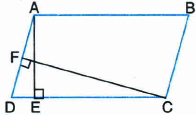
In figure, ABCD is a parallelogram, \(AE\bot DC\)and \(CF\bot AD\). If AB = 16cm, AE = 8 cm and CF = 10 cm, find AD.
1.
In \(\Delta\)GHK; F and E are the mid-points of HG and GK respectively.
\(\therefore\) By mid-point theorem,
\(FE=\frac { 1 }{ 2 } KH\quad and\quad FE||KH\) ...........(i)
In quadrilateral EFHK,
EF || HK (by (i))
\(\therefore\) EFHK is a trapezium.
Also,
ar(EFHK) = ar(FHD) + ar(DEF) + ar(DEK) .............(ii)
We have, FE || HD and FE = HD
\(\therefore\) FEDH is a ||gm,
So, ar(FHD) = ar(DEF) ..........(iii)
Similarly, DFGE is a ||gm,
\(\therefore\) ar(DEF) = ar(GEF) ...........(iv)
Also, DFEK is a ||gm,
\(\therefore\) ar(DEF) = ar(DEK) ...........(v)
Using (iii), (iv) & (v) we get,
ar(GEF) = ar(FHD)
= ar(DEK) = ar(DEF)
\(=\frac { 1 }{ 4 } \) ar(GHK) ...........(vi)
Using (vi) and (ii), we get
ar(EFHK) = \(\frac { 3 }{ 4 } ar(GHK)\)
Hence proved
2.
Given: BQ||CR
\(\because\) \(\Delta \) BCQ and \(\Delta \)BQR are on the same base BQ and between the same parallel BQ and CR.
\(\therefore\) ar(\(\Delta \)BCQ) = ar (\(\Delta \)BQR) ......(i)
Also, AP||BQ. (Given)
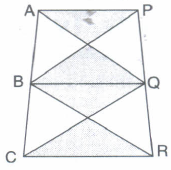
Again, \(\Delta \)ABQ and \(\Delta \)PBQ are on the same base BQ and between the same parallels BQ and AP.
\(\therefore\) ar(\(\Delta \)ABQ) = ar (\(\Delta \)PBQ) .......(ii)
Adding (1) and (2), we get
ar(\(\Delta \)BCQ) + ar(\(\Delta \)ABQ) = ar(\(\Delta \)BQR) + ar(\(\Delta \)PBQ)
ar(\(\Delta \)AQC) = ar(\(\Delta \)PBR).
3.
ar(\(\Delta\)DRC) = ar(\(\Delta\)DPC), (Given)
But they are on the same base DC.
Therefore, \(\Delta\)DRC and \(\Delta\)DPC must lie between the same parallels.
So, DC || RP
i.e., one pair of opposite sides of quadrilateral DCPR is parallel.
therefore, DCPR is a trapezium.
Also, ar(\(\Delta\)BDP) = ar(\(\Delta\)ARC) (Given) ........(i)
and ar (\(\Delta\)DPC) = ar(\(\Delta\)DRC) (Given) .........(ii)
Subtracting (ii) from (i), we get
ar(\(\Delta\) BDP) - ar(\(\Delta\)DPC) = ar(\(\Delta\)ARC) - ar(\(\Delta\)DRC) ar(\(\Delta\)BDC) = ar(\(\Delta\)ADC)
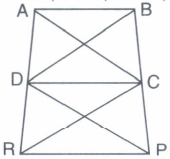
But they are on the same base DC.
Therefore, \(\Delta\)BDC and \(\Delta\)ADC must lie between the same parallels.
So, AB || DC
i.e., One pair of opposite sides of quadrilateral ABCD is parallels.
So, AB || DC
i.e., One pair of opposite sides of quadrilateral ABCD is parallel.
Therefor, ABCD is a trapezium.
4.
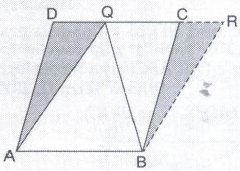
Given: \(\Delta\)ABQ and parallelogram ABCD are on the same base AB and between the same parallels DC and AB.
To prove:
Area(\(\Delta\)ABQ) = \(\frac { 1 }{ 2 } \)Area (Parallelogram ABCD)
Construction: Extend DC to R so that BR||AQ
Proof: DCBA and QRBA are on the same base and between same parallels
ar(DCBA) = ar(QRBA) ............(i)
A diagonal divides a parallelogram into two congruent triangles with equal area
\(\Rightarrow \ ar(QAB)=\frac { 1 }{ 2 } ar(QCBA)\) .....(ii)
From (i) and (ii)
ar(QAB) = \(\frac { 1 }{ 2 } ar\left( DCBA \right) \)
5.
Given: A parallelogram MNOP is which one of the diagonals is PN
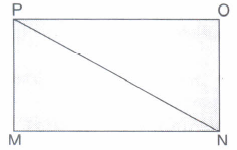
To show: ar(\(\Delta\)PMN)=ar(\(\Delta\)PON)
Now, since two congurent figures are equal in area, so we will show that
\(\Delta\)PMN\(\cong \)\(\Delta\)PON
\(\therefore\) In \(\Delta\)'s PMN and PON,
MN = PO
[MNOP is a ||gm, \(\therefore\) opp.sides are equal MN=PO
PM = ON
and, PN = NP
\(\therefore\) By SSS congurence criterion, we get
\(\Delta\)PMN\(\cong \)\(\Delta\)PON
Hence ar(\(\Delta\)PMN) = ar(\(\Delta\)PON)
6.
Given: Diagonals AC and BD of a quadrilateral ABCD intersect at 0 in such a way that ar(\(\Delta \) AOD) = ar(\(\Delta \) BOC).
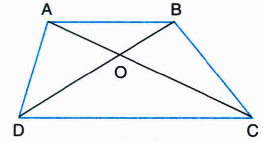
To Prove: \(\Box \) ABCD is a trapezium.
Proof: ar(\(\Delta \) AOD) = ar(\(\Delta \) BOC) IGiven
ar(\(\Delta \) AOD) + ar(\(\Delta \) AOB)
= ar(\(\Delta \) BOC) + ar(\(\Delta \) AOB)
I Adding ar(\(\Delta \)AOB) to both sides
= ar(\(\Delta \) ABD) = ar(\(\Delta \)ABC)
But \(\Delta \)ABD amd \(\Delta \) ABC are on the same base AB.
\(\Delta \) ABD and \(\Delta \) ABC will have equal corresponding altitudes.
\(\Delta \) ABD and \(\Delta \) ABC will lie between the same parallels.
AB || DC
ABCD is a trapezium.
A quadrilateral is a trapezium if exactly one pair of opposite sides are parallel
7.
Given: AP || BQ || CR.
To Prove: ar(\(\Delta \) AQC) = ar(\(\Delta \)PBR).
Proof: \(\Delta \) BAQ and \(\Delta \)BPQ are on the same base BQ and between the same parallels BQ and AP.
ar(\(\Delta \) BAQ) = ar(\(\Delta \) BPQ) ...(1)
|Two triangles on the same base (or equal bases) and between the same parallels are equal in area
\(\Delta \) BCQ and \(\Delta \)BQR are on the same base BQ and between the same parallels BQ and CR.
ar(\(\Delta \) BCQ) = ar(\(\Delta \) BQR) ...(1)
|Two triangles on the same base (or equal bases) and between the same parallels are equal in area
Adding the corresponding sides of (1) and (2), we get
ar(\(\Delta \) BAQ) + ar(\(\Delta \) BCQ)
= ar(\(\Delta \) BPQ) + ar(\(\Delta \) BQR)
= ar(\(\Delta \) AQC) = ar(\(\Delta \) PBR).
8.
Given: AB CD is a trapezium with AB || DC. A line parallel to AC intersects AB at X and BC at Y.
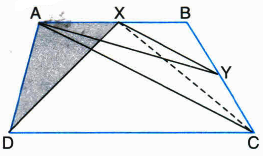
To Prove: ar(\(\Delta \)ADX) = ar(\(\Delta \)ACY).
Construction: Join CX.
Proof: \(\Delta \)ADX and \(\Delta \)ACX are on the same base AX and between the same parallels AB and DC.
ar(\(\Delta \)ADX) = ar(\(\Delta \)ACX) ...(1)
|Two triangles on the same base (or equal bases) and between the same parallels are equal in area
\(\Delta \)ACX and \(\Delta \)ACY are on the same base AC and between the same parallels AC and XY.
ar(\(\Delta \)ACX) = ar(\(\Delta \)ACY) ...(2)
|Two triangles on the same base (or equal bases) and between the same parallels are equal in area
From (1) and (2), we get
ar(\(\Delta \)ADX) = ar(\(\Delta \)ACY).
9.
Let ABCD be the plot of land of the shape of a quadrilateral. Let the portion ADE be taken over by the Gram Panchayat of the village from one corner D to construct a Health Centre. Join AC. Draw a line through D parallel to AC to meet BC produced in P. Join EP. Then Itwaari must be given the land ECP adjoining his plot so as to form a triangular plot ABP as then
\(ar(\Delta ADE)=ar(\Delta PEC)\)
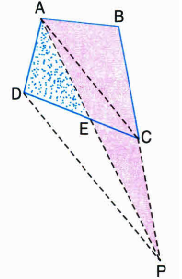
Proof: \(\Delta \)DAP and \(\Delta \)DCP are on the same base DP and between the same parallels DP and AC.
ar(\(\Delta \)DAP) = ar(\(\Delta \)DCP)
| Two triangles on the same base (or equal bases) and between the same parallels are equal in area
ar(\(\Delta \)DAP) - ar(\(\Delta \)DEP)
= ar(\(\Delta \)DCP) - ar(\(\Delta \)DEP)
I Subtracting ar(\(\Delta \) DEP) from both sides
ar(\(\Delta \) ADE) = ar(\(\Delta \) PCE)
ar(\(\Delta \)DAE) + ar(\(\Box \) ABCE)
= ar(\(\Delta \)PCE) + ar(\(\Box \) ABCE)
I Adding are \(\Box \) ABCE) to both sides
ar(\(\Box \) ABCD) = ar(\(\Delta \) ABP).
10.
ar(parallelogram ABCD) = AB x AE
= 16 x 8 cm2
= 128 cm2 ...(1)
ar(parallelogram ABCD) = AD x CF
= AD x 10 cm2 .......(2)
From (1) and (2), we get
AD x 10 = 128
AD = \(\frac { 128 }{ 10 } \)
AD = 12.8 cm.

9th Standard CBSE Syllabus & Materials
9th Standard CBSE
CBSE 9th Mathematics Lines and Angles Sample Question Papers Study Material - QB365 Set A
NEW9th Standard CBSE
CBSE 9th Mathematics Introduction to Euclid's Geometry Sample Question Papers Study Material - QB365 Set A
NEW9th Standard CBSE
CBSE 9th Mathematics Linear Equations in Two Variables Sample Question Papers Study Material - QB365 Set A
NEW9th Standard CBSE
CBSE 9th Mathematics Coordinate Geometry Sample Question Papers Study Material - QB365 Set A



CBSE 9th Standard CBSE Subjects
CBSE Standards