100% FREE ACCESS
9th Standard CBSE Syllabus & Materials
9th Standard CBSE
CBSE 9th Science Is matter around us pure? - New Model Questions Papers Study Material - QB365 Set A
NEW9th Standard CBSE
CBSE 9th Science Matter in our surroundings - New Model Questions Papers Study Material - QB365 Set A
NEW9th Standard CBSE
CBSE 9th Mathematics Heron's Formula Sample Question Papers Study Material - QB365 Set A
NEW9th Standard CBSE
CBSE 9th Mathematics Circles Sample Question Papers Study Material - QB365 Set A
NEW9th Standard CBSE
CBSE 9th Mathematics Quadrilaterals Sample Question Papers Study Material - QB365 Set A
NEW9th Standard CBSE
CBSE 9th Mathematics Triangles Sample Question Papers Study Material - QB365 Set A

Published on: 09/10/2019
Circles
Download CBSE Class 9th Standard CBSE Mathematics question papers, sample papers, important questions, and previous year solved papers in PDF format. Get free study materials, NCERT solutions, and exam preparation resources for Class 9th Standard CBSE Mathematics
Questions + Answers key
Take MCQ Mathematics Test
1.
In a circle with centre O, chord SR = chord SM. Radius OS intersects the chord RM at P. Prove that RP = PM.
2.
ABC is a triangle and P is a point on the side BC such that AB = AP. If AP produced meets the circumcircle of \(\Delta ABC\) at Q, prove that CP = CQ.
3.
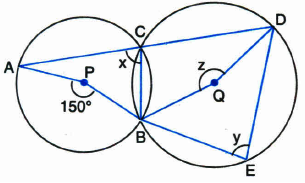
P and Q are centres of the two circles which intersect at B and C. ACD is a straight line. Find the values of x, y, z.
4.
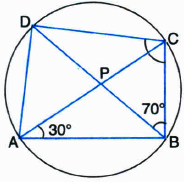
In the given figure, ABCD is a cyclic quadrilateral whose diagonals intersect at P. If \(\angle DBC=70°\) and \(\angle BAC=30°\) , find \(\angle BCD\).
|
5.
Find the angle marked as x in each of following figures where O is the centre of the circle:
(i)
.png)
(ii)
.png)
(iii)
.png)
(iv)
.png)
(v)
.png)
6.
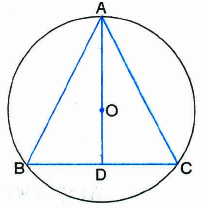
Bisector AD of \(\angle BAC\) of \(\Delta ABC\) passes through the centre O of the circumcircle of
\(\Delta ABC\) Prove that AB = AC.
7.
Prove that the line drawn through the centre of a circle to bisect a chord is perpendicular to the chord.
8.
Prove that the perpendicular from the centre of a circle to a chord, bisects the chord.
9.
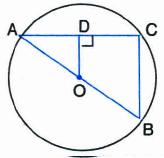
In the figure, diameter AB and a chord AC have a 'common end point A. If the length of AB is 20 cm and of AC is 12 cm, how far is AC from the centre of the circle?
1.
Construction: Join RO and OM.
Proof: SR = SM (given)
\(\angle\)ROS = \(\angle\)SOM (equal chords subtend equal angles at the centre)
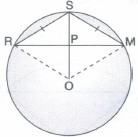
In \(\Delta\)ROP and \(\Delta\)MOP,OR = OM (radius)
\(\angle\)ROS = \(\angle\)SOM (proved above)
OP = OP (common)
\(\Delta\)ROP \(\cong\) \(\Delta\)MOP (SAS)
RP = PM
2.
Given: ABC is a triangle and P is a point on the side BC such that AB = AP. AP produced meets the circumcircle of \(\Delta ABC\) at Q.
To Prove: CP=CQ
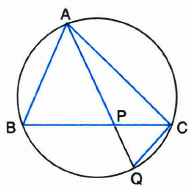
Proof: In \(\Delta ABP\) and \(\Delta CQP\),
\(\angle BAP=\angle QCP\)
| Angles in the same segment of a circle are equal
\(\angle ABP=\angle CPQ\)
| Vertically opposite angles
∴ \(\Delta ABP\cong \Delta CPQ\)
| AA criterion of similarity
∴ \(\frac { AB }{ CQ } =\frac { BP }{ QP } =\frac { AP }{ CP } \)
| ∵ Corresponding sides of two similar triangles are proportional
⇒ \(\frac { AB }{ CQ } =\frac { AP }{ CP } \)
But AB=AP | Given
∴ CQ=CP
3.
\(2x=150°\)
| The angle subtended by an arc of a circle at the centre is twice the angle subtended by it at any point on the remaining part of the circle
⇒ \(x=75°\) ....(1)
\(x+\angle BCD=180°\)
| ∵ ACD is a straight line
⇒ \(75°+\angle BCD=180°\)
⇒ \(\angle BCD=105°\)
∵ BEDC is a cyclic quadrilateral
∴ \(\angle BCD+\angle BED=180°\)
I Opposite angles of a cyclic quadrilateral are supplementary
⇒ \(105°+y=180°\)
\(y=75°\) ....(2)
\(z=2y\)
| The angle subtended by an arc of a circle at the centre is twice the angle subtended by it at any point on the remaining part of the circle
⇒ \(z=2\times 75°=150°\) ...(3)
4.
Given: ABCD is a cyclic quadrilateral whose diagonals intersect at P. \(\angle DBC=70°\) and \(\angle BAC=30°\).
Required: To find \(\angle BCD\) .
Determination: \(\angle BDC=\angle BAC(=30°)\)
| Angles in the same segment of a circle are equal
Now, in \(\Delta BCD\) ,
\(\angle BCD+\angle BDC+\angle DBC=180°\)
| ∵ The sum of the three angles of a \(\Delta \) is 180°
⇒ \(\angle BCD+30°+70°=180°\)
⇒ \(\angle BCD+100°=180°\)
⇒ \(\angle BCD=180°-100°=80°\).
5.
(i) x = 2 x 35° = 70°
I ∵ Angle subtended by an arc of a circle at the centre is double the angle subtended by it at any point of the remaining part of the circle
(ii) \(x=\frac { 1 }{ 2 } \times 110°=55°\)
| ∵ Angle subtended by an arc of a circle at the centre is double the angle subtended by it at any point of the remaining part of the circle
(iii) \(x=\frac { 1 }{ 2 } \times 70°=35°\)
I ∵ Angle subtended by an arc of a circle at the centre is double the angle subtended by it at any point of the remaining part of the circle
(iv) x = 180° - (90° + 55°) I ∵ Angle in a semi-circle is 90°
= 180° - 145° = 35°
(v) \(x=\frac { 1 }{ 2 } \times \left( 180°-120° \right) \)
| ∵ Angle subtended by an arc of a circle at the centre is double the angle subtended by it at any point of the remaining part of the circle \(=\frac { 1 }{ 2 } \left( 60° \right) =30°\).
6.
Given: Bisector AD of \(\angle BAC\) of \(\Delta ABC\) passes through the centre O of the circumcircle of \(\Delta ABC\).
To Prove: AB = AC.
Construction: Draw OP丄AB and OQ丄AC.
Proof:
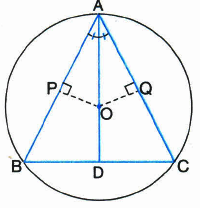
In \(\Delta APO\) and \(\Delta AQO\)
\(\angle OPA=\angle OQA\)
I Each = 90° (By construction)
\(\angle OAP=\angle OAQ\) | Given
OA = OA | Common
∴ \(\Delta APO\cong \Delta AQO\) I AAS
∴ OP= OQ I CPCT
∴ AB = AC. I ∵ Chords equidistant from the centre of a circle are equal.
7.
Given: A circle with centre O. PQ is a chord of this circle. M is the mid-point of the chord PQ.
To Prove: OM 丄 PQ.
Construction: Join OP and OQ.
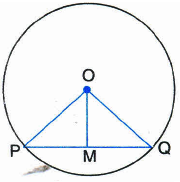
Proof: In \(\Delta OMP\) and \(\Delta OMQ\),
OP = OQ I Radii of the same circle
OM = OM I Common
MP = MQ
I ∵ M is the mid-point of PQ
∴ \(\Delta OMP\cong \Delta OMQ\) I By SSS congruence criterion
∴ \(\angle OMP=\angle OMQ\) I CPCT
But \(\angle OMP+\angle OMQ=180°\) I Linear pair axiom
∴ \(\angle OMP+\angle OMQ=90°\)
⇒ OM 丄 PQ.
8.
Given: A circle with centre O. PQ is a chord of this circle.
OL is the perpendicular drawn to chord PQ from centre O.
To Prove: PL = QL
Construction: Join OP and OQ.
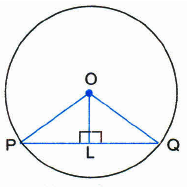
Proof: In \(\Delta OLP\) and
OP=OQ I Radii of the same circle
OL = OL I Common
\(\angle OLP=\angle OLQ\) I Each = 90°
∴ \(\Delta OLP\cong \Delta OLQ\) I By RHS congruence criterion
∴ PL=QL ICPCT
9.
Given: Diameter AB and a chord AC have a common end point A. AB = 20 cm and AC = 12 cm.
To determine: OD
Determination: ∵ OD丄AC
∴ \(AD=DC=\frac { 1 }{ 2 } AC=\frac { 1 }{ 2 } \times 12=6\quad cm\)
| ∵ The perpendicular drawn from the centre of a circle to a chord bisects the chord.
\(OA=OB=\frac { 1 }{ 2 } AB=\frac { 1 }{ 2 } \times 20=10\quad cm\)
In right triangle ODA,
OA2 = OD2 + AD2 I By Pythagoras Theorem
⇒ (10)2=OD2+(6)2
⇒ OD=8 cm
Hence, AC is 8 cm far from the centre of the circle.

9th Standard CBSE Syllabus & Materials
9th Standard CBSE
CBSE 9th Mathematics Lines and Angles Sample Question Papers Study Material - QB365 Set A
NEW9th Standard CBSE
CBSE 9th Mathematics Introduction to Euclid's Geometry Sample Question Papers Study Material - QB365 Set A
NEW9th Standard CBSE
CBSE 9th Mathematics Linear Equations in Two Variables Sample Question Papers Study Material - QB365 Set A
NEW9th Standard CBSE
CBSE 9th Mathematics Coordinate Geometry Sample Question Papers Study Material - QB365 Set A



CBSE 9th Standard CBSE Subjects
CBSE Standards