100% FREE ACCESS
9th Standard CBSE Syllabus & Materials
9th Standard CBSE
CBSE 9th Science Is matter around us pure? - New Model Questions Papers Study Material - QB365 Set A
NEW9th Standard CBSE
CBSE 9th Science Matter in our surroundings - New Model Questions Papers Study Material - QB365 Set A
NEW9th Standard CBSE
CBSE 9th Mathematics Heron's Formula Sample Question Papers Study Material - QB365 Set A
NEW9th Standard CBSE
CBSE 9th Mathematics Circles Sample Question Papers Study Material - QB365 Set A
NEW9th Standard CBSE
CBSE 9th Mathematics Quadrilaterals Sample Question Papers Study Material - QB365 Set A
NEW9th Standard CBSE
CBSE 9th Mathematics Triangles Sample Question Papers Study Material - QB365 Set A

Published on: 24/09/2019
Circles
Download CBSE Class 9th Standard CBSE Mathematics question papers, sample papers, important questions, and previous year solved papers in PDF format. Get free study materials, NCERT solutions, and exam preparation resources for Class 9th Standard CBSE Mathematics
Questions + Answers key
Take MCQ Mathematics Test
1.
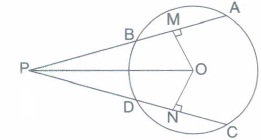
In the figure, AB and CD are two chords of a circle with centre O such that MP = NP. If OM \(\bot\) AB and ON \(\bot\)DC, show that AB = CD.
2.
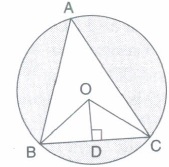
If O is the circumcentre of a \(\Delta\)ABC and OD\(\bot\) BC, then prove that \(\angle\)BOD = \(\angle\)BAC.
3.
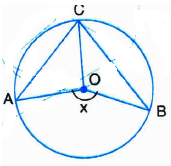
In figure, O is the centre of the circle, \(\angle CAO=40°\) and \(\angle CBO=30°\) , find x.
4.
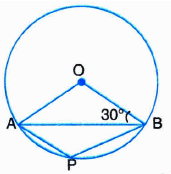
In the given figure, if O is the centre of circle, determine \(\angle APB\).
5.
ABCD is a parallelogram. The circle through A, B and C intersect CD (produced if necessary) at E. Prove that AE = AD.
6.
Prove that a cyclic parallelogram is a rectangle.
7.
If circles are drawn taking two sides of a triangle as diameters, prove that the point of intersection of these circles lies on the third side.
8.
ABCD is a cyclic quadrilateral whose diagonals interest at a point E. If \(\angle DBC=70°, \angle BAC\) is 40°, find \(\angle BCD\) . Further, if AB=BC, find \(\angle ECD\) .
9.
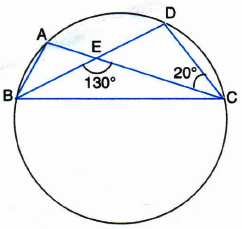
In figure, A, B,C and Dare four points on a circle. AC an BD interest at a point E such that \(\angle BEC=130°\) and \(\angle ECD=20°\) . Find \(\angle BAC\).
10.
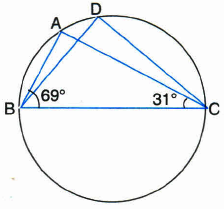
In figure, \(\angle ABC=69°,\ \angle ACB=31°\), find \(\angle BDC\) .
11.
A circular park of radius 20 m is situated in a colony. Three boys Ankur, Syed and David are sitting at equal distance on its boundary each having a toy telephone in his hands to talk each other. Find the length of the string of each phone.
12.
If two equal chords of a circle intersect within the circle, prove that the segments of one chord are equal to corresponding segments of the other chord.
13.
Two circles of radii 5 cm and 3 cm intersect at two points and the distance between their centres is 4 cm. Find the length of the common chord.
14.
Draw different pairs of circles. How many points does each pair have in common? What is the maximum number of common points?
1.
Construction: Join OP.
Proof: In \(\Delta\)OMP and \(\Delta\)ONP,
\(\angle\)OMP = \(\angle\)ONP = 90° (given)
OP =OP (common)
MP =NP (given)
\(\Delta\)OMP :;\(\Delta\)ONP (RHS)
\(\therefore\) OM=ON (c.p.c.t.)
\(\therefore\) AB =CD (chords equidistant from centre are equal)
2.
Given: OD \(\bot\)BC
Proof: In \(\Delta\)OBD and \(\Delta\)OCD
OB = OC (radii)
OD = OD (Common)
\(\angle\)ODB = \(\angle\)ODC (90°)
\(\Delta\)OBD \(\cong \) \(\angle\)OCD (RHS rule)
\(\angle\)BOD = \(\angle\)COD (c.p.c.t.) 1
But \(\angle\)BOC = 2\(\angle\)BOD = 2\(\angle\)BAC
\(\Rightarrow\) \(\angle\)BOD = \(\angle\)BAC
3.
140°
4.
120°
5.
Given: ABCD is a parallelogram. The circle through A, B and C intersects CD (produced, if necessary) at E.
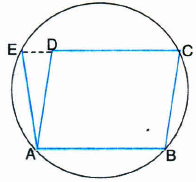
To Prove: AE = AD.
Proof: In cyclic quadrilateral ABCE,
\(\angle AED+\angle ABC=180°\) ....(1)
| ∵ Opposite angles of a cyclic quadrilateral are supplementary.
Also, \(\angle ADE+\angle ADC=180°\)
I Linear Pair Axiom
But \(\angle ADC=\angle ABC\)
Opposite angles of a || gm
∴ \(\angle ADE+\angle ABC=180°\) ....(2)
From (1) and (2), we have
\(\angle AED+\angle ABC=\angle ADE+\angle ABC\)
⇒ \(\angle AED=\angle ADE\)
∴ In triangle ADE,
AE = AD
| ∵ Sides opposite to equal angles of a triangle are equal.
Hence Proved.
6.
Given: ABCD is a cyclic parallelogram.
To Prove: ABCD is a rectangle.
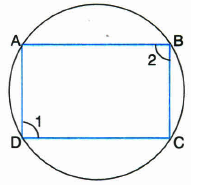
Proof: ABCD is a cyclic quadrilateral
∴ \(\angle 1+\angle 2=180°\) ...(1)
| ∵ Opposite angles of a cyclic quadrilateral are supplementary
∵ ABCD is a parallelogram
∴ \(\angle 1=\angle 2\) ...(2)
| Opp. angles of a || gm
From (1) and (2),
\(\angle 1=\angle 2=90°\)
∴ || gm ABCD is a rectangle.
[A parallelogram with one of its angles 90° is a rectangle]
7.
Given: Circles are drawn with sides AB and AC of a triangle ABC as diameters. They intersect at a point D.
To Prove: D lies on the third side BC of \(\Delta \)ABC
Construction: Join AD
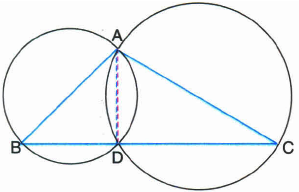
Proof: ∵ Circle drawn on AB as diameter intersects BC in D.
∴ \(\angle ADB=90°\)
| Angle in a semi-circle
But \(\angle ADB+\angle ADC=180°\)| Linear Pair Axiom
∴ \(\angle ADC=90°\)
Hence, the circle described on AC as diameter must pass through D.
Thus, the two circles intersect in D.
Now, \(\angle ADB+\angle ADC=180°\).
∴ Points B, D, C are collinear.
∴ D lies on BC.
8.
\(\angle CDB=\angle CAB\) | Angles in the same segment of a circle are equal
=40° .............(1)
\(\angle DBC=70°\) ..............(2)
In \(\Delta BCD\),
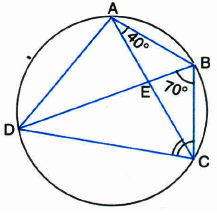
\(\angle BCD+\angle DBC+\angle CDB=180°\) | Sum of all angles of a triangle is 180°
⇒ \(\angle BCD+70°+40°=180°\)| Using (1) and (2)
⇒ \(\angle BCD+110°=180°\)
⇒ \(\angle BCD=180°-110°\)
⇒ \(\angle BCD=70°\) ............(3)
In \(\Delta ABC\),
AB=BC
∴ \(\angle BCA=\angle BAC\)| Angles opposite to equal sides of a triangle are equal
=40° .........(4)
\(|\because \quad \angle BAC=30°\) (given)
Now, \(\angle BCD=70°\) | From (3)
\(\Rightarrow angle BCA+\angle ECD=70°\) | From (4)
\(\Rightarrow 40°+\angle ECD=70°\)
\(\Rightarrow \angle ECD=70°\)
\(\Rightarrow \angle ECD=70°-40°\)
\(\Rightarrow \angle ECD=30°\)
9.
\(\Rightarrow \)\(\angle CED+130°=180°\)
\(\Rightarrow \) \(\angle CED=180°-130°=50°\) ..........(1)
\(\angle ECD=20°\) .............(2)
In \(\Delta CED\),
\(\angle CED+\angle ECD+\angle CDE=180°\) | Sum of all the angles of a triangle is 180°
\(\Rightarrow \) 50°+20°+\(\angle CDE=180°\) | Using (1) and (2)
\(\Rightarrow \) \(70°\angle CDE=180°\)
\(\Rightarrow \) \(\angle CDE=180°\)-70°
\(\Rightarrow \) \(\angle CDE=110°\) ...........(3)
Now, \(\angle BAC=\angle CDE\)
| Angles in the same segment of a circle are equal=110°. |Using (3)
10.
In \(\Delta ABC\),
\(\angle BAC+\angle ABC+\angle ACB=180°\)
Sum of all the angles of a triangle is 180°
⇒ \(\angle BAC+69°+31°=180°\)
⇒ \(\angle BAC+100°=180°\)
⇒ \(\angle BAC=180°-100°=80°\) .........(1)
Now, \(\angle BDC=\angle BAC\)
Angles in the same segment of a circle are equal = 80°. Using (1)
11.
Let BD = x m
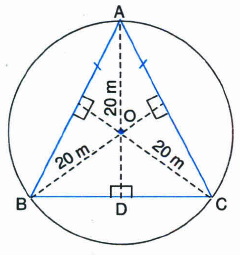
Then in right triangle ODB,
OB2 = OD2 + BD2
By Pythagoras Theorem
⇒ (20)2 = OD2 + x2
⇒ OD2= 400 - x2⇒ OD =\(\sqrt { 400-x^{ 2 } } \)
Again, area of equilateral triangle ABC
= Area of \(\Delta OBC\) + Area of \(\Delta OCA\) + Area of \(\Delta OAB\)
= 3 Area of \(\Delta OBC\)= 3\(\frac { \left( BC \right) \left( OD \right) }{ 2 } \)
\(=3x\sqrt { 400-x^{ 2 } } \) ....(2)
⇒ \(\sqrt { 3 } \sqrt { 400-x^{ 2 } } =x\)
Squaring both sides,
3(400 - x2) = x2
⇒ 1200 - 3x2 = x2
⇒ 4x2 = 1200 ⇒ x2 = 300
⇒ \(x=10\sqrt { 3 } \) ⇒ BD=\(10\sqrt { 3 } \)
⇒ \(2BD=20\sqrt { 3 } \) ⇒ \(BC=20\sqrt { 3 } \)
Hence, the length of string of each phone is \(20\sqrt { 3 } \) m.
12.
Given: A circle with centre O. Its two equal chords AB and CD intersect at E.
To prove: AE = DE and CE = BE.
Construction: Draw OM 丄 AB and ON 丄 CD join OE.
Proof: In \(\Delta OME\) and \(\Delta ONE\) ,
OM = ON
| ∵ Equal chords of a circle are equidistant from the centre
OE = OE I Common
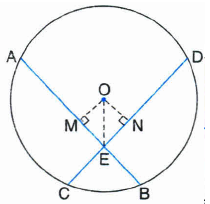
∴\(\Delta OME\cong \Delta ONE\) | RHS Rule
∴ ME = NE I CPCT
⇒AM + ME = DN + NE
∵ \(AB=CD\Rightarrow \frac { 1 }{ 2 } AB=\frac { 1 }{ 2 } CD\Rightarrow AM=DN\)
⇒ AE = DE
⇒ AB - AE = CD - DE | ∵ AB=CD
⇒ B E= CE. | Given
13.
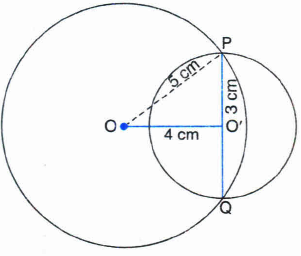
Let O and O' be the centres of circles of radii 5 cm and 3 cm respectively. Let PQ be the common chord of the two circles.
∵ 52 = 42 + 32
∴ OP2 = OO'2 + O'P2
⇒ \(\angle OO'P=90°\)
I By Converse of Pythagoras Theorem
⇒ O' lies on the common chord PQ.
∵ OO' 丄 PQ
∴ OO' bisects PQ
I The perpendicular drawn from the centre of a circle to a chord of it bisects the chord PQ.
∵ O' is the mid-point of PQ.
Therefore, length of the common chord
= PQ = 20'P
= 2 x 3 = 6 cm
14.
(i)
.png)
No point common
(ii)
.png)
One point common
(iii)
.png)
Two points common
Each pair has at the most two common points. The maximum number of common points is two.

9th Standard CBSE Syllabus & Materials
9th Standard CBSE
CBSE 9th Mathematics Lines and Angles Sample Question Papers Study Material - QB365 Set A
NEW9th Standard CBSE
CBSE 9th Mathematics Introduction to Euclid's Geometry Sample Question Papers Study Material - QB365 Set A
NEW9th Standard CBSE
CBSE 9th Mathematics Linear Equations in Two Variables Sample Question Papers Study Material - QB365 Set A
NEW9th Standard CBSE
CBSE 9th Mathematics Coordinate Geometry Sample Question Papers Study Material - QB365 Set A



CBSE 9th Standard CBSE Subjects
CBSE Standards