100% FREE ACCESS
9th Standard CBSE Syllabus & Materials
9th Standard CBSE
CBSE 9th Science Is matter around us pure? - New Model Questions Papers Study Material - QB365 Set A
NEW9th Standard CBSE
CBSE 9th Science Matter in our surroundings - New Model Questions Papers Study Material - QB365 Set A
NEW9th Standard CBSE
CBSE 9th Mathematics Heron's Formula Sample Question Papers Study Material - QB365 Set A
NEW9th Standard CBSE
CBSE 9th Mathematics Circles Sample Question Papers Study Material - QB365 Set A
NEW9th Standard CBSE
CBSE 9th Mathematics Quadrilaterals Sample Question Papers Study Material - QB365 Set A
NEW9th Standard CBSE
CBSE 9th Mathematics Triangles Sample Question Papers Study Material - QB365 Set A

Published on: 21/09/2019
Introduction to Euclid's Geometry
Download CBSE Class 9th Standard CBSE Mathematics question papers, sample papers, important questions, and previous year solved papers in PDF format. Get free study materials, NCERT solutions, and exam preparation resources for Class 9th Standard CBSE Mathematics
Questions + Answers key
Take MCQ Mathematics Test
1.
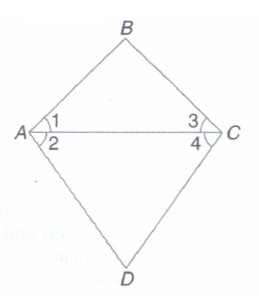
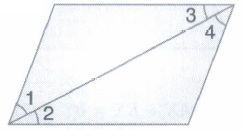
In the given figure, we have \(\angle1=\angle3\) and \(\angle2=\angle4\). Show that, \(\angle A=\angle C.\)
2.
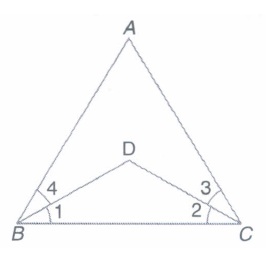
In the given figure, we have \(\angle ABC=\angle ACB, \angle3=\angle4\). Show that \(\angle 1=\angle2.\)
3.
In a triangle ABC, X and Y are the points On AB and BC such that BX = BY and AB = BC. Show that AX = CY. State the Euclid's Axiom used.
4.
In the given figure, if \(\angle1=\angle3, \angle2=\angle4\ and\ \angle3=\angle4\), write the relation between \(\angle1\ and\ \angle2\) using Euclid's axiom.
5.
(i) Why is Axiom 5, in the list of Euclid's axioms, considered a 'universal truth'? (Note that the question is not about the fifth postulate).
(ii) How would you rewrite Eulid's fifth postulate so that it would be easier to understand?
6.
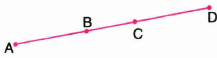
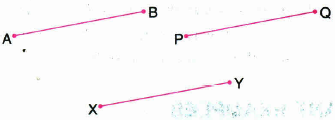
In figure, if AC = BD, then prove that AB = CD.
7.
Point C is called a mid-point of line segment AB. Prove that every line segment has one and only one mid-point.
8.
Consider two 'postulates' given below:
(i) Given any two distinct points A and B, there exists a third point C which is in between A and B.
(ii) There exist at least three points that are not on the same line.
Do these postulates contain any undefined terms? Are these postulates consistent? Do they follow from Euclid's postulates? Explain.
9.
Which of the following statements are true and which are false? Give reasons for your answers:
(i) Only one line can pass through a single point.
(ii) There are an infinite number of lines which pass through two distinct points.
(iii) A terminated line can be produced indefinitely on both the sides.
(iv) If two circles are equal, then their radii are Equal.
1.
Since \(\angle1=\angle3\ and \ \angle2=\angle4\), therefore adding before equations.
\(\angle1+\angle2=\angle3+\angle4\)
\(\Rightarrow \angle BAD= \angle BCD\)
\(\Rightarrow \angle A= \angle C.\)
2.
Given\(\angle ABC=\angle ACB\)
\(\Rightarrow \angle1+\angle4=\angle2+\angle3\)
\(\Rightarrow \angle1+\angle4-\angle4=\angle2+\angle3-\angle3\)
(As, \(\angle3=\angle4\))
\(\Rightarrow \angle1=\angle2\)
3.
AB = BC (given)
BX = BY (given)
If equals are subtracted from equals, then remains are also equal.
AB - BX = BC - BY
\(\Rightarrow\) AX = CY
4.
Here, \(\angle1=\angle3, \angle2=\angle4\ and\ \angle3=\angle4\), Euclid's first axiom says, the things which are equal to same things are equal to one another.
So, \(\angle 1=\angle 2\)
5.
(i) Since this is true for anything in any part of the world, this is a universal truth.
(ii) If the sum of the cointerior angles made by a transversal intersect two straight lines at distinct points is less than 180o, then the lines cannot be parallel.
6.
We have
AC = BD
\(\Rightarrow \) AC - BC= BD - BC
If equals are subtracted from equals, the remainders are equal (Euclid's Axiom (iii))
\(\Rightarrow \) AB = CD
AC - BC coincides with AB; BD - BC coincides with CD [Things which coincide with one another are equal to one another (Euclid's Axiom (iv))]
7.
Let a line AB have two mid-points, say, C and D. Then,
AC = \(1\over2\) AB ...(1)
AD = \(1\over2\)AB ...(2)
From (1) and (2),
AC = AD.
Things which are equal to the same thing are equal to one another
8.
Yes! These postulates contain two undefined terms: Point and Line. Yes! These postulates are consistent because they deal with two different situations
(i) says that given two points A and B, there is a point C lying on the line in between them,
(ii) says that given A and B, we can take C not lying on the line through A and B. These 'postulates' do not follow from Euclid's postulates, however, they follow from Axiom 'Given two distinct lines, there is a unique line that passes through them.
9.
(i) False. This can be seen visually.
(ii) False. This contradicts the Axiom.
[Given two distinct points, there is a unique line that passes through them.]
(iii) True by Euclid's Postulate
[A terminated line can be produced indefinitely.]
(iv) True. If we superimpose the region bounded by one circle on the other, then they coincide. So, their centres and boundaries coincide, therefore, their radii will coincide.
(v) True by the first Axiom of Euclid.
[Things which are equal to the same thing are equal to one another.]

9th Standard CBSE Syllabus & Materials
9th Standard CBSE
CBSE 9th Mathematics Lines and Angles Sample Question Papers Study Material - QB365 Set A
NEW9th Standard CBSE
CBSE 9th Mathematics Introduction to Euclid's Geometry Sample Question Papers Study Material - QB365 Set A
NEW9th Standard CBSE
CBSE 9th Mathematics Linear Equations in Two Variables Sample Question Papers Study Material - QB365 Set A
NEW9th Standard CBSE
CBSE 9th Mathematics Coordinate Geometry Sample Question Papers Study Material - QB365 Set A



CBSE 9th Standard CBSE Subjects
CBSE Standards