100% FREE ACCESS
9th Standard CBSE Syllabus & Materials
9th Standard CBSE
CBSE 9th Science Is matter around us pure? - New Model Questions Papers Study Material - QB365 Set A
NEW9th Standard CBSE
CBSE 9th Science Matter in our surroundings - New Model Questions Papers Study Material - QB365 Set A
NEW9th Standard CBSE
CBSE 9th Mathematics Heron's Formula Sample Question Papers Study Material - QB365 Set A
NEW9th Standard CBSE
CBSE 9th Mathematics Circles Sample Question Papers Study Material - QB365 Set A
NEW9th Standard CBSE
CBSE 9th Mathematics Quadrilaterals Sample Question Papers Study Material - QB365 Set A
NEW9th Standard CBSE
CBSE 9th Mathematics Triangles Sample Question Papers Study Material - QB365 Set A

Published on: 29/02/2020
9th Standard CBSE Mathematics Public Exam Important Question 2019-2020
Download CBSE Class 9th Standard CBSE Mathematics question papers, sample papers, important questions, and previous year solved papers in PDF format. Get free study materials, NCERT solutions, and exam preparation resources for Class 9th Standard CBSE Mathematics
Questions + Answers key
Take MCQ Mathematics Test
1.
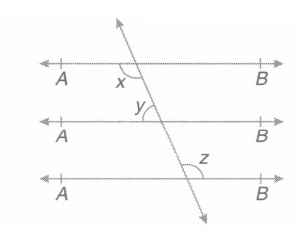
In figure if AB||CD||EF and x:y=3:2. Find z
2.
Two parallel lines I and m are intersected by a transversal ' t'.Show that the quadrilateral formed by bisectors of interior angles is a rectangle.
3.
In a triangle PQR, X and Y are the points on PQ are QR respectively. If PQ = QR and QX = QY, Show that PX = RY.
4.
Three coins are tossed simultaneously 200 times with the following frequencies of different outcomes
| Outcome | Frequency |
| 3 heads | 24 |
| 2 heads | 70 |
| 1 head | 75 |
| 3 tails | 31 |
Compute the probability of getting
(i) less than 2 heads
(ii) 3 heads.
5.
Find the area of the triangle whose two sides are of measure 13 cm and 14 cm and perimeter is 42 cm.
6.
PQRS is a cyclic quadrilateral, in which \(\angle P=2x°\), \(\angle Q=y°\), \(\angle R=3x°\) and \(\angle S=2y°\). Find the values of x and y.
7.
Solve 4x - 7 = 9. Represent the solution
(i) on the number line
(ii) in the Cartesian plane.
8.
Plot the points A(6,6), B(4,4), C(-1,-1) in the Cartesian plane and show that the points are collinear.
9.
Write \((3a+4b+5c)^2\) in expanded form.
10.
Find the rational numbers a and b such that \(\frac { 2+5\sqrt { 7 } }{ 2-5\sqrt { 7 } } =a+\sqrt { 7 } b\)
11.
An experiment has two outcomes E and F P(E)+P(F) is equal to:
1
0
2
\(\frac { 1 }{ 2 } \)
12.
The mean of 3,4,5,6,7 is
7
6
5
4
13.
The lateral surface area of a cuboid of length l, breadth b and height h is
2(lb + bh + hl)
2(l + b)h
lbh
none of these.
14.
The sides of a triangular park are in the ratio 25: 17: 12 and its perimeter is 540 m. Find the smallest side of the park.
60 m
120 m
90 m
45 m
15.
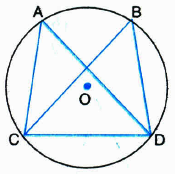
A and B are points on the circle with centre O. If a chord CD of the circle subtends an angle of 50° at the point A on the circle and \(\angle BDC=70°\), then \(\angle BCD\) equals:
60°
50°
70°
90°
16.
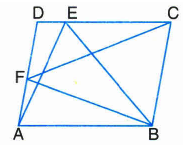
In given figure, ABCD is a parallelogram. If ar(\(\Delta\)BFC) = 40 cm2, then ar(\(\Delta\) AEB) is equal to:
20 cm2
40 cm2
80 cm2
10 cm2
17.
ABCD is a rhombus such that \(\angle \)ABC=\(40°\) then \(\angle \)ADC is equal to
40°
45°
50°
20°
18.
The symbol for correspondence is
⟶
⇔
↔
≡
19.
We can draw two different lines in
Only one way
two different ways
three different ways
None of these
20.
John Playfair was a
french mathematician
Scottish mathematician
Indian mathematician
Egyptian mathematician
21.
Any point on the line y = 3x is of the form:
(a, 3a)
(3a, a)
\(\left(a,{a\over3}\right)\)
\(\left({a\over3},-a\right)\)
22.
The distance of the point (1,0) from O is:
0
1
2
None of these
23.
For what value of a, is the polynomial \(x^3+2x^2-3ax-8\) divisible by x-4?
\(\frac{22}{3}\)
\(\frac{11}{3}\)
11
3
24.
If \(\sqrt { 3 } =1.732\) and \(\sqrt { 2 } =1.414\) , the value of \(\frac { 1 }{ \sqrt { 3 } -\sqrt { 2 } } \) is:
0.318
3.146
1/3.146
\(\sqrt { 1.732 } -\sqrt { 1.414 } \)
25.
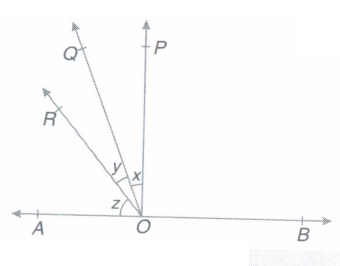
In the given figure, \(PO\bot AB\), If x:y:z=1:3:5, then find the degree measure of x,y and z.
26.
In the given figure, if \(\angle1=\angle3, \angle2=\angle4\ and\ \angle3=\angle4\), write the relation between \(\angle1\ and\ \angle2\) using Euclid's axiom.
27.
If a = 2 + √5 and b = \(\frac{1}{a}\), find a2 + b2
28.
Given below is the frequency distribution of salary in Rs of 80 workers in a factory.
| Salary | No.of workers |
| 1000-2000 | 8 |
| 2000-3000 | 14 |
| 3000-4000 | 20 |
| 4000-5000 | 24 |
| 5000-6000 | 14 |
Find the probability that the salary of a worker selected at random is:
(i) Less than 4000
(ii) More than or equal to 3000
(iii) More than or equal to 2000 but less than 5000
29.
The length of 40 leaves of a plant are measured a correct one millimeter, and the obtained data is represented in the following table:
| Length (in mm) | Number of leaves |
| 118-126 | 3 |
| 127-135 | 5 |
| 136-144 | 9 |
| 145-153 | 12 |
| 154-162 | 5 |
| 163-171 | 4 |
| 172-180 | 2 |
(i) Draw a histogram to represent the given data.
(ii) Is there any suitable graphical representation for the same data?
(iii) Is it correct to conclude that the maximum number of leaves are 153 mm long? Why?
30.
If the lateral surface of a cylinder is 94.2 cm2 and its height is 5 cm, then find
(i) radius of its base
(ii) its volume.
31.
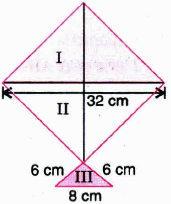
A kite in the shape of a square with a diagonal 32 cm and an isosceles triangle of base 8 cm and side 6cm each is to be made of three different shades as shown in figure. How much paper of each shade has been used in it?
32.
A chord of a circle is equal to the radius of the circle. Find the angle subtended by the chord at a point on the minor arc and also at a point on the major arc.
33.
Write four solutions for each of the following equations:
x=4y
34.
Find the coordinates of the vertices of a rectangle placed in III quadrant, in the Cartesian plane with length 'p' units on x-axis and breadth 'q' units on y-axis.
35.
Write the degree of the following polynomials:
5x3 + 4x2 + 7x
36.
The following table gives the pocket money (in Rs) given to children per day by their Parents:
| Pocket Money |
0-10 | 10-20 | 20-30 | 30-40 | 40-50 |
|---|---|---|---|---|---|
| No. of children | 12 | 23 | 35 | 20 | 10 |
Represent the data in the form of a historgram
37.
Show that the bisectors of angles of a parallelogram form a rectangle
38.
In \(\triangle\)ABC and \(\triangle\)PQR, AB = PQ, AC = PR and altitude AM and PN are equal. Show that, \(\triangle ABC\cong \triangle PQR.\)
39.
Prove that \(\frac { 1 }{ 3+\sqrt { 7 } } +\frac { 1 }{ \sqrt { 7 } +\sqrt { 5 } } +\frac { 1 }{ \sqrt { 5 } +\sqrt { 3 } } +\frac { 1 }{ \sqrt { 3 } +1 } =1\)
40.
State Factor theorem. Using Factor theorem, factorise x3-3x2-x+3.
41.
The percentages of marks obtained by a student in examination are given below:
| Examination subjects |
% marks |
| I | 58 |
| II | 64 |
| III | 76 |
| IV | 62 |
| V | 85 |
Find the probability that the student gets
(i) a first class i.e. at least 60% marks
(ii) a distinction i.e. 75% or above
(iii) marks between 70% and 80%
42.
The base of an isosceles triangle measures 24 cm and its area is 60 cm2, Find its perimeter.
43.
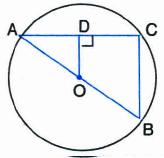
In the figure, diameter AB and a chord AC have a 'common end point A. If the length of AB is 20 cm and of AC is 12 cm, how far is AC from the centre of the circle?
44.
If l,m,n are three lines such that l || m and n \(\bot \) l , then prove that n \(\bot \)m
45.
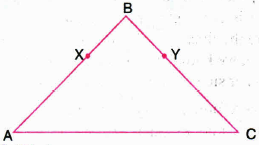
In the given figure AB = BC and BX = BY. Show that AX = CY. State Euclid's Axiom used.
46.
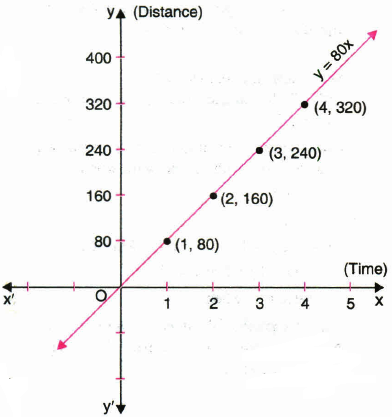
Rohit is driving his car at a uniform speed of 80 km per hour. Draw time-distance graph taking time along x-axis and distance along y-axis.
47.
Plot the points A(3,0), B(3,3) and C(0,3) in a Cartesian plane.Join OA, OB, BC and CO.Name the figure so formed and write its one property.
48.
Two solid spheres made of the same metal have masses 5920 g of and 740 g respectively. Determine the radius of the larger sphere, if the diameter of the smaller sphere is 5 cm.
49.
Three students Priyanka, Sania and David are protesting against killing innocent animals for commercial purposes in a circular park of radius 20 m. They are standing at equal distance on its boundary by holding banners in their hands.
(i) Find the distance between each of them?
(ii) Which mathematical concept is used in it?
(iii) How does an act like this reflects their attitude towards society?
50.
For spreading the message "Save Girl Child Save Future" a rally was organized by some students of a school. They were given triangular cardboard piece PQR which they divided in to two parts by drawing the angle bisectors QO and RO of base angles Q and R and wrote a slogan. Prove that \(\angle\)QOR = 90° + \(\frac{1}{2}\)\(\angle\)P. What is the benefit of these types of rallies?
51.
Represent the following data by means of a frequency polygon.
| Marks | Frequency |
|---|---|
| 41-45 | 4 |
| 45-49 | 10 |
| 49-53 | 15 |
| 53-57 | 18 |
| 57-61 | 20 |
| 61-65 | 12 |
| 65-69 | 13 |
52.
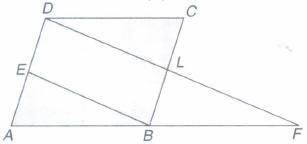
In the given figure ABCD is a parallelogram and E is the mid-point of AD. A line through D, drawn parallel to EB, meets AB produced at F and BC at L Prove that
(i) AF = 2DC
(ii) DF = 2DL
53.
If x = 3-2√2, find the value of √x+\(\frac{1}{\sqrt{x}}\)
1.
Let x=3k, y=2k
Then, x+y=3k+2k=180o
(Angles on the same side of transversal)
5k=180o
k=360
x=3k=108o
y=2k=72o
Thus, \(\angle z=\angle x=108^o\) (Alternate interior angles)
2.
∠APR=ㄥDRP
or ㄥ1=ㄥ2
But these are alternate interior angles
SP II RQ, SR II PQ
PQRS is a parallelogram
∠APR+ㄥBPR=180°,(linear pair)
⇒ \(\frac{1}{2}\) ∠APR+\(\frac{1}{2}\)ㄥBPR=\(\frac{1}{2}\)x180°
⇒ ∠1+ㄥ3=90°
⇒ ∠SPQ=90°
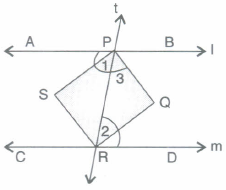
PQRS is a rectangle
3.
PQ = QR
QX = QY
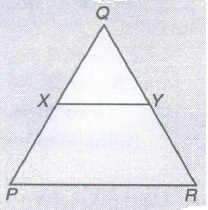
If equals are subtracted from equals, the remainders are also equal.
We have PQ - QX = QR - QY
PX = RY
4.
\((i)\frac { 53 }{ 100 }\)
\((ii)\frac { 3 }{ 25 } \)
5.
84 cm2
6.
36, 60
7.
x=4
8.
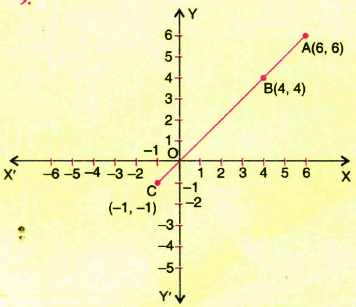
9.
Comparing the given expression with (x + y + z)2, we find that
x = 3a, y = 4b and z = 5c.
Therefore, using Identity V, we have
(3a + 4b + 5c)2 = (3a)2 + (4b)2 + (5c)2 + 2(3a)(4b) + 2(4b)(5c) + 2(5c)(3a)
= 9a2 + 16b2 + 25c2 + 24ab + 40bc + 30ac
10.
\(\quad a=-\frac { 179 }{ 171 } ,b=\frac { -20 }{ 171 } \)
11.
P(E)+P(F)=1
12.
\(\overset{-}{x}=\frac {3+4+5+6+7}{5}=5.\)
13.
Volume = 15 \(\times\) 10 \(\times\) 8 = 1200 cm3
14.
Smallest side = \(\frac { 12 }{ 25+17+12 } \times 540\) = 120 m.
15.
\(\angle CBD=\angle CAD=50°\)
16.
(b)
40 cm2
17.
A rhombus is a parallelogram and in a parallelogram, opposite angles are equal.
18.
↔ denotes correspondence
19.
(b)
two different ways
20.
(b)
Scottish mathematician
21.
(a, 3a) satisfies y=3x
22.
(b)
1
23.
\(f(x)=x^3+2x^2-3ax-8\)
\(\Rightarrow \ f(4)=0\)
\(\Rightarrow \ 4^3+2 (4)^2-3a(4)-8=0\)
\(\Rightarrow \ 64+32-12a-8=0\)
\(\Rightarrow \ 12a=88\)
\(\Rightarrow \ a=\frac{22}{3}\)
24.
(b)
3.146
25.
\(OP\bot AB\)
\(\Rightarrow \angle POA=90^o\)
Let \(\angle POQ=a\)
\(\therefore \angle QOR=3a\)
\(\angle ROA=5a\)
\(\Rightarrow\) a+3a+5a=90o
\(\Rightarrow\) 9a=90o
\(\Rightarrow\)a=10o
\(\therefore\)x=10o
and y=3x10o=30o
z=5x10o=50o
26.
Here, \(\angle1=\angle3, \angle2=\angle4\ and\ \angle3=\angle4\), Euclid's first axiom says, the things which are equal to same things are equal to one another.
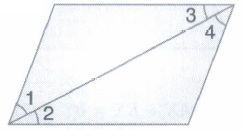
So, \(\angle 1=\angle 2\)
27.
\(b=\frac { 1 }{ 2+\sqrt { 5 } } \)
\(=\frac { 1 }{ 2+\sqrt { 5 } } \times \frac { 2-\sqrt { 5 } }{ 2-\sqrt { 5 } } \)
\(=\frac { 2-\sqrt { 5 } }{ -1 } =-2+\sqrt { 5 } \)
\({ a }^{ 2 }={ \left( 2+\sqrt { 5 } \right) }^{ 2 }=9+4\sqrt { 5 } \)
\({ b }^{ 2 }={ \left( -2+\sqrt { 5 } \right) }^{ 2 }=9-4\sqrt { 5 } \)
\({ a }^{ 2 }+{ b }^{ 2 }=9+4\sqrt { 5 } +9-4\sqrt { 5 } \)
= 18
28.
\((i)\frac { 21 }{ 40 }\)
\((ii)\frac { 29 }{ 40 }\)
\((iii)\frac { 29 }{ 40 } \)
29.
Modified Continues Distribution
| Length (in mm) | Number of leaves |
| 117.5-126.5 | 3 |
| 126.5-135.5 | 5 |
| 135.5-144.5 | 9 |
| 144.5-153.5 | 12 |
| 153.5-162.5 | 5 |
| 162.5-171.5 | 4 |
| 171.5-180.5 | 2 |
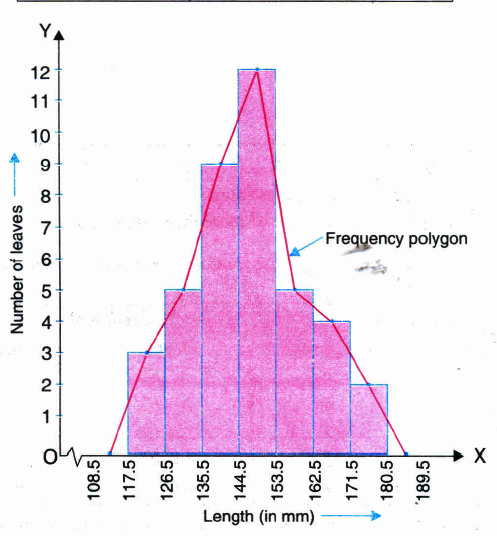
(ii) Frequency Polygon.
(iii) No, because the maximum number of leaves have their lengths lying in the original interval 145-153 (or modified interval 144.5-153.5).
30.
Let the radius of the base of the cylinder be r cm.
= 5 cm
Lateral surface =94.2 cm2
\(\Rightarrow 2\pi rh=94.2\)
\(\Rightarrow 2\times 3.14 \times r\times 5=94.2\)
\(\Rightarrow r=\frac{94.2}{2\times3.14\times5}\)
\(\Rightarrow r=\frac{94.2}{31.4}\)
\(\Rightarrow r=3cm\)
(ii) r = 3cm, h = 5 cm
ஃ Volume of the cylinder =\(\pi r^2h\)
= 3.14 x (3)2 x 5 =141.3 cm3
31.
Area of paper of shade I \(2\times \left( \frac { 1 }{ 2 } \times 16\times 16 \right) =256\)cm2
Similarly, Area of paper of shade II = 256 cm2
For area of paper of shade III
a = 8 cm, b = 6 cm, c = 6cm
\(\therefore s=\frac { a+b+c }{ 2 } =\frac { 8+6+6 }{ 2 } =10\) cm
\(\therefore \) Area of paper of shade III = \(\sqrt { s(s-a)(s-b)(s-c) } \)
\(=\sqrt { 10(10-8)(10-6)(10-6) } \)
\(=\sqrt { (10)(2)(4)(4) } =8\sqrt { 5 } \)
= 17.89 cm2
32.
Construction: Join OA and OB.
∵ OA = OB = AB I Given
∴ \(\Delta AOB\) is equilateral.
∴ \(\angle AOB=60°\)
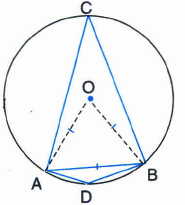
\(\angle ACB=\frac { 1 }{ 2 } \angle AOB\)
The angle subtended by an arc at the centre is double the angle subtended by it at any point on the remaining part of the circle
\(=\frac { 1 }{ 2 } \times 60°=30°\)
Now, ∵ ADBC is a cyclic quadrilateral.
∴ \(\angle ADB+\angle ACB=180°\)
The sum of either pair of opposite angles of a cyclic quadrilateral is 180°
\(\Rightarrow \ \angle ADB+30°=180°\)
\(\\ \Rightarrow \angle ADB=180°-30°\)
\(\\ \Rightarrow angle ADB=150°.\)
33.
x=4y
\(\Rightarrow\ \ y={x\over 4}\)
Put x=0, we get \(y={0\over4}=0\)
Put x=4, we get \(y={4\over4}=1\)
Put x=-4, we get \(y={-4\over 4}=-1\)
Put x=2, we get \(y={2\over4}={1\over 2}\)
Four solutions are (0,0), (4, 1), (-4, -1) and \(\left(2,{1\over 2}\right)\)
34.
(0,0); (-p,0); (5,0); (0,-q)
35.
Term with the highest power of x = 5x3
Exponent of x in this term = 3
Therefore Degree of this polynomial = 3
36.
| Pocket Money | No. of children |
|---|---|
| 0-10 | 12 |
| 10-20 | 23 |
| 20-30 | 35 |
| 30-40 | 20 |
| 40-50 | 10 |
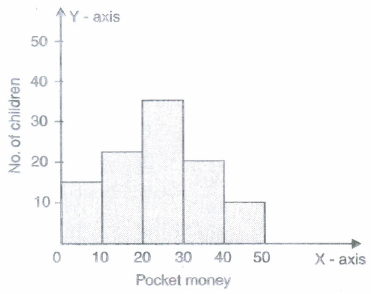
37.
Let ABCD is a parallelogram
To show LMNO is a rectangle,
ㄥA+ㄥD=180°
\(\frac{1}{2}\)ㄥA+\(\frac{1}{2}\)ㄥD=90°
ㄥOAD+ㄥODA=90°
In ΔOAD,
ㄥOAD+ㄥADO+ㄥDOA=180°
⇒ ㄥDOA = 90°
⇒ ㄥLON = 90°
Similarly, ㄥOLM =ㄥLMN =ㄥMNO = 90°
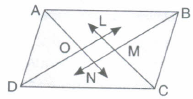
ஃ A quadrilateral with all angles 90° is a rectangle. Also opposite angles are equal. It is rectangle.
38.
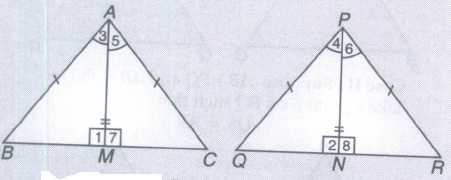
In \(\triangle\)AMB and \(\triangle\)PNQ,
AB = PQ (Given)
AM = PN (Given)
\(\angle\)1 = \(\angle\)2 = 90°
(AM\(\bot \)BC & PN \(\bot \)QR)
\(\Rightarrow\) \( \triangle AMP\cong \triangle PNQ\) (By RHS)
\(\Rightarrow\) \(\angle\)3 =\(\angle\)4 (By c.p.c.t.)
Similarly, \(\triangle AMC\cong \triangle PNR\)
\(\Rightarrow\) \(\angle\)5 = \(\angle\)6
(In congruent triangles, corresponding angles are equal)
\(\therefore\) In \(\triangle\)ABC and \(\triangle\)PQR,
AB = PQ (Given)
AC = PR (Given)
\(\angle\)A =\(\angle\)P
(\(\angle\)3 + \(\angle\)5 = \(\angle\)4 + \(\angle\)6) (proved)
\(\triangle ABC\cong \triangle PQR\) (By SAS)
39.
\(\frac { 1 }{ 3+\sqrt { 7 } } =\frac { 1 }{ 3+\sqrt { 7 } } \times \frac { 3-\sqrt { 7 } }{ 3-\sqrt { 7 } } =\frac { 3-\sqrt { 7 } }{ 9-7 } =\frac { 3-\sqrt { 7 } }{ 2 } \)
\(\frac { 1 }{ \sqrt { 7 } +\sqrt { 5 } } =\frac { 1 }{ \sqrt { 7 } +\sqrt { 5 } } \times \frac { \sqrt { 7 } -\sqrt { 5 } }{ \sqrt { 7 } -\sqrt { 5 } } =\frac { \sqrt { 7 } -\sqrt { 5 } }{ 2 } \)
\(\frac { 1 }{ \sqrt { 5 } +\sqrt { 3 } } =\frac { 1 }{ \sqrt { 5 } +\sqrt { 3 } } \times \frac { \sqrt { 5 } -\sqrt { 3 } }{ \sqrt { 5 } -\sqrt { 3 } } =\frac { \sqrt { 5 } -\sqrt { 3 } }{ 5-3 } \)
\(=\frac { \sqrt { 5 } -\sqrt { 3 } }{ 2 } \)
\(\frac { 1 }{ \sqrt { 3 } +1 } =\frac { 1 }{ \sqrt { 3 } +1 } \times \frac { \sqrt { 3 } -1 }{ \sqrt { 3 } -1 } =\frac { \sqrt { 3 } -1 }{ 3-1 } =\frac { \sqrt { 3 } -1 }{ 2 } \)
\(LHS=\frac { 3-\sqrt { 7 } }{ 2 } +\frac { \sqrt { 7 } -\sqrt { 5 } }{ 2 } +\frac { \sqrt { 5 } -\sqrt { 3 } }{ 2 } +\frac { \sqrt { 3 } -1 }{ 2 } \)
\(=\frac { 3-1 }{ 2 } =\frac { 2 }{ 2 } =1=RHS\)
40.
Factor theorem - statement
Let p(x)=x3-3x2-x+3
the factors of the constant term 3 are \(\pm \)1, \(\pm \)3
p(1)=13-3(1)2-1+3=0
(x-1) is a factor
p(-1)=(-1)3-3(-1)2-(-1)+3=0
(x+1) is a factor
p(3) = 33-3(3)2-3+3 = 0
(x-3) is a factor
(x-1)(x+1)(x-3) are the factors of p(x)
41.
Total number of subjects = 5
(i) Number of subjects in which the student gets a first class = 4
Probability that the students gets a first class \(=\frac { 4 }{ 5 } \)
(ii) Number of subjects in which the student gets a distinction = 2
Probability that the student gets a distinction \(=\frac { 2 }{ 5 } \)
(iii) Number of subjects in which the student gets marks between 70% and 80% = 1
Probability that the students gets marks between 70% and 80% \(=\frac { 1 }{ 5 } \)
42.
Area = \(=\frac { a }{ 4 } \sqrt { 4{ b }^{ 2 }-{ a }^{ 2 } } \)
\(\Rightarrow 60=\frac { 24 }{ 4 } \sqrt { 4{ b }^{ 2 }-{ (24) }^{ 2 } } \)
\(\Rightarrow 10=\sqrt { 4{ b }^{ 2 }-576 } \)
\(\Rightarrow 100=4{ b }^{ 2 }-576\) | Squaring
\(\Rightarrow 4{ b }^{ 2 }=676\)
\(\\ \Rightarrow { b }^{ 2 }=\frac { 676 }{ 4 } =169\)
\(\Rightarrow b=\sqrt { 169 } \) = 13 cm
\(\therefore\) Perimeter = a + b + b
= 24 + 13 + 13 = 50 cm
43.
Given: Diameter AB and a chord AC have a common end point A. AB = 20 cm and AC = 12 cm.
To determine: OD
Determination: ∵ OD丄AC
∴ \(AD=DC=\frac { 1 }{ 2 } AC=\frac { 1 }{ 2 } \times 12=6\quad cm\)
| ∵ The perpendicular drawn from the centre of a circle to a chord bisects the chord.
\(OA=OB=\frac { 1 }{ 2 } AB=\frac { 1 }{ 2 } \times 20=10\quad cm\)
In right triangle ODA,
OA2 = OD2 + AD2 I By Pythagoras Theorem
⇒ (10)2=OD2+(6)2
⇒ OD=8 cm
Hence, AC is 8 cm far from the centre of the circle.
44.
Given l,m,n are three lines such that l || m and n \(\bot \)m
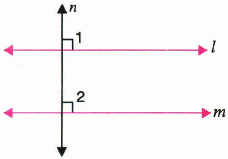
\(\therefore \)l || m and n is a transversal
\(\therefore \) \(\angle \)1=\(\angle \)2 |Corresponding angles
But \(\angle \)1=\(90^{ 0 }\)
\(\therefore \) \(\angle \) 2= \(90^{ 0 }\)
\(\Rightarrow \) n \(\bot \) m
45.
We have
AB = BC
\(\Rightarrow \) AB - BX = BC - BX
|If equals are subtracted from equals, the remainders are equal (Euclid's Axiom (iii))
AB - BX = BC - BY \(|\)\( \because\) BX = BY
AB - BX coincides with AX;
BC - BY coincides with CY
[Things which coincide with one another are equal to one another (Euclid's Axiom (iv))]
46.
Let us represent time (in hour) by x and distance (in km) by y. Then, we have y =80x.
Table of solution
| x | 1 | 2 | 3 | 4 |
|---|---|---|---|---|
| y | 80 | 160 | 240 | 320 |
We plot the points (1, 80), (2, 160), (3, 240) and (4, 320) on a graph paper and join these points by a ruler to get the line which is the graph of the equation y = 80x.
47.
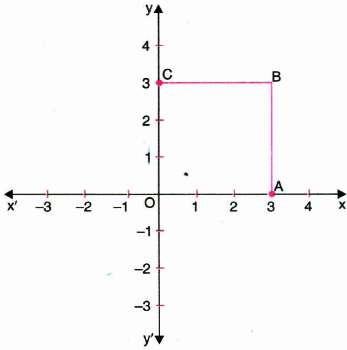
The figure formed is a square.
Its all the sides are of equal length.
48.
Let r and R be the radii of the smaller and larger spheres respectively, we have
\(r=\frac { 5 }{ 2 } cm\)
Volume of the smaller sphere \(=\frac { 4 }{ 3 } \pi { r }^{ 3 }=\frac { 4 }{ 3 } \pi { \left( \frac { 5 }{ 2 } \right) }^{ 3 }\)
\(=\frac { 4 }{ 3 } \times \pi \times \frac { 125 }{ 8 } { cm }^{ 3 }\)
Density of metal\(=\frac { mass }{ Valume } \)
\(=\frac { 740 }{ \frac { 4 }{ 3 } \pi \times \frac { 125 }{ 8 } } g\quad { cm }^{ 3 }\) ...........(i)
Volume of larger sphere = \(\frac { 4 }{ 3 } \pi { R }^{ 3 }\)
Density of metal=\(\frac { mass }{ Volume } =\frac { 5920 }{ \frac { 4 }{ 3 } \pi { R }^{ 3 } } \) ......(ii)
From (i) and (ii), we have
\(\frac { 740 }{ \frac { 4 }{ 3 } \pi \times \frac { 125 }{ 8 } } =\frac { 5920 }{ \frac { 4 }{ 3 } \pi { R }^{ 3 } } \)
\(\Rightarrow \quad { R }^{ 3 }=\frac { 5920\times 125 }{ 740\times 8 } \)
= 125
\(\Rightarrow\) R = 5 cm.
49.
(i) Let us assume that A, Band C are the position of Priyanka, Sania and David respectively on the boundary of circular park with centre O.
Draw AD\(\bot\) BC
Since the centre of the circle coincides with the centroid of the equilateral \(\triangle\) ABC
\(\therefore\) Radius of circumscribed circle = \(\frac{2}{3}\) AD
\(\Rightarrow 20=\frac { 2 }{ 3 } AD\)
\(\Rightarrow AD=20\times \frac { 2 }{ 3 } \)
\(\Rightarrow AD=30m\)
Now, AD\(\bot\)BC, and let AB=BC=CA=x
\(\Rightarrow BD=CD=\frac { 1 }{ 2 } BC=\frac { x }{ 2 } \)
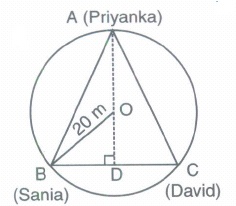
In rt. \(\triangle\)BDA, D=900
By Pythagoras Theorem, we have
AB2=BD2+AD2
\(\Rightarrow { x }^{ 2 }={ \left( \frac { x }{ 2 } \right) }^{ 2 }+{ (30) }^{ 2 }\)
\(\Rightarrow{ x }^{ 2 }-{ \frac { { x }^{ 2 } }{ 4 } }=90\)
\(\Rightarrow \frac { 3 }{ 4 } { x }^{ 2 }=90\)
\(\Rightarrow { x }^{ 2 }=900\times \frac { 4 }{ 3 } \)
\(\Rightarrow { x }^{ 2 }=1200\)
\(\therefore x=\sqrt { 1200 } =20\sqrt { 3 } \)
Hence, the distance between each of them is \(20\sqrt { 3 } .\)
(ii) Properties of the circle, equilateral triangle and Pythagoras theorem.
(iii) Live and let live.
50.
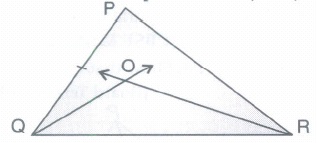
Proof: QO is bisector of \(\angle\)PQR
\(\angle\)OQR = \(\frac{1}{2}\)\(\angle\)PQR = \(\frac{1}{2}\) =\(\angle\)Q
RO is bisector \(\angle\)ORQ
\(\therefore\) \(\angle\)ORQ =\(\frac{1}{2}\) \(\angle\)PRQ = \(\frac{1}{2}\) \(\angle\)R
In \(\angle\)OQR
\(\angle\)QOR + \(\angle\)OQR + \(\angle\)ORQ = 180°
(Angle sum property)
\(\angle\)QOR + \(\frac{1}{2}\) \(\angle\)Q + \(\frac{1}{2}\) \(\angle\)R = 180°
\(\angle\)QOR = 180°- \(\frac{1}{2}\)(\(\angle\)Q + \(\angle\)R)
But in \(\angle\)PQR
\(\angle\)P + \(\angle\)Q + \(\angle\)R = 180°
\(\angle\)Q + \(\angle\)R = 180°- \(\angle\)P
\(\angle\)QOR = 180°- \(\frac{1}{2}\) (180°- \(\angle\)P)
= 180°-90° + \(\frac{1}{2}\)\(\angle\)P
= 90° + \(\angle\)P Hence Proved.
These type of rallies spread awareness among people for not to kill girl child and helping in equalising sex ratio.
51.
| Marks | Frequency | Class Marks |
|---|---|---|
| 37-41 | 0 | 39 |
| 41-45 | 4 | 43 |
| 45-49 | 10 | 47 |
| 49-53 | 15 | 51 |
| 53-57 | 18 | 55 |
| 57-61 | 20 | 59 |
| 61-65 | 12 | 53 |
| 65-69 | 13 | 67 |
| 69-73 | 0 | 71 |
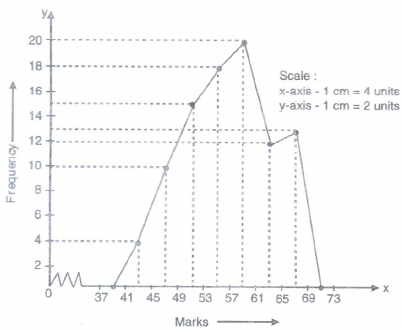
52.
(i) As EB II DL and ED II BL.
Therefore EBLD is a parallelogram.
ஃ BL = ED
=\(\frac{1}{2}\)BC=CL ...(i)
Now in triangles DCL and FBL, we have
CL=BL from (i)
ㄥDLC= ㄥFLB
ㄥCDL=ㄥBFL
ΔCDL≡ΔBFL
CD= BF
and DL= FL
Now, BF = DC = AB
⇒ 2AB = 2DC
⇒ AF = 2DC
(ii) ∵ DL=FL
⇒ DF = 2DL
53.
\(x=3-2\sqrt { 2 } \Rightarrow \frac { 1 }{ x } =3+2\sqrt { 2 } \)
\({ \left( \sqrt { x } +\frac { 1 }{ \sqrt { x } } \right) }^{ 2 }=8\)
\(\Rightarrow \sqrt { x } +\frac { 1 }{ \sqrt { x } } =\pm 2\sqrt { 2 } \)

9th Standard CBSE Syllabus & Materials
9th Standard CBSE
CBSE 9th Mathematics Lines and Angles Sample Question Papers Study Material - QB365 Set A
NEW9th Standard CBSE
CBSE 9th Mathematics Introduction to Euclid's Geometry Sample Question Papers Study Material - QB365 Set A
NEW9th Standard CBSE
CBSE 9th Mathematics Linear Equations in Two Variables Sample Question Papers Study Material - QB365 Set A
NEW9th Standard CBSE
CBSE 9th Mathematics Coordinate Geometry Sample Question Papers Study Material - QB365 Set A



CBSE 9th Standard CBSE Subjects
CBSE Standards